This week – nuclear and climate – the good news

Well, of course, it’s hard to find good news. I see that a “good news” media has just started up . I don’t  like their chances – but that’s only because good news isn’t really news. News is about something unusual happening. The vast majority of human beings are going about their lives, trying to care for their family and friends, trying to live a decent life. That’s just not news. Particularly at this time of year, people are mostly making an extra effort to be kindly to others, – with Christmas, Hanukka, and at least 12 other religious celebrations. So – it’s the much rarer bad incidents that are news.
On climate, so many millions of people, and so many organisations are trying to save this planet’s quite fragile environment. Intergovernmental efforts continue, with the recent Paris Summit. Renewable energy is taking off across the globe, especially in China, but also in America, despite Trump.
The global nuclear-free movement continues to have successes, exposing the nuclear industry, working for nuclear clean-ups, and for dismantling nuclear power, and for preventing new nuclear development
The much maligned United Nations continues its work, with a huge number of positive agencies, including many humanitarian ones. Non government agencies join in this work
AUSTRALIA.
CLIMATE Throughout 2017, the team at REneweconomy have persistently publicised the many exciting developments in clean energy. South Australia, so recently threatened with a nuclear nightmare, is now the clean energy star.
The movement for climate action and clean energy is having successes – preventing the Adani coal megamine could be its great achievement for this period.
NUCLEAR. The International Campaign to Abolish Nuclear Weapons won the Nobel Peace prize – a global campaign that began in Melbourne, and was worked on steadily for 10 years, by dedicated Australians. The nuclear-free movement continues its steady work – with the umbrella group The Australian Nuclear Free Alliance, Aboriginal activists, and the hard-working federal and state conservation groups. They have prevented nuclear waste dumping in the Northern Territory. They have helped stop plans for importing nuclear wastes to south Australia. Now their challenges are to stop Lucas Heights nuclear wastes being dumped on rural South Australia, and working for a clean, uranium-mining-free Western Australia.
INTERNATIONAL
The Nobel Peace Prize Award to ICAN might appear to be ineffective. But to have 122 of the UN member states adopting the Treaty on the Prohibition of Nuclear Weapons is a great symbolic start – in universal recognition that having nuclear weapons , planning to use them, and using them – are crimes against humanity.
Nuclear power began in America in the 1940s, with the Manhattan project to develop nuclear bombs. Of course it is till aligned with nuclear weapons, but now, “peaceful” nuclear power is dying in USA. France is moving away from nuclear power. In China, and India, as renewable energy booms, while nuclear power slows.
The global movement for a nuclear free world is active everywhere, but faces huge challenges, especially where the industry is tax-payer funded, and exceptionally secretive – as in Russia and China.
One nice little news item – the early release from prison of brave anti nuclear activist Sister Megan Rice.
I suppose that next week – I will resume the dreary recitation of all the bad stuff – because that’s what news is. In the meantime, many millions of people are being kind to each other, and wishing for peace – not news, but true all the same.
Australia’s Hot Ocean Blob Fuels Record Heat, Extreme Weather, Risk to Coral Reefs

Between Australia and New Zealand there’s a kind of climate change fed thing on the prowl in the off-shore waters. It takes the form of an angry layer of far warmer than normal surface water. And it’s been lurking around since late November.

(A hot, angry blob of much warmer than normal ocean temperatures has erupted between Australia and New Zealand.)
We can see this disruptive beast pretty clearly in the sea surface temperature anomaly maps provided by Earth Nullschool. Today’s readings show temperatures in this new blob hitting between 3.5 and 4.2 degrees Celsius above average across a broad expanse of ocean.
That’s much, much warmer than normal for this region of water. A place where 2 degree above average sea surface readings would tend to be unusual. But with global temperatures now hitting between 1.1 and 1.2 C above 1880s averages, we’re starting to…
View original post 748 more words
Overwhelming majority of French people want renewable energy, not nuclear
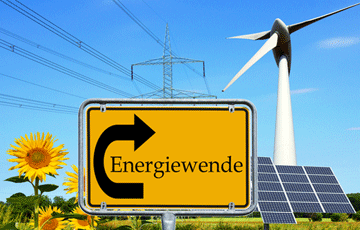 French people support energy transition, survey reveals, Energy Transition by Energiewende Team19 Dec 2017 “……… It is often said that the French people strongly support nuclear energy as a jewel of the French industry. However, a survey commissioned by the French office of the Heinrich Boell Foundation and the French Think tank La Fabrique écologique, carried out by the research institute Harris Interactive, shows that the French people would rather like to pull up the anchor and set sail for a new model based on renewable energy.
Indeed, 91 % of interviewees consider the energy transition as “priority issue” (47%) or a “major issue” (44%). 63% see the energy transition as an opportunity rather than as a threat (11 %). But what should energy transition look like, according to them?
A clear preference for the development of renewable energy
The trend is very clear: 83 % of French people think France should prioritize investments in renewable energy. Only 12% of the interviewees prefer that investments go towards the modernization and life extension of nuclear power plants. 66 % of respondents come out against the construction of new nuclear power plants. It shows that the advertising and constantly repeated arguments that nuclear energy – often described as “clean energy” – is the only adequate solution when it comes to fighting climate change is not having the intended effect on French public opinion.
Also surprising is the fact that the actor in which the French people have the most confidence to lead the energy transition is neither the state (trusted by 49% of the interviewees) nor the energy producers and providers like the state owned EDF (trusted by only 46%). Rather, people trust citizen energy cooperatives (trusted by 78%), as well as NGOs and associations (trusted by 66 %).
A positive view of the Energiewende
Another salient point of the survey is the opinion of the French people about the German energy transition. Respondents perceived the German Energiewende much more positively than their economic and political elites……..
Over half of them see the Energiewende as “a good example for the energy transition.” Last but not least, the French people think France should work more closely with Europe (54%) and with Germany (51%) on energy issues……
The complete results of the survey (in French) are available here: Enquête “Le rapport des Francais à l’énergie” – Harris Interactive
In the press :
- FAZ: Die Franzosen wollen weniger Atomenergie
- Libération: Energie : les Français veulent plus de renouvelable et moins de nucléaire (französisch)
- Alternatives Economiques: Climat : la France est-elle vraiment exemplaire? (französisch) https://energytransition.org/2017/12/french-people-support-energy-transition-survey-reveals/?t=1&cn=ZmxleGlibGVfcmVjc18y&refsrc=email&iid=b0fd4fb85ba34dc690d233cf08200f82&uid=585629311&nid=244+293670920
Forests suffer the long term consequences of climate change after wildfires
 Forests destroyed in wildfires not recovering due to climate change, scientists reveal http://www.independent.co.uk/environment/forests-wildfires-climate-change-california-australia-not-recover-global-warming-regeneration-a8122501.html
Study suggests higher temperatures in the Rocky Mountains are preventing trees from growing back following wildfires Josh Gabbatiss Science Correspondent 21 Dec 17 A new study suggests hotter climates resulting from global warming may prevent forests from regenerating after wildfires.
Recent wildfires in California were the most destructive on record, with governor Jerry Brown warning climate change could make such fierce events “the new normal”.
In hot, dry climates like those found in the western US, wildfires are often a natural part of the environment, contributing to the cycling of nutrients and growth of new plants.
However, a new study published in the journal Ecology Letterssuggests increasing global temperatures may be preventing this natural cycling from taking place.The result could be long-term damage to areas of forest destroyed by wildfires.
Led by Dr Camille Stevens‐Rumann, an ecologist at Colorado State University, the study involved testing fire-struck areas of forest for signs of regeneration.
The scientists examined 1485 sites in the Rocky Mountains, all of which had been affected by fires between 1985 and 2015.
They looked for seedlings growing in the examined sites, comparing growth with nearby unburned forests to determine how well forests in each area were able to regenerate.
The team found the proportion of sites in which no post-fire tree regrowth had taken place increased from 19 to 32 per cent when comparing earlier years of the analysis to the more recent years.“Significantly less tree regeneration is occurring after wildfires in the start of the 21st century compared to the end of the 20th century,” the scientists wrote in their paper.
Comparing these findings with information on the region’s changing climate suggested increases in global temperatures were influencing forest regeneration, particularly in the driest regions.
“Dry forests that already occur at the edge of their climatic tolerance are most prone to conversion to non-forests after wildfires,” the scientists wrote. Natural disasters are increasingly being linked to climate change, and according to Todd Gartner, a senior associate at environmental think tank World Resources Institute, climate change is a “contributing factor” to the recent events in California.
Scientists have linked changes in temperature, levels of rain and soil moisture – all of which are influenced by global warming – to increased risk of wildfires.
This new study suggests the impact of climate change on wildfires may have longer term consequences as well.
“As scientists, managers and the public aim to understand and plan for increasing fire activity, our results suggest a high likelihood that future wildfires will facilitate shifts to lower density forest or non-forested states under a warming climate,” the scientists concluded.
The new reality of climate change – wildfires
 WILDFIRES MARK THE NEW REALITY OF CLIMATE CHANGE IN 2017
As fire conditions intensify around the globe, scientists are helping countries prepare for a fiery new normal. Pacific Standard, BOB BERWYN, DEC 20, 2017
Russia’s nuclear secrecy and heavy handed tactics
it’s hard to access reliable information about Rosatom’s plans because many of its nuclear facilities are in so-called closed cities, like Zheleznogorsk. There are around 40 of these towns across Russia, the majority of which are sealed off from the outside world by barbed wire, fences and armed guards. Access is forbidden to foreigners, and even Russians who don’t live there have to receive special permission from the authorities to visit.
Those restrictions mean it’s easier for the authorities to ramp up the pressure against critics.
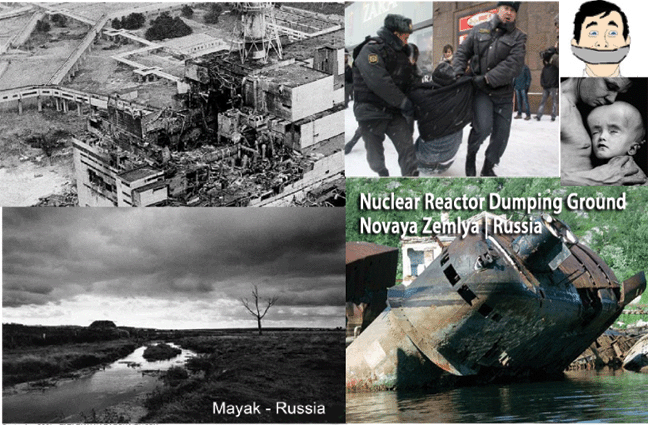
CRACKDOWN IN RUSSIA: CRITICS ACCUSE NUCLEAR AUTHORITIES OF SOVIET-STYLE COVER-UPS AND HEAVY-HANDED TACTICS, .http://www.newsweek.com/crackdown-russia-critics-accuse-nuclear-authorities-soviet-style-cover-ups-and-755389 Newsweek, BY When Russia’s FSB security service raided Fyodor Maryasov’s apartment in Siberia last year, the authorities seized his computer and a scathing report he had compiled about Rosatom, the Kremlin-owned nuclear corporation. Among other things, the authorities accused him of inciting hatred against nuclear industry employees, an unusual charge that carries a maximum sentence of five years behind bars. “They accused me of revealing state secrets in my report,” the 49-year-old environmental activist says. “But every single thing in it was taken from open sources.”
The raid came as activists are increasingly criticizing Rosatom over a range of issues, including the way it handles nuclear waste. This fall, for instance, critics alleged that one of its facilities was the source of a mysterious cloud of radioactive pollution that drifted across Europe.
Russian authorities have responded to these critics with tough tactics—including raids and smear campaigns—and in recent years, they’ve employed similar measures against other environmental groups. Rosatom says it was in no way trying to stifle dissent. “We strongly believe that every voice should be heard,” a spokesman for the nuclear agency tells Newsweek, “and we welcome open dialogue with civil society, including with those who are opposed to nuclear power.”
Maryasov says the crackdown is a continuation of the routine cover-ups of nuclear accidents and atomic pollution during the Soviet era and beyond—from the 1957 Kyshtym disaster to the meltdown at Chernobyl in 1986. “Trust in Rosatom and the authorities,” he says, “is at an absolute minimum.” Continue reading
The environmental ravages of uranium tailings
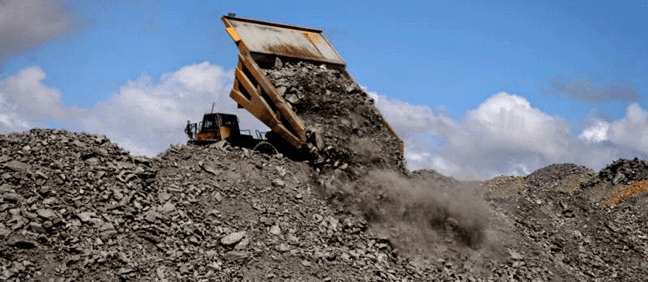

 The 26,000 tons of radioactive waste under Lake Powell http://www.hcn.org/articles/pollution-a-26-000-ton-pile-of-radioactive-waste-lies-under-the-waters-and-silt-of-lake-powell
The West’s uranium boom brought dozens of mills to the banks of the Colorado River — where toxic waste was dumped irresponsibly.
Turnbull has politicked himself into irrelevance on energy and climate in 2018 — RenewEconomy

Medals of Valour should be awarded to Chief Scientist Alan Finkel, AEMO chief executive Audrey Zibelman, and South Australian Premier Jay Weatherill.
via Turnbull has politicked himself into irrelevance on energy and climate in 2018 — RenewEconomy
Japan downplayed Chernobyl concerns at G-7 for energy policy’s sake: declassified documents


View original post 455 more words
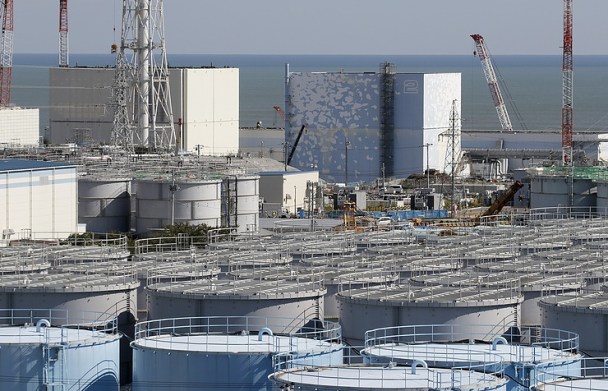
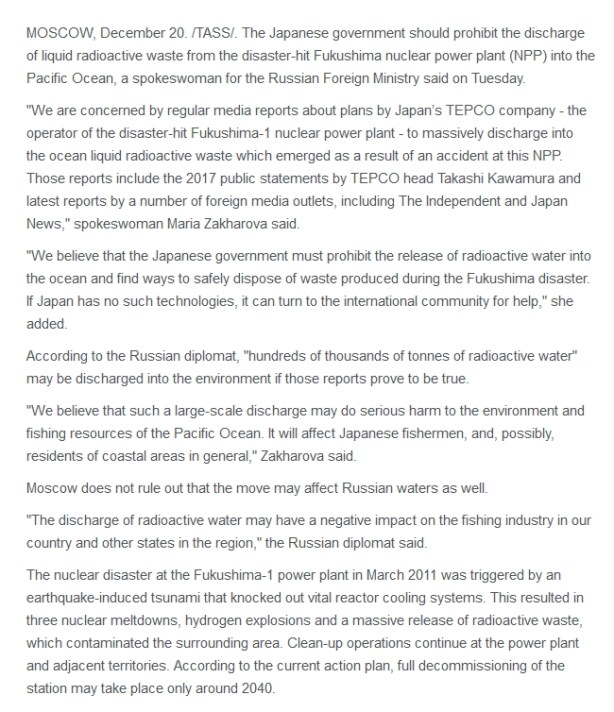
Moscow urges Tokyo to prevent discharge of Fukushima radioactive water
Moscow does not rule out that the move may affect Russian territorial waters.
Japan’s Kansai Electric used possibly falsified Mitsubishi Materials products at reactors

View original post 261 more words
John Pratt – on climate, Barrier Reef, Adani and renewable energy
-
Scientists working against time #ClimateChange & Politics to Save the Reef #StopAdani #auspol
The Guardians of the Great Barrier Reef
Australia’s scientists are working against time and climate change politics to save their beloved coral reef.
Kate MackenzieDecember 21, 2017
-
Replacing India’s coal plants with renewables saves money & lives. #StopAdani #auspol #qldpol
Replacing coal plants with renewables will help save Rs 54000 crore in power costs’
Greenpeace campaigner Ashish Fernandes said that it is now widely accepted that new coal power plants are not financially competitive with new renewables in India.
By: PTI | New Delhi | Published: December 21, 2017 9:35 pm
-
India will soon breed green energy engineers #StopAdani #auspol #qldpol
Why India will soon breed green energy engineers
December 21, 2017, 20:38IST
Electrical engineers or energy professionals are a sad lot today.
-
World’s Natural Wonders at Risk #ClimateChange #auspol #qldpol #StopAdani
World’s Natural Wonders Are at Risk From #ClimateChange
Allegra CalliesNov 28
“Climate change acts fast and is not sparing the finest treasures of our planet.
-
#ClimateChange Threatens National Security. #auspol #qldpol #StopAdani
Trump’s Silence on Climate Change Threatens Our National Security
By Mark Nevitt On 12/21/17 at 7:24 AM
This article first appeared on Just Security.
“Campaigners in Cumbria have thanked Essex Councillors for Opposing a Nuclear Power Station” —

From Wednesday’s Essex Gazette Anti-nuclear Support 300 miles away. Campaigners in Cumbria have thanked Essex councillors for opposing a nuclear power station. Designs for a nuclear power station close to the site of a former plant in Bradwell have been revealed. The design for the new Bradwell B reactor has passed the first step of […]
via “Campaigners in Cumbria have thanked Essex Councillors for Opposing a Nuclear Power Station” —
22 December More REneweconomy News
 RenewEconomy
-
2020 RET in hand, with enough projects remaining to deliver 50% renewables2017 has been an impressive year for renewables, but ends with a major cloud hanging over it: what happens once the RET is sorted?
-
First thoughts: Snowy 2.0 will lift emissions without more renewableSnowy 2.0 only makes sense if Australia has a much higher share of renewables than contemplated under the NEG.
BHP may dump global group, but looks to forgive Australian coal lobby — RenewEconomy
BHP has flagged ending its association with international coal lobby groups, but appears to be more forgiving of the Minerals Council and other Australian organisations.
via BHP may dump global group, but looks to forgive Australian coal lobby — RenewEconomy
1 This month
7 April – WEBINAR – Australia and the Doomsday Clock – Preventing nuclear war through NoFirstUse and other policies
Online | Tuesday April 7, 4:00-5:30pm, Australian Eastern Time / 8:00-9:30am Central Europe Time
– Access the registration link
15 April – Zoom –Nuclear Power is Not the Solution
Apr 15, 2026 01:00 AM in Canberra, Melbourne, Sydney

Join the International Physicians for the Prevention of Nuclear War (IPPNW) on Tuesday, April 14th for a timely webinar exploring the risks associated with nuclear power and challenging the myth that it offers a simple, safe, carbon-free solution to the climate crisis

21 April Webinar: No Nuclear Weapons in Australia
Start: 2026-04-21 18:00:00 UTC Canberra, Melbourne, Sydney (GMT+10:00)
End: 2026-04-21 19:30:00 UTC Canberra, Melbourne, Sydney (GMT+10:00)
Event Type: Virtual
A virtual link will be communicated before the event.
Host Contact Info: australia@icanw.org

of the week – Australians for War Powers Reform (AWPR)
To see nuclear-related stories in greater depth and intensity
 Antinuclear