In 1995 the Australian government knew that Sydney’s Lucas Heights high level radioactive trash was a problem
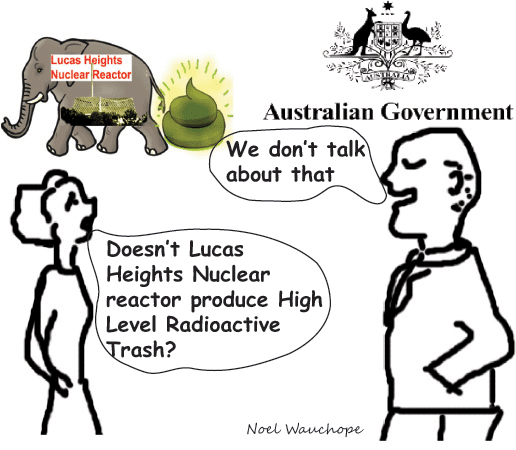
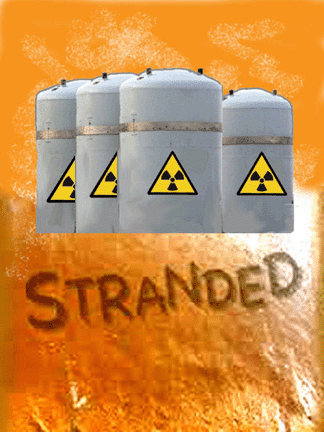 Spent nuclear fuel storage http://www.smh.com.au/nsw/spent-nuclear-
 fuel-storage-20171215-h0590r.html Damien Murphy,
Spent nuclear fuel storage at Sydney’s Lucas Heights was destined to be full within three years, cabinet was told in a December 1995 minute.
The cabinet agreed the Australian Nuclear Science and Technology Organisation should cost proposals to have Britain reprocess their spent fuel in Scotland, return all American spent fuel to the United States and not accumulate spent fuel beyond the capacity of existing storage.
Cabinet wanted the information for consideration in the 1996-97 budget.
The minister for primary industries and energy, Bob Collins, and the minister for industry, technology and commerce, Peter Cook, told cabinet that reducing spent research reactor fuel holdings would be welcomed by the community at Lucas Heights although any operations involving radioactive materials were likely to be opposed by groups that object to nuclear activities.
Facebook obeys U.S. government – deletes accounts of Palestinians
 FACEBOOK NOW SEEMS to be explicitly admitting that it also intends to follow the censorship orders of the U.S. government.
the Trump administration — has the unilateral and unchecked power to force the removal of anyone it wants from Facebook and Instagram by simply including them on a sanctions list.
Facebook Says It Is Deleting Accounts at the Direction of the U.S. and Israeli  Governments, The Intercept, IN SEPTEMBER OF last year, we noted that Facebook representatives were meeting with the Israeli government to determine which Facebook accounts of Palestinians should be deleted on the ground that they constituted “incitement.” The meetings — called for and presided over by one of the most extremist and authoritarian Israeli officials, pro-settlement Justice Minister Ayelet Shaked — came after Israel threatened Facebook that its failure to voluntarily comply with Israeli deletion orders would result in the enactment of laws requiring Facebook to do so, upon pain of being severely fined or even blocked in the country.
The predictable results of those meetings are now clear and well-documented. Ever since, Facebook has been on a censorship rampage against Palestinian activists who protest the decades-long, illegal Israeli occupation, all directed and determined by Israeli officials. Indeed, Israeli officials have been publicly boasting about how obedient Facebook is when it comes to Israeli censorship orders:
Shortly after news broke earlier this month of the agreement between the Israeli government and Facebook, Israeli Justice Minister Ayelet Shaked said Tel Aviv had submitted 158 requests to the social media giant over the previous four months asking it to remove content it deemed “incitement.” She said Facebook had granted 95 percent of the requests. Continue reading
Dr Margaret Beavis on the value of United Nations Treaty on the Prohibition of Nuclear Weapons
 Nuclear disarmament unrealistic? So is keeping the bombs and surviving, https://www.brisbanetimes.com.au/world/asia/nuclear-disarmament-unrealistic-so-is-keeping-the-bombs-and-surviving-20171231-h0bqot.html By Margaret Beavis
As we look back on the past year, one issue that abruptly came into focus was nuclear weapons. On the one hand, North Korea aggressively tested new weapons and both Kim Jong-un and Donald Trump threatened catastrophe; on the other, we have a new United Nations Treaty on the Prohibition of Nuclear Weapons and a Nobel peace prize to the Australian-founded organisation the International Campaign to Abolish Nuclear weapons.How will these two extremes meet?
Let’s start with the “ugly”. We are assured that nuclear weapons keep us safe, but with almost 15,000 in existence and more than 4000 deployed, the reverse is true. To say they will never be used is magical thinking, the stuff of fairy stories. It is only a matter of time. There have been many near misses, due to human or technical error, where only luck has stopped a nuclear launch. This luck cannot hold indefinitely.
The extent of destruction is so vast it’s difficult to contemplate. The fears of the 1950s and ’60s have given way to a sort of collective denial. But the horrors of the past are just a pale shadow of what lies ahead, with current weapons 30 to 50 times more powerful than those used on Hiroshima and Nagasaki.
No response will be possible. All hospitals and health workers will be destroyed. The thermonuclear blast will be followed by a massive firestorm, reaching temperatures of 800 degrees. All oxygen within a radius of 25 kilometres will be consumed, killing anyone who survives the fire.
After the blast, the soot in the atmosphere will create a decade-long nuclear winter, damaging crop yields and resulting in global famine. Careful modelling has found up to 2 billion lives will be put at risk from starvation.
Jong-un and Trump are unequivocally “bad”, way beyond the Twitter use of the word. They have horrified millions with their immature brinkmanship, name-calling and threats. Not since the Cuban missile crisis has there been such public concern.
The United States blames North Korea for acquiring these weapons yet, given the fate of Iraq and Libya, it’s unsurprising that the North feels it needs them. Clearly, as long as these weapons are regarded as legitimate, nations will try to acquire them. Indeed, the US is spending $US1.2 trillion($A1.5 trillion) to update its nuclear arsenal.
It’s appalling that North Korea has them yet, in many ways, inevitable given the nuclear-armed states’ abject failure to honour their undertakings to disarm under the non-proliferation treaty.
So where is the “good” in all this? The new UN treaty finally places nuclear weapons on the same footing as biological and chemical weapons. Stigmatising these weapons and holding governments to account is a critical next step in restarting the disarmament process. One-hundred-and-twenty-two countries voted in favour of this treaty and, once 50 countries sign and ratify it, it will become international law. Fifty-six countries have signed so far.
Once it is international law, using these weapons will constitute a war crime. Major divestment and a shift in how the public and the military view these weapons will follow. There needs to be serious negotiations, with an agreed, verifiable, balanced, stepwise reduction in stockpiles, with a specific timetable. No one is saying the new treaty is a magic wand. All this will take time and extensive diplomacy.
In Australia, the government continues to cling to the belief that nuclear weapons make us safer. By legitimising these weapons, it ultimately encourages proliferation. Japan, South Korea, Saudi Arabia and the United Arab Emirates are all considering becoming nuclear-armed.
We are at a turning point. New Zealand, Thailand and the Philippines were among the first to sign the treaty, and all remain US allies.
People say nuclear disarmament is unrealistic, but what is truly unrealistic is to pretend our luck will continue to hold, and that these appalling weapons will never be used. The humanitarian impacts are too great, and the risks too high. The treaty offers a new impetus and renewed hope for a safer world. It’s high time for our government to acknowledge this, and sign it.
Dr Margaret Beavis, a GP, is a board member of ICAN (Australia) and the Medical Association for Prevention of War.
Russian military patrols in South Pacific prompt Australian defence alert
Australian Defence Force on heightened alert during Russian military exercise in Indonesia ABC News Defence reporter Andrew Greene, 30 Dec 17, Defence personnel in Darwin were operating at “increased readiness” earlier this month as Russian strategic bombers conducted navigation exercises close to Australia, flying out of an Indonesian military base.
Key points:
- RAAF Base Darwin placed on a “short period” of heightened alert
- Russian Ministry of Defence claims it “carried out air alert mission over neutral waters of south Pacific Ocean”
- Defence Department would have been concerned about Russian intelligence collection, defence expert says
The ABC can reveal RAAF Base Darwin was placed on a “short period” of heightened alert, while over 100 Russian personnel and several aircraft were stationed at the Biak Airbase in Indonesia’s eastern Papua province.
During the five-day stopover two nuclear-capable Tu-95 bombers flew their first ever patrol mission over the South Pacific, prompting concerns they may have been collecting valuable intelligence.
The Russian Ministry of Defence claims its strategic bombers “carried out air alert mission over neutral waters of south Pacific Ocean” in a flight lasting more than eight hours………http://www.abc.net.au/news/2017-12-30/australia-on-alert-during-russian-military-exercise-in-indonesia/9293362
Would You Play Ball at Fukushima?
 “The Japanese government wants to show the fake side of Fukushima,”
Large swaths of Fukushima remain uninhabitable, with cleanup at the plant estimated to take up to 40 years and cost almost $200 billion
Would You Play Ball at Fukushima?, NYT, FUKUSHIMA, Japan — A sea of brightly colored banners and advertisements decorated Fukushima train station in early November to celebrate coming road races and Fukushima United, the local soccer club.
ANOTHER nuclear power station is going into financial meltdown
 Blunders, catastrophic, delays, even bankruptcy… ANOTHER nuclear
 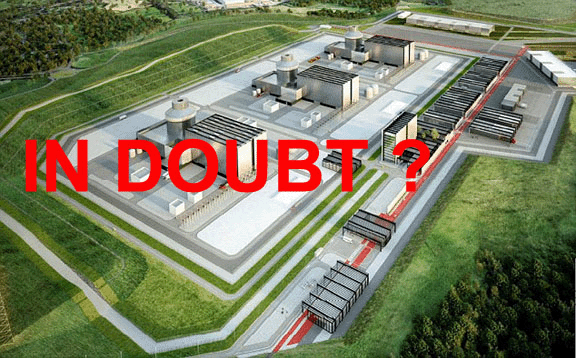 power plant is going into financial meltdown http://www.thisismoney.co.uk/money/article-5223475/ANOTHER-nuclear-power-plant-enerting-financial-meltdown.html Neil Craven for The Mail on Sunday, 1 January 2018 The company behind one of Britain’s biggest nuclear power projects has plunged to a £266 million loss citing ‘uncertainties’ over its future and the viability of crucial technology.
Japanese firm Toshiba said the huge loss incurred by one of its UK subsidiaries was due to writing off hundreds of millions of pounds of investment in the proposed Moorside plant, in west Cumbria.
It is the latest sign of financial strain at the Tokyo-based firm amid wider concerns over the spiralling costs and catastrophic delays that have beset the UK’s nuclear industry. Continue reading
Australian govt prioritised BHP’s Olympic Dam mine’s business above the dangers of French nuclear testing
French nuclear test tensions threatened Olympic Dam expansion plans, declassified Cabinet documents reveal, Peter Jean, The Advertiser, January 1, 2018
About 50% of local bodies near nuke plants want say over reactor restarts

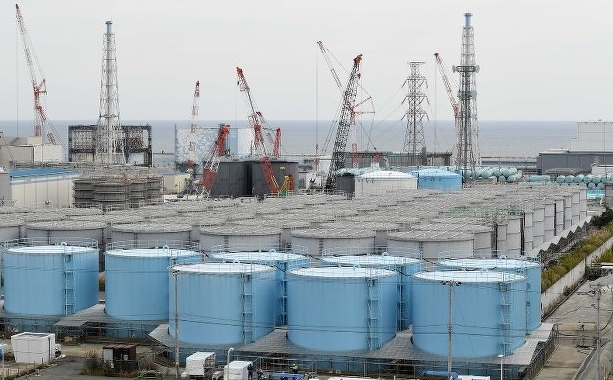
View original post 453 more words
Keating government considered, but rejected, a carbon tax
The papers note the Australian government was under increasing pressure from Europe and Pacific island nations to take tougher steps to reduce carbon dioxide emissions.
The truth was that the “no regrets” policy made Australia’s efforts to cut emissions ineffectual, as officials acknowledged in the cabinet papers.
Among the policy responses considered was a carbon or energy tax
Cabinet papers: Keating MPs considered carbon tax to tackle climate change https://www.theguardian.com/australia-news/2018/jan/01/cabinet-papers-keating-mps-considered-carbon-tax-to-tackle-climate-change
Cabinet debated how to cling on to government’s ‘no regrets’ policy while maintaining Australia’s influence at international bargaining table, Guardian, Anne Davies, Australia’s response to climate change and the challenge of meeting its international obligations proved as difficult for the Keating government in 1994 and 1995 as it would for future governments.
Cabinet papers released by the Australian National Archives on Monday show that much of the debate in the Keating cabinet was about how to cling on to the government’s “no regrets” policy while maintaining Australia’s influence at the international bargaining table.
The “no regrets” policy meant Australia would consider only measures that involved cutting emissions without any adverse impact on the economy or trade competitiveness. That ruled out most measures to tax fossil fuels, which would increase the cost of electricity.
It meant Australia relied mainly on creating carbon sinks by limiting land-clearing and planting trees.
Australia had signed on to targets at an international conference in Toronto in 1990 on the basis that the convention would recognise Australia’s high dependence on fossil fuels.
2017 Clean Energy Revolution is unstoppable. #StopAdani #Auspol #qldpol — jpratt27

2017 showed the global clean energy revolution is unstoppable no matter what Trump does The solar, wind, battery, and electric car “miracles” have gone mainstream. Dec 14, 2017, 1:56 pm The competition for the biggest clean energy story of 2017 is intense. Building and running new renewable energy is now cheaper than just running old […]
via 2017 Clean Energy Revolution is unstoppable. #StopAdani #Auspol #qldpol — jpratt27
1 This month

of the week – Australians for War Powers Reform (AWPR)
To see nuclear-related stories in greater depth and intensity
 Antinuclear