Pacific rift: When nuclear tests made France a dirty word, SMH, Damien Murphy, 1 Jan 18 “…….the 1985 sinking of the Greenpeace vessel Rainbow Warrior by French operatives, union outrage, peacenik panic and maintenance of uranium exports shaped Australia’s response to Paris’ decision to start letting off bombs as far away as possible from La Belle France.
In a June 5 report to cabinet about possible resumption of French tests, the minister for foreign affairs, Gareth Evans and the minister for Pacific Island affairs, Gordon Bilney, said memories of the Rainbow Warrior were strong and New Zealand could be expected to postpone official visits and suspend military-related co-operation with France.
The ministers were concerned about Australia looking as hard-nosed as New Zealand.
“New Zealand will obviously be hoping that Australia’s response is similar to theirs,” the ministers said. “Wellington’s response may have an impact in Australia if it is significantly stronger than ours.”
The ministers advised treading softly so as not to make nuclear testing dominant in the bilateral relationship and stop the French from taking retaliation.
“Three specific areas of current Australian interest could be targeted by the French: Australia’s (United Nation’s) Security Council bid, market access for special Australian products such as kangaroo meat, and Australia’s candidature for the position of secretary-general of the South Pacific Commission.”
On June 13, president Jacques Chirac announced the resumption of nuclear tests in the South Pacific.
The Keating government hardened up its act.
On June 22 cabinet decided to recall Australia’s ambassador and Australian Defence Force staff from Paris, suspend Australian ship and aircraft visits to French territories and ban French ship visits and “not progress” collaboration on military logistics and equipment or exchange classified information.
Cabinet maintained the policy of not negotiating any new uranium contracts with France while it was conducting nuclear tests in the South Pacific.
“These measures are in line with the government’s consistent policy on this issue, which has been to respond in a measured, graduated way, leaving open every avenue for France to respond to South Pacific concerns,” an attachment to a cabinet minute noted.
The dry-storage plan OK’ed by the Coastal Commission is the Holtec system: cheaper canisters with 1/2 to 5/8-inch thick stainless steel walls, wildly short of the 10 to 20-inch thick-walled ones used in other countries.
At the controversy’s core is the susceptibility of Holtec canisters to cracking, which could leak radiation into the environment.
Holtec canisters have no seismic rating, are not proven safe for transport, and there is no means to even inspect them for cracks or for existing cracks to be repaired in a safe manner. A crack can’t even be detected until after a radiation leak has occurred.
A highly disturbing report from Sandia National Laboratories states that a crack in a hot canister can penetrate the wall in under 5 years.
Mosko: Ticking Time Bomb at San Onofre Nuclear Plant,https://voiceofoc.org/2018/01/mosko-ticking-time-bomb-at-san-onofre-nuclear-plant/By SARAH “STEVE” MOSKOThe seaside nuclear reactors at the San Onofre Nuclear Generating Station in San Clemente were permanently shut down in 2013 following steam generator malfunction. What to do with the 3.6 million pounds of highly radioactive waste remains an epic problem, however, pitting concerned citizens against Southern California Edison, the California Coastal Commission and the Nuclear Regulatory Commission (NRC). Edison operates San Onofre, the Coastal Commission is charged with protecting the coastline, and the NRC is responsible for long-term storage of spent nuclear fuel and protecting the public.The Problem
A reactor’s spent nuclear fuel must be stored safely for 250,000 years to allow the radioactivity to dissipate. San Onofre’s nuclear waste has been stored in containers 20 feet under water in cooling pools for at least five years, the standard procedure for on-site temporary storage. Long-term storage necessitates transfer to fortified dry-storage canisters for eventual transportation to a permanent national storage site which, under the Nuclear Waste Policy Act of 1982, the federal government is under obligation to construct.
However, the plan to build an underground repository at Yucca Mountain in the Nevadan desert was ditched in 2011 out of concern that deep groundwater could destabilize the canisters, leaving the United States with literally no plan on the horizon for permanent storage of nuclear waste from San Onofre or any other of the country’s nuclear power plants. In fact, under the NRC’s newest plan – the so-called Generic Environmental Impact Statement – nuclear power plant waste might be stored on-site forever.
Given this, informed southern Californians are up in arms about the 2015 permit by the Coastal Commission allowing Edison to build a dry-storage bunker right at San Onofre – near major metropolitan areas and within a few hundred feet of both the I-5 Freeway and the shoreline in a known earthquake zone – using thin-wall canisters never proven safe for storage or transport (Coastal Development Permit No. 9-15-0228). Most other countries, including Germany, France, Japan, Russia and Australia, utilize thick-wall canisters with time proven safety technology. Continue reading →
He says through its social media manipulation operations, spy agency Government Communications Headquarters (GCHQ) tried to influence online activists during the 2009 Iranian presidential election protests, and the 2011 uprisings widely known as the Arab Spring.
Al-Bassam told the Chaos Communication Congress in Germany last week that the Joint Threat Research Intelligence Group (JTRIG) – a unit in GCHQ – uses “dirty tricks” to target activists. Continue reading →
with the whole world receding from setting up nuclear plants, by the time this “major powerhouse” is established in 4-6 years, where are the foreign orders for nuclear plant components going to come from? Or, are we planning to use tax-payers’ money to continually prop up the ailing big manufacturing industries in India by giving them nuclear power orders, whether we want nuclear power or not?
India Should Halt Further Expansion of its Nuclear Power ProgramThe Citizen, –-A. GOPALAKRISHNAN[Dr A.Gopalakrishnan is former Chairman, Atomic Energy Regulatory Board,Governmentof India. He welcomes discussions and comments from readers. They can contact him at his e-mail:agk37@hotmail.com]13 NOVEMBER, 2017
Nuclear safety is in jeopardy An overall evaluation of the status of the Indian civilian nuclear power sector, and the government’s uncertain future plans, do cause a great deal of concern for the welfare of the country and the safety of our people. Therefore, it is best to freeze all plans for the further expansion of this sector until Parliament and the public are provided full details of the government’s intentions and rationale and a national consensus is reached.
Background: The Indian civilian nuclear power program is ultimately administered by the Department of Atomic Energy (DAE) which reports to the Prime Minister.
The detailed policies, programs, and projects of both the civilian and military aspects of atomic energy are overseen and approved by a supra-powerful body called the Atomic Energy Commission (AEC).
…… Once this group approves a program or gives a decision, no other entity like the Comptroller & Auditor General (CAG), who should be overseeing financial propriety in the Central Government expenditure or the Atomic Energy Regulatory Board (AERB) which is responsible for project & public safety, will usually dare to question the AEC decision. This top-heavy administration of the nuclear program and the fear that it exudes is at the heart of most of the ailments of the nuclear sector.
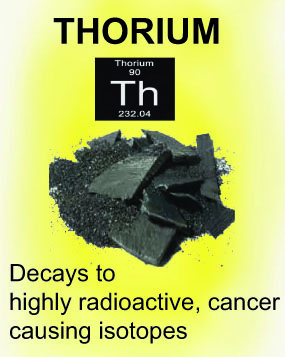
The militants had hoped to transform low-grade radioactive Thorium 232 (Th-232) into deadly Uranium 233 (U-233). When combined with powerful home-made explosive triacetone triperoxide (TATP), the concoction can create a “nuclear bomb”, according to an instruction manual used by the militants and reviewed by Reuters.
IS supporters in Malaysia may build bombs with radioactive materials, Today online 02 JANUARY, 2018, KUALA LUMPUR— Fears are growing that fighters from the Islamic State (IS) group, including their sympathisers in Malaysia, may attempt to build bombs using radioactive materials.
This concern is especially real as the Malaysian police have recorded no less than 20 cases involving radioactive and nuclear materials which have “gone missing” over recent years.While some may have been retrieved, the whereabouts of many others remain unknown.
Perturbed by the combination of “missing radioactive goods and IS”, sources in security agencies said it was crucial for the counter-terrorism division to aggressively trace the missing radioactive materials.Normally, these cases will be investigated by the police’s Criminal Investigation Department. However, it should not be treated as a usual case of theft,” the sources said.
“There is a need to trace who the perpetrators are, their background, contacts and find out their motives. These are all vital information that must be cross-checked to ensure that these dangerous materials do not fall into the wrong hands.”
The sources also warned that terrorists might make use of radioactive and nuclear materials which had not been categorised as “controlled items”.
“There are two groups of radioactive and nuclear materials: those which are controlled and monitored by the authorities, and the others that we cannot control as they are stolen or improperly disposed off.”
Concerns about security threats in South-east Asia intensified when Indonesian security forces recently foiled an attempt by militants to detonate a dirty bomb.A dirty bomb is a conventional bomb that contains radioactive material.
The plot was foiled when police raided homes and arrested five suspects in Bandung, West Java in August last year. After the raids, police spoke of a plan to explode a “chemical” bomb but provided no other details.
The militants had hoped to transform low-grade radioactive Thorium 232 (Th-232) into deadly Uranium 233 (U-233). When combined with powerful home-made explosive triacetone triperoxide (TATP), the concoction can create a “nuclear bomb”, according to an instruction manual used by the militants and reviewed by Reuters.
Malaysia has been on high alert since gunmen linked to the IS launched multiple attacks in Jakarta in January 2016 and has arrested hundreds of people over the past few years for suspected links to militant groups, and has arrested hundreds of people over the past few years for suspected links to militant groups.
Malaysia’s Atomic Energy Licensing Board (AELB) director-general Hamrah Mohd Ali cautioned the authorities against underestimating terrorists’ knowledge and capabilities in utilising radioactive and nuclear materials to produce dirty bombs.
Originally posted on nuclear-news: Fukushima Prefecture, where agriculture was a key industry, is highly contaminated and food production has been severely impacted. China cannot afford to risk a repetition of the Fukushima disaster in the Northeast. In order to put the North Korean nuclear genie back in its bottle, should China protect Pyongyang under its…
The reason that science (and the trusting public) dont believe Fukushima did any harm is because the old school, which includes the ICRP linear dose model is outdated dogma, and can under-predict fallout danger by hundreds or even thousands of times.
If our best and brightest at Woods Hole and Scripps are going to change their belief, they need to come up to speed on the radiation science of the last 15 or 20 years.
The science of radiation effects is in fact almost entirely an extrapolation. You will not find studies on individual radionuclide effects at different doses, different forms, (like nano particle alloys), and different exposure routes.
Governments and agencies are responsible for manipulating and censoring data and on media who assists governments and industry in hiding information from the public eye.
Some background on Linear no-threshold debate
“Disproving what critics of the Linear No-Threshold (LNT) Risk Model…
The delay is another setback for China’s ambitious development programme, which aims to raise its installed nuclear power capacity to 58 gigawatts by the end of 2020 from 34.73GW last year, and the world’s hopes for a successful launch of third-generation nuclear reactors.
They are touted by their designers to be safer and more efficient than second-generation ones, a key selling point after the global nuclear industry was dealt a blow by Japan’s Fukushima disaster in 2011.
“The delays reflect our concerns over the high execution risk for CGN in rolling out its aggressive expansion target and its adoption of a new generation of nuclear technology,” Ada Li, senior analyst at Moody’s, wrote in a note on Tuesday.
“The delays also imply the deferral of cash flows from the two nuclear units and potential additional capital expenditure, which would further pressure CGN’s financial metrics.”
She estimated the two reactors to initially make 5 billion yuan in annual revenues, amounting to 7 per cent of the firm’s 2016 revenues, adding its repeated delays are “credit negative”.
CGN said on Friday the first two generating reactors of the plant in Taishan – 136 kilometres west of Hong Kong – has been delayed to 2018 and 2019, from the second half of 2017 and the first half of 2018 respectively.
“As no nuclear power generating unit with the EPR [Evolutionary Power Reactor] technology has been put into commercial operation across the world … Taishan Nuclear has to conduct more experimental verifications in respect of design and equipment,” it added.
The firm in early 2015 cited a “comprehensive evaluation” of the construction plan and risks for its first delay. In the second delay early last year, it said it the needed to conduct “more experimental verifications in respect of its design and equipment”.
The project was originally expected to come on line in 2015.
Moody’s said the latest postponement will not affect its A3 issuer credit rating on CGN, which has already incorporated a six to 12-month delay.
Dennis Ip, head of Hong Kong and China utilities equities research at Daiwa Capital Markets, believes CGN will have difficulty meeting the revised target, saying in a note that he expects the first unit to start up in the first half of 2019.
Ip a year ago projected the Taishan plant’s investment cost to rise to between 22 and 23 yuan per watt from his previous forecast of 21 yuan. The company, meanwhile, had budgeted it at 14 yuan. Each unit has 1.75 billion watt of capacity.
Microgrids are in their early stages in Australia, but the country is swiftly taking a world-leading position, making the nation a renewable innovation hub.
Australian towns going off the grid http://www.theage.com.au/business/the-economy/australian-towns-going-off-the-grid-20171219-p4yxvv.html, Cole Latimer, 3 Jan 17, Australia is facing an energy crisis. As prices rose to new highs last year and the ever-constant threat of blackouts hung over the east coast, many Australians looked for energy alternatives. Some turned to solar panels and battery storage technology to solve their bill woes, gain greater control of their own power and make a real change in terms of their impact on the climate.
While they are taking steps at the individual level, others are looking to take full advantage of the push for more renewable energy and shift away from centralised power systems on a larger scale.
This is seeing the rise of microgrids, a unique solution to a very Australian problem.
The vast distance covered by Australian energy distribution networks presents a serious problem: How do you get energy generated from point A to a user at point B, and how much will it cost?
Microgrids circumvent this issue by creating power and keeping it local, and at the same time lowering costs by cutting much of the associated distribution costs. Microgrids are autonomous energy distribution systems that can generate power from its users and operate off the main grid, or connect to existing grids, and support different generation assets and load demand.
This market is forecast to increase to more than $20 billion annually, with around half of all Australian homes expected to have rooftop solar panels installed, by 2024. Continue reading →
Apr 15, 2026 01:00 AM in Canberra, Melbourne, Sydney
Join the International Physicians for the Prevention of Nuclear War (IPPNW) on Tuesday, April 14th for a timely webinar exploring the risks associated with nuclear power and challenging the myth that it offers a simple, safe, carbon-free solution to the climate crisis
21 April Webinar: No Nuclear Weapons in Australia
Start: 2026-04-21 18:00:00 UTC Canberra, Melbourne, Sydney (GMT+10:00)
End: 2026-04-21 19:30:00 UTC Canberra, Melbourne, Sydney (GMT+10:00)
Event Type: Virtual A virtual link will be communicated before the event.










 Antinuclear