The facts on PROPOSED NATIONAL RADIOACTIVE WASTE DUMP
Anti-Nuclear Coalition South Australia antinuclearcoalition@gmail.com 24 Jan 18 The Federal Government proposes to establish a National Radioactive Waste Management Facility in SA. This ‘repository’ would co-locate:
- Various low-level and hazardous but short lived intermediate level wastes requiring isolation for 300 years in a shallow ground repository.
- An above-ground store designed to operate for 100 years to house used reactor fuel from Lucas Heights. This intermediate-level long-lived waste requires isolation from
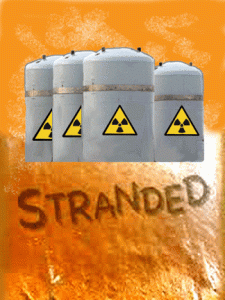 the environment for over 10,000 years.
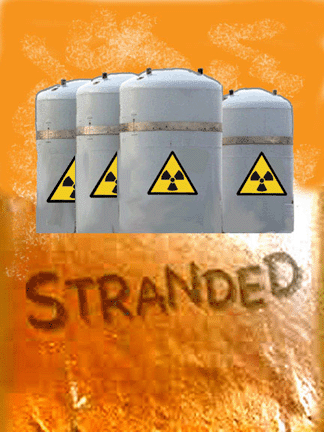
No plans have been made available for structures or maintenance for the first 100 years of this above-ground store. Plans for the ensuing 10,000 years are unavailable.
There are no plans available to establish a ‘permanent’ solution for this waste. It is not currently known how to safely store such higher level nuclear waste in isolation from the environment for such a long period of time.
Nuclear waste is currently stored at Lucas Heights where it is securely monitored.
Lucas Height’s ‘Interim Waste Store” has been identified by ANSTO as capable of safely storing reprocessed nuclear fuel waste and intermediate-level waste has been stored at Lucas Heights since the 1950s. Lucas Heights has been identified as the best resourced and secure facility to responsibly manage the extended storage of Australia’s nuclear waste.
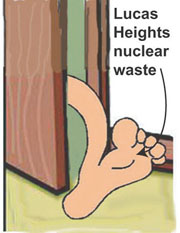 A national radioactive waste dump could be used as a “foot in the door” to establish an International Radioactive Waste dump at the same site or another site in the future. This was advocated as an objective by state Liberal Party adviser Richard Yeeles who advised that “…as a first step in such further development, the
S A Govt. offers to host a national facility for storage and disposal of Australia’s own low and intermediate-level radioactive waste with the ultimate aim of securing Federal Govt. support for hosting an international radioactive waste management facility in SA.”
Although plans for an international waste dump in SA have been rejected by the public at this time advocates for an international waste dump and the nuclear industry continue to lobby and work towards the establishment of such a dump. If a national waste dump was established with higher-level radioactive waste stored above ground at the same site, pressure could be brought to bear to establish a deep-level below ground facility to store both this waste and international radioactive waste from overseas.
New Trans-Pacific Partnership agreement “less problematic”
 ‘Hallelujah’ moment: Revised TPP to be signed in March Radio New Zealand, 23 Jan 18 The revised Trans-Pacific Partnership agreement is to be signed in March, the Trade Minister has confirmed. Australia’s Trade Minister, Steve Ciobo, said the 11 nations, including New Zealand, are “finally at the finish line” following talks between officials in Tokyo………
The rebranded the Comprehensive and Progressive Trans-Pacific Partnership (CPTPP), covers nearly 500 million people and the 11 countries involved make up 14 percent of global economic activity, or about $US10 trillion.
If the trade pact is successfully concluded, lower barriers and standardised rules are expected, making it easier for businesses to sell their goods and services in these markets.
Speaking at the World Economic Forum in Davos, Switzerland, Canada’s Prime Minister Justin Trudeau called the agreement the “right deal”.
The country’s trade minister said it included an improved arrangement on autos with Japan and the suspension of intellectual property provisions that had been a concern…….
Trade specialist Stephen Jacobi said it was a less problematic deal than the initial one.
“It suspends a number of the more problematic areas of TPP, particularly intellectual property provisions and some aspects of the investor state settlement that was very controversial in New Zealand.
“It’s taken the hard edge off TPP … in those areas.”
Mr Jacobi said [New Zealand] parliament needed to ratify the agreement, but while he did not think there would be major issues passing it in New Zealand there would still be critical voices in this country.https://www.radionz.co.nz/news/national/348764/hallelujah-moment-revised-tpp-to-be-signed-in-march
Helen Caldicott on Our Denial of the Threat of Nuclear Armageddon
 http://www.truth-out.org/progressivepicks/item/42494-helen-caldicott-on-our-denial-of-the-threat-of-nuclear-armageddonNovember 05, 2017By Mark Karlin, Truthout | Interview Since the corporate media give short shrift to the peril of nuclear weapons, most world residents are unaware of how close we are to nuclear annihilation. So argues advocate and physician Dr. Helen Caldicott, editor of Sleepwalking to Armageddon: The Threat of Nuclear Annihilation, in this interview with Truthout.
Mark Karlin: Despite Donald Trump’s insinuation that he might launch a first-strike nuclear attack on North Korea, the anti-nuclear weapons movement is still relatively quiescent. Do you have thoughts as to why most people on the Earth are “sleepwalking to Armageddon”?
Helen Caldicott: Yes. It’s because the US media has totally failed in its duty to educate and inform the American people about the current state of world affairs, including the current US plans for a winnable nuclear war and the huge nuclear arsenals still being maintained by Russia and America. As Thomas Jefferson said so long ago, “An informed democracy will behave in a responsible fashion.” Of the 16,400 nuclear bombs in the world, Russia and the US own 94 percent — only they can destroy most life on Earth, so in reality, these two nations are today’s real terrorists.
Do you think the fact that the 2017 Nobel Peace Prize was awarded to the International Campaign to Abolish Nuclear Weapons will bring the issue more to the forefront?
No I don’t. However, their strategy is wise and relatively subliminal. Already, 122 nations have committed to the pledge of nuclear abolition. This massive support will no doubt place pressure upon the NATO countries that harbor US tactical nuclear weapons — the Netherlands, Turkey, Germany, Italy and Belgium — to forgo these commitments. This, then, will place further pressure upon other nuclear armed nations to abolish their nuclear stocks, including India, Pakistan, France, Britain, China, North Korea and Israel. Only then will international condemnation be so great that Russia and the US will be forced to contemplate abandoning their nuclear arsenals once and for all. Whether we have time before all hell breaks loose, nobody knows.
You state that the United States will spend $1 trillion over the next 30 years modernizing its nuclear arsenal. What exactly does that mean?
It means exactly that. In order for the New Strategic Arms Reduction Treaty (New START) to pass the Senate, Obama promised then-Senator Jon Kyl that he would authorize the spending of $1 trillion over the next 30 years to replace every single nuclear weapon, missile, aircraft carrier, submarine, ship and plane.
How are corporations stirring the pot of militarizing international relations? Clearly, the military corporations have huge influence upon the House and Senate by funding the campaigns of the representatives, so in effect, most Congress people and senators … in a fundamental sense do not represent the health, well-being and lives of their constituents.
You comment that “an order to launch [nuclear weapons] in US missile silos is the length of a tweet.” How long does it take to launch a nuclear weapon?
Three minutes once the presidential order has been received. This is why the men in the missile silos are called Minutemen. [As described by former Minuteman ICBM launch control officer Bruce Blair here.]
What are some of the promising forms of resistance to nuclear weapons that are taking shape?
There are young people in many countries involved in the UN ban treaty; however, I see very little awareness in the general public about the fact that we are closer to nuclear war than we have ever been, and this according to former Secretary of Defense William Perry, retired Gen. James Cartwright and others highly knowledgeable and experienced in this area. Most people are in fact practicing psychic numbing and denial.
Minerals Council lobbying hard for the coal industry
Minerals Council steps up coal advocacy despite BHP call for neutrality, MCA publicises report asking governments to commit similar resources to carbon capture and storage as to renewables, Guardian, Michael Slezak@MikeySlezak, The Minerals Council of Australia has stepped up its advocacy for coal power in spite of its biggest member, BHP, saying it will leave the group unless it shifts its stance to become technology-neutral.
Australian government’s repressive action against charities
 Silencing the Poor, https://probonoaustralia.com.au/news/2018/01/silencing-the-poor/By attacking charities and their ability to advocate, we’re creating a society where only those with power and access to start with have the ability to influence policy, writes Anglicare Australia executive director Kasy Chambers. 23rd January 2018 Kasy Chambers @ProBonoNews Over the past four years, community organisations and charities have gotten used to being under sustained attack. Think of the de-funding (and later re-funding) of community legal centres, the targeting of environment groups, and the recent appointment of charities critic Gary Johns to head up the charity regulator.
But the latest attack goes beyond the sector and threatens democracy itself. The government is proposing to classify most major charities as “political campaigners”, allowing it to audit their advocacy work and their sources of income. It suggests an impurity of motive, yet nothing could be further from the truth.
This is because a new amendment to the Electoral Act would force any group to register as a political campaigner if it has spent more than $100,000 on “political expenditure” in a three-year period.
Political expenditure is defined as: “The public expression of any views on an issue that is, or is likely to be, before electors in an election (whether or not a writ has been issued for the election).”
In other words, this would apply to any comment on any policy issue at any time. Every charity that employs someone to analyse issues like aged care, homelessness, disability, living costs and virtually any other issue is likely to end up classified as a political campaigner.
The end result will be a set of requirements so complicated that some charities will be forced to hire staff simply to manage their compliance. Any charity would rather spend this money on their core mission. Others might stop speaking out altogether, deterred by the new requirements and huge penalties for getting it wrong – miscalculating the date that you become a “political campaigner” could cost up to $50,000 per day in fines.
So why, when almost everyone would agree that the most corrupting influence on public debate comes from lobbyists and big donors, is civil society being targeted?
Charities already enter the public debate with a huge disadvantage compared to moneyed interests. They are barred from endorsing candidates, donating to parties, or advocating outside their charitable purpose.
The big influencers in Australian politics can do all of this and more. Charities now have their DGR status threatened regularly, while business spending on advocacy and lobbying can be written off as a legitimate cost. Membership fees that companies pay to their own advocacy bodies are tax deductible. Even donations to political parties, from both businesses, unions and individuals, can be taken from pre-tax income. Just this week, the Minerals Council admitted that its donations are designed to buy access to decision-makers.
On top of that, big business and vested interests can afford to spend millions on lobbyists to help them secure important meetings, on advertising before elections, and on airspace to set the political agenda.
All of this is known to have a major impact on public debate, yet none of it would be curbed by the new rules. In light of that, attacking the groups who speak up for the public good, a purpose that goes beyond their own self-interest, seems perverse. Unless it was the point all along.
Maybe it simply suits governments these days for charities to provide essential services (work that many Australians would rather see done by government itself), without ever questioning the root causes of poverty, inequality, and homelessness. It serves the dual purpose of turning charities into an arm of government while also silencing the poor and protecting an unfair system from scrutiny.
The charity sector is uniting against the proposed changes. But seeing off the Electoral Act amendments won’t end the attacks. One of Gary Johns’ first major tasks as commissioner will be to review the ACNC, and there is every reason to be concerned that community advocacy will be threatened yet again.
It seems to us that all of these attacks are driven by an agenda to exclude the least powerful members of society, and those who speak up on their behalf, from public debate. By attacking charities and their ability to advocate, we’re creating a society where only those with power and access to start with have the ability to influence policy.
Community advocacy has proven to be one of the only ways we can balance the coordinated, self-interested, and privileged forces that drive decision making and policy in Australia. It is in everybody’s interests to protect it.
About the author: Kasy Chambers is executive director of Anglicare Australia. Anglicare Australia is a network of 40 agencies, more than 20,000 staff and volunteers, working with over 900,000 clients annually across Australia.
Controversial Pacific trade pact revived
Perth Now Lisa Martin with Reuters | AAP January 24, 2018 The Trans-Pacific Partnership trade pact, which had been on life support since America’s withdrawal, has finally been resuscitated.
Canada threw a spanner in the works at the APEC summit in Vietnam last year derailing efforts to finalise the deal.
Ottawa has since been coaxed back to the fold following lobbying efforts from Tokyo and Canberra……….The TPP 11 is made up of:
Australia, Brunei, Canada, Chile, Japan, Malaysia, Mexico, New Zealand, Peru, Singapore and Vietnam……..
Some opponents of the TPP fear it opens doors for companies to sue governments for changing policies if it harms their investments. The deal has a controversial investor state dispute settlement clause.
* China is not part of the TPP and is trying to get up a rival deal with seven TPP countries, including Australia, and eight others.
The Regional Comprehensive Economic Partnershp is much narrower and less ambitious.https://www.perthnow.com.au/business/controversial-pacific-trade-pact-revived-ng-s-1822008
Critical year for USA nuclear industry
 Watershed year ahead for US nuclear industry 22 January 2018 This may be a “watershed” year for the US nuclear industry, which must maintain a strong domestic sector by keeping its reactors operating but must also demonstrate it can build new plants, while paving the way for advanced reactors, the Nuclear Energy Institute’s (NEI) John Kotek told the US Energy Association’s State of the Energy Forum on 18 January………
RET is met, and Frydenberg concedes more wind and solar will lower prices, improve reliability — RenewEconomy

New data confirms the 2020 RET will be met well ahead of time, and even energy minister Josh Frydenberg says more wind and solar will cut prices and improve reliability.
Rooftop solar plays key role in reducing, deferring peak in heatwave — RenewEconomy

Rooftop solar was providing more capacity in South Australia than the old Northern coal generator at the height of Thursday’s peak. Solar pushed the peak grid demand into early evening.
via Rooftop solar plays key role in reducing, deferring peak in heatwave — RenewEconomy
2018 to see Third Consecutive Mass Coral Bleaching Event for the Great Barrier Reef? — robertscribbler

One point two degrees Celsius hotter than average (1.2 C). That’s the temperature threshold where 50 percent of the world’s corals are likely to die off according to a scientific study written in Nature during 2013. The El Nino year 2016 was about 1.2 C hotter than 1880s averages. Meanwhile 2017 was about 1.1 C […]
1 This month

of the week – Australians for War Powers Reform (AWPR)
To see nuclear-related stories in greater depth and intensity
 Antinuclear