USA community stuck for decades with stranded nuclear wastes (like Kimba might be)
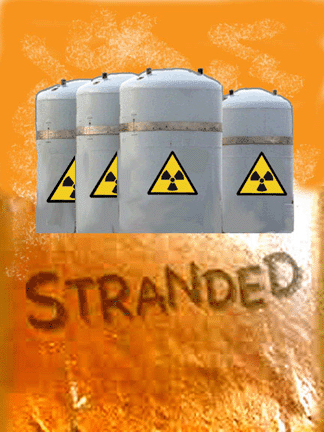
 Oyster Creek’s Spent Nuclear Fuel Casks Aren’t Going Anywhere
Almost 50 years of spent nuclear fuel dry casks are stored at the Route 9 plant in Lacey Township. Lacey Patch By Patricia A. Miller, Patch Staff |
LACEY TOWNSHIP, NJ – The Oyster Creek Nuclear Plant may be closing in October, but the spent nuclear fuel stored at the plant off Route 9 here for nearly 50 years isn’t going anywhere.
Why? There is no place in the United States to store them.
The proposed Yucca Mountain underground storage facility in Nevada never materialized. So nuclear plants around the country have been storing spent nuclear fuel in dry casks onsite for decades. Oyster Creek’s spent fuel is stored in horizontal dry casks in an area located near the entrance checkpoint off Route 9, NRC spokesman Neil Sheehan said.
“It is in the plant’s Protected Area, which is the fenced-in, highly secured area,” he said.
Spent fuel pools were originally designed as a short-term solution. The fuel would then cool enough so it could be shipped offsite to be reprocessed.
“But reprocessing didn’t end up being an option for nuclear power plants and the pools began to fill up,” according to the NRC.
Janet Tauro, chairman of the environmental group Clean Water Action and other environmental groups are calling for Oyster Creek’s dry casks to be “hardened,” meaning additional reinforcement in the future. They also want the capability for instrumentation, with the amount of heat and radiation inside each cask able to be monitored.
“Lacey Township is going to be a mini-Yucca,” Tauro said.
Sheehan says Oyster Creek’s dry casks consist of stainless steel canisters that hold the spent fuel. The canisters are then loaded into a steel-reinforced concrete vault.
“The vaults certainly qualify as “hardened,” as they weigh more than 100 tons when loaded and must be able to withstand hurricanes, tornadoes and more,” Sheehan said.
Oyster Creek is the oldest nuclear plant in the United States. It went online in December of 1969. The plant has a General Electric Mark I boiling water reactor, the same as the ill-fated Fukushima nuclear plant in Japan.
“None of our country’s Fukushima-design reactors should have operated for even one more day
once we saw the catastrophic events publicly unfold worldwide at Fukushima,” said Paul Gunter, of Beyond Nuclear, an anti-nuclear watchdog group…….. https://patch.com/new-jersey/lacey/oyster-creeks-spent-nuclear-fuel-casks-arent-going-anywere
Most Australians do not want the government to limit charities’ ability to advocate
Only One in Five Australians Favour Proposed Limits on Charitable Advocacy https://probonoaustralia.com.au/news/2018/02/one-five-australians-favour-proposed-limits-charitable-advocacy/ Only one in five Australians support the Turnbull government’s proposed measures to restrict charitable advocacy, including just 36 per cent of Coalition supporters, according to a new poll. , 7th February 2018, Luke Michael,
The Electoral Funding and Disclosure Reform Bill 2017 aims to block donations by foreign entities attempting to influence Australian politics.
But the charity sector has strongly pushed to re-draft the bill, fearing it will curtail its ability to advocate on social issues.
In response, the Fred Hollows Foundation commissioned polling for the Hands Off Our Charities alliance to gauge the public’s opinion on the legislation and on charity advocacy.
YouGov Galaxy polled a nationally representative sample of 1,008 Australian residents between 29 January and 1 February 2018.
The poll found that less than one in five Australians believed charities took one-sided, political positions with their advocacy.
Despite it being a coalition policy, more than half (53 per cent) of coalition supporters said they believed Australian charities played a vital role in highlighting social issues to government.
Coalition supporters were also broadly against the proposed move to limit charitable advocacy, with only 36 per cent of supporters in favour of the legislation, along with just 14 per cent of Labor supporters and 12 per cent of Greens supporters.
Overall, only 20 per cent of respondents supported the proposed measures.
Fred Hollows Foundation director of public affairs Nick Martin, told Pro Bono News that these results highlighted the public’s support for charitable advocacy.
“What it showed is that people do see charities speaking out on key matters of public policy as very important for a vibrant democracy and for seeing issues that otherwise might not be considered by government or our political leaders,” Martin said.
“What’s also clear from the results is that people have a lot of trust and faith in charities’ work. The findings showed the Australian public does not agree that charities are one sided and rather they think charities are non-partisan and conduct their work fairly to all governments and all political actors.
“So any inference that charities might be partisan in one way or another was rejected in the research.”
Martin said the government should be taking “a good, hard look at the laws as they are [currently] drafted”.
“Whatever the intention of the drafters, the bills they’ve put before parliament go much further and would seriously restrict the ability of charities to legitimately do their work,” he said.
“Our view is that the laws the bill presents should be scrapped and they should be completely redrafted to meet the stated objectives the government put forward. The impact of the bill would be absolutely devastating for every charity in Australia.
“What we hope is that the government pays attention to the number of charities and other stakeholders who have raised their concerns about this. [Some] really important constituents in Australia are voicing their opposition right now through this survey and other means.”
Marc Purcell, the CEO of the Australian Council for International Development (ACFID) said the bill would “fundamentally alter how Australians participate in our democracy”.
“There is widespread opposition to this bill from every corner of Australian society. Australians support charities having a strong voice and believe they play a vital role in our democracy,” Purcell said.
“It’s clear that Australians think we would be a poorer place if we started down the dangerous path of silencing communities.
“This bill will bring in new harsh civil and criminal penalties, an increased red-tape burden, restrictions on funding sources and places a burden on everyday Australians making a charitable donation. We fear charities will stop advocating and contributing to public debate.”
These findings come as a recent Pro Bono Australia survey of the charity sector found more than two thirds (63 per cent) of respondents were unclear on how the bill would affect their charity.
A total of 79 per cent said they were concerned by the new obligations, while 96 per cent said their charity or not for profit had not been consulted by the government on the draft bill.
A parliamentary inquiry into the bill is currently underway with a report due by 2 March 2018.
If Asteroids Don’t Destroy Elon Musk’s Space Tesla, Radiation Will, Experts Say
The Drive, BY KYLE CHEROMCHAFEBRUARY 7, 2018
Space: The final frontier. These are the voyages of the Tesla Roadster. Its billion-year mission: To circle the sun, to hopefully not crash into Mars, to boldly go where no car has gone before.
That is, unless the cosmic radiation eats it first.
Elon Musk’s old Roadster became the first car in history to be blasted into space on Tuesday, riding the successful test launch of the Falcon Heavy mega rocket to an orbital path that’s projected to send it out to Mars—or maybe even further. In a tweet, Musk reported that the “third burn” procedure to push the Roadster out of Earth’s orbit worked a little too well, with the trajectory now slated to reach the edge of the asteroid belt between Mars and Jupiter. (Someone didn’t listen to C-3PO.)
But as Live Science reported, big space rocks aren’t really the most significant threat to the spacefaring sports car. No, that would be good ol’ radiation, which has the potential to mostly disintegrate the Tesla Roadster within a year or two, according to William Carroll, an Indiana University chemist and molecular expert. Without the protection afforded by the Earth’s atmosphere and magnetic field, the Roadster will be bombarded by radiation that will eventually tear apart anything not made of metal on the car.
“All of the organics will be subjected to degradation by the various kinds of radiation that you will run into there,” Carroll said, noting that the term “organics” in this case includes not only fabric and leather but all plastic components as well as the car’s carbon fiber body. “Those organics, in that environment, I wouldn’t give them a year.”…….http://www.thedrive.com/news/18301/if-asteroids-dont-destroy-elon-musks-space-tesla-radiation-will-experts-say
India fired two Nuclear Capable Ballistic Missile in the last Week
 India Test Fires Second Nuclear Capable Ballistic Missile in a Week, The nuclear capable Prithvi-II missile was test fired on February 7. The Diplomat, By Franz-Stefan GadyFebruary 09, 2018
Terrorism: Radical Islamists in the nuclear industry?

 RTL 6th Feb 2018, According to”Mediapart”, the Operational Staff for the Prevention of Terrorism (EMOPT) has identified 59 people in 2017 as radical Islamists who have worked or
worked in nuclear power with “different degrees of radicalization”.
http://www.rtl.fr/actu/societe-faits-divers/terrorisme-des-islamistes-radicaux-dans-la-filiere-nucleaire-7792148539
Fukushima 49.17% thyroid deficiency in the 295 000 young people under 18 years examined between 2011 and 2014 .
Australia rooftop solar boom continues with best January ever — RenewEconomy

Australian homes and businesses continue to install solar at a cracking pace in January, adding another 111MW to the 2017 total of more than 1.25GW.
via Australia rooftop solar boom continues with best January ever — RenewEconomy
OpenNEM: An open platform for National Electricity Market data — RenewEconomy

Energy Transition Hub is pleased to launch the OpenNEM project with the ‘alpha’ release of our website and our new widget in RenewEconomy.
via OpenNEM: An open platform for National Electricity Market data — RenewEconomy
South Australia should aim for 100% renewables by 2025, not 50% — RenewEconomy
South Australia can show the rest of the nation how to build a 100 per cent renewable energy system to makes people’s lives better.
via South Australia should aim for 100% renewables by 2025, not 50% — RenewEconomy
Tokyo court orders Tepco to pay $10 million in damages over 2011 disaster — Fukushima 311 Watchdogs

30,000$ per person is no much paid for 7 years of misery and a whole life to rebuild… TOKYO (Reuters) – A Tokyo court on Wednesday ordered Tokyo Electric Power (Tepco) to pay around 1.1 billion yen ($10 million) to a group of Fukushima residents, local media reported, nearly seven years after the company’s reactor […]
via Tokyo court orders Tepco to pay $10 million in damages over 2011 disaster — Fukushima 311 Watchdogs
Energy efficiency market report: A “spectacular” start to 2018 — RenewEconomy

Having brought 2017 to a close on a comparatively stable note, the VEEC market began 2018 in a far more spectacular fashion. ESC market has also started in a positive frame of mind.
via Energy efficiency market report: A “spectacular” start to 2018 — RenewEconomy
Tasmania Libs propose solar + battery microgrid ahead of election — RenewEconomy

Tasmania’s Liberal government promises to boost state energy security with $200k solar and battery storage “microgrid,” if re-elected.
via Tasmania Libs propose solar + battery microgrid ahead of election — RenewEconomy
1 This month

of the week – Australians for War Powers Reform (AWPR)
To see nuclear-related stories in greater depth and intensity
 Antinuclear