Key points
- Cheaper solar and more expensive grid electricity mean it’s more affordable to finance rooftop solar
- Schemes are emerging that help renters get access to rooftop solar
- Experts warn renters need to weigh costs as well as benefits to decide if it’s worth it
Sunny Australia sure is the lucky country for many of us cashing in on the financial benefits of putting solar panels on their roof — but what can renters do if they want to save money and reduce their greenhouse emissions?
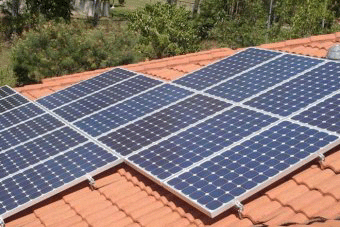
Skyrocketing grid electricity prices and the falling cost of solar technology saw a record number of Australian dwellings put solar photovoltaic (PV) cells on their roof in 2017, taking the total to 1.8 million.
But ever-more-elusive home ownership means there is a growing number of renters (now over 30 per cent of us) who tend to be the “solar have-nots”.
“It’s a bit of a risk of the country dividing into the solar energy haves and have-nots,” Andrew Reddaway, an energy analyst from the Alternative Technology Association (ATA), said.
And it’s not only renters’ hip pockets that are at stake here. Mr Reddaway estimates that by 2037, Australia could save as much as 5.6 million tonnes of greenhouse gas thanks to solar energy generated on the roofs of rental properties — equivalent to around a million or so cars off the road.
So what’s stopping us?
Solutions to the ‘split incentive’ The main barrier to landlords installing solar panels is what’s called the “split incentive”, Mr Reddaway said.
“It’ll be the tenant who sees the benefit on the electricity bill, whereas the person who pays for the solar system is generally the landlord. So the main question is: What’s in it for the landlord?”
But according to the ATA, there are options starting to become available to get past this problem — and they mainly involve splitting the costs and the benefits of a rooftop system between the tenant and landlord………
One “climate conscious” community group in regional NSW called Z-Net Uralla recently teamed up with the not-for-profit CORENA fund (Citizens Own Renewable Energy Network Australia) to give landlords interest-free loans to install solar on their rental properties. CORENA also helps broker a fair rent increase to help cover the cost of repayments.
“We are hoping that the partnership can be a model for communities elsewhere to copy,” Margaret Hender of CORENA said.
Councils take the lead There’s also a move among local councils to offer landlords interest-free loans that can be paid off via rate instalments.
Under the “solar savers” scheme pioneered by Darebin City Council in Melbourne, landlords can even transfer their loan to the new owner when the property is sold. Darebin is now targeting landlords, which means renters will be able to negotiate a rent increase to help cover the loan repayment. The City of Adelaide is another council that has followed this lead.
There are also a number of commercial schemes that offer to help manage a landlord-tenant agreement. A few of these are described in a recent article in the ATA’s ReNew magazine, along with some options for apartment dwellers, who face their own unique challenges installing rooftop solar.
But there are also solutions that don’t require the landlord to be out of pocket at all, ATA Policy & Research Manager Damien Moyse said.
This can involve a company installing rooftop solar — with permission from the landlord — and then charging the tenant, either for the electricity they use, or a fixed lease repayment, Mr Moyse said.
But, he said, no matter what a tenant does it’s important they weigh the costs and benefits before proceeding…….. http://www.abc.net.au/news/science/2018-02-18/how-can-renters-get-solar-panels/9409098







 Antinuclear