Antinuclear

Australian news, and some related international items

This week in nuclear and climate news, Australia

While I’m supposedly focussed on nuclear news, it is really madness to ignore climate.  The  biosphere is being dramatically changed by human activities.  Climate news has become ever more complicated.  Last week, I struggled to explain the complexity of the Arctic currents of warm air, their effects on the polar vortex, and the extreme cold in Northern Europe and America.

At the same time, climate change is heating up the southern half of the globe.

Rapid Sea Level Rise Possible as Ocean Floods into Antarctica at up to 400 Meters Per Year. Antarctica’s great ice sheet being eroded by warm water circulating underneath. Drastic action on fossil fuels is needed, as the Poles melt – with unpredictable consequences.

Women, today and always, understand and fight the peril of nuclear war, nuclear pollution.

The carbon footprint of huge digital data centres.

AUSTRALIA

Australia needs an independent National Environment Protection Agency.

The latest sally in the fight to further dumb down the ABC.

We should be outraged at the silencing of Julian Assange.

NUCLEAR. Submissions to the Australian Senate on process for siting of nuclear waste dump . Well, I think that this is a disgrace. Apart from the Terms of Reference being so weighted, and with the assumption that it’s a fait accompli that the proposed dump must be in South Australia – apart from all that – their handling of the submissions is odd indeed. For many weeks they published only 5 pro nuclear submissions. those 5 looked suspiciously alike – all coached by the nuclear lobby?

Now they’ve published 19 submissions – that would appear at first glance to be heavily weighted pro nuclear. (they did not publish mine, by the way).

New South Wales National Party rules out nuclear power plan. They distanced themselves from their Deputy Premier, John Barilaro, who spruiked for “new nuclear”. Barilaro, practically unknown as a nuclear advocate, was publicised, in his tax-payer funded jaunt to an American nuclear conference, billed  as “one of the biggest names in nuclear“. Barilaro is a stooge for the shadowy group “Nuclear For Climate”. (I will attach their map plan for nuclear reactors below this page). Labor MP Yasmin Catley calls for Premier Gladys Berejiklian to rule out nuclear power in New South Wales.

URANIUM-  Aboriginal traditional owners warn that Rum Jungle uranium mine rehabilitation is jeopardised. 20 years’ anniversary of Mirarr traditional Aboriginal owners blockade of Jabiluka.

Worrying changes to Gippsland mining plan – risk of radioactive pollution.

ENERGY– Monash family calls for coal power politicians to change the name of their group (Monash Forum)  Australian rooftop solar boom rolls on – 351MW in first quarter – and heaps more news at reneweconomy.com.au


April 6, 2018 Posted by | Christina reviews | Leave a comment

New South Wales National Party rules out nuclear power plan (touted by “Big Name in Nuclear” John Barilaro

Nationals rule out nuclear power ‘madness’ Echo Daily April 6, 2018 | by The Echo
The NSW Nationals have ruled out plans for building a nuclear power station on the north coast in the face of mounting pressure to do so ‘once and for all’.

Labor candidate for the seat of Ballina, Asren Pugh, made the call in the wake of the recent attendance at a US nuclear industry conference by NSW Nationals leader and Deputy Premier, John Barilaro.

But Mr Barilaro’s spokesman told Echonetdaily there were ‘absolutely’ no plans for such plants on the north coast nor nuclear energy ‘anywhere in NSW’.

However, the spokesman said Mr Barilaro’s views ‘are not representative of the party’s position or the NSW governments’.

‘Nuclear energy is banned under federal law,’ the spokesman said.

On Tuesday during a radio interview, Mr Barilaro said that premier Berejiklian was “open minded” to nuclear power in NSW.

But the deputy premier’s spokesman said the Nationals did not support the idea of nuclear power in NSW, and that Mr Barilaro was ‘expressing his personal views, in the interests of sparking a conversation about the prospects and environmental benefits of nuclear energy’.

Mr Pugh said Mr Barilaro not only participated in the US conference but was a key speaker, billed as one of the ‘Biggest Names in Nuclear’.

He said that since returning to Australia from the International SMR and Advanced Reactor Summi, in Atlanta, Mr Barilaro ‘has been spruiking nuclear power right across NSW, claiming that it could be a reality within 10 years’.

‘When the Nationals leader started this madness, most people thought it was just an April Fools joke, but this is now getting serious,’ Mr Pugh said.  ‘There are no circumstances in which our community on the North Coast want nuclear power here. ‘Nuclear power is unsafe, dangerous and leaves a legacy of toxic waste to our children and our children’s children.

‘Our community doesn’t want a discussion about nuclear power on the North Coast, or anywhere in NSW. I am calling on the Nationals MPs from across the North Coast to stand up for our community and say no.

‘I am asking for a clear commitment to a nuclear free North Coast,’ Mr Pugh said.

Mr Barilaro’s spokesman said the deputy premier’s position on nuclear energy ‘is his own. It is not the position of the Nationals or the NSW Government’……….https://www.echo.net.au/2018/04/nationals-push-nuclear-power-north-coast-madness/

April 6, 2018 Posted by | New South Wales, politics | Leave a comment

Volcano erupts only 40 miles from Japanese nuclear power plant, and more eruptions predicted

Another powerful eruption observed at Mount Shinmoe , Japan Times, 5 Apr 18   Another powerful eruption was observed at Mount Shinmoe in southwestern Japan early Thursday, with ash sent spiralling into a plume around 5,000 meters high, the Meteorological Agency said.

The eruption at the 1,421-meter volcano that straddles Miyazaki and Kagoshima prefectures was the largest since March 25, according to the agency.

Mount Shinmoe erupted violently for the first time in about seven years on March 6, and the agency said a week later that it was expected to continue explosive eruptions for several months or more……..https://www.japantimes.co.jp/news/2018/04/05/national/another-powerful-eruption-observed-mount-shinmoe/#.WsggQIhubIU

April 6, 2018 Posted by | General News | Leave a comment

Change the name: Monash family  

The descendants of Sir John Monash and former deputy PM Tim Fischer have demanded pollies change the name of their pro-coal group… (subscribers only) 
https://www.theaustralian.com.au/national-affairs/monash-family-call-for-coal-power-politicians-to-change-name-of-their-group/news-story/38540315a1e4826c3463a190e01fe4db

April 6, 2018 Posted by | General News | Leave a comment

Japan finally shuts failed “dream nuclear reactor” – costly feast breeder reprocessing policy

Japan prepares to shut troubled ‘dream’ nuclear reactor https://asia.nikkei.com/Politics/Japan-prepares-to-shut-troubled-dream-nuclear-reactor

Decades-old plant has cost almost $10bn and hardly ever operated    

TOKYO — Japan is set to start decommissioning its troubled Monju fast-breeder reactor after decades of accidents, cost overruns and scandals. It is the beginning of the end of a controversial project that exposed the shortcomings of the country’s nuclear policy and the government’s failure to fully explain the risks and the costs.

In July, the Japan Atomic Energy Agency will begin decommissioning what was hailed as a “dream” reactor that was expected to produce more nuclear fuel than it consumed. The government has so far spent more than 1 trillion yen ($9.44 billion) on the plant, which has barely ever operated.

The plan approved by the Nuclear Regulation Authority on March 28 to decommission the reactor, located in central Japan’s Fukui Prefecture, calls for the extraction of spent nuclear fuel to be completed by the end of the fiscal year through March 2023. Full decommissioning is expected to take about 30 years.

 Total costs to shut down the reactor are currently estimated at 375 billion yen, but that could climb, as the full technical requirements and the selection of the nuclear waste sites are not well understood.

Japan does not have the technological ability to manage the decommissioning process on its own, and must enlist the help of France, which has more experience with fast-breeder reactors. Among the technical challenges is handling the plant’s sodium coolant, which is highly reactive and explodes on contact with air.

Many of the problems with Japan’s nuclear policy were brought to light by the Fukushima Daiichi nuclear disaster caused by the tsunami and earthquake of March 2011. Such problems have included the high costs of plants, the selection of nuclear disposal sites, and the threat of shutdowns due to lawsuits. Japan’s nuclear policy has largely been gridlocked since the disaster.

But the Monju project had many problems before the Fukushima catastrophe.

Planning for the project began in the 1960s. Its fast-breeder technology was considered a dream technology for resource-poor Japan, which had been traumatized by the oil crisis of the 1970s. The reactor was supposed to generate more plutonium fuel than it consumed.

The reactor finally started operating in 1994, but was forced to shut down the following year due to a sodium leak. It has been inoperative for most of the time since. The decision to decommission it was made in December 2016 following a series of safety scandals, including the revelation that many safety checks had been omitted.

Recent experience suggests the government’s estimated cost of 375 billion yen to decommission Monju could be on the low side. In 2016, the estimate for decommissioning the Fukushima Daiichi plant ballooned to 8 trillion yen from an initial 2 trillion yen in 2013, largely due to inadequate understanding of the decommissioning process.

While “the JAEA will try to keep costs down,” said Hajime Ito, executive director with the agency, the process of extracting sodium, the biggest hurdle, has yet to be determined. Future technical requirements will also involve significant costs.

The Monju reactor is not the only example of failure in Japan’s nuclear fuel cycle policy — the cycle of how nuclear fuel is handled and processed, including disposing nuclear waste and reprocessing used fuel.

Central to this policy is a nuclear fuel reprocessing plant in the village of Rokkasho in northern Aomori Prefecture that was supposed to extract plutonium and uranium by reprocessing spent nuclear fuel to be reused at nuclear plants.

More than 2 trillion yen has been spent on the plant so far. Construction was begun in 1993, but completion has been repeatedly postponed due to safety concerns. On Wednesday, the NRA decided to resume safety checks on the plant, but if it chooses to decommission it, the cost would be an estimated 1.5 trillion yen.

Had Japan taken into consideration the costs of decommissioning plants and disposing of spent nuclear fuel, it probably would not have been able to push ahead with its nuclear policy in the first place, said a former senior official of the Ministry of Economy, Trade and Industry, who was involved in formulating the country’s basic energy plan.

April 6, 2018 Posted by | General News | Leave a comment

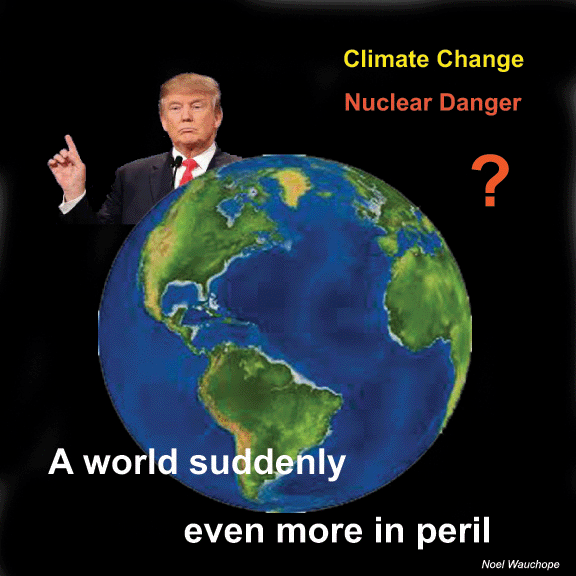
Fascism on the rise, and the danger of Donald Trump

Will We Stop Trump
Before It’s Too Late? https://www.nytimes.com/2018/04/06/opinion/sunday/trump-fascism-madeleine-albright.html  Fascism poses a more serious threat now than at any time since the end of World War II.  

April 6, 2018 Posted by | Uncategorized | Leave a comment

Faster and smarter: Grid operator hails performance of Tesla big battery — RenewEconomy

Grid operator recognises that the Tesla big battery is faster and smarter than conventional turbines – and also reducing prices.

via Faster and smarter: Grid operator hails performance of Tesla big battery — RenewEconomy

April 6, 2018 Posted by | Uncategorized | Leave a comment