Federal Nuclear Waste Dump the precursor to importing nuclear waste – South Australia’s Liberal Party plan

Lib Senator Ramsay triggered KImba’s offer whilst Lib ex-Senator & absentee landlord Chapman dumped on the Flinders.
Join the Dots peeps! https://www.facebook.com/groups/1314655315214929/
ANSTO’s plan – to keep producing radioactive trash – and sending away to rural south Australia
Anti nuclear protests at South Australia Liberal headquarters
Anti-nuclear protests at SA Liberal HQ https://www.eyretribune.com.au/story/5395082/anti-nuclear-protests-at-sa-liberal-hq/?cs=1825 MAY 11 2018
South Australians concerned about the prospect of a radioactive waste facility in the state protested outside of the Liberal Party headquarters in Adelaide this morning to oppose the proposal to both state and federal Liberals with a giant inflatable radioactive waste barrel drawing the attention of peak hour traffic.
The protesters were calling for Premier Steven Marshall and the Liberal government to oppose the federal government’s plan to establish a nuclear waste facility in Kimba or near Hawker.
“We want Premier Marshall to defend our state against the prospect of the federal proposal, just like he defended South Australia against the proposal for an international high level radioactive waste facility,” Mr Porter said.
“We call on the federal government to stop this process, stop dividing communities and take a responsible approach to the management of Australia’s nuclear waste.”
Why Closing Kim’s Test Site Won’t Hinder His Nuclear Plans
Bloomberg By David Tweed and Kanga Kong May 15, 2018,
A decade ago, the last time North Korea took talks with the U.S. so far, then-leader Kim Jong Il blew up a cooling tower at the Yongbyon nuclear plant as part of a deal to limit its weapons program. Within months, he was reassembling the reactor — a key source of weapons-grade plutonium. That’s one reason why arms-control experts are watching with caution as his son, Kim Jong Un, now moves to publicly dismantle the remote subterranean testing site used by the regime to detonate six nuclear bombs.
…….Does North Korea need more tests?
Possibly not. Both India and Pakistan established themselves as nuclear powers after a similar number of tests — and neither has detonated a bomb since 1998. In his April 20 statement announcing the Punggye-ri closing, Kim said the country’s efforts to build a warhead small enough to fit on a ballistic missile had progressed to the point where tests were no longer necessary. Still, it’s unclear whether North Korea has figured out how to prevent a warhead from burning up during re-entry from space.
Would the site’s closing be permanent?
No. A 38 North analysis of satellite images taken May 7 showed that several support buildings outside the northern, western and southern portals had been razed while some mining cart rails had been removed. Such facilities can be replaced as easily as the Yongbyon cooling tower. Lewis, of the Middlebury Institute, argues that the tunnel’s horizontal layout would also make it relatively easy to “pop” open the sealed entrances and regain access after their closing.
What about building a new tunnel?
A new test site could be constructed in three to six months, depending on how much labor was thrown at the job, according to Suh Kune Y., a nuclear engineering professor at Seoul National University. Future detonations — most likely to test warhead miniaturization — might only require a simple straight tunnel with one right angle at the end, he said.
What about other sites?
North Korea, which is believed to manage a vast subterranean network in part to frustrate U.S. and South Korean spies and military planners, probably has other locations that could house tests. Suh pointed out that North Korea refers to the Punggye-ri facility as its “northern test site,” possibly implying there are others. And, of course, tests don’t need to be underground. In September, North Korea Foreign Minister Ri Yong Ho suggested that his country could detonate a hydrogen bomb over the Pacific Ocean. https://www.bloomberg.com/news/articles/2018-05-15/closing-kim-s-test-site-won-t-hinder-his-nuke-plans-quicktake
Australian businesses on the move to renewable energy
Almost half of Australian big business moving to renewables
Climate Council says capacity of firms to generate solar power has doubled in less than two years, Guardian, Ben Smee, 15 May 18,
Almost half of Australia’s large businesses are actively transitioning to cheaper renewable energy, including many going off the grid by building their own generators and battery storage, as power bills threaten their bottom line.
A new report by the Climate Council details the increased speed of a business-led transition to renewables as power bills have increased.
The average household and small-business energy bill is more than 80% higher than a decade ago. Gas prices have increased threefold in five years.
Many businesses – including 46% of large operations – have responded by seeking green alternatives. The Climate Council report, released on Tuesday, said the capacity of Australian businesses to generate their own solar power had doubled in less than two years.
Business owners report making their investment back through cost savings in less than five years.
The general manager of AustChilli at Bundaberg, Ian Gaffel, said the decision to invest in solar panels was a “no-brainer”.
AustChilli employs more than 100 people in the agriculture and food manufacturing process. The business initially built a 100kW solar system and about 18 months ago added an additional 200kW.
Solar now accounts for about a quarter of the business’s power usage.
“We looked for many years at the idea before jumping in a few years ago,” Gaffel said. “We’re a growing business so as we’ve grown the energy we’re using goes up.”
“My role is on the financial side and from the numbers it was a very easy decision……..
Gaffel said the cost savings gave the business more confidence and certainty when deciding to expand and hire more employees. The next step for the business will likely be battery storage, which will further decrease its reliance on the energy grid.
The story is being repeated across the country, particularly in the manufacturing industry, where increased power bills have squeezed profits……. https://www.theguardian.com/environment/2018/may/15/almost-half-of-australian-big-business-moving-to-renewables
Crunch time coming for uneconomic Small Modular Nuclear Reactors (SMRs)
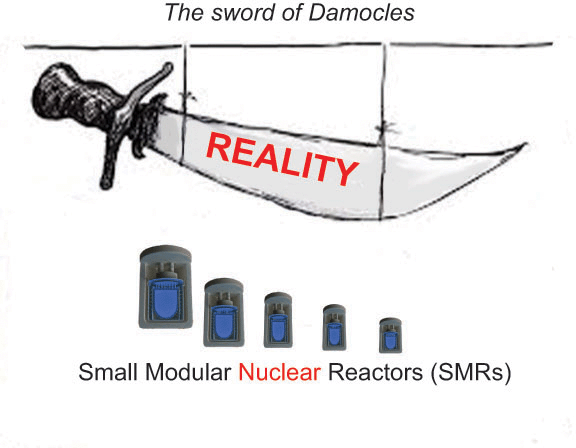
Small Modular Nuclear Reactors Will Soon Face a Moment of Reckoning
NuScale is bringing small nuclear alive. But will the concept survive? GreenTech Media MAY 14, 2018 Last month’s first-ever small modular reactor design approval could usher in a new era for nuclear power, provided the technology can live up to the hype.
Climate change could be intensifying dust storms in India, experts say
Mongabay, by Mayank Aggarwal on 14 May 2018
In the past couple of weeks, severe dust storms, thunderstorms and lightning have hit several parts of India, resulting in the deaths of more than 150 people and injuries to at least 300 others.
With the rise in global temperatures, the intensity of dust and thunderstorms is expected to increase in the future, experts say.
But even though dust storms and thunderstorms are a common feature in India, there has been no focused work on studying the trends related to it.
India could witness an increase in the severity and frequency of dust storms and thunderstorms due to rising global temperatures, experts say.
“[The] intensity of sandstorms is increasing across the world,” said Chandra Bhushan, deputy director general at the Centre for Science and Environment (CSE), a Delhi-based think tank. He cited studies from the U.S. Midwest, the Middle East and the Sahara, all of them linking the phenomenon to sudden increases in surface temperature.
“All of them are saying that as the climate gets warmer the temperature gradient is going to become very steep. This steep increase in temperature gradient will lead to two things — heat waves and sand storms,” Bhushan said.
“There is enough research happening [to predict] that the intensity of sandstorms is going to become more intense as the temperature increases further. It is indeed linked to climate change.”
On May 2, severe dust storms, thunderstorms and lightning hit several parts of India, resulting in the deaths of at least 124 people and injuries to 300 others. More than 10,000 utility poles and hundreds of power transformers were damaged, while farmers suffered losses to their cattle and poultry stocks. Similarly, on May 13, fierce dust and thunderstorms led to the deaths of some 40 people, while several others were injured.
Bhushan said the enormity of losses from dust storms was shocking, but that they would only become more intense in the future. With higher global temperatures, he said, the soil would become drier. That will result in an increase in the amount of dust carried by the wind, and consequently the intensity of dust storms.
“Climate change is intensifying all extreme weather events,” Bhushan said…….https://news.mongabay.com/2018/05/climate-change-could-be-intensifying-dust-storms-in-india-experts-say/
Global Sea Level Rise Accelerated to 4.6 mm Per Year After 2010 — robertscribbler

Human forced climate change through fossil fuel burning now presents a serious threat to the world’s coastal cities and island nations. Diverse regions of the world are now facing increased inundation at times of high tide and during storms. Unfortunately, this trend is only worsening. And depending on how much additional fossil fuel is burned, we […]
via Global Sea Level Rise Accelerated to 4.6 mm Per Year After 2010 — robertscribbler
Australia’s biggest solar farm switches on in Port Augusta — RenewEconomy

The 220MW Bungala solar farm – Australia’s largest – begins production, signalling a milestone for the transformation of Port Augusta into a renewable energy hub.
via Australia’s biggest solar farm switches on in Port Augusta — RenewEconomy
Queensland’s biggest solar farm connects to the grid — RenewEconomy

Clare solar farm begins production in north Queensland, while Hughenden solar farm also connected to the grid.
via Queensland’s biggest solar farm connects to the grid — RenewEconomy
Antiwar.com — To understand Iran, try history, not hysteria — Brett Wilkins

Originally published at Antiwar.com Most Americans trace the origins of the US-Iran conflict back to the 1979 seizure of the US Embassy in Tehran by Islamist revolutionaries overthrowing an erstwhile valuable regional ally. What most people in the United States don’t know is that the actions of those young Iranians nearly 40 years ago were […]
via Antiwar.com — To understand Iran, try history, not hysteria — Brett Wilkins
May 15 Energy News — geoharvey

Opinion: ¶ “Russia Will Use Floating Nuclear Plant To Power Arctic Oil Exploration. What Could Possibly Go Wrong?” • Thanks to global warming, much of the Arctic ice has melted, making it easier to drill for more oil. But exploring for oil is energy intensive. What to do? Use a floating nuclear plant to power […]
1 This month

of the week – Australians for War Powers Reform (AWPR)
To see nuclear-related stories in greater depth and intensity
 Antinuclear