To May 19 – nuclear and climate news Australia
 International politics teeters about over the Iran nuclear deal. Plans falter for nuclear summit meeting between Trump and Kim Jong Un. Trump will “decimate” North Korea unless Kim agrees to denuclearise the Korean peninsula.
Pro nuclear propaganda becomes more sophisticated and subtle. National Geographic now a stooge for the International “New Nukes”lobby
Scientists warn that worst-case climate change scenario could be more extreme than previously thought. Climate change is heading for a major wipeout of the world’s insect species.
AUSTRALIA
Labor prepared to strengthen environmental protections, as grass roots members demand.
ACT brings forward zero emissions target to 2045.
Australia’s nuclear propagandist Ben Heard wrote a paper rubbishing renewable energy’s potential: a group of international scientists refute it.
NUCLEAR. South Australia nuclear waste dump plan. A journey to the heart of the anti-nuclear resistance in Australia: Radioactive Exposure Tour 2018. ANSTO is lying to South Australians: nuclear medicine does NOT need a nuclear waste dump in Flinders Ranges. South Australia’s battles against nuclear waste dumping won, – and now fought again. Federal Nuclear Waste Dump the precursor to importing nuclear waste – South Australia’s Liberal Party plan. We must not leave nuclear waste decisions up to poorly informed Kimba residents.
Latest Submissions to Senate Inquiry:
- Sue Tulloch’s scathing criticism of the federal nuclear waste dump process and shambolic Barndioota Consultative Co
- Janette Thomas – on the biased “community consultation”on Barndioota nuclear dump plan, seismic and flooding dangers.
- Ken and Carole Wetherby demand that Eyre Peninsula remain ‘clean and green’ – NO nuclear waste dump.
CLIMATE. Turnbull’s budget shows complete ignorance about climate change. Adani’s vain hope global coal market will save Carmichael mine. ECOM withdrawal from Adani Coal Should be ‘Final Nail in the Coffin’
RENEWABLE ENERGY Australia’s scarce water could be helped by solar and wind power. Australian businesses on the move to renewable energy. Community Buying of solar power – a very good deal for Australia’s Non Profit organisations. Australia’s biggest solar farm switches on in Port Augusta . Australia’s biggest wind farm project lands connection deal. Queensland’s biggest solar farm connects to the grid. Mackay council goes solar – and saves big – with city-wide rollout . NAB, CBA to provide $80m finance for Crowlands wind farm .
Australian government increases pressure for nuclear waste dump – (will the Senate Inquiry be irrelevant?)
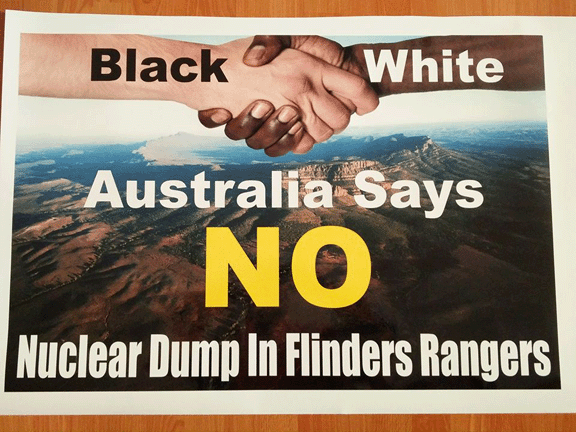
Make peace by defying SA nuclear dump https://www.eurekastreet.com.au/article.aspx?aeid=55371 Michele Madigan 17 May 2018
Sunday 29 April 2018 marked the second anniversary for many such South Australian peacemakers. It was on that date in 2016, at 2.30am, that Adnyamathanha Elder Aunty Enice Marsh heard the news that the federal government had ‘chosen’ the Flinders Ranges to be the ‘top of the list’ site of the proposed national nuclear dump.
Incredulous at hearing this on the 8am news, I rang Aunty Enice. ‘I’m sitting here trying to eat my weetbix and keep my thoughts calm,’ she said. ‘But do you know what I was thinking? Colonisation is again attacking the First Nations people and poisoning their land.’
For her colleague, Regina McKenzie, it was ‘like getting news of a death’: death to a 60,000-year cultural heritage.
Since then, South Australia’s international grain farming area of Kimba has again emerged as an alternative site. At last month’s first joint meeting in Port Augusta, both Kimba and Flinders Ranges peoples opposing the dump reported that after ‘a quiet last few months’, the pressure from the federal government is now back on with a vengeance.
The announcement of $2 million in ‘untied’ government grants to various local applicants in each region has been integral to this. What was surprising to the Kimba opponents, faced with the absence of five of their key colleagues, was the unannounced (at least to them) appearance of the Minister, National Party Senator Matt Canavan, at this announcement.
When challenged about this lack of notice, the senior public servant’s response was that he hadn’t been ‘really sure’ that the Minister was coming. Kimba opponents cite this as just another example of the government campaign strategy: ‘It’s all about stealth.’
The Minister also announced that the Australian Electoral Commission local voting for and against either region becoming Australia’s national nuclear dump would take place on 20 August. Currently there is a Senate Estimates Committee examining the process of site selection and related matters, with its recommendations due on 13 August — leaving hardly time for a dispersion, reading and respectful cognisance of its findings prior to the vote.
Political maneuvering is again evident in the insistence of the Minister to tightly restrict the voting area — as if the small numbers of local people will be the only ones affected. Kimba farmer opponents warn constantly of the danger to their international markets of other crops and produce (such as Port Lincoln’s seafood trade) on the whole of the Eyre Peninsula region.
The oft-repeated government saying: ‘We will not impose the federal nuclear dump on an unwilling community’ continues to fly in the face of the lately renewed state legislation, which actually forbids the transportation of such waste into South Australia.
On 28 April, some of us ‘southerners’ joined locals at the glorious Wilpena Pound (pictured) site to inform national and international tourists of the Australian government’s intention to make the region home to Australia’s highest level nuclear waste — if permitted.
Predictable reactions to the news (‘Incredible!’ ‘Why?‘) included inquiries about the distance from the Pound. Amazement followed the map sighting: that any government would deliberately jeopardise such an internationally recognised site by proposing, just 40km away, a dump site for nuclear waste. Measured by radioactivity, over 90 per cent of the waste would be intermediate long lived nuclear waste from the Lucas Heights nuclear reactor in Sydney — waste that will be hazardous for thousands of years.
Our dinner at the camping ground was accompanied by ring-necked parrots and, later, flocks of apostle birds. In the morning, my prayer companions included a mother kangaroo, who fossicked among the leaves while keeping herself discreetly behind the wire fence. Her joey however was a close encounter type, constantly circling within a metre of my chair.
The Flinders is an idyllic place. Kimba is important grain farming country. No wonder much of the emphasis in the government campaign, and by local proponents for both regions, continues to be on the low level nuclear waste component.
With the campaign stretching past its third year since the announcement of the respective leaseholders simply ‘offering’ their respective properties, both Aboriginal and non-Aboriginal opponents are rock solid in their constant efforts ‘to look after the country’. But it has come at huge personal and communal costs.
Barry Wakelin, the retired Coalition federal member, is one of the farmers fiercely opposing the plan. In the face of groundwater, transport and serious, hugely long-term safety risks, Wakelin insists, ‘This is a national issue, not something that a regional community should be left to deal with.’
A national response (in the form of a petition being circulated by Conservation South Australia) can be made in solidarity with the country and peoples who will be affected by the proposed site. Click here to sign the petition.
Response to ‘Burden of proof: A comprehensive review of the feasibility of 100% renewable-electricity systems’
Science Direct 18 May 18
- https://doi.org/10.1016/j.rser.2018.
Highlights
- •We respond to a recent article that is critical of the feasibility of 100% renewable-electricity systems.
- •Based on a literature review we show that none of the issues raised in the article are critical for feasibility or viability.
- •Each issue can be addressed at low economic cost, while not affecting the main conclusions of the reviewed studies.
- •We highlight methodological problems with the choice and evaluation of the feasibility criteria.
- •We provide further evidence for the feasibility and viability of renewables-based systems.
-
Abstract
A recent article ‘Burden of proof: A comprehensive review of the feasibility of 100% renewable-electricity systems’ claims that many studies of 100% renewable electricity systems do not demonstrate sufficient technical feasibility, according to the criteria of the article’s authors (henceforth ‘the authors’). Here we analyse the authors’ methodology and find it problematic. The feasibility criteria chosen by the authors are important, but are also easily addressed at low economic cost, while not affecting the main conclusions of the reviewed studies and certainly not affecting their technical feasibility. A more thorough review reveals that all of the issues have already been addressed in the engineering and modelling literature. Nuclear power, which the authors have evaluated positively elsewhere, faces other, genuine feasibility problems, such as the finiteness of uranium resources and a reliance on unproven technologies in the medium- to long-term. Energy systems based on renewables, on the other hand, are not only feasible, but already economically viable and decreasing in cost every year
-
1. Introduction
………..https://www.sciencedirect.com/science/article/pii/S1364032118303307
Scientists refute Ben Heard’s paper opposing reneweable energy
Can we get 100 percent of our energy from renewable sources? https://www.eurekalert.org/pub_releases/2018-05/luot-cwg051718.php New article gathers the evidence to address the sceptics LAPPEENRANTA UNIVERSITY OF TECHNOLOGY
Is there enough space for all the wind turbines and solar panels to provide all our energy needs? What happens when the sun doesn’t shine and the wind doesn’t blow? Won’t renewables destabilise the grid and cause blackouts?
 In a review paper last year in the high-ranking journal Renewable and Sustainable Energy Reviews, Master of Science Benjamin Heard (at left) and colleagues presented their case against 100% renewable electricity systems. They doubted the feasibility of many of the recent scenarios for high shares of renewable energy, questioning everything from whether renewables-based systems can survive extreme weather events with low sun and low wind, to the ability to keep the grid stable with so much variable generation.
Now scientists have hit back with their response to the points raised by Heard and colleagues.The researchers from the Karlsruhe Institute of Technology, the South African Council for Scientific and Industrial Research, Lappeenranta University of Technology, Delft University of Technology and Aalborg University have analysed hundreds of studies from across the scientific literature to answer each of the apparent issues. They demonstrate that there are no roadblocks on the way to a 100% renewable future. Continue reading
1 This month
7 April – WEBINAR – Australia and the Doomsday Clock – Preventing nuclear war through NoFirstUse and other policies
Online | Tuesday April 7, 4:00-5:30pm, Australian Eastern Time / 8:00-9:30am Central Europe Time
– Access the registration link
15 April – Zoom –Nuclear Power is Not the Solution
Apr 15, 2026 01:00 AM in Canberra, Melbourne, Sydney

Join the International Physicians for the Prevention of Nuclear War (IPPNW) on Tuesday, April 14th for a timely webinar exploring the risks associated with nuclear power and challenging the myth that it offers a simple, safe, carbon-free solution to the climate crisis

21 April Webinar: No Nuclear Weapons in Australia
Start: 2026-04-21 18:00:00 UTC Canberra, Melbourne, Sydney (GMT+10:00)
End: 2026-04-21 19:30:00 UTC Canberra, Melbourne, Sydney (GMT+10:00)
Event Type: Virtual
A virtual link will be communicated before the event.
Host Contact Info: australia@icanw.org

of the week – Australians for War Powers Reform (AWPR)
To see nuclear-related stories in greater depth and intensity
 Antinuclear