USA Secretary of State Mike Pompeo says that USA- North Korea talks will take place next week
 The Latest: Trump’s claim of no nuke threat seen as dubious WASHINGTON (AP) 14 June 18, — The Latest on the summit between President Donald Trump and North Korean leader Kim Jong Un
Secretary of State Mike Pompeo says he’s confident that U.S. talks with North Korea will resume “sometime in the next week.”
Pompeo says he doesn’t know the exact timing. Speaking in Seoul, he says he expects it to happen fairly quickly after he and the North Koreans return to their nations. Pompeo returns late Thursday to the U.S.
He says President Donald Trump is “in the lead” but that “I will be the person who takes the role of driving this process forward.”
He says much more work has been done by the U.S. and North Korean that couldn’t be encapsulated in the Trump-Kim Jong Un statement. So he says teams will now work to make more progress on those items……..https://apnews.com/79a6ec899f4c4fa08adbd05d4315ae24/The-Latest:-Pompeo-says-NKorea-talks-to-resume-next-week
Russia suspends nuclear waste transport due to safety fears with World Cup visitors
 World Cup puts break on nuclear transport A load of containers with spent nuclear fuel from Andreeva Bay on the Kola Peninsula will have to wait because of a general ban on transport of dangerous goods in Russia during the Football World Cup. https://thebarentsobserver.com/en/ecology/2018/06/world-cup-puts-break-nuclear-transport Thomas Nilsen, 14 June 18,
In the north, the ban now delays a shipment of nuclear waste that otherwise would be on its way to Mayak north of Chelyabinsk in the South Urals.
Head of Rosatom State Nuclear Corporation’s international technical assistance project, Anatoly Grigoryev, says three railway sets already have departed to Mayak this year. «The fourth is ready, but we can’t send it because transport of dangerous goods during the World Cup is prohibited,» Grigoriyev says to Interfax in an interview reposted by Rosatom.
From Andreeva Bay near Russia’s border to Norway, the containers with old uranium fuel from Cold War submarines are shipped to Murmansk, where they are loaded over to a set of special rail-wagons. From Murmansk, the train follows Russia’s railway lines south through Karelia towards St. Petersburg and Yaroslav before heading east towards the Urals, a distance of more than 1,600 kilometers.
Mayak reprocessing plant is located between the cities of Chelyabinsk and Yekaterinburg. The last is one of the cities where football matches will be played.
Anatoly Grigoryev assures that the load of nuclear waste containers from the Murmansk region will be shipped to Mayak as soon as the World Cup is over by mid-July.
Last June, a top brass of Russian and Norwegian politicians, diplomates and nuclear safety experts cheered and waved as the first load of containers set out to sea from Andreeva Bay. Since the 1990s, Norway has spent tens of millions of euros to support preparing for the nuclear waste removal from the site to start.
In Murmansk, nuclear safety expert with the Bellona Foundation, Andrey Zolotkov, says this is the first time to his knowledge transport of nuclear waste has been put on break for such reason as a international tournament.
«I don’t recall any such thing. This is most likely due to keeping the railway routes free from such cargos because of all the [football] fans on the move,» Zolotkov says to the Barents Observer. Additional to Bellona, Zolotkov has for many years been working on board the Russian nuclear icebreaker fleet’s transport- and storage vessel «Imandra».
From Murmansk, the nuclear waste cargo-train follows the same tracks, and through the same big cities, as ordinary passenger trains.
«After all, we are just talking about a one month delay,» Andrey Zolotkov explains pointing to the many-years it will take to remove all spent nuclear fuel elements from Andreeva Bay.
A total of about 22,000 such uranium fuel elements where stored in three rundown concrete tanks. That is equal to about 100 submarine reactor cores.
Anatoly Grigoryev with Rosatom estimates it will take about 10 years to remove it all from the Kola Peninsula to the Mayak plant.
Graham Readfern exposes the climate denial group “The Australian Environment Foundation”

The Australian Environment Foundation has secured a former prime minister to speak. But what does it actually do?
Securing a former prime minister to speak at your organisation is no doubt a coup for many groups.
Singapore’s Lee Kuan Yew School of Public Policy recently got Kevin Rudd. Australia’s Nelson Mandela Day committee has snaffled Julia Gillard for their next annual lecture.
What about our most recent former PM, Tony Abbott?
Next month, Abbott will deliver the “2018 Bob Carter Commemorative Lecture” to the Australian Environment Foundation (AEF), where the ticketing site says he’ll talk about “Climate Change and Restraining Greenhouse Gas Emissions”.
The AEF is an “environment charity” that promotes views that wind turbines make you sick, that human-caused climate change isn’t really a thing, and that environmentalists (the other sort) are killing farmers, fisheries and the economy.
Abbott’s lecture will no doubt pick up from his speech in London in December, where he delivered a suite of climate science denial talking pointsto the Global Warming Policy Foundation.
So who, or what, is the AEF? To look into its history, and the people involved with it, is to take a deep dive into Australia’s climate science denial network.
But first let’s look at the AEF right now because, as an “environmental charity”, Abbott’s next port of call doesn’t seem to do very much.
Latest figures available from the Australian Charities and Not-for-Profits Commission show that in 2016, the charity declared an annual income of just $1,175.
In May 2017, the AEF lent its logo to a letter to US President Donald Trump to offer “enthusiastic support” for his commitments to withdraw from the UN Paris climate agreement. But between July 2017 and February 2018, there was virtually nothing posted on its website.
Much of that website, including the “Climate News” section, is content from former Institute of Public Affairs fellow Alan Moran and postings that variously dismiss human-caused climate change and renewable energy, in particular wind power.
The charity has two other trading names listed with the Australian Securities and Investments Commission – the Australian Climate Science Coalition(ACSC) and ListenToUs – but both of these seem to be defunct. …….https://www.theguardian.com/environment/planet-oz/2018/jun/15/inside-the-aef-the-climate-denial-group-hosting-tony-abbott-as-guest-speaker
Why Are Nations Throwing Cash At Nuclear ‘White Elephants’?
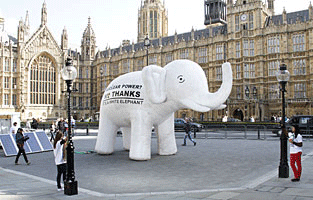
Jeremy Leggett: Why Are Nations Throwing Cash At Nuclear ‘White Elephants’? Impact4All.org, 14 June 18
In recent weeks we have seen evidence on the one hand of the fast advance of renewable energy, and on the other the incredible resilience of the energy-incumbency defence against that advance, including big oil and nuclear.
Celebrations of the fast growth of renewables I will leave to the inestimable REN21 report, published on 4 June. All clean-energy advocates should spend some time immersed in it, arming themselves with bullish ammunition. The point I want to make in this column is about the residual strength of the incumbency rearguard action.
In the last week of May and the first week of June the UK, US, and Canadian governments all tried to bail out uneconomic or stranded fossil fuel and nuclear projects with many billions in public funds. I have dubbed it “The Week of the White Elephants.”
First, the Canadian government bailed out a stranded Kinder Morgan oil pipeline system for US$3.5 bn. They hope to sell this, the Trans Mountain pipeline, in due course. Analysts doubt they can, so economically unattractive and risky is the proposition. In the interim, protestors have labelled Canadian PM Justin Trudeau – who says he aspires to be a climate hero – a climate criminal.
Second, US President Donald Trump ordered emergency federal action to stem coal and nuclear plant shutdowns. Proposals in a leaked memo included forcing utilities to buy electricity from coal and nuclear operators for two years, despite the fact that renewables and gas are both better value. The Economist describes Trump’s gambit as follows: “The plan would benefit a handful of firms the president favours at the expense of consumers: it entails up to $12bn worth of ‘cash for cronies’.”
Third, in a remarkable U-turn, the UK government agreed to a £5bn injection of taxpayer money into a Welsh nuclear power station, Wylfa. The total cost, to be shared with Hitachi and Japanese government, is £16 bn. The price of power will be £75-77 MWh (they say). That is more than solar and wind.
These are all very strange things to do when you consider not just the economics but the general direction of travel in all relevant areas
……..As for the UK nuclear decision, in France nuclear regulators now fear an “epidemic” safety-culture collapse at Flamanville, the supposed precursor of the British Hinkley Point C reactor. 150 weld failures mean the nuclear plant scheduled online in 2012 at €3.5bn is now probably delayed to 2020, at €10.5bn and counting. This is not the same type of reactor that Hitachi intends for Wylfa, but the horror show at Flamanville shows how badly, and quickly, things can go wrong in modern nuclear.As the formerly pro-nuclear The Economist put it in 2016, in a analysis entitled “Hinkley Pointless”, “Britain should cancel its nuclear white elephant and spend the billions on making renewables work.”…….https://impact4all.org/jeremy-leggett-new-coal-and-nuclear-deals-show-power-of-incumbent-energy-players/
Event 27 June The Need for Leadership to Address White Supremacy in the NGO Sector
Pro Bono Australia Luke Michael, 14 June 18
 Charities and not for profits need to show leadership to address the issue of white supremacy in the NGO sector, a prominent Aboriginal writer and activist believes.
Nayuka Gorrie is a Kurnai/Gunai, Gunditjmara, Wiradjuri and Yorta Yorta writer and activist who spoke on a panel at the Victorian Council of Social Service (VCOSS) 2018 Summit on Wednesday.
She was joined by Victorian ombudsman Deborah Glass OAM, Will Stracke from the Victorian Trades Hall Council, Reason Party leader Fiona Patten, and Centre for Social Impact CEO Kristy Muir.
The panel discussed the “shifting nature of leadership and the role of citizens to shape their own prosperous and inclusive society”.
One of the topics discussed was the need for greater diversity in leadership, particularly around race and gender.
Stracke admitted during the panel discussion that leadership in the trade union movement was “too white”.
“One of our values that we say is ‘diversity is our strength and solidarity is our power’,” Stracke said.
“And that’s about the diversity of our movement and our movement is very diverse… but I think we as a union movement [still] need more voices.
“We’ve very white in terms of our leadership and we need to get better at that.”………
“Leadership needs to be much more representative of the people,” Glass said.
“It’s not just gender, it’s race, it’s disability, it’s everything we all stand for. We can’t have leaders speaking for us who don’t represent us, who don’t look like us or don’t speak like us.”………
Gorrie has organised an event to discuss “dismantling white supremacy in the NGO sector” at Victorian Trades Hall on 27 June.
She told Pro Bono News why she decided to create the event.
“I decided to put on that event after chatting to a number of different people that work in the not-for-profit sector,” she said.
“And [people of colour] are doing twice as much work just to survive I think.”
Gorrie said while white supremacy was found across all sections of society, it was especially disappointing to see it in the not-for-profit sector, considering the sector’s purpose to make the world a better place.
……..“I think a lot of not for profits make a lot of money and the Indigenous Advancement Strategy was a really good example of that. Most of the money in the strategy went to non-black organisations.“So there is a lot of money to be made in perceived black dysfunction and I don’t know if it’s possible for them to do the work they’ve set out to do if they haven’t examined and [removed] the white supremacy within themselves.”https://probonoaustralia.com.au/news/2018/06/need-leadership-address-white-supremacy-ngo-sector/
AEMO sees rooftop solar trebling in 10 years, batteries rising 10-fold — RenewEconomy
AEMO sees rooftop solar and battery storage uptake surging in WA, but grid to remain stable even as fossil fuel plants retire. EV forecasts vary widely.
via AEMO sees rooftop solar trebling in 10 years, batteries rising 10-fold — RenewEconomy
Weak NEG puts pressure on farmers, truckers, factories to cut emissions — RenewEconomy
A weak NEG will let the electricity sector off lightly, and put pressure on emissions reductions on to truckers, farmers and factories. Here’s what needs to be done.
via Weak NEG puts pressure on farmers, truckers, factories to cut emissions — RenewEconomy
Energy retailer greed backfires, as consumers switch to solar, batteries — RenewEconomy
Consumers now trust energy retailers less than they do banks and insurers, thanks to soaring prices and confusing bills, so they are taking matters into their own hands, and looking to solar and storage.
via Energy retailer greed backfires, as consumers switch to solar, batteries — RenewEconomy
Who should control household rooftop solar and batteries? — RenewEconomy
AEMO and networks lobby release paper arguing for “orchestration” of rooftop solar and battery storage as Australia leads the world on distributed generation. But who gets to hold the baton?
via Who should control household rooftop solar and batteries? — RenewEconomy
June 14 Energy News

Science and Technology:
¶ Sea levels will rise and all coastal countries could be seriously threatened by flooding if nothing is done to stop the massive melt of sea ice in Antarctica, according to nine award-winning scientists who have studied the continent for many years. In the journal Nature, they outline two scenarios, one promising, one bleak, for what could happen by 2070. [CNN]
 Penguin selfie
¶ Antarctica is shedding ice at an accelerating rate, according to a report in the journal Nature. Satellites monitoring the state of the White Continent indicate some 200 billion tonnes a year are now being lost to the ocean as a result of melting. This is pushing up global sea levels by 0.6 mm annually, three times as fast as it was in 2012. [BBC]
World:
¶ Scotland’s Climate Change Secretary announced that the country had met its statutory annual…
View original post 781 more words
State-based renewable schemes “critical” – especially under NEG — RenewEconomy
Renewables policy pioneer, Simon Corbell, details why state schemes like VRET are critical – including to counter “stifling impact” of NEG on solar and wind investment.
via State-based renewable schemes “critical” – especially under NEG — RenewEconomy
More solar farms prepare to connect as solar pipeline leaps to 35GW — RenewEconomy
Another three new solar farms ready to begin production as list of projects in the pipeline jumps to a breath-taking 35GW.
via More solar farms prepare to connect as solar pipeline leaps to 35GW — RenewEconomy
Construction underway at Australia’s largest, possibly cheapest wind farm — RenewEconomy
Construction underway at Goldwind’s 530MW Stockyard Hill Wind Farm in Victoria, one of Australia’s biggest and cheapest wind projects.
via Construction underway at Australia’s largest, possibly cheapest wind farm — RenewEconomy
1 This month

of the week – Australians for War Powers Reform (AWPR)
To see nuclear-related stories in greater depth and intensity
 Antinuclear