Paul Waldon on the unreliability of manufactured news from the Department of Industry Innovation and Science (DIIS)
Paul Waldon Fight To Stop Nuclear Waste Dump In Flinders Ranges SA
 Where are all of these alleged proponents of a nuclear waste dump that the Department of Industry, Innovation and Science has claimed support the risk of contaminating their own environment of Hawker for a few jobs.
Only one, yes 1, that’s less than two, nearly zero, zip, squat, zilch, butt kiss, and it was only that one elderly local that got up and spoke in support of a risky program at the Hawker community meeting on the 6th of May 2016. A man with No conscience, and willing to burden the young with the contamination of Hawker and the Flinders,
the same meeting that had over 100 concerned people decrying the abandonment of radioactive waste, yet the DIIS claim this one man was the majority. The augury of the DIIS’s factoids needs to raised so people are adroit to the dangers of their manufactured figures. https://www.facebook.com/groups/344452605899556/
Senator Rex Patrick attended Kimba Senate Nuclear Waste meeting – concerned about problem of “community support”
 Senator Rex Patrick Nuclear Fuel Cycle Watch South Australia, 5 July 18
It was great to hear everyone’s perspective – the local council, land nominators, the Barngarla Determination Aboriginal Corporation and local groups from both sides of the fence. It’s too early in the inquiry process to pass judgement, but I must say I share concerns with some witnesses over the lack of consultation, the inconsistency of certain information, the lack of transparency and especially the lack of any apparent ‘formula’ to determine whether the Government has broad community support.
The Committee is spending the night in Port Augusta; Crossroads of Australia. We travel to Hawker tomorrow to hear more evidence.
Here’s a photo of me and my Senate colleagues, Chris Ketter (QLD) and Dean Smith (WA) standing in front of The Big Galah in Kimba. No jokes about politicians and galahs please.
Jodie Joyce – another true believer in the National Radioactive Waste Facility for Kimba
 Jodie Joyce Submision Committee Secretariat Senate Standing committees on Economics RE – Proposed National Radioactive Waste Management Facility Submission no. 33
I have lived in the Kimba District since my family moving here in 1982. I married a local born and bred farmer. Living on a farming property with a cropping programme incorporating cattle and sheep. My husband has been truck driving for 15 years living away from home, recently gaining employment with a local Transport business. For the past 6 years I am very fortunate to have full time employment in a family owned Kimba. My husband and myself have volunteered on many local committees. I am pleased to be able to provide information to the inquiry on the appropriateness and thoroughness of the National Radioactive Waste Management Facility site process in Kimba SA. I give my permission for this submission to be made public.
a) The financial compensation offered to applicants for the acquisition of land under the nominations of Land Guidelines;
I believe the financial compensation offered to the land owners (four times the value of the land) is a fair representation, it is not an exorbitant amount, you must take into consideration this land will not be farmed gaining income as previous. It will be deemed useless to the land holder, with land steadily on the increase, this is a fair price. It will not impact the running’s of their farming practises. I fail to see this money being used as an incentive for people to offer their land. Land holders would only offer their land if they were truly convinced there would be no health or safety issues that would impact them or their family’s health and wellbeing, and to benefit their community on a whole.
b) How the need for ‘broad community support’ has played and will continue to play in a part in the process, including: i) The definition of ‘broad community support’, and ii) How ‘broad community support’ has been or will be determined for each process advancement stage;
People who reside, work, support, volunteer and genuinely care for the future of the town, this is to define community.
Broad community support is fundamental to this process. The District Council have been activity involved in the process and has shared their views seeing this process into the next phase. Kimba community were despondent in the flawed phone poll and suggested a vote. District council organised an Electoral Commission vote for the registered voters in the Kimba electorate so that it was a fair and exact representation. 57.4% of voters in June 2017 concluded that they were in favour of Kimba moving into Phase 2, this is a very clear affirmative. There is a 90% ‘direct neighbour’support on the two selected sites.
This is how I determine Broad Community support in Kimba.
Indigenous groups have been informed of Kimba’s nominations and have had two years to voice any concerns they have and up till date they have not opposed. [???]
Direct neighbouring support has to be regarded a high priority, as with District council support in co junction with an Electoral commission vote is the only fair exact representation of what Kimba residents want for their community. In saying so any number above the 50% is an indication of support.
Kimba is struggling, population is declining, we are a farming community relying heavily on agriculture to survive. Farms are being bought out by their neighbours. Businesses are cutting back staff we are in need of a life line
and this is a glimmer of hope, without our nominations gaining momentum and advancing I have fears for our community and my lively hood. The possibilities this facility could provide a small failing community is endless with jobs, the infastructure and many beneficial health care related services.
- How any need for Indigenous support has played and will continue to play a part in the process, including how Indigenous support has been or will be determined for each process advancement stage;I believe the Department has been in contact and liaised with the Barngarla Tribe regarding any heritage titles. From my knowledge they have visited the proposed nominated sites and without any issues or concerns. I am without a doubt if there was a problem or concern these issues would have been addressed quickly and promptly.
d) Whether and /or how the Government’s ‘community benefit program’ payments affect broad community and Indigenous community sentiment;
Kimba residents have been pro active learning about this process and facility. There have been many experts in the field visiting Kimba offering their vast knowledge and time. The Governments Community Benefit Program will help many ailing clubs and facilities, raising money in a small community town with many sporting clubs and committees all vying for the same results is major hard work. Bake sales and raffle tickets can only scrape the surface. Local businesses are inundated with letters of help with sponsorship, there is only so much money people can give. This community benefit programme moves those parameters giving people insight what it would be like in a bigger community when raising funding for your club. In saying this do I think this government Community Benefit Money entice broad community support. No way. No one is going to exchange their beliefs for a may or may not financial gain for a committee they volunteer on. The media hasn’t helped this situation people are always willing to hear the sensualism [?] of the negative. We are mostly made up of mature reasonable intelligent community members, who can make their decisions regardless of financial gain.
e) Whether wider (Eyre Peninsula or state – wide) community views should be taken into consideration and, if so, how this is occurring or should be occurring; and
I have personally attend many information sessions, been fortunate enough to listen to many visiting nuclear and radiation experts. There are officials in Kimba two days a week setting up shop down our main street. Newsletters adorn our mail boxes, French residents highly regarded in their field held an information session. A session on nuclear medicine was offered. A 3D model is offered for visual representation of a proposed facility. Many trips have been scheduled to ANTSO and I am fortunate enough to be attending one in June. There has been an overwhelming opportunity of information assessable for all Kimba’s residents. This is why I believe this should be a Kimba Community decision only. We have had the resources to be able to make informed decisions. We all know the imagery Google can offer when searching radioactive and nuclear. This is not an exact representation. You cannot make an informed mature decision when you haven’t been given the true and correct facts.
f) Any other related matters
There have been many mis informed media representations portraying our small community as divided, this has continued to put us in the wrong light. We are a small community and until you are part of a small rural community there is no possible way you can understand one. You come across the same people week in week out, whether you both support the same cricket or tennis team or serve on the same committee. Small rural communities are hard work but can in turn provide an amazing support network. We all might not support the same AFL football team, attend the same church, vote for the same political party, when the town is in need we can get together and raise thousands of dollars for a struggling community member. This is the true essence of Kimba. Those of us who are Adults are entitled to vote however we decide this is our chosen right. There is a handful of residents whom behaviour is subpar and I personally hope that they will keep their negative thoughts to themselves and let Kimba’s residents make their own informed decisions.
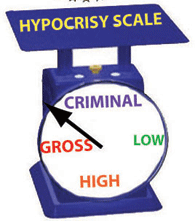
Breathtaking hypocrisy of nuclear enthuisiasts Minister Josh Frydenberg, and Rowan Ramsey
 Paul Waldon Fight To Stop Nuclear Waste Dump In Flinders Ranges SA,
An excerpt from Rowan Ramsey’s news letter…
[“Minister Josh Frydenberg visit to Wilpena and Rawnsley Park.” Members of the SA Department for Environment and Water discussed their pursuit of a nomination for World Heritage for parts of the Flinders ranges with Federal Environment Minister Josh Frydenberg, Rowan and State Tourism Minister David Ridgeway in May.
The department is engaged in conversations with stakeholders to proceed. Both the Minister and Rowan also attended the 50 year celebration of tourism at Rawnsley Park. Congratulations to the Smith family on the world class experience they have created and their role in increasing the profile of tourism in the Flinders Ranges.] So I put it to everyone, what is Josh Frydenberg’s and his coterie’s sudden interest in World Heritage, Tourism or the environment of the Flinders, and politics.? https://www.facebook.com/groups/344452605899556/
U.S. Secretary of State visiting North Korea: it’s a lot more complicated than Trump made it out to be

 Mike Pompeo under pressure to secure nuclear progress in North Korea visit , Guardian , Justin McCurry in Tokyo and agencies, 5 Jul 2018 Secretary of state faces pressure to establish timeline for denuclearisation as well as duty to reassure regional allies
Weeks after Donald Trump declared the world a safer place following his historic summit with Kim Jong-un, Mike Pompeo is due to arrive in Pyongyang on Friday amid growing doubts over the regime’s willingness to abandon its nuclear weapons.
The secretary of state is expected to meet Kim in person in Pyongyang, according to the White House, though details of the agenda have not yet been released. Pompeo, on his third visit to the North Korean capital, is expected to press Kim on a recent report suggesting that far from beginning the process of denuclearisation, North Korea was making “rapid upgrades” to its Yongbyon nuclear complex.
Unnamed US intelligence officials also concluded that North Korea does not intend to completely give up its nuclear stockpile.
Pompeo will also use his visit to consult and reassure Washington’s allies in the region, with meetings planned with Japanese and South Korean officials in Tokyo on Sunday. Japan has voiced support for the leaders’ Singapore declaration, but reacted cautiously to Trump’s decision to cancel a joint US-South Korea military exercise scheduled for August.
Pompeo must establish how far North Korea’s nuclear and missile programmes have advanced before US officials can even attempt to draw up a potential timeline for America’s central demand – their complete, irreversible and verifiable dismantlement [CVID].
At present, the US has no reliable information on where all of North Korea’s production and testing facilities are located or the size of its ballistic inventory.
In a tweet this week, Trump said Washington and Pyongyang had been having “many good conversations” with North Korea over denuclearisation. “In the meantime, no Rocket Launches or Nuclear Testing in 8 months, he said. “All of Asia is thrilled. Only the Opposition Party, which includes the Fake News, is complaining. If not for me, we would now be at War with North Korea!”
Sceptics have pointed out that Kim no longer believes such tests are necessary now that the North has successful developed an intercontinental ballistic missile, and that dismantling North Korea’s missile and nuclear infrastructure represents a much tougher diplomatic challenge that could take years and cost billions of dollars, if it happens at all.
“Denuclearisation is no simple task,” Daryl Kimball, executive director of the Arms Control Association, wrote in a commentary. “There is no precedent for a country that has openly tested nuclear weapons and developed a nuclear arsenal and infrastructure as substantial as the one in North Korea to give up its nuclear weapons.”
Experts have played down Trump’s upbeat appraisal of his 12 June meeting with Kim in Singapore, where the leaders made a loose commitment to work towards the denuclearisation of the Korean peninsula and agreed goodwill measures such as the possible return of the remains of US soldiers from the 1950-53 Korean war.
There are signs Pompeo might abandon all-or-nothing demands for CVID and replace them with incremental steps that South Korea has reportedly suggested would be more likely to secure Kim’s cooperation…….https://www.theguardian.com/us-news/2018/jul/05/mike-pompeo-north-kroea-visit-pressure-nuclear-progress
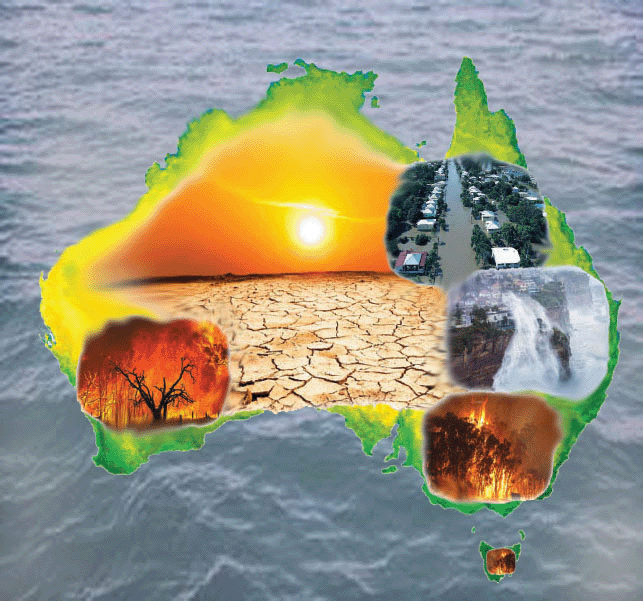
Ecosystems across Australia are collapsing under climate change
 The Conversation 4 July 18 Climate Research Fellow, University of Tasmania, Professor, Environmental Change Biology, University of Tasmania, Senior Lecturer, Macquarie University,
To the chagrin of the tourist industry, the Great Barrier Reef has become a notorious victim of climate change. But it is not the only Australian ecosystem on the brink of collapse.
Our research, recently published in Nature Climate Change, describes a series of sudden and catastrophic ecosystem shifts that have occurred recently across Australia.
These changes, caused by the combined stress of gradual climate change and extreme weather events, are overwhelming ecosystems’ natural resilience.
Variable climate
Australia is one of the most climatically variable places in the world. It is filled with ecosystems adapted to this variability, whether that means living in scorching heat, bitter cold or a climate that cycles between the two.
Despite land clearing, mining and other activities that transform the natural landscape, Australia retains large tracts of near-pristine natural systems.
Many of these regions are iconic, sustaining tourism and outdoor activities and providing valuable ecological services – particularly fisheries and water resources. Yet even here, the combined stress of gradual climate change and extreme weather events is causing environmental changes. These changes are often abrupt and potentially irreversible.
They include wildlife and plant population collapses, the local extinction of native species, the loss of ancient, highly diverse ecosystems and the creation of previously unseen ecological communities invaded by new plants and animals.
Australia’s average temperature (both air and sea) has increased by about 1°C since the start of the 19th century. We are now experiencing longer, more frequent and more intense heatwaves, more extreme fire weather and longer fire seasons, changes to rainfall seasonality, and droughts that may be historically unusual.
The interval between these events has also shortened, which means even ecosystems adapted to extremes and high natural variability are struggling.
As climate change accelerates, the magnitude and frequency of extreme events is expected to continue increasing.
What is ecosystem collapse?
Gradual climate change can be thought of as an ongoing “press”, on which the “pulse” of extreme events are now superimposed. In combination, “presses” and “pulses” are more likely to push systems to collapse.
We identified ecosystems across Australia that have recently experienced catastrophic changes, including:
not all examples can be directly linked to a single weather event, or a series of events. These are most likely caused by multiple interactingclimate “presses” and “pulses”. It’s worth remembering that extreme biological responses do not always manifest as an impact on the dominant species. Cascading interactions can trigger ecosystem-wide responses to extreme events.
The cost of intervention
Once an ecosystem goes into steep decline – with key species dying out and crucial interactions no longer possible – there are important consequences.
Apart from their intrinsic worth, these areas can no longer supply fish, forest resources, or carbon storage. It may affect livestock and pasture quality, tourism, and water quality and supply.
Unfortunately, the sheer number of variables – between the species and terrain in each area, and the timing and severity of extreme weather events – makes predicting ecosystem collapses essentially impossible.
Targeted interventions, like the assisted recolonisation of plants and animals, reseeding an area that’s suffered forest loss, and actively protecting vulnerable ecosystems from destructive bushfires, may prevent a system from collapsing, but at considerable financial cost. And as the interval between extreme events shorten, the chance of a successful intervention falls.
Critically, intervention plans may need to be decided upon quickly, without full understanding of the ecological and evolutionary consequences.
How much are we willing to risk failure and any unintended consequences of active intervention? How much do we value “natural” and “pristine” ecosystems that will increasingly depend on protection from threats like invasive plants and more frequent fires?
We suspect the pervasive effects of the press and pulse of climate change means that, increasingly, the risks of doing nothing may outweigh the risks of acting.
The beginning of this century has seen an unprecedented number of widespread, catastrophic biological transformations in response to extreme weather events.
This constellation of unpredictable and sudden biological responses suggests that many seemingly healthy and undisturbed ecosystems are at a tipping point https://theconversation.com/ecosystems-across-australia-are-collapsing-under-climate-change-99367?utm_medium=email&utm_campaign=Latest%20from%20The%20Conversation%20for%20July%205%202018%20-%20105629347&utm_content=Latest%20from%20The%20Conversation%20for%20July%205%202018%20-%20105629347+CID_3caffe1f73b33
The past week – all-time heat records set around the planet
 All-time heat records have been set all over the world during the past week, https://www.brisbanetimes.com.au/environment/climate-change/all-time-heat-records-have-been-set-all-over-the-world-during-the-past-week-20180705-p4zply.htmlBy Jason Samenow
Washington: From the normally mild summers of Ireland, Scotland and Canada to the scorching Middle East, numerous locations in the Northern Hemisphere have witnessed their hottest weather ever recorded over the past week.
Large areas of heat pressure or heat domes scattered around the hemisphere led to the sweltering temperatures. No single record, in isolation, can be attributed to global warming. But collectively, these heat records are consistent with the kind of extremes we expect to see increase in a warming world.
Let’s take a tour around the world of the recent hot-weather milestones. Continue reading
Earthquake rocks planned area for nuclear waste dump Eastern Eyre Peninsula

Earthquake rocks Eastern Eyre Peninsula https://www.eyretribune.com.au/story/5500632/earthquake-rocks-eastern-eyre-peninsula/?cs=1825 Kathrine Catanzariti Eyre Tribune, 2 July 18 Kathrine Catanzariti
Eastern Eyre Peninsula was rocked by a 3.7 magnitude earthquake on Sunday morning.
At 11.57am, an earthquake occurred north east of Cleve towards Mangalo, at a depth of 10 kilometres.
According to Geoscience Australia, the earthquake could have been felt by people up to 47 kilometres away.
Did you feel the shake? Did you receive any damage? Let us know!
USA government proclaims that the nuclear weapons industry depends on the civilian nuclear power industry
 This loss of nuclear competence is being cited by nuclear and national security experts in both the U.S. and in Europe’s nuclear weapons states as a threat to their military nuclear programs. The White House cited this nuclear nexus in a May memo instructing Rick Perry, the Secretary of Energy, to force utilities to buy power from unprofitable nuclear and coal plants. The memo states that the “entire US nuclear enterprise” including nuclear weapons and naval propulsion, “depends on a robust civilian nuclear industry.”
All the while, nuclear is falling further behind renewable solar and wind power. As Schneider notes, the 3.3 GW of new nuclear capacity connected to the grid worldwide in 2017 (including three in China and a fourth in Pakistan built by Chinese firms) pales in comparison to the 53 GW of solar power installed in China alone.
A Double First in China for Advanced Nuclear Reactors, https://spectrum.ieee.org/energywise/energy/nuclear/a-double-first-in-china-for-advanced-nuclear-reactors By Continue reading
Nuclear power a very bad choice as part of action on climate change

Many argue that NPPs are necessary to mitigate climate change, but only one stage out of the 14-stage nuclear fuel cycle is carbon free. Unless equipped with desalination facilities, reactors consume vast amounts of water, an increasingly-scarce resource in countries like Pakistan, which is predicted to completely run out of water by 2025. Nuclear waste must be stored and secured for tens of thousands of years, not to mention the environmental disasters caused by reactor meltdowns. There are other strategies to limit global temperature rise below two degrees, and the idea that countries should deploy all low-carbon technologies no matter the costs should not be used to support such a volatile industry
Why the Civil Nuclear Trap Is Part and Parcel of the Belt and Road Strategy
Civil nuclear energy presents grave pitfalls in terms of cost, innovation and security that BRI countries cannot and should not afford. The Diplomat By Sam Reynolds July 05, 2018 The Larger Point
Although China will continue to promote the benevolent aspects of the BRI, countries along its corridors and elsewhere should not fall victim to the civil nuclear trap. Nuclear energy is too costly, too time-consuming and too risky, especially in light of better alternatives. Instead, developing countries should lead the way towards a secure, low-carbon, low-cost energy future without NPPs.
Nuclear advocates argue correctly that nuclear has comparable levelized costs to solar photovoltaics (PV). The irony is that projects regularly go over budget and costs can actually increase the more nuclear experience a country has, contradicting the learning curve phenomenon. Although the French nuclear program was incredibly successful, it demonstrated “negative learning,” wherein costs actually increased for additional projects. (Solar PV and wind costs decreased the fastest with every doubling of experience.)
Therefore, innovations and experience in nuclear technology might not lead to cost reductions. Continue reading
Light water nuclear reactors, new reactors, Amall Modular Nuclear Reactors (SMRs) none will combat climate change
 The vanishing nuclear industry, Science Daily, July 2, 2018
- Source:
- College of Engineering, Carnegie Mellon University
- Summary:
- Could nuclear power make a significant contribution to decarbonizing the US energy system over the next three or four decades? Probably not.
-
Could nuclear power make a significant contribution to decarbonizing the U.S. energy system over the next three or four decades? That is the question asked by four current and former researchers from Carnegie Mellon University’s Department of Engineering and Public Policy (EPP). Their answer: probably not.
In a paper, “U.S. nuclear power: The vanishing low-carbon wedge,” just published in the Proceedings of the National Academy of Science (PNAS), the team examined the current U.S. nuclear fleet, which is made up of large light water nuclear reactors (LWRs). While for three decades, approximately 20% of U.S. power generation has come from these LWRs, these plants are ageing, and the cost of maintaining and updating them along with competition from low cost natural gas, makes them less and less competitive in today’s power markets.
In place of these LWRs, the team asked whether advanced reactor designs might play a significant role in U.S. energy markets in the next few decades. They concluded that they probably would not. Then, the team examined the viability of developing and deploying a fleet of factory manufactured smaller light water reactors, known as small modular reactors (SMRs). The team examined several ways in which a large enough market might be developed to support such an SMR industry, including using them to back up wind and solar and desalinate water, produce heat for industrial processes, or serve military bases. Again, given the current market and policy environments, they concluded that the prospects for this occurrence do not look good. …https://www.sciencedaily.com/releases/2018/07/180702154736.htm
Australia at 19% renewables – NEG 2030 target to be reached in 2021 — RenewEconomy

Australia is already at 19 per cent renewables as at June, and could reach 43 per cent renewables by 2030, just with the state targets in Queensland and Victoria, new data shows.
via Australia at 19% renewables – NEG 2030 target to be reached in 2021 — RenewEconomy
Temp Records Shattered Across Northern Hemisphere; 33 Lives Lost to Heat in Quebec — robertscribbler

Over the past week, 21 all-time temperature records were shattered across the Northern Hemisphere. These records coincide with an extreme heatwave blanketing large parts of Europe, North America, Africa, the Middle East and Asia. A heatwave that has resulted in the tragic loss of 33 lives in Quebec. (Global heatwave in context.) According to news […]
via Temp Records Shattered Across Northern Hemisphere; 33 Lives Lost to Heat in Quebec — robertscribbler
Rooftop solar clocks second-best month ever, buoyed by commercial boom — RenewEconomy

Rooftop solar PV registrations for June fell from May’s record volume, but the first six months are still 50% ahead of last year.
via Rooftop solar clocks second-best month ever, buoyed by commercial boom — RenewEconomy
Monash University signs off-take deal with Victorian wind farm — RenewEconomy

Monash commits to wind offtake deal that brings the university into powerful consortium of corporate buyers, and closer to target of 100% renewables.
via Monash University signs off-take deal with Victorian wind farm — RenewEconomy
1 This month

of the week – Australians for War Powers Reform (AWPR)
To see nuclear-related stories in greater depth and intensity
 Antinuclear