July 17 Energy News — geoharvey

Opinion: ¶ “As subsidies wane, market forces drive the growth of renewables” • For twenty years, Germany had a subsidy scheme for renewables. As that was replaced by an auction system, the market has proceeded along a bumpy road. Now, the declining costs of wind and solar power are increasingly competing on their own merits. […]
AEMO report shows only ‘6 coal-fired power stations’ will be left: Bandt — RenewEconomy

Despite government spin, the electricity market operator’s plan released today shows a future with almost no coal-fired power is coming, Greens climate and energy spokesperson Adam Bandt MP said today.
via AEMO report shows only ‘6 coal-fired power stations’ will be left: Bandt — RenewEconomy
Western Sydney Uni solar car wins first leg of American Solar Challenge — RenewEconomy

Students from Western Sydney University Solar Car Team have won the first stage of the biannual American Solar Challenge race.
via Western Sydney Uni solar car wins first leg of American Solar Challenge — RenewEconomy
Investment in nuclear power declined 45% last year
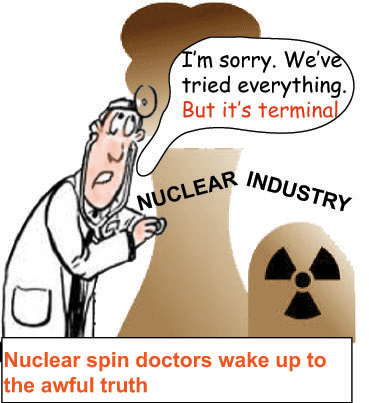 Investment in new nuclear declines to five-year low, WNN 17 July 2018 Global energy investment fell for the third consecutive year in 2017, according to the International Energy Agency (IEA). Investment in nuclear power declined by nearly 45% last year to USD17 billion. Although spending on new reactors reached the lowest level in five years, investment on upgrades of existing units increased………
Of the four new reactors commissioned last year, three were in China. More than 5 GWe of nuclear generating capacity was retired, leading to a net reduction of about 2 GWe in total nuclear capacity worldwide. Capacity was still about 10 GW higher than in 2007. While around 60 GWe of nuclear power remains under construction worldwide, new construction starts totalled just over 3 GWe.
Modernisations and upgrades of existing reactors represented about half of total nuclear investment last year. “Large investments have recently been made in OECD countries to extend lifetime operation and power uprates of the existing nuclear fleet,” the IEA said. “In general, spending on existing plants yields more output per dollar invested.”
……… Access to both direct and indirect government finance remains vital for investments in nuclear power, the report says. “Most investment in new nuclear capacity has occurred in markets where the government retains full ownership or a majority stake in most of the utilities.” Investment in nuclear power also remains highly dependent on government involvement in various areas, including market structure, price regulation and financing………http://www.world-nuclear-news.org/NP-Investment-in-new-nuclear-declines-to-five-year-low-1707185.html
Concern over nuclear waste transport incident

 Herald 16th July 2018 , AN INVESTIGATION has been launched after a freight train carrying nuclear
material ran a stop signal near to Kingussie on Friday night. The service
was carrying spent fuel from the Dounreay Power Station to the
decommissioning site at Sellafield, Cumbria. It came to a stop after
travelling past a red light before being moved to a “position of safety” by
concerned officials. Direct Rail Services (DRS), the company which handles
shipments between the two sites on behalf of the Nuclear Decommissioning
Authority (NDA), said they understand there was no risk of collision due to
the error.
However, concerns have been raised as to why a train loaded with
radioactive material was allowed to sit there for almost two hours. An
investigation has since been launched into the circumstances of the
“highly-disturbing” incident. DRS has been transporting spent fuel between
the two sites for a number of years. The material is taken from Dounreay to
Georgemas Junction and loaded on to the train to Carlisle and then onto
Sellafield.
Tor Justad, chairperson of the Highlands Against Nuclear
Transport group, said: “We’ve been campaigning for these shipments to be
stopped and for the material to be kept on site. Storing nuclear material
is hazardous enough but it’s when you go to transport it that accidents can
happen. And obviously an incident like this is highly-disturbing. We know
that low-level radiation is emitted from these canisters so to hear that
the train was sitting at Kingussie for hours is concerning.”
http://www.heraldscotland.com/news/16356092.investigation-launched-after-train-carrying-nuclear-material-ran-stop-signal-at-kingussie/
ACT won’t back NEG in current form, despite intense pressure — RenewEconomy

ACT energy minister Shane Rattenbury says Territory under “enormous pressure” to agree to NEG, but that won’t be happening in the policy’s current form.
via ACT won’t back NEG in current form, despite intense pressure — RenewEconomy
ACT won’t back NEG in current form, despite intense pressure — RenewEconomy
ACT energy minister Shane Rattenbury says Territory under “enormous pressure” to agree to NEG, but that won’t be happening in the policy’s current form.
via ACT won’t back NEG in current form, despite intense pressure — RenewEconomy
Bad news for coal-huggers: Renewables at 50% by 2030 — RenewEconomy
King coal to rule? Murdoch media should read the AEMO report again – it suggests that even under Coalition and state policies renewables will be around 50% by 2030. And that’s without being serious about climate change.
via Bad news for coal-huggers: Renewables at 50% by 2030 — RenewEconomy
Battery recycling could generate billion-dollar industry for Australia, push down prices — RenewEconomy

CSIRO report says Australia could lead world in re-use and recycling of lithium-ion batteries, generating potential billion-dollar industry, and helping to push down costs of EVs and battery storage.
AEMO: Cheapest way to replace coal is solar, wind, storage — RenewEconomy

AEMO says 70TWh of coal is to retire by 2040, and the cheapest way to replace it is with solar, wind and storage, and just a tiny bit of gas. And no coal. But it wants more transmission lines and renewable zones to manage this transition.
via AEMO: Cheapest way to replace coal is solar, wind, storage — RenewEconomy
1 This month

of the week – Australians for War Powers Reform (AWPR)
To see nuclear-related stories in greater depth and intensity
 Antinuclear