Scrutiny on Hansard reveals the Australian government’s confusion about nuclear wastes

Federal nuclear waste dump will have large storage for intermediate to high grade storage
The $31 million bribe to entice Hawker to become a nuclear waste sacrifice zone
 $31 million boost for nuclear location, The Transcontinental, Marco Balsamo -23 July 18 The Flinders Ranges community could receive up to $31 million through a Community Development Package if the Wallerberdina Station site is chosen to host the National Radioactive Waste Management Facility.
Initially touted to be about $10M, federal government has more than tripled the package to be awarded to the selected community.
“This enhanced package will ensure the successful community is ready and able to take advantage of the benefits of hosting this facility both during construction and the lifetime of its operation,” he said.
“What shipbuilding or aircraft bases do for some communities, and steel-making or mining does for other towns, the National Radioactive Waste Management Facility will do for its host town in terms of employment, opportunities for new careers in trades and university qualified positions and flow-on benefits.”
The package includes a $20M National Radioactive Waste Management Facility Community Fund, delivering infrastructure and development benefits to the community………
The announcement from federal government has been slammed by Australian Greens Senator Sarah Hanson-Young, who recently visited the Wallerberdina Station site.
“Resources Minister Matt Canavan should be ashamed of himself for trying to bribe the community in return for dumping radioactive waste on them,” Ms Hanson-Young said.
“Putting money on the table, just weeks before the Kimba and Hawker communities vote on whether they want a nuclear waste dump in their front yard smacks of desperation and bribery.
“Polling shows the majority of South Australians want our state to put a stop to this project. Nuclear waste is not welcome in Kimba or the Flinders Ranges, and the rest of the state is behind these two communities in their fight against this proposal.”
Ms Hanson-Young also questioned why the Liberal government has not revealed how much profit former Liberal Senator Grant Chapman, who owns the Wallerberdina Station site, would earn from a successful bid.
The Wallerberdina Station site is one of three nominated locations for the national facility, with the other two both based in Kimba.
A postal ballot is set to commence on August 20 to measure the community support for the three nominated sites.
Federal Member for Grey Rowan Ramsey said the successful community would have the opportunity to “create a long-term future for itself”.
“Now, coupled with the commitment of a minimum 45 jobs on site, it will really give the citizens of both communities something to contemplate before next month’s vote,” Mr Ramsey said.
“This facility will provide wonderful opportunities for either community if selected.” https://www.transcontinental.com.au/story/5540993/31-million-boost-for-nuclear-location/
The death of Australia’s quality news media – Fairfax gobbled up by Nine
 A modern tragedy: Nine-Fairfax merger a disaster for quality media, The Conversation, Senior Research Fellow in the Centre for Advancing Journalism, University of Melbourne,
All deaths are sudden, even if long expected.
Appropriately enough, this is the opening sentence of a book called Journalism in a Culture of Grief.
And if ever there was a time of grief for journalism in Australia, it is today, with the announcement that Nine Entertainment is taking over Fairfax Media.
It means the death of Fairfax and is the most consequential change in Australian media ownership in 31 years.
It also means that three of Australia’s best and biggest newspapers – The Age, The Sydney Morning Herald and The Australian Financial Review – are now subsumed into a media conglomerate whose editorial culture is characterised by mediocre journalism.
Nine’s news bulletins consist largely of police stories with a tincture of politics, and highlights of colourful or violent events overseas.Its current affairs program, A Current Affair, is a formulaic procession of stories about consumer rorts and personal tragedies.
So there is a huge question mark over the future editorial quality of the newspapers.
A particularly pressing question is: what will happen to The Age’s investigative unit?
It is led by two of the best investigative reporters Australia has produced, Nick McKenzie and Richard Baker.
In addition to breaking an extraordinary range of major stories on subjects like organised crime and scandals in the banking industry, they have developed a highly successful collaboration with the ABC’s Four Corners team.
It seems very unlikely Nine would allow this collaboration to continue, since it involves a rival television channel.
There is also a question about editorial independence.
Fairfax has a charter of editorial independence, which all owners since 1990 have signed up to. Will Nine sign up to it? Will the charter have any meaning when the newspapers are owned by a company whose chairman, Peter Costello, was treasurer in the Liberal-National Coalition government of former Prime Minister John Howard?
The answers to these questions will not be known for some time. They will depend largely on who is given editorial control of the combined operation. Since the Nine CEO, Hugh Marks, is to be CEO of the combined operation, it seems more likely than not that it will be a Nine executive who calls the editorial shots, too.
The takeover also means a further loss of diversity in an already highly concentrated media-ownership landscape. The big players are now down to four: News Corp, Nine, Seven West Media and the ABC.
And it is almost certain to mean the loss of yet more journalists’ jobs.
Since 2012, more than 3,000 jobs have been lost across Australian journalism. Yet, if the takeover is really going to represent “compelling value” for shareholders, as Fairfax chairman Nick Falloon says, then newsroom “synergies” – to borrow the corporate jargon – are likely to be essential.
The Fairfax company’s death throes have been painful and prolonged……https://theconversation.com/a-modern-tragedy-nine-fairfax-merger-a-disaster-for-quality-media-100584?utm_medium=email&utm_campaign=Latest%20from%20The%20Conversation%20for%20July%2027%202018%20-%20107389538&utm_content=Latest%20from%20The%20Conversation%20for%20July%2027%202018%
South Australia’s Liberal government now happy with progress towards 75% renewables target
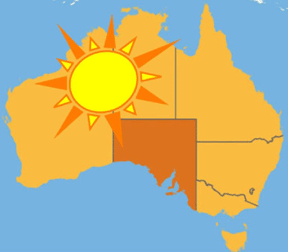 South Australia on track to meet 75% renewables target Liberals promised to scrap, Guardian, Adam Morton , 26 July 18
Liberal energy minister, who inherited policy criticised as a mix of ‘ideology and idiocy’, says he’ll ensure it does not come at too high a price
South Australia’s energy minister says the state is on track to have 75% of its electricity from renewable sources by 2025 – the target set by the former Labor premier Jay Weatherill and once rejected by his Liberal government. And Dan van Holst Pellekaan pledged to ensure it does not come at too high a price.
But several expert analyses have found the state is likely to meet or nearly meet the aspirational target, which was not tied to a policy mechanism. The Australian Energy Market Operator has projected South Australia would have 73% renewable power by 2020/21 while consultants Green Energy Markets found it could reach 74% by 2025 without any additional policies being introduced.
The South Australian energy and mining minister, Dan van Holst Pellekaan, said that was also his understanding. “That’s what the reports I’ve read are saying,” he said. “We need to harness it properly so consumers aren’t paying too high a price along the way.”
Van Holst Pellekaan has responsibility for shaping the future of energy in a state that already gets about half its electricity from variable sources such as wind and solar – a situation that Weatherill described in 2015 as “a big international experiment”. The new minister has inherited some of Labor’s proposed solutions, including a giant lithium-ion battery, a 20-year power purchase contract to underwrite a solar thermal plant with built-in storage and a “virtual power plant” of solar and batteries across public housing sites. ……..
Speaking in his electorate office in Port Augusta, home to the state’s coal power until the last plant closed in 2016, and now with up to 13 clean energy at varying stages of development including the solar thermal project, van Holst Pellekaan said the shift from coal to more clean energy in South Australia had been messier than it needed to be, but was inevitable.
“We must transition away from fossil fuels towards renewable energy,” he said. “There’s no doubt about it. And we need to do it sensibly.”
……… South Australia is also backing small-scale storage. Under a deal signed by Labor, the government is installing a “virtual power plant” – initially 1,100 solar panels and Tesla batteries in public housing backed by a $30m loan from taxpayers.
Van Holst Pellekaan announced last week an initial trial had been a success, increasing supply and the reliability of the network and lowering cost at times of peak demand. He said delivering Labor’s full promise of 50,000 public housing systems depended on private-sector financing and Tesla and the government signing off on the final program design.
The Labor scheme will sit alongside a Liberal-pledged $100m plan to subsidise batteries at 40,000 private homes. Details are promised in coming months………
He stressed the importance of improved connection between the states, particularly a long-mooted link between South Australia and New South Wales, to improve grid efficiency and reliability. The transmission company ElectraNet has recommended a $1.5b interconnector between South Australia’s mid-north and Wagga Wagga.
Van Holst Pellekaan, a National Basketball League player in the 1980s with the Hobart Devils, said South Australia’s energy policies were in line with recent advice from the Australia Energy Market Operator and the competition and consumer watchdog…..https://www.theguardian.com/environment/2018/jul/25/south-australia-to-hit-75-renewables-target-by-2025-liberal-energy-minister-says
Heat affecting Finland’s nuclear power
 Warm sea water in Finland reduces power from Loviisa nuclear plant https://www.reuters.com/article/us-finland-nuclear-fortum-oyj/warm-sea-water-in-finland-reduces-power-from-loviisa-nuclear-plant-idUSKBN1KF2CO Lefteris Karagiannopoulos- 26 July 18 OSLO (Reuters) – Finland’s Loviisa power plant, consisting of two reactors with a combined capacity of 1 gigawatt, had to reduce power by 170 megawatts on Wednesday as the sea water that is used to cool the reactors had become too warm, operator Fortum said.
Because of the very warm temperatures the Nordic region is currently experiencing, the sea water that is collected to cool the Loviisa reactors is warmer and the water released is also warmer, at 32 degrees Celsius on Wednesday.
Releasing hot water back to the sea after cooling the reactors could be a hazard and if it exceeds 34 degrees Fortum said the reactors must be shut down due to regulations.
“We decreased power by 170 megawatts for a bit less than two hours. The sea water that cools the reactors was at 24 degrees, which is warmer than usual,” Fortum’s chief of operations in the plant, Timo Eurasto, told Reuters.
Such a rare occurrence may happen again in the next days because of the unusually warm temperatures, he said, adding that there was no danger to people, the plant, or the environment.
“High sea water temperature may indeed reduce the efficiency of the cooling systems of the plant. This is compensated by reducing or shutting down the reactor power,” said Nina Lahtinen, nuclear safety section head at Finland’s regulator STUK.
In Germany traders warned last week that higher temperatures in August may create cooling issues for the country’s reactors, with E.ON subsidiary PreussenElektra cutting output slightly from two units.
Sweden’s nuclear energy regulator SSM, told Reuters on Tuesday that power production at the Forsmark nuclear plant has also been reduced “by a few percentage points” due to cooling issues.
Last time Fortum had to reduce power in its reactors due to warmer-than-usual cooling water was seven years ago, said Loviisa plant’s Eurasto.
Unusually warm and dry weather in the Nordics led temperatures to record highs this summer, affecting water levels at the reservoirs that feed Norway and Sweden with hydropower, causing prices to spike as a result.
Extreme heat causing outages at France’s nuclear power stations
S&P 24th July 2018 , France’s EDF expects nuclear-fired power production at its Bugey and
Saint-Alban power stations to be curtailed “due to extreme temperature forecast,” the utility said Tuesday. On grid operator RTE’s website, EDF said environmental issues are limiting “some” nuclear production availability in the country, starting Saturday. EDF did not give details on the exact impact of the output restrictions. The two nuclear power stations have a combined capacity of over 6 GW. Environmental issues have already resulted in weekend outages at EDF’s Bugey-3 reactor on the river Rhone.
Hot weather conditions previously have led to cooling water restrictions due to raised river temperatures. According to forecaster MeteoFrance, temperatures should remain above seasonal average, or around 2 degrees Celsius above norms over the weekend.
https://www.spglobal.com/platts/en/market-insights/latest-news/electric-power/072418-high-temperatures-to-cut-french-nuclear-production-edf
The announced takeover of Fairfax by Channel Nine will change the news landscape of Australia altogether.
The Fairfax takeover is a great pity – Nine has the ethics of an alley cat, Guardian, The kind of merger announced today between Channel Nine and Fairfax was bound to happen the moment the cross-media legislation introduced by the Hawke government 30 years ago was suspended.
The so-called cross-media rule gave Australia 30 years of media diversity, especially between Australia’s major television networks and its capital city print.
Those barriers in the wholesaling of news underwrote diversity of opinion, guaranteeing an altogether better informed and livelier public debate.
It is true that the technology has brought myriad voices to a public eager for diversity of information. But the atomisation of web-based content, much of it other than local, cannot in terms of impact, be compared with the big local media players, particularly in consolidations of the kind announced today.
The announced takeover of Fairfax by Channel Nine will change the news landscape of Australia altogether.
Notwithstanding the obvious disruption that international platforms like Google and Facebook have made to advertising and traditional media revenues, the answer for Australia is diversity of income streams for Australia’s majors and not a closedown in news and content with major print being taken over by major television.
This is an exceptionally bad development.
……… If in the announced arrangement Channel Nine has a majority of the stock, Channel Nine will run the editorial policy.
The problem with this is that, in terms of news management, Channel Nine, for over half a century, has never other than displayed the opportunism and ethics of an alley cat.
There has been no commanding ethical or moral basis for the conduct of its news and information policy.
Through various changes of ownership, no one has lanced the carbuncle at the centre of Nine’s approach to news management. And, as sure as night follows day, that pus will inevitably leak into Fairfax.
For the country, this is a great pity.
And, of course, if the government really had its way, Australia would face this much closed down and managed landscape without an ABC as it is today – an independent national broadcaster.
On competition grounds and those of the imperative of local diversity, the competition commissioner should put this proposal under high scrutiny.
Of course, the current managements of Nine and Fairfax will scream enhanced media diversity via the web – news and views everywhere. And some of this is true. https://www.theguardian.com/media/2018/jul/26/the-fairfax-takeover-is-exceptionally-bad-news-nine-has-the-journalistic-ethics-of-an-alley-cat
July 26 Energy News — geoharvey

Opinion: ¶ “Deaths Rise As Earth Swelters – Could Global Warming Be Responsible?” • It has been brutally hot this July all over the world. The temperature touched 106°F, the highest temperature ever recorded in Japan, and 44 people have already died in heat wave. Heat all over the world has led to wildfires. Even […]
NEG worse than thought – penalising rooftop solar and large scale projects — RenewEconomy

ESB modelling is false and misleading, claiming credit for projects already in pipeline. The latest NEG outline also penalises rooftop solar and large scale solar, does crazy things with offsets and will end up lifting prices.
via NEG worse than thought – penalising rooftop solar and large scale projects — RenewEconomy
Win for Tesla, batteries, EVs and smart tech in Australian grid — RenewEconomy

Decision by energy market rule-maker could pave way for Tesla and others to develop virtual power plants, demand response, and combine electric vehicle load that can compete in the wholesale market with traditional peaking power plants.
via Win for Tesla, batteries, EVs and smart tech in Australian grid — RenewEconomy
Graph of the Day: What really causes the biggest price spikes? — RenewEconomy

Answer: It’s not renewables, or the lack of them. Most are caused by network problems or failing fossil fuel plants.
via Graph of the Day: What really causes the biggest price spikes? — RenewEconomy
Japan’s Tepco plans 7GW renewables roll-out, in pivot away from nuclear — RenewEconomy

Japan’s biggest utility reveals plans to develop up to 7GW of new renewable energy capacity, in effort to “gain the competitive advantage.”
via Japan’s Tepco plans 7GW renewables roll-out, in pivot away from nuclear — RenewEconomy
Photo of the day: Striped Tesla visualises global warming — RenewEconomy

Tesla owner gives his EV its very own climate change makeover to start a conversation about global warming.
via Photo of the day: Striped Tesla visualises global warming — RenewEconomy
Striking renewable oil using sewage in Gladstone — RenewEconomy
Australian Renewable Energy Agency backs pioneering project aiming to turn biosolids from sewage into crude oil.
via Striking renewable oil using sewage in Gladstone — RenewEconomy
1 This month
7 April – WEBINAR – Australia and the Doomsday Clock – Preventing nuclear war through NoFirstUse and other policies
Online | Tuesday April 7, 4:00-5:30pm, Australian Eastern Time / 8:00-9:30am Central Europe Time
– Access the registration link
15 April – Zoom –Nuclear Power is Not the Solution
Apr 15, 2026 01:00 AM in Canberra, Melbourne, Sydney

Join the International Physicians for the Prevention of Nuclear War (IPPNW) on Tuesday, April 14th for a timely webinar exploring the risks associated with nuclear power and challenging the myth that it offers a simple, safe, carbon-free solution to the climate crisis

21 April Webinar: No Nuclear Weapons in Australia
Start: 2026-04-21 18:00:00 UTC Canberra, Melbourne, Sydney (GMT+10:00)
End: 2026-04-21 19:30:00 UTC Canberra, Melbourne, Sydney (GMT+10:00)
Event Type: Virtual
A virtual link will be communicated before the event.
Host Contact Info: australia@icanw.org

of the week – Australians for War Powers Reform (AWPR)
To see nuclear-related stories in greater depth and intensity
 Antinuclear