Peter Malinauskas, South Australia’s Labor leader says the nuclear waste selection process is wrong

Katrina Bohr No Nuclear Waste Dump Anywhere in South Australia, 12 Aug 18
I shared my concerns for the people in the communities, and the process that’s been imposed on them.
He agreed that the process is wrong, and gave me his word, that the issue will be brought up in Parliament as soon as it returns.
He was shocked to hear how people’s health and lives are being affected.
I’m holding him to his word! https://www.facebook.com/groups/1314655315214929/
Earthquakes: another good reason to not establish a nuclear waste dump in the Flinders Ranges
 Lyn Blume Fight To Stop Nuclear Waste Dump In Flinders Ranges SA Here is another good reason to not dump nuclear waste in SA as this is a seismic region in Australia, here is the most recent record. Earthquake Details
Summary
Origin (UTC): 06/08/2018 22:35:45 Epicentral Time: 07/08/2018 08:05:45
Longitude: 138.511 Latitude: -31.000
Magnitude: 2.4 (ML) Depth: 10 km
Event Id: ga2018pkbnhd https://earthquakes.ga.gov.au/ Blinman is a town deep in the Flinders Ranges, in the mid-north of South Australia. It is very small but has the claim of being the highest surveyed town in South Australia. It serves as a base for large acre pastoralists and tourism. The town is just north of the Flinders Ranges National Park, is 60 kilometres(km) north of Wilpena Pound and 485 km north of Adelaide. https://www.whereis.com/search-results?query=Blinman%20SA….
ANSTO expans its nuclear activities – Australian tax-payers bear the costs of its nuclear wastes
Steve Dale Nuclear Fuel Cycle Watch South Australia, 12 Aug 18 “ANSTO is expanding nuclear activities, which will mean massive increases in wastes.” – why are countries sending us 45 tonnes of Silicon ingots each year to be irradiated and then sent back overseas?
I have the horrible suspicion that this is another activity the taxpayer subsidises so that ANSTO can justify their reactor. There are other ways of N-doping Silicon. Is Australia again distorting the market using taxpayer funds? Whatever the price ANSTO charges, it is too low to cover the costs of imposing nuclear waste on a community, and a state that is still suffering from the Maralinga abuse. https://www.facebook.com/groups/1021186047913052/permalink/2063697496995230/?comment_id=2066005023431144¬if_id=1533994761191907¬if_t=group_comment
Ian Carpenter, Chelsea Haywood, John Hennessy and Janice McInnis’ submission, attacking Flinders Ranges Action Group
 Ian Carpenter, Chelsea Haywood, John Hennessy and Janice McInnis sent in another submission to the Senate, on 19 July – Submission to Senate Inquiry on Selection Process for Nuclear Waste Facility They call themselves “Say Yes to 45 Jobs”. This submission consists entirely of criticism of, indeed an attack on, the Flinders Local Action Group (FLAG), (no mention of jobs, or any other aspect of the process) . They claim that FLAG used deceptive means to oppose the nuclear waste plan for Wallerberdina. They criticise the FLAG survey, FLAG’s distribution of petition forms, and FLAG’s submission to the Senate. They criticise Flag’s criticising of the Barndioota Consultative Committee (BCC) and od DIIS personnel. “FLAG have no regard for the truth or scientific fact”. They single out Dr Susan Anderson. They include FLAG’s brochure, with survey questions. (I have not, so far, been able to copy this submission)
Conflict of interest in Holtec’s plan for transporting and “temporary” storage of nuclear wastes
opposition in New Mexico to siting the facility there, and opposition along any potential transportation routes, would doom the idea
“It’s extremely troubling because they are going to be handling a decommissioning fund of almost a billion dollars,” Tauro said. “This really points to the need absolutely for the independent oversight board. To lend this whole deal transparency and independence, and having people on that board who have absolutely nothing to gain.”
Once a privately held company is in charge of decommissioning, she said, transparency will be lost.
Will Oyster Creek’s nuclear waste be cash cow for buyer Holtec? https://www.pressofatlanticcity.com/business/will-oyster-creek-s-nuclear-waste-be-cash-cow-for/article_1e07daca-586c-50a2-b29a-8eec0227a7ff.html MICHELLE BRUNETTI POST Staff Writer, 10 Aug 18
Angelina Stuart wants the nuclear waste facility, to provide jobs for her children and grandchildren
ANGELINA STUART – Submission to Selection process for a national radioactive waste management facility in South Australia Submission 112
My name is Angelina Stuart, formally McKenzie, and I am the oldest sister of the McKenzie family. I was born in January 1943 on the land. My mother and father were living on the eastern side of the Flinders Ranges. That’s named Viliwarinha and it’s my birthplace – I was born out where the dingos were howling.
My late father was a strong Adnyamathanha man. As me and my siblings travelled through the Flinders Ranges, Dad would tell us Dreamtime stories about certain places. We were told the stories of the landscape that gave us a map of the area – the hills and creeks, these were the stories my dad told us. My dad made recordings and we still have his voice to listen to today.
My two older brothers and one sister who has now passed on, were born in the heart of the Flinders Ranges as well in 1938, 1940, and 1949, and I was born in 1943. Two siblings were then born in 1947 and 1950 in Beltana. There were 4 born in Hawker in 1944, 1952, 1956 and 1959. When we moved to Port Augusta, and that was the first time I saw Wallerberdina. After that, 3 siblings were born in Port Augusta, along with my five children.
I moved back to the land in 1998 to Yappala Station, next to Wallerberdina. In the mid-nineties I was one to put a claim for Station.
It is very upsetting to me that stories are being told that shouldn’t be told, and that stories are being said are ours, even though they are not our stories. The one that is distressing, is the story of the seven sisters because it isn’t our story – my father told me the Dreamtime story, and it was a different story. The story being told of the seven sisters isn’t right – it belongs to the other side of Lake Torrens, not near Wallerberdina.
On this land, this site at Wallerberdina, I’ve been out there with the heritage assessment with RPS. I know where they walked, and where the site is, and there are no visuals sites on the ground, I didn’t see anything. Any little cuttings would be from people passing through. It’s a lie to say the stories and lore of the land would disappear if a facility was built on Wallerberdina.
This process has given everyone a chance to sit down and meet. I really appreciate that we’ve been able to sit down and talk, and share our culture. If the facility did go ahead, I would want to see work done by Adnyamathanha to explain to non-Indigenous and other groups the value of our land, the spiritual side of it, so that the lore of the land and the tradition of the area around it is carried on. It is still there and it will always be there.
Thinking about my grandkids and great grandkids, I want to see development on the land, so that they can return to the land and surrounding areas, and so they can come back and get opportunities of employment. They need to be able to come back to the land.
Australian mining companies get federal funding to promote coal, uranium etc to schoolkids?
Mining industry in promotional push targeting school students, The Age By Nicole Hasham13 August 2018
 Resources companies including Adani are targeting school students in a campaign to spruik the benefits of mining and recruit future workers, in a strategy some say risks pushing a biased agenda onto young minds.
The programs in primary and high schools include teacher training and free curriculum material, such as a fact sheet on mining and the environment that fails to mention climate change…….. Former Rio Tinto boss Tom Albanese has pointed to an image problem facing the coal industry, reportedly saying in June that “coal is becoming the next tobacco … Who’s gonna join coal as a career?”
The Queensland Resources Council in 2005 created the Queensland Minerals and Energy Academy, which last year grew to involve more than 3000 students, some aged as young as 10.
The academy receives $1 million a year in industry funding as well as state government support, and places “students onto pathways into the resources sector and other science, technology, engineering and maths (STEM) industries”.
……Programs include students working with industry representatives in engineering and other challenges that replicate steps in the mining process.
Staff from Indian mining giant Adani – proponent of the controversial Carmichael coal mine – this year visited several schools to discuss the industry. Adani told Fairfax Media it was one of 30 sponsors of the academy and no information on the Carmichael project was included in the academy’s educational content.
The academy also runs professional development for teachers including robotics and 3D printing sessions in a resources context…….
The Oresome Resources website, backed by the nation’s peak mining bodies, provides free educational content to teachers across Australia. It includes a fact sheet titled “Mining and the Environment” that covers effects such as habitat destruction and land subsidence, but makes no mention of climate change resulting from burning coal. ……..
Dalrymple Bay Coal Terminal near Mackay has been accused of marketing coal to young children through its mascot Hector, a lump of coal with his own Youtube channel who offers advice on topics such as nutrition, bus safety and making new friends.
In NSW, the Upper Hunter Mining Dialogue school tours program is offered to all schools in the region. About 1000 students are expected to visit mine sites this year.
NSW Mining has previously offered scholarships to high school students studying mining-related subjects.
Most Victorian schools, as well as state government-run science and mathematics centres, develop partnerships with industry and business such as the Australasian Institute of Mining and Metallurgy, which supports the Earth Ed science centre near Ballarat.
……Tom Swann, researcher at progressive think-tank the Australia Institute, said industry engagement with education brought risks as well as benefits.
“Think of a school that takes funding or teaching materials from a coal mining company. Is that school also going to teach its children about the need to keep most of the coal in the ground and transition quickly into other forms of energy?” Mr Swann said.
“It is essential … that we do not allow education to become part of a public relations campaign.”….
University of Queensland professor Bob Lingard, who has researched commercialisation in schools, said it was the responsibility of governments, not the mining industry, to promote STEM subjects.
“There is teacher concern … [about] too much potential commercial involvement in schools,” he said.
Industries were “intervening in the curriculum from a particular perspective and that’s why we need to be careful”…….https://www.theage.com.au/politics/federal/mining-industry-in-promotional-push-targeting-school-students-20180723-p4zt36.html
IN USA State cannot override federal law on “temporary” nuclear waste, but can influence transport
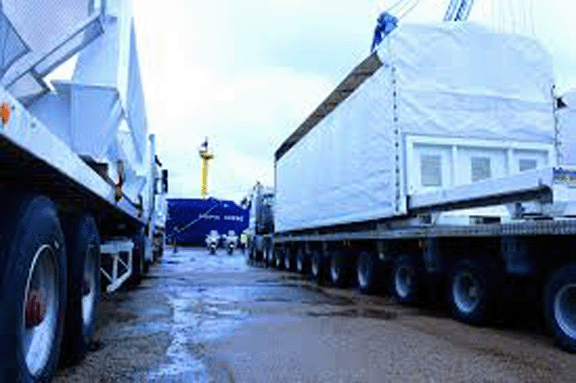
Transportation Eyed for State Role Nuclear watchdogs concur that the federal government doesn’t  need New Mexico’s approval to award a license. But the state could do more to stop the project’s progress if leaders want to.
The cities of Albuquerque and Las Cruces, as well as Bernalillo County, have voted to formally oppose Holtec’s project.
A proposed nuclear storage project in Utah, for example, received a license but never accepted waste after opponents there raised questions about transportation, as well as other concerns.
Holtec Nuclear Waste Project’s Opponents Seek Role for New Mexico Bloomberg, By Brenna Goth, August 8, 2018
New Mexico’s attorney general thinks the state can do little to stop Holtec International’s application to temporarily store high-level waste from commercial nuclear reactors, but that doesn’t deter critics of the project.
A state lawmaker and an environmentalist, who oppose the project to store the toxic trash in New Mexico before it is buried forever at Nevada’s Yucca Mountain or another site, said they believe the state—and not just the federal Nuclear Regulatory Commission—can exert some influence over the Holtec project’s future.
New Mexico Attorney General Hector Balderas (D) recently assessed the state’s role in regulating Holtec’s plan to store the radioactive materials in rural southeast New Mexico near the the Waste Isolation Pilot Plant (WIPP). An Energy Department facility that stores a different type of nuclear waste generated from weapons production, WIPP was subject to some state reviews before opening in 1999.
Holtec has an application before the NRC for a temporary place to keep nuclear waste from commercial power plants throughout the U.S. while the federal government develops permanent storage deep underground. There’s no timeline for permanent storage, as work on Yucca Mountain has long been stalled and has been met with
Intense opposition from Nevada lawmakers.
The plan to consolidate used fuel in New Mexico has drawn support for its potential economic impact and criticism for a range of health of safety concerns. Candidates running in November to replace Gov. Susana Martinez (R) have had conflicting views on the project.
But of all the factors that the NRC considers when awarding a license for temporary storage, “state approval is not among them,” said the attorney general’s July 19 letter, released to Bloomberg Environment under New Mexico’s public-records law.
Federal Law Governs Project
1 This month

of the week – Australians for War Powers Reform (AWPR)
To see nuclear-related stories in greater depth and intensity
 Antinuclear