Bangarla Aboriginal Corporation to go to Supreme Court to halt Kimba vote on nuclear waste dump
 Barngarla People seeking Supreme Court injunction to halt Kimba vote on nuclear waste facility, 2018 https://www.adelaidenow.com.au/…/87afb1b5d47db75b415c402d97…Peter Jean, Jade Gailberger, The Advertiser, August 14, 2018
A VOTE by Kimba residents on whether they want a radioactive waste dump in the district is in jeopardy after an indigenous group sought an injunction to stop it.
The Barngarla People on Tuesday applied for an urgent Supreme Court injunction to halt the Kimba vote.
The Hawker district will also vote.
Two sites near Kimba, on the Eyre Peninsula, have been short-listed as possible locations for a low-level radioactive waste storage facility. A third short-listed site is near the Flinders Ranges community of Hawker.
The Barngarla Determination Aboriginal Corporation will argue that native title-holders who live outside Kimba District Council boundaries should be entitled to vote.
The Barngarla have more than 200 members, most of whom live outside the council’s boundaries.
The group will argue that the ballot breaches the Racial Discrimination Act and that Kimba Council does not have the power to conduct the vote.
The corporation is seeking a court hearing this week. The ballots are to help the Federal Government determine a preferred site for the radioactive waste storage centre.
The legal challenge was launched as a Senate inquiry recommended that grain and produce be grown in the buffer zone of the national radioactive waste dump to “reassure the community” that it is safe.
A Senate inquiry into the selection process for three SA sites proposed by the Federal Government says that it “sees value” in the Department of Industry, Innovation and Science working with local stakeholders so that part of the remaining 60ha buffer zone can be used to “grow and test agricultural produce”.
It believes this would “reassure the community and agricultural markets” that food grown in the surrounding region does not contain “excessive amounts of radiation” and is “safe for consumption”, a report tabled in Parliament yesterday reveals.
Cameron Scott, in a submission to the inquiry, raised concerns about reputational impacts a waste facility could have on regional exports.
“All grain from Eyre Peninsula is delivered, blended and exported out of Lower Eyre Peninsula,” Mr Scott wrote.
“Therefore, Kimba’s grain is mixed with every other town’s grain on Eyre Peninsula — the effect that this could have on our exports hasn’t been taken into consideration at all.”
However, the experience of French farmers who live around a waste disposal facility in Aube was this month used to squash the “potential perception issues” from stakeholders.
The Australian Greens, in a dissenting report, called on the Federal Government to abandon its plans to build a nuclear waste dump in Outback SA.
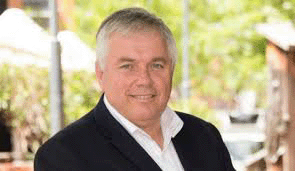
Centre Alliance Senator Rex Patrick said the Hawker and Kimba communities were bitterly divided and the selection process had been unfair. The Federal Government has offered $31 million worth of incentives for the community where the radioactive waste centre is built.”
Senator Rex Patrick: Additional Comments on Senate Report re selection process for siting nuclear waste dump
Recommendation 1 The Minister must quantify how broad community support will be determined and do so before vote.
Recommendation 2 As a minimum, broad community support must mean a 65% vote in favour in the AEC vote, AND agreement from all adjoining neighbours AND the agreement from aboriginal communities.
Recommendation 3 The ANSTO Act should be changed to permit the storage of intermediate-level waste until such time as an appropriate facility site has been identified and a facility built and commissioned
Senator Rex Patrick Senator for South Australia, Selection process for a national radioactive waste management facility in South Australia, 14 August 2018
p. 67 Additional Comments by Senator Rex Patrick Kimba and Hawker, when you finally surrender, it must be of your own free will!
The Work of the Committee
1.1 I thank the committee for the work it has done in relation to this very important inquiry. I also thank the secretariat for their behind the scenes efforts.
1.2 I support the general findings in this report and the recommendations that flow from them, but I feel they do not address several substantive issues with enough force.
1.3 Out of responsibility to the communities of Hawker and Kimba, I address those issues now. Continue reading
Conflict of interest: Richard Yeeles, adviser to South Australian Premier on Olympic Dam Aboriginal Trust
 Tim Bickmore shared a link.No Nuclear Waste Dump Anywhere in South Australia, 15 Aug 18
The Olympic Dam Aboriginal Trust distributes funding to 3 aboriginal groups based upon income from the mine. Those groups are: Barngarla, Kuyani (Adnymathanha) & Kokotha.
Barngarla & Kuyani are currently the groups targeted by the radioactive waste site suppository process.
According to the ODAT website, currently Richard Yeeles, senior economic adviser to State Premier Steven Marshall is listed as a BHP representative on the council which determines who gets what monies…..
Conflict of interest? https://www.facebook.com/groups/1314655315214929/?multi_permalinks=2493650837315365%2C2493518107328638¬if_id=1534298281981165¬if_t=group_activity
Greens Dissenting Report on selection process for nuclear waste dump
The definition of broad community support has been inconsistent throughout the entire process
decision-making power of the Minister is wholly arbitrary. It is nonsensical to say that we must accept an arbitrary decision-making process as a means to avoid arbitrary decision-making processes.
The Adnyamathanha people have a demonstrable interest in the process of site selection.
it is condescending and inaccurate to suggest that community concerns around the impact of a radioactive waste dump on agriculture and tourism perceptions of safety and attractiveness are unfounded.
It is imperative that all stakeholders within transport corridors should be consulted.
 Dissenting Report from the Australian Greens Selection process for a national radioactive waste management facility in South Australia, 14 August 2018
1.1 The Australian Greens believe the site selection process is fundamentally flawed. There has been a consistently stated commitment by the Minister to respect the views of the communities relevant to the process by not proceeding without “broad community support”, ensuring that the absence of such shall serve as an effective veto. However, the Minister has refused to explain what he would consider to be sufficiently “broad”, ensuring that any number can be considered sufficient, or insufficient, and ultimately disenfranchising affected communities in the name of ministerial ‘discretion’.
1.2 Jobs figures have been floated and inflated. Traditional owners have been cherry-picked or ignored altogether. Sites have been nominated by absentee landowners with no direct tie to the community on which the site selection process is being inflicted. And this process is simply unnecessary. It does nothing to address the need for long-term intermediate level storage, consistent with international best practice. It avoids amending the relevant Act by spending millions of dollars on a divisive and unnecessary process that is being pushed through to align with the electoral cycle instead of the science.
1.3 ARPANSA Chief Regulatory Officer Mr Jim Scott has told the Committee that Lucas Heights cannot offer long-term storage of low-level waste under the ANSTO Act. He argues that this requires the identification of a long-term disposal facility.
1.4 Low-level waste is set to be disposed at the NRWMF, consistent with international best practice regarding low-level waste management. However, intermediate level waste is also set for long-term storage at the NRWMF. This is not consistent with international best practice which supports medium to deep burial disposal of intermediate level waste. Continue reading
Senate Report on Selection Process for Nuclear Waste Facility in South Australia
The report is at https://www.aph.gov.au/Parliamentary_Business/Committees/Senate/Economics/Wastemanagementfacility/Report
It is 77 pages. I confess to have only skimmed through it at this stage. It appears to be a careful attempt to bless the process, while not having a real opinion about it, one way or the other. To be fair, it does contain a few questions, does not appear to be a “full go ahead” recommendation.
Coalition Senators Senator Jane Hume Senator Dean Smith put in Additional Comments. Short and not very interesting.
Greens, Senator Hanson-Young put in a longer Dissenting Report report, strongly criticising the process.
Senator Rex Patrick put in Additional Comments, also criticising the process
RECOMMENDATIONS in the Report
Chapter 2 Community sentiment
- 22. Recommendation 1 2.67 If a National Radioactive Waste Management Facility were to be sited in an agricultural region, the committee recommends that the Department of Industry, Innovation and Science work with local stakeholders, so that part of the remaining 60 hectare buffer zone can be used to grow and test agricultural produce, in order to reassure the community and agricultural markets that the produce from the surrounding region does not contain excessive amounts of radiation and is safe for consumption.
- 23 Chapter 3 Indigenous support
- 31 Recommendation 2 3.40 The committee recommends that the Minister intensify and expedite efforts to fully engage with the Indigenous stakeholders near Kimba and Hawker so that comprehensive heritage assessments for all nominated sites can be completed
- 33 Chapter 4 Financial compensation and incentives to communities
p.36. 4.22 The committee notes that it is unfortunate for a former politician, particularly one with significant exposure to the nuclear waste issues, to place the government in the invidious position of p. 37 deciding whether he should receive financial compensation for hosting a NRWMF on his property, thereby further politicising an already contentious process.
Recommendation 3 4.25 The committee recommends that the government undertake an independent valuation of the land to be acquired to ensure that the financial compensation is consistent with the original proposal to compensate the landholder at four times the land value.
- 43 Chapter 5 General comments about the site selection process
- 49 Recommendation 4 5.35 The committee recommends that the Department of Industry, Innovation and Science make submissions received during the consultation process publicly available in the circumstances where the authors originally intended for their submission to be made public. ((That requirement has apparently been fulfilled)
- 50 Recommendation 5 5.37 The committee recommends that the Office of the Chief Economist within the Department of Industry, Innovation and Science undertake a policy evaluation of the first two phases of the site selection process for a National Radioactive Waste Management Facility.
The committee made no other general recommendation)
Nuclear waste being shipped to Australia by company with a terrible safety record
Responsibility overboard: the shocking record of the company shipping nuclear waste to Australia http://www.onlineopinion.com.au/view.asp?article=19892&page=0
| By Natalie Wasley -, 14 August 2018In the very early hours of Sunday July 29, the federal government carried out a highly secretive transport of spent nuclear fuel. Helicopters and hundreds of police accompanied trucks from the Australian Nuclear Science and Technology’s reactor at Lucas Heights to Port Kembla in Wollongong.
Any transportation of nuclear materials carries risks, but Briese has a particularly terrible safety record, including leaking oilfrom vessels, losing cargo overboard and failing to follow basic navigation rules. In 2015, French nuclear giant Areva (now Orano) chartered the controversial Briese ship the BBC Shanghai to bring reprocessed spent fuel waste back to Australia. This was despite the ship being recently detained in Australia and Spain, and banned from carrying government cargo in the United States, for failing safety inspections The transport occurred during a federal Parliamentary Inquiry into Flag of Convenience ships, where it was revealed that the BBC Shanghai was “owned and operated by a web of German companies, registered in the tiny Caribbean islands of Antigua and Barbuda and crewed by a mix of Russian and Ukrainian seafarers.” At the time, independent Senator John Madigan accused the government of “tendering out its national security to the lowest common denominator.” A complex web of ownership and vessel registration allows Briese to circumvent systematic regulation and accountability. Along with safety breaches, vessels have been caught carrying weapons, allegedly intended for war-ravaged nations. Briese is known to have transported Russian and Ukrainian weapons and has an “important functional role” of “heavy weapons shipments to countries with poor infrastructure” as part of the Odessa Network that has allegedly supplied weapons used in Syria. Briese ships have been stopped and crew detained with weapons cargo and tanks “presumably intended” for Sudan and Singapore. Amnesty International identified a Briese vessel moving cluster bombs between South Korea and Pakistan in 2010, contravening the 2008 Convention on Cluster Munitions. The vessel was not sailing under a German flag, and therefore did not need the permit that would usually be required under German law. Workers’ rights Briese has a terrible track record on workers’ rights. In 2015, the Maritime Union of Australia (MUA) argued that the crew of the BBC Shanghai only signed a binding wage agreement en route to Australia after the radioactive waste shipment attracted public scrutiny. International Transport Federation National Coordinator Dean Summers inspected a sister ship at Port Kembla and found the crew was underpaid and working under a “sham” collective agreement. The MUA has a long held policy of opposition to all aspects of the nuclear industry. The position recognises that handling and transport of radioactive materials is a risk to stevedores, seafarers and other transport and emergency workers. It also expresses support for Traditional Owners and community members resisting imposition of nuclear projects. When the BBC Shanghai docked in 2015, MUA Southern NSW Branch Secretary Garry Keane reiterated: “Our members do not support the nuclear industry. There is no totally safe way to transport or store waste which remains a danger and threatens communities for thousands of years.” Community opposition The reprocessing waste that returned to Australia was categorised as long-lived intermediate level waste (ILW). The intention was for it to be stored at a purpose built national radioactive waste facility, along with other low and intermediate level waste that would be transported from around the country. However, the attempts of successive federal government to construct such a facility have been thwarted by persistent community campaigns and legal actions. Nominated sites in South Australia (1998-2004) and the Northern Territory (2005-2014) were dropped by the federal government after years of hard fought campaigning. Significant government resources are currently being thrown at advancing the assessment of three shortlisted sites in South Australia- one on Adnyamathanha country in the Flinders Ranges and two in the Kimba region of the Eyre Peninsula. The SA waste dump plan has caused great anxiety and stress for Traditional Owners and local community members near the sites. Adnyamathanha Traditional Owner Regina McKenzie describes the Flinders Ranges as “arngurla yarta” (spiritual land). Upon receiving the 2016 Peter Rawlinson environment award, Regina said: “The proposed dumpsite contains thousands of Aboriginal artefacts. Our ancestors are buried there. We don’t want a nuclear waste dump here on our country and worry that if the waste comes here it will harm our environment and muda (our lore, creation).” Communities – including many of Regina’s extended family – have campaigned for decades to stop uranium mining and nuclear waste dumps and to fight for compensation for people affected by nuclear bomb tests conducted in the 1950s and 1960s. The nuclear chain is toxic from start to finish. As we move, albeit slowly, towards creation of long-term, sustainable and safer jobs in renewable industries there will be ongoing need ‒for many generations ‒to manage the radioactive materials already stockpiled around the world. Instead of continuing with plans to greatly expand the production and export of radioactive medical isotopes from Lucas Heights, the federal government should start planning to replace the reactor with more benign technologies for scientific and medical applications. A recent conveyor beltbreakdown and two spills of radioactive material that affected workers in the past year highlight the risks and vulnerabilities inherent in this industry. Environment groups, trade union and health organisations have long called for an independent inquiry into the production, transport and management of radioactive waste in Australia that includes all key stakeholders. This is essential to take the discussion around intergenerational management out of the trenches and to the table. Arthur Rorris from the South Coast Labour Council summarised it well in the lead up to the 2015 transport: “When a shipment of solarpanels comes through the port you don’t see hundreds of cops blocking highways and a national security operation. Communities the world over want to see the back of the nuclear industry so we don’t have to endure these unnecessary risks to public health, the environment and our national security.” |
First reliable estimates of highly radioactive cesium-rich microparticles released by Fukushima disaster
 https://www.eurekalert.org/pub_releases/2018-08/gc-1re081218.php GOLDSCHMIDT CONFERENCE
Scientists have for the first time been able to estimate the amount of radioactive cesium-rich microparticles released by the disaster at the Fukushima power plant in 2011. This work, which will have significant health and environmental implications, is presented at the Goldschmidt geochemistry conference in Boston*.
The flooding of the Fukushima Daiichi Nuclear Power Plant (FDNPP) after the disastrous earthquake on March 11 2011 caused the release of significant amounts of radioactive material, including cesium (Cs) isotopes 134Cs (half-life, 2 years) and 137Cs (half-life, 30 years). Continue reading
Nuclear waste transport port; Port Lincoln? there will be no discussion – says Dept of Industry Innovation and Science
 Port Lincoln a possible port for waste transport https://www.eyretribune.com.au/story/5584011/nuclear-port-talk-to-wait/
The Department of Innovation, Industry and Science says there will be no discussion on whether ports, including in Port Lincoln, will have nuclear waste material move through them until a storage site has been chosen.
For the site reports for Lyndhurst and Napandee, near Kimba, it discusses the potential for waste to be shipped from Port Kembla, New South Wales, to key ports including Port Lincoln, Port Pirie and Whyalla.
It also details the potential for a new commodities port in the upper Spencer Gulf to be used to transport waste to either Lyndhurst or Napandee.
The report details Port Lincoln’s potential to utilise rail to transport the waste from the port, but would be subject to third party restrictions due to the railway being privately owned.
Despite these report findings, department head of resources Bruce Wilson said no transport routes had been locked in and would not be discussed until the storage site itself was determined.
“Our initial focus will be on getting approval to build the site, then identify potential transport routes,” he said.
“We will consult the communities as required when we identify waste routes.”
Mr Wilson said there would also be a small number of waste shipments that would go through, with about four to five identified in the next 40 years.
He said the low to intermediate waste that would be transported would be safely secured and would meet the standards set by the Australian Radiation Protection and Nuclear Safety Authority.
Regional Development Australia Whyalla and Eyre Peninsula economic development manager Peter Scott said the organisation would work closely with the department should a transport route through Eyre Peninsula be identified so a consultation plan could be developed for all affected communities.
Despite weather extremes the grand Walkatjurra Walkabout against uranium mining presses on
K-A Garlick at Nuclear Free WA, 15 Aug 18 The Walkatjurra Walkabout have survived the first 10 days of the protest walk in freezing overnight temperatures and long hot walking days. Walking strong a group of 55 people gathered at Yeelirrie to support Traditional Owners, Aunty Shirley, Lizzie Wonyabong and Vicky Abdhullah in their 40-year struggle to stop the proposed Yeelirrie uranium mine.
The three women have shared stories of the area where they and their families grew up on. and their ancestors grew up. The group was joined by Youno Downs Station, who shared stories of the history of uranium exploration and company intimidation over the years they have lived on the pastoralist station. “Water is what the company is after, they (Cameco) need up to 10 millions of litres of water and they want us to give it to them!” ……. to be continued!
Radioactive sheep in Australia add evidence about Israeli nuclear bomb test
Radioactive sheep shed light on secret nuclear weapons test, https://nypost.com/2018/08/14/radioactive-sheep-shed-light-on-secret-nuclear-weapons-test/ Christopher Carbone, Fox News, August 14, 2018 Newly discovered data from radioactive sheep provides strong evidence that a mysterious “double flash” detected almost 39 years ago near a remote island group was a nuclear explosion.
Ever since the flash was observed by a US Vela satellite orbiting above Earth in September 1979, there’s been speculation that it was produced by a nuclear weapon test by Israel. International researchers in the journal Science & Global Security analyzed previously unpublished results of radiation testing at a US lab of thyroid organs from sheep in southeastern Australia in order to make their determination.
The flash was located in the area of Marion and Prince Edward islands, which are in the South Indian Ocean about halfway between Africa and Antarctica.
“A new publication sheds further light on the Vela Incident of 1979,” said Professor Nick Wilson of Otago University at Wellington, who highlighted the findings but was not involved with the study itself. “[The research] adds to the evidence base that this was an illegal nuclear weapons test, very likely to have been conducted by Israel with assistance from the apartheid regime in South Africa.”
Wilson, an epidemiologist and member of the Australia-based Medical Association for the Prevention of War, said the test would have violated the Limited Test Ban Treaty signed in 1963, and urged the United Nations to mount a full inquiry.
The researchers conclude that iodine-131, which is an unstable radioactive form of the element iodine found in the thyroids of some Australian sheep, “would be consistent with them having grazed in the path of a potential radioactive fallout plume from a [Sept. 22, 1979] low-yield nuclear test in the Southern Indian Ocean.”
Thyroid samples from sheep killed in Melbourne were regularly sent to the US for testing — monthly in 1979 but also in the 1950s and 1980s, researchers say.
According to a report in the New Zealand Herald, the sheep had been grazing in an area hit by rain four days after the flash incident was observed, which would have been in the downwind path from the suspected explosion site.
Researchers also said the detection of a “hydroacoustic signal” from underwater listening devices at the time is another piece of evidence pointing to a nuclear test.
Israel, which has neither confirmed nor denied the existence of a nuclear program, dismissed the claim that it was responsible for the 1979 incident.
srael’s ambassador to New Zealand, Itzhak Gerberg, told the Herald, when asked if Israel was responsible for the explosion: “Simply a ridiculous assumption that does not hold water.”
However, the country’s former Knesset speaker, Avrum Burg, told a conference in 2013 that “Israel has nuclear and chemical weapons” and called for public discussion.
Commenting on the findings, US nuclear weapons expert Leonard Weiss of Stanford University said in the online Bulletin of the Atomic Scientists that the “important” new evidence “removes virtually all doubt” that the flash was a small-yield nuclear explosion.
Weiss added that there was “growing circumstantial evidence” that it was conducted by Israel.
“Israel was the only country that had the technical ability and policy motivation to carry out such a clandestine test,” he said.
Rally in Canadian town against siting as nuclear waste dump

 Hornepayne residents rally against nuclear waste storage https://www.cbc.ca/news/canada/thunder-bay/hornepayne-nuclear-waste-1.4783656 Tuesday’s rally includes march, guest speakers, Aug 14, 2018
Tesla big battery to be installed at Lake Bonney wind farm — RenewEconomy

Infigen Energy to install 25MW/52MWh Tesla Powerpack battery storage system at its Lake Bonney wind farm in South Australia. The post Tesla big battery to be installed at Lake Bonney wind farm appeared first on RenewEconomy.
via Tesla big battery to be installed at Lake Bonney wind farm — RenewEconomy
Gupta launches 1GW renewable plan at Cultana solar project — RenewEconomy

Gupta confirms plans for 1GW of dispatchable renewables at ground-breaking ceremony at new Cultana solar project, a day after Coalition agree to NEG policy that models zero new investment in large-scale renewables and storage over next decade. The post Gupta launches 1GW renewable plan at Cultana solar project appeared first on RenewEconomy.
via Gupta launches 1GW renewable plan at Cultana solar project — RenewEconomy
August 14 Energy News — geoharvey

Science and Technology: ¶ “Minesto to fly Wales kite” • Minesto, a Swedish company, is poised to start subsea testing of its 500-kW tidal kite off the coast of Wales after completing initial commissioning sea trials. The company said the DG500 will undergo “flying” full subsea trajectories off Holyhead as part of the next phase […]
Video of the Day: Counting Frydenberg’s NEG “lies” — RenewEconomy

Smart Energy Council counts eight “lies” told by the federal energy minister in his Sunday ABC TV interview – and fact-checks them all. The post Video of the Day: Counting Frydenberg’s NEG “lies” appeared first on RenewEconomy.
via Video of the Day: Counting Frydenberg’s NEG “lies” — RenewEconomy
1 This month
7 April – WEBINAR – Australia and the Doomsday Clock – Preventing nuclear war through NoFirstUse and other policies
Online | Tuesday April 7, 4:00-5:30pm, Australian Eastern Time / 8:00-9:30am Central Europe Time
– Access the registration link
15 April – Zoom –Nuclear Power is Not the Solution
Apr 15, 2026 01:00 AM in Canberra, Melbourne, Sydney

Join the International Physicians for the Prevention of Nuclear War (IPPNW) on Tuesday, April 14th for a timely webinar exploring the risks associated with nuclear power and challenging the myth that it offers a simple, safe, carbon-free solution to the climate crisis

21 April Webinar: No Nuclear Weapons in Australia
Start: 2026-04-21 18:00:00 UTC Canberra, Melbourne, Sydney (GMT+10:00)
End: 2026-04-21 19:30:00 UTC Canberra, Melbourne, Sydney (GMT+10:00)
Event Type: Virtual
A virtual link will be communicated before the event.
Host Contact Info: australia@icanw.org

of the week – Australians for War Powers Reform (AWPR)
To see nuclear-related stories in greater depth and intensity
 Antinuclear