Destructive Process and Oversold Benefits: New Report questions nuclear dump economic case, as Govt ballot postponed
 20 August 2018 A new report into the claimed economic benefits to regional communities of the
 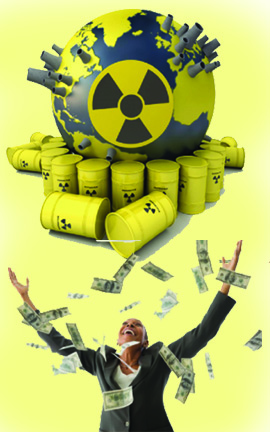 Federal Government nuclear waste facility has found the government has exaggerated the benefits, and not properly factored in insurance costs and
  other risks.
The report’s release comes as the Federal Government scrambles to fix up a controversial community ballot process in the wake of a Supreme Court injunction. The ballot was due
to begin today (Monday) in the two affected communities of Kimba and Hawker.
“This whole process has been poorly conducted and horribly divisive from day one,” said Craig Wilkins, Chief Executive of the state’s peak environment body, Conservation SA.
“Knowing how reluctant many people in Kimba and the Flinders Ranges are to having a nuclear waste dump in their backyard, the Federal Government has greatly over-sold the economic benefits to try and buy community support.
“This report is a reality check for a community sick of the spin from the Federal Government,” he said.
Conservation SA commissioned economic think tank The Australia Institute to examine more closely Federal Government’s claims of an economic windfall for the affected communities.
The “Down in the Dumps” report compared the current Australian National Radioactive Waste Management Facility (NRWMF) plans with similar facilities overseas, and found a raft of exaggerated jobs and economic return claims. For example, a proposed facility in Canada which is more than one hundred times larger with more functions and features, will cost only half as much to construct and operate.
As the report’s author, Dr Cameron Murray, states: ‘Either the waste facility is orders of magnitude larger than need for Australia’s nuclear waste, or the government has exaggerated the economic returns to the local community of the NRWMF facility’.
It also questioned the true value of the promised $31 million in local grants and infrastructure promises, as some of this appears to be double-counting, re-labelling of other programs or matched by cuts to other funding streams.
Adjusting the economic impact assessment to account for the exaggerated claims reduces the number of net full time jobs down to just 6.
“At the end of the day, the case for shifting waste across from Sydney to South Australia simply doesn’t stack up,” said Mr Wilkins.
“Why is the Federal Government pushing so hard to move Australia’s highest risk radioactive waste from Lucas Heights where it is safely and securely stored, to park it in SA in temporary sheds while they work out what to do with it?
“Wouldn’t it be better to work out the final disposal plan first, including the true cost and benefit to the local community, and then move it once when everything is sorted?
“Double handling is incredibly wasteful, is not international best practice, and makes no sense in terms of public health or radiation safety.
“It is time for the Federal Government to apologise, walk away and put in place a credible pathway for a long term, permanent solution to nuclear waste stored at Lucas Heights,” he said.
The full report can be found her
For comment:
Dr Cameron Murray, The Australia Institute, 0422 144 674
Craig Wilkins, Conservation SA, 0417 879 439
It’s not too late to send a submission about the nuclear waste dump plan – it’s necessary and it’s easy
 One step pro-forma online submission to DIIS page.
Closing date 24th September
Send a submission to the Department of Industry, Innovation and Science (DIIS) https://nowastedump.good.do/radioactivewastesubmissiontodiis/radwasteDIISsubmission/
The Department is calling for submissions about the proposed National Radioactive Waste Management Facility in Kimba or the Flinders Ranges and says these will be “one of the factors the Minister for Resources and Northern Australia may take into account when determining broad community support for the Facility.”
The communities of Kimba on the Eyre Peninsula and the Flinders Ranges are being asked to participate in a ballot to gauge community sentiment about the NRWMF proposal, although the results are not binding on Minister Canavan. Many affected people are ineligible to vote, including Traditional Owners who live outside the ballot area.
Minister Canavan is hoping to select a site in October – if you or others who are interested are not eligible to vote in the community you are still able to make a comment and express your view by sending DIIS a submission..
Australia’s racist politicians are also mostly Australia’s nuclear-loving politicians
Alice Workman No Nuclear Waste Dump Anywhere in South Australia August 15
Here’s a list of the politicians who shook hands / hugged / kissed Fraser Anning after his “final solution” speech calling for an end to Muslim immigration and a return to the White Australia policy.
Minister Mathias Cormann
Minister Bridget McKenzie
Minister Nigel Scullion
Minister Conchetta Fierravanti-Wells
Minister Matt Canavan
Assistant minister James McGrath
Assistant minister Anne Ruston
Steve Martin
Amanda Stoker
Jonathan Duniam
James Paterson
Dean Smith
David Bushby
Wacka Williams
Barry O’Sullivan
Cory Bernardi
Derryn Hinch
David Leyonhjelm
One Nation’s Peter Georgiou
Centre Alliance’s Stirling Griff & Rex Patrick
No Labor/Greens senators congratulated him. https://www.facebook.com/groups/1314655315214929/
Legal challenge against nuclear waste community vote for Hawker?
Injunction stalls one nuclear waste dump community vote‘The Barngarla people have won a Supreme Court injunction
against the vote in Kimba, with the Hawker ballot
still scheduled to open Monday.’ By Brooke Fryer
‘A community vote on whether a nuclear waste facility should be built on
South Australia’s Eyre Peninsula near Kimba has been stalled,
after a group argued the poll was discriminatory. …
‘NITV News understands a similar legal challenge for Hawker is being considered. …
‘The court heard an example is that a person who owns a property at Kimba
but lives away from the district would be entitled to vote,
but a person who holds native title rights and lives away would not. … ‘
‘Mr Dare says the Barngarla people opposed to a nuclear waste dump
stand alongside the Adnyamathanha people who are also
facing the prospect of a waste dump on their land.
‘”Of course we stand behind them in their pursuit
to not let this waste dump go on their country also.” … ‘
www.sbs.com.au/nitv/article/2018/08/17/injunction-stalls-one-nuclear-waste-dump-community-vote
Should there be another nuclear reactor at Lucas Heights?
| Siting another reactor at Lucas Heights http://ssec.org.au/our_environment/issues_campaigns/nuclear/info_sheets/1997_oct_1a.htm |
| Even if we assume that Australia does need a third nuclear reactor, is Lucas Heights the best site? There are numerous and compelling reasons why it is not.
1. It’s not remote Lucas Heights was selected in 1955, as a site for Australia’s nuclear industry for the very reason that it was remote from population. Now, 40 years later, it is surrounded by houses, on the edge of Australia’s largest city. This is no longer in a good site for a nuclear reactor! 2. It’s not been the subject of a proper site-selection process The most recent search for a dump for low and short-lived intermediate level radioactive waste has taken 4 years and has considered criteria such as low rainfall, freedom from flooding, stable hydrology, freedom from cyclones, tectonic, seismic or volcanic activity, as well as socio-economic, ecological and land-use factors. Selection of a site for a nuclear reactor – its production of high, medium and low level waste- should be at least as stringent as that for a low level waste dump! The McKinnon report said that “If a decision were made to construct a new reactor, it would not necessarily best be placed at Lucas Heights. An appropriate site would best be decided after exhaustive search and taking into account community views. Any siting decision should be based on criteria similar to those developed by the National Resource Information Centre (in its search for a low level waste dump) with an additional range of economic and scientific criteria.” (1993 Research Reactor Review 20.1-2.) 3. It’s the easiest option ANSTO maintains that “The relocation of infrastructure and personnel to a new site would significantly add to the costs of a new research reactor.” (Website) This is no justification for building a reactor at Lucas Heights! According to leaked memo to Peter McGauran on the Relocation of the Lucas Heights Nuclear Reactor, “the political fallout from either the refurbishment of the old reactor or the construction of a new one would be of the same order.” The real reason that Lucas Heights was seen by the Federal Government as being the best site was that it knew that no other community in Australia would accept it. It also believed that the Local Council would be compliant as would the surrounding population 4. It does not comply with public opinion ANSTO’s recent public opinion poll – commissioned at a cost of $40,000 of taxpayers’ money – found that 83% of Sutherland Shire people surveyed thought that a new reactor should be in a “remote location”. This is consistent with this Centre’s 1992 poll which found that 81 % people felt that a new reactor should be away from population centres. The Commonwealth has ignored this finding. 5. It is a health and safety risk to the local population According to ANSTO “The annual dose of radiation received by any member of the public living near ANSTO as a result of authorised emissions from the site is currently less than one-100th of the amount permitted by the National Health and Medical Research Council and by NSW Government regulations. A modern research reactor would not produce more than those levels…” (Website) Regulations or not, there is no proof that this (or any) level of radiation is safe. There are neither medical records nor diagnostic tests to assess the effects of radiation on the local population. Apart from obvious cancers and leukaemia – which can take decades to develop – more subtle health or genetic problems could be caused such as impaired scholastic performance, visual impairment or reproductive problems. The NSW Health Authorities have avoided their responsibilities and declined to carry out health studies. They say that one “would not be warranted”. Current scientific studies in the UK suggest that even radiation exposure less than 1mSv may be harmful and could be poisoning the human gene pool (New Scientist Oct. ’97) Yet we are daily subjected to routine emissions of radioactive gasses from the nuclear plant at Lucas Heights! There is no insurance to cover the public against risk of a nuclear accident. Commercial insurance companies will not insure against radiation or nuclear accidents because they “would not have enough funds to cover claims” . (NRMA Insurance letter.) In the event of such an accident claims would have to be made against the Commonwealth Government. The NSW Government and the local Council may also be liable for damages and they are uncertain of their position. 6. Lucas Heights a potential disaster area In 1994 and 1997 disastrous bushfires struck the area. In the most recent calamity Barden Ridge, the suburb closest to ANSTO, was evacuated at the height of the fire. Eleven houses in the next suburb of Menai were destroyed. At the same time the ANSTO staff were locked in, unable to telephone their families. The official reason was that staff were held back on police advice. For several days the only road connecting the site was blocked to through traffic. This is hardly the perfect site for Australia’s only nuclear reactor! |

Prime Minister Malcolm Turnbull sells out on climate policy, in effort to save his job
 Turnbull dumps emissions from NEG in final act of capitulation, REneweconomy
Right-wing in Liberal Coalition causing Turnbull to again weaken climate action
 Malcolm Turnbull plans more changes to energy policy amid pressure from within Coalition, ABC News, By Jade Macmillan , 20 Aug 18 Prime Minister Malcolm Turnbull has outlined further changes to his national energy policy amid increasing pressure from within his own party.
Japan’s 2020 Olympic Games – preparing for a Fukushima nuclear disaster cover-up
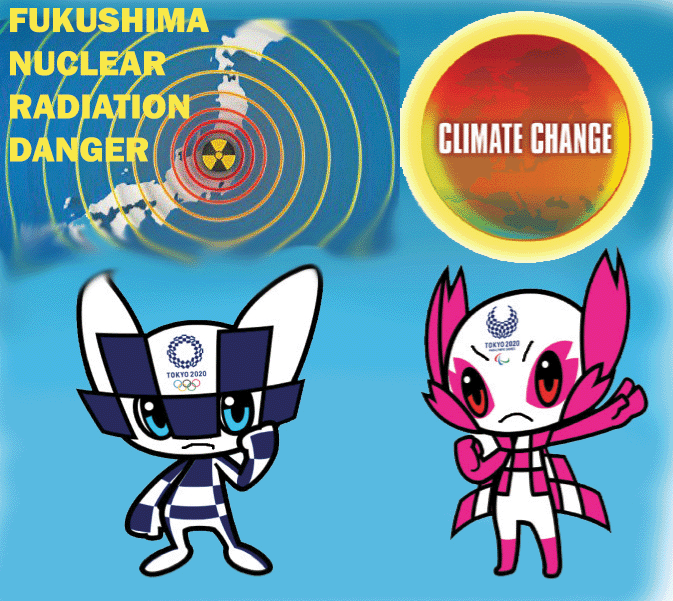
Pay no attention to that radiological disaster behind the curtains https://globalhibakusha.com/page-2/?permalink=hiding-fukushima-behind-the-curtains-in-official-japan The government of Japan is clearly intending that the 2020 Olympics will function as a public relations win in which the image of Japan, and especially of Northern Japan and Fukushima are cleansed of images of radiological contamination. Even as the Fukushima Daiichi site itself, and the traces where the plumes of its explosions deposited fallout throughout the area remain un-remediated, the public perceptions will be remediated. This is typical of the behavior of governments in the developed world that suffer radiological disasters. The disasters themselves are so difficult to clean up, and take decades to even begin the clean up, that money is allocated for extensive public relations efforts. These become tasks that CAN be completed and CAN be considered successful. They function both to advance the public image agenda of the governments, and also deliver a sense of agency when the overall tone of nuclear disaster remediation is one of lacking effective agency.
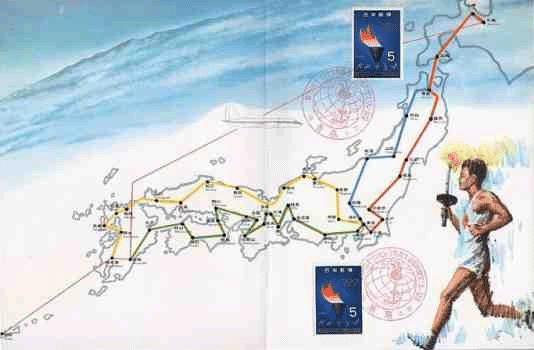
Towards that end, the Japanese government is planning to integrate Fukushima sites and perceptions into the upcoming Olympics media fest. The journey of the Olympic torch through every prefecture of Japan will begin in Fukushima, a symbolic rebirth intended to facilitate the repopulating of the local communities that were evacuated, many of which have had few returnees since the government has declared them “safe” and cut public funds to those forcibly evacuated.
The government is also planning to hold multiple Olympic events in Fukushima prefecture including baseball and softball events. “Tokyo 2020 is a showcase for the recovery and reconstruction of Japan from the disaster of March 2011, so in many ways we would like to give encouragement to the people, especially in the affected area,”said Tokyo 2020 president Yoshiro Mori last March.
This active rebranding of Fukushima as safe involves removing physical reminders of ongoing risk. The central government has recently announced that it will be removing 80% of public radiation monitors from the region. An argument can be made that the presence of these monitors is theatrical in that they only measure external gamma radiation levels, which are not the primary risk to residents (this comes from internalizing radioactive particles that blanketed the region in the fallout of the plumes of the explosions of March 2011), and that positioning these gamma detectors in midair produces low readings since the particles are primarily on the ground. However, they are a tangible, embodied reminder that risk remains.
While there is a clearly an active campaign to rehabilitate the image of the region leading up to the 2020 Olympics, an effort that will no doubt intensify as the event draws near, there is also pushback and resistance in the local and national communities. A recent sculpture unveiled at the JR train station in prefectural capital Fukushima City (about 80km from the Daiichi nuclear site) 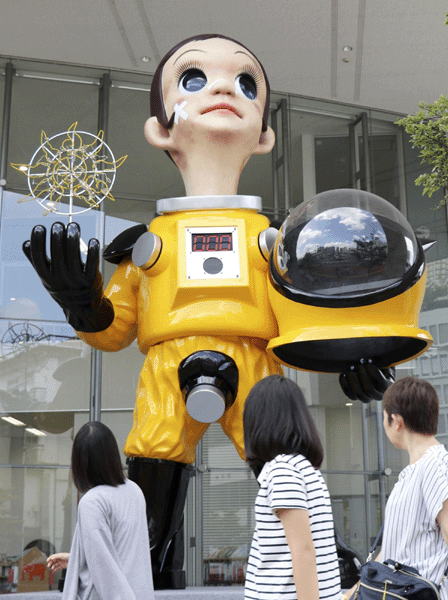 has been stirring up controversy. A Guardian article explained:
“The statue, by Kenji Yanobe, depicts a child dressed in a yellow Hazmat-style suit, with a helmet in one hand and an artistic representation of the sun in the other.
Yanobe said his Sun Child, which was installed by the municipal government after appearing at art exhibitions in Japan and overseas, was intended to express his desire for a nuclear-free world.
The artist said he did not mean to give the impression that local children needed to protect themselves from radiation more than seven years after the Fukushima Daiichi plant became the scene of the world’s worst nuclear disaster since Chernobyl.
He pointed out that the child was not wearing the helmet and that a monitor on its chest showed radiation levels at ‘000’.”
While some, including the mayor of Fukushima City, have praised the statue for emphasizing a hopeful future for local children, others have criticized the statue for suggesting that there is any danger to local children.
Regardless of how one interprets the sculpture, it does confront people with the fact that things are far from normal in the region. This, in spite of the central government’s strong efforts to implore people not to pay any attention to what is happening behind the curtains it has been raising.
Nuclear has left its run too late: a response to Ian Hore-Lacy
ETHOS, 14 August 2018 | Robert Farago “………… Nuclear as the solution? There are a number of unresolved problems around nuclear power and questions of whether nuclear energy can grow quickly enough to solve our climate change problem. I will just list some of these problems with a sentence each:
- Weapons proliferation – enriching Uranium for civilian nuclear energy programs can lead to fuel being diverted and further enriched for nuclear weapons programs.
- Safety – although less deaths have been recorded from nuclear power than from coal mining, nuclear accidents such as Three Mile Island, Chernobyl and Fukushima have shaken the confidence of citizens to have nuclear reactors near their homes and food sources.
- Waste – although we have generated nuclear waste for 70+ years we still don’t have a solution. Nuclear waste needs to be stored safely for hundreds of thousands of years, longer than settled agricultural society has existed.
- Decommissioning – cost estimates vary wildly and it’s particularly technically challenging and expensive after nuclear accidents.
- Water use – like thermal coal generators, nuclear needs large quantities of water for cooling, making droughts and heatwaves a problem.
- Capacity – if we moved to a large portion of our global electricity generation to nuclear power, will there be enough Uranium to fuel them?
- Timeliness – can we move quickly enough to a majority nuclear electricity future and meet our global emission reductions?
Exaggerated ‘benefits’ of a radioactive waste dump for rural South Australia
The economic benefits of a radioactive waste dump proposed for rural South Australia have been exaggerated, a new report warns https://www.adelaidenow.com.au/news/south-australia/the-economic-benefits-of-a-radioactive-waste-dump-proposed-for-rural-south-australia-have-been-exaggerated-a-new-report-warns/news-story/34bfd2eba14e0b3a9975dc861315112a Peter Jean, Senior Federal Political Reporter, The Advertiser August 20, 2018
Dangerous transport of nuclear wastes – and it leads to a police state
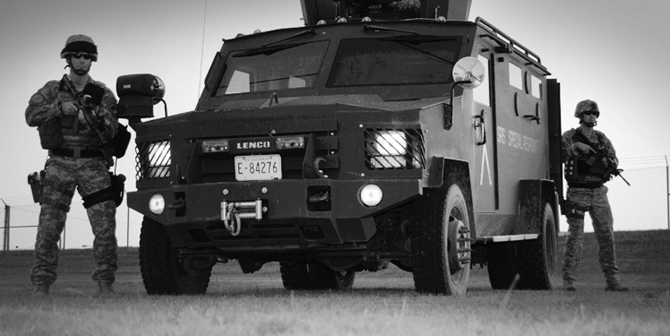
The danger: Police state The nuclear industry has traveled a long, dark way from its claims in the 1950s that it would produce energy too cheap to meter, Keegan said.
With nuclear power plants being retired around the globe, the age of nuclear energy has become the age of nuclear waste, Keegan said. No solution has been found for the safe disposal or storage of the waste, which remains dangerous essentially for eternity.
As the LaSalle proposal suggests, the potential involvement of the military, the secrecy of the transportation routes and the absence of consultation with the public are signs of a police state taking shape, according to Keegan.
“We’ve become a police state in which the transportation of the lethal excrement of the nuclear industry — nuclear waste — is totally secret and takes place under military escort,” said Keegan.
One of the costs: Our civil liberties.
“The industry and the government say, Sorry, we can’t tell you the details,” said Keegan. “We’re protecting you by not telling you.
 Exelon Corp. proposes shipping nuclear waste by road through Port Huron, Route is under review by NRC, By Jim Bloch For The Voice, 18 Aug 18
1 This month

of the week – Australians for War Powers Reform (AWPR)
To see nuclear-related stories in greater depth and intensity
 Antinuclear