Injunction to halt Kimba nuclear waste ballot remains, Wallerberdina needs similar injunction
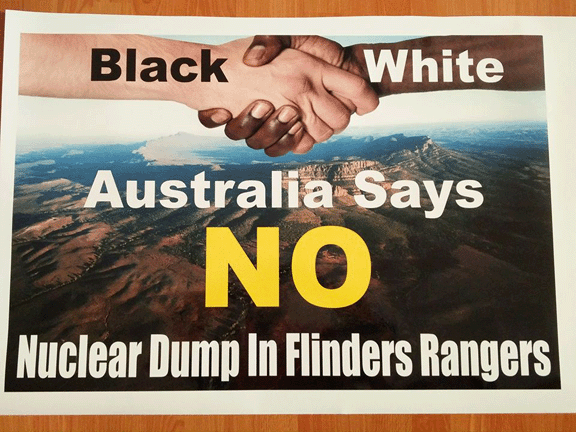 Jim Green shared a link. Fight To Stop Nuclear Waste Dump In Flinders Ranges South Australia, Sept 7 18 – The District Council of Kimba today attended conciliation in the Australian Human Rights Commission with representatives of Barngarla Determination Aboriginal Corporation and the Department of Innovation, Industry and Science, with parties agreeing to continue ongoing discussions in the hope a resolution satisfactory to all can be reached.
The interlocutory injunction restricting Council from conducting the National Radioactive Waste Management Facility site selection ballot remains in place.
As conciliation is a confidential process, Council will be making no further comment, but remains committed to keeping members of the Kimba community informed as new information becomes available. https://www.facebook.com/groups/344452605899556/?multi_permalinks=822945051383640%2C822909001387245%2C822613141416831%2C822573228087489¬if_id=1536234627130021¬if_t=group_activity
The Federal Government no longer pushing exclusively for a vote to determine support for a nuclear waste facility at Kimba and opal licence fees set to increase – News for the 7th of September 2018, read by Tom Rohde.
Australian government out to wreck international climate talks
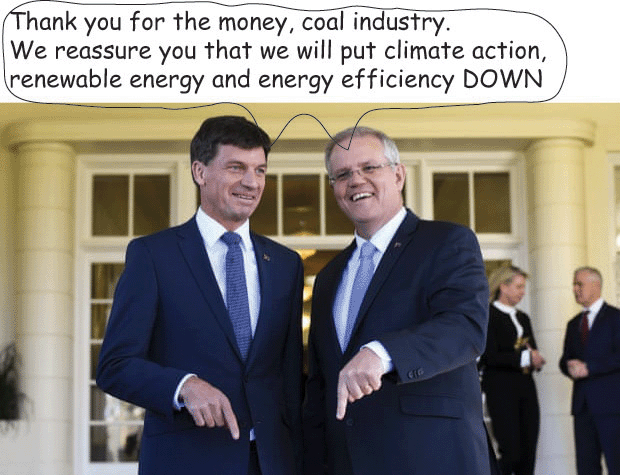
Australia gets out the wrecking ball, again, in international climate talks https://reneweconomy. com.au/australia-gets-out-the-wrecking-ball-again-in-international-climate-talks-17099/
The international community is looking on in horror, and so are the main business lobby groups in Australia, such as the Business Council of Australia – who have campaigned vigorosuly for a decade to minimise Australia’s contribution to climate action, but understand the considerable reputational, trade and business consequences of choosing to do nothing.
Morrison has so far resisted calls from the party’s far right to follow Trump out of the Paris climate treaty, but in crucial and complex climate talks in Bangkok this week, sided with the US and Japan in a dramatic attempt to weaken climate finance obligations.
The Bangkok talks were called to give negotiators extra time to put together the so-called “rule-book,” which will provide the fine details of the Paris agreement, particularly as countries gear up to increase their climate targets to try and drag the collective efforts closer to the target of limiting global warming to “well below” 2°C, and possibly 1.5°C.
But little progress has been made in Bangkok, forcing the UNFCCC, which runs the climate talks, to call for the annual talks scheduled this year in Poland to begin a day earlier, in the hope that visiting heads of state have something to work with when they turn up.
One of the biggest road-blocks has been erected by Australia, the US and Japan, who put in a joint submission that seeks to water down climate finance guidelines, and casts doubt that this week’s Bangkok negotiations will deliver the clear climate rules UN leaders have been calling for. Climate campaigners say the proposed text on article 9.7 of the Paris accord, which refers to accounting and is meant to establish rules about how developed countries report what finance they provide to developing countries, serves to muddy the rules rather than clarify them.
The campaigners say that the proposal would allow countries to report whatever items they like – including commercial loans ≠ as climate finance, in contrast to demands of clear financial and technical packages to help them developing countries cope with future extreme weather-related events.
“(This) does not create any meaningful rules on how climate finance is accounted for, and instead it essentially says ‘countries should report what they want,’” Brandon Wu, director of policy and campaigns for ActionAid USA, told Devex.
“This would completely let rich countries off the hook and deprive developing countries of real money for real action,” Wu said. Other campaigners said this meant climate finance could just be re-badged existing aid.
These problems are being felt acutely in the Pacific, where island nations are furious with Australia’s stance on climate, its attachment to coal, and its refusal to act on its declarations that “it takes climate change seriously.”
The current Coalition government still has no policy in place to try and reach what is regarded as a very low interim target of a 26-28 per cent reduction in emissions by 2030. Continue reading
Compensation to be paid to family, as Japan acknowledges death caused by Fukushima radiation

 Fukushima disaster: Japan acknowledges first radiation death from nuclear plant hit by tsunami, ABC News 6 Sept 18 Japan has acknowledged for the first time that a worker at the Fukushima nuclear power plant, destroyed by an earthquake and tsunami more than seven years ago, has died from radiation exposure.
Key points:
- The man had worked at the plant since the earthquake and tsunami in 2011
- He was diagnosed with lung cancer in 2016, in his 50s
- The Health, Labour and Welfare Ministry ruled that compensation should be paid to the family
The Health, Labour and Welfare Ministry ruled that compensation should be paid to the family of the man in his 50s who died from lung cancer, an official said.
The worker had spent his career working at nuclear plants around Japan and worked at the Fukushima Daiichi plant operated by Tokyo Electric Power at least twice after the March 2011 meltdowns at the station.
He was diagnosed with cancer in February 2016, the official said. ……..
The ministry had previously ruled exposure to radiation caused the illnesses of four workers at Fukushima, the official said.
But this was the first death……
Tokyo Electric is facing a string of legal cases seeking compensation over the disaster.
The news came as the northern Hokkaido region was hit by a 6.7 magnitude earthquake, sparking concerns at the three-reactor Tomari nuclear plant, which lost power as a result of the earthquake.
The Tomari plant has been in shutdown since the Fukushima disaster.
The Fukushima crisis led to the shutdown of the country’s nuclear industry, once the world’s third-biggest.
Seven reactors have come back online after a protracted relicensing process.
The majority of Japanese people remain opposed to nuclear power after Fukushima highlighted failings in regulation and operational procedures in the industry.http://www.abc.net.au/news/2018-09-06/first-man-dies-from-radiation-from-fukushima-nuclear-disaster/10208244
Very reluctantly, Australian govt signs declaration on Pacific climate threat
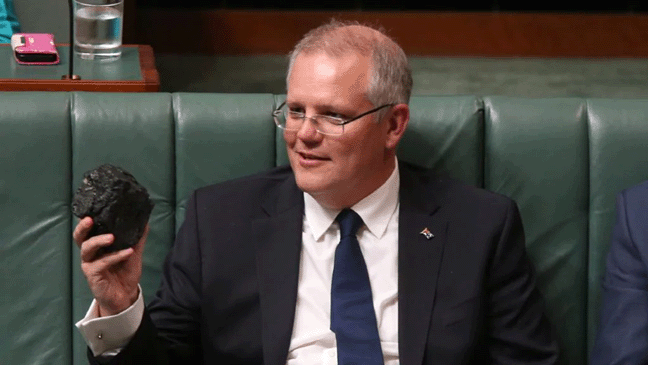 Australia signs declaration on Pacific climate ‘threat’, islands call on US to return to Paris deal, ABC News, By Pacific affairs reporter Stephen Dziedzic, Michael Walsh and Jack Kilbride, 5 Sept 18
Australia, New Zealand and Pacific nations have signed a declaration highlighting climate change as “the single greatest threat” to Pacific people, while island nations called on the United States to return to the Paris agreement.
Key points:
- The declaration expands the idea of regional security to include environmental issues
- It specifically names climate change as the region’s “single greatest threat”
- It recognises that the Pacific is “increasingly crowded” in terms of geopolitics
The communique was signed at the end of the Pacific Islands Forum in Nauru, attended by large and small island states as well as New Zealand’s Prime Minister Jacinda Ardern and Australia’s Foreign Minister Marise Payne.
But there was last-minute wrangling over the language on climate change, with some Pacific nations privately accusing Australia of trying to water down the final declaration from leaders.
Australia would also not back a statement from small island states which calls for countries to “urgently accelerate” reductions in carbon emissions.
Tuvalu’s Prime Minister Enele Sopoaga didn’t directly name Australia, but when pressed by journalists confirmed a country “starting with a capital A” had objected.
“The issues are so critical for leaders of smaller island states because of their vulnerability to climate change,” Mr Sopoaga said.
“We appealed to Forum leaders to endorse [the statement] so we can walk the talk.”
Australia and New Zealand also didn’t join a call from other Pacific Island Forum members for the United States to re-join the Paris climate change agreement.
Washington formally announced it would withdraw from the landmark climate agreement in August last year.
The Boe Declaration is named after the district in Nauru it was signed in.
It declares that climate change “remains the single greatest threat to the livelihood, security and wellbeing of the peoples of the Pacific”.
Leaders also signed a communique saying they would work together in the lead-up to this year’s COP24 climate conference in Poland, in order to “ensure effective progress on Pacific priorities with regards to the Paris Agreement”……. http://www.abc.net.au/news/2018-09-05/australia-and-pacific-nations-sign-climate-security-declaration/10204422
The heat’s on solar farm for anti-renewables Liberal candidate Beverley McArthur

A Liberal candidate, Beverley McArthur, who has attacked government subsidies for renewable energy stands to make a huge sum from a $150 million solar farm on her family’s property… (subscribers only)
Solar energy microgrid for Euroa, Victoria

The Euroa Environment Group is behind the $6 million grassroots project to install 589 kilowatts of new solar photovolatic (PV) panels, and up to 400 kilowatts of new batteries.
It will work with Mondo Power and Globird Energy as well as 14 businesses within Euroa which will install the technology.
The project may eventually extend to the residential community of Euroa and to other towns as it will demonstrate how a microgrid can operate.
The town has endured countless blackouts and it is hoped the microgrid will address the issue in the lead-up to summer.
The closure of the Hazelwood coal-fired power station in Victoria last year drove up energy power prices in southern states and put pressure on the market operator to deliver enough power to meet demand on summer’s hottest days.
Shirley Saywell, who is a business owner in Euroa and president of the group, said power options had been limited.
“This microgrid within another microgrid will give us the opportunity to generate power locally, store power locally and share power locally. It’s the town making itself more resilient in these times of uncertainty.
“There’s been stories about how complicated renewables are, and I see my role as showing people that it shouldn’t be as complicated as it’s made out to be.”
The intention of the project is to give the town greater reliability in its power supply as well as decrease the price of energy.
Energy strategy one of many Continue reading
Australia’s two-faced attitude to Pacific Islands on climate change
 Australia relationship with Pacific on climate change ‘dysfunctional’ and ‘abusive’
Palau’s climate change coordinator says Australia provides aid to region but on world stage undermines attempts to halt global warming, Guardian, Kate Lyons in Koror and Ben Doherty 5 Sep 2018 Australia’s relationship with the Pacific region on the issue of climate change has been described as “dysfunctional” and “abusive” – providing aid to the region to deal with the effects of global warming but undermining attempts to halt its progress, according to a climate change representative for the Pacific nation of Palau.
Xavier Matsutaro, the national climate change coordinator for Palau, a small nation in the north-west Pacific, said Australia’s relationship with the Pacific was “dysfunctional”, adding that Australia was also responsible for diluting the strength of previous regional declarations on climate change.
“Australia is a bit of an anomaly, because on the floor [of climate summits] they’re basically sometimes as far right as Trump in some of their views on climate change, at one point they even denied that it existed … But then on a regional basis they’ve actually given a lot of support to our region,” said Matsutaro.
“Sometimes the way I think about it … it’s like you’re in a relationship and you get abused by your spouse but at the same time they feed you and clothe you and things like that,” he said. “You could say it’s a bit of a dysfunctional relationship.”…….
Matsutaro said Australia, which has historically been the key aid partner for the Pacific region, had supported projects in Palau related to climate change, including a coastal erosion project and research on coral bleaching. Australia even provided research on the impact of climate change on Palau which formed the basis for a section of Palau’s climate change policy.
But when it came time to make commitments on climate change, Matsutaro, who has attended COP meetings on Palau’s behalf for the last five years, said Australia was regularly out of sync with the rest of the region, and was responsible for diluting the strength of resolutions on the environment.
“They’re responsible for making our declarations weaker sometimes in the region. So there’s been forums that were formulated so [Australia] won’t be involved in it, they’re not members, so that whatever language that really reflects our views and our circumstances is actually reflected in the declaration,” he said.
Pacific leaders have called for Australia to do more to reduce emissions and act to curb the effects of climate change……..https://www.theguardian.com/environment/2018/sep/05/australia-relationship-with-pacific-on-climate-change-dysfunctional-and-abusive
On climate change, Scott Morrison contradicts the energy advice of Energy Security Board
Scott Morrison contradicts energy advice, saying Paris targets can be met ‘at a canter’, Guardian, Katharine Murphy Political editor@murpharoo 5 Sep 2018 Prime minister claims Australia will easily meet its obligations without an emissions reduction policy Scott Morrison is continuing to insist that Australia will meet its Paris climate commitments “in a canter” despite the government having no emissions reduction policies to achieve that result.The prime minister used a radio interview on Wednesday afternoon to declare “the business-as-usual model gets us there in a canter” – which contradicts advice from the Energy Security Board that says business as usual will mean the electricity sector will “fall short of the emissions reduction target of 26% below 2005 levels”.
Even if the the ESB projections are wrong, and the electricity sector managed to reduce emissions by 26% with no policy to drive that result, the Paris target applies across the economy, not just to the electricity sector, and the government’s own data shows emissions in other sectors of the economy are rising.
Morrison told 2GB on Wednesday that business as usual “and technology and the amount of renewable technologies that are already in the system and not being subsidised off into the future means these [Paris] targets are hit”.
A summary of modelling undertaken by the ESB and released only a month ago said if no policy was put in place in the electricity sector – which is the business-as-usual case the prime minister refers to – emissions would fall initially, then flatten out and rise towards the end of the decade to 2030 as forecast demand increased, then dip again in 2029-30.
The ESB said if the national energy guarantee wasn’t implemented, the national electricity market would “fall short of the emissions reduction target of 26% below 2005 levels”.
On Wednesday the prime minister initially said that the renewable energy target was driving up power prices “and that’s why we are stripping [subsidies] out of the system”, then said later in the same interview that the biggest driver of higher power prices was gold-plating of the electricity networks.
Asked by his host on 2GB what was ultimately more important, complying with Australia’s international climate obligations, or lowering power prices, Morrison said: “Power prices.” He counselled against being “distracted by ideological debate”.
The ESB has warned that if governments fail to implement the national energy guarantee – the policy Malcolm Turnbull shelved to try and stave off the civil war that ultimately cost him the prime ministership – that will “prolong the current investment uncertainty, and deny customers more affordable energy”……..https://www.theguardian.com/australia-news/2018/sep/05/scott-morrison-contradicts-energy-advice-saying-paris-targets-can-be-met-at-a-canter
Japan nuclear plant’s power restored after quake triggers Hokkaido blackout — Fukushima 311 Watchdogs

August 6, 2018 (Reuters) – Power was restored to a nuclear energy plant in Hokkaido, northern Japan on Thursday after a strong earthquake left it relying on emergency generators for 10 nervous hours, but it may be a week before lights are back on all over the major island. Triggering a blackout just after 3 […]
Coalition aims to clamp down on activist charities
 Push to clamp down on activist charities
Senior Coalition government figures are pushing for politically active charities including Greenpeace and the Australian Conservation Foundation to lose their charity status in a pre-election crackdown… (subscribers only)
Australia losing credibility, reputation, in the Pacific, as it follows Trump’s anti-climate policies
Australia’s authority in Pacific ‘being eroded by refusal to address climate change’
Top climate scientist says leaders disenchanted with Australia’s promotion of coal and slowing down action on meeting Paris targets, Guardian, Ben Doherty, 6 Sept 18 Australia’s regional authority and influence is being eroded by its refusal to address the threat climate change poses to many of its Pacific neighbours, according to a pre-eminent climate scientist.
As part of the Pacific Islands Forum, Australia was a signatory to the Boe declaration in Nauru on Wednesday which said climate change represented “the single greatest threat to the livelihoods, security and wellbeing of the peoples of the Pacific”.
But Australia attempted to water down the language of the declaration, other Pacific countries have said, resisting language around urgent action to cut emissions, and issued qualifications to part of the Pacific Islands Forum communique over the Paris climate agreement.
The prime minister of Tuvalu, Enele Sopoaga, said the name of the country seeking qualifications “[started] with capital A”. Australia is the only country in the PIF beginning with A.
Several sources from the PIF forum have corroborated Australia’s efforts to weaken the Boe Declaration. Vanuatu’s minister for foreign affairs Ralph Regenvanu said: “I was there, and can confirm this is true. And unfortunate.”
Asked specifically by Guardian Australia whether Australia had sought to weaken the language of the declaration, Australia’s foreign minister Marise Payne neither rejected nor confirmed the allegation……
Dr Bill Hare, managing director of Climate Analytics and a lead author on the IPCC fourth assessment report, told Guardian Australia that Pacific leaders were growing increasingly disenchanted with Australia’s refusal to commit to cutting carbon emissions, even as their nations faced massive economic, physical and social disruption, even existential threat.
“The leaders are not fools, and they are increasingly confronted by the problems of climate change, in all its different dimensions,” Hare said. “The problem for Australia is it doesn’t have credibility on climate…….https://www.theguardian.com/world/2018/sep/07/australias-authority-in-pacific-being-eroded-by-refusal-to-address-climate-change
September 6 Energy News — geoharvey

World: ¶ “Lower Costs, Incentives Drive Electric Bus Adoption” • A senior research analyst for Navigant Research said the adoption of electric buses is gaining speed but not as fast as some might hope for. China is adding about 95,000 electric buses each year, but Navigant predicts electric buses will account for only 15% of […]
The inconvenient truths about South Australia’s renewable success — RenewEconomy

Conservatives are still using South Australia as a renewables punching bag. But the reality is the state has shown how solar and wind, with battery storage and smart management, can drive down prices and emissions, and deliver grid stability. The post The inconvenient truths about South Australia’s renewable success appeared first on RenewEconomy.
via The inconvenient truths about South Australia’s renewable success — RenewEconomy
16 renewable hydrogen projects backed by ARENA grants — RenewEconomy

ARENA offers $22.1m in funding to 16 different R&D projects working to fast-track establishment of national renewable hydrogen industry. The post 16 renewable hydrogen projects backed by ARENA grants appeared first on RenewEconomy.
via 16 renewable hydrogen projects backed by ARENA grants — RenewEconomy
Australia’s new Energy Minister Angus Taylor is not a climate science denier – he’s much more dangerous.
Just as we begin to imagine life without Tony Abbott undermining every sensible interaction between climate and energy policy, his “energy brain” in the form of the new energy minister, Angus Taylor, is now calling the shots.
Taylor has been fighting against the wind industry since the late 1990s, when developers came knocking, wanting to build a windfarm on his parents’ Monaro Plains property. The Taylor family turned down the opportunity, and the Boco Rock windfarm was instead built on the next ridgeline. Last year the windfarm generated enough zero-emissions electricity to power more than 70,000 average New South Wales households, and pumped $6.7m through the local economy.
Ever since that first approach, Taylor has been tilting at windmills.
Just two weeks ago, when Malcolm Turnbull was risking his prime ministership over a policy that would have done practically nothing for emissions, Taylor was busy working conservative talkback radio. Taylor boasted to Ray Hadley that he’s been speaking out against renewables policies “for many many years, well before anyone else … I argued in the party room many times to reduce it … I was able … to reduce the [RET] working with Tony as prime minister”.
While Taylor didn’t get everything he wanted, he did manage to cut 40% out of the renewable development pipeline……
for Australia, the chance of real progress is bleak under Team Morrison. It’s now clear that Taylor will continue Josh Frydenberg’s campaign of half truths and politicisation. When Taylor faced the media (sort of) for the first time in his new role last Thursday, he spoke forcefully of South Australia’s “failed experiment” with renewables.
The truth is that South Australia is an international model of success for energy transition. That such a statement goes so far against the orthodoxy shows the depravity of our national energy conversation – bear with me:
Exhibit A: Wind and solar have pushed coal completely out of South Australia and even displaced some gas. While the state imports 8% of its power from Victoria, it sends more in the other direction.
Exhibit B: Electricity prices in South Australia have always been high, but while its wholesale prices are lower than a decade ago in real terms, prices have risen elsewhere.
Exhibit C: Over the past decade, South Australia has reduced its electricity sector emissions by 56% from 10.1 MtCO2-e to 4.5 MtCO2-e.
Exhibit D: In the same decade SA cut its emissions intensity (measured in kg CO2-e/MWh) from 734 to just 340, five times as fast as the reduction in NSW, Victoria and Queensland.
Exhibit E: And while we’ve been regaled with endless stories about blackouts, the truth is that SA has only been caught short of generating power for 1.9 “load minutes” this decade (0.00004%), down from 16.8 load minutes last decade (0.00032%).
- Tell the truth – our grid is reliable and renewables aren’t the cause of high prices.
- Depoliticise energy – industry is crying out for bipartisan policy certainty.
- Respond to the science – any policy that’s incompatible with climate science is not credible, and therefore unstable.
Unfortunately Taylor chose to reject all of the above in week one, condemning us to another round of deep stupidity on climate and energy.
Taylor has always been quick to claim he’s on board with the climate science. Yet, as Abbott’s protege, he’s chosen to spend his time in politics actively undermining sensible and effective climate and energy policy.
Angus Taylor is not a climate science denier – he’s much more dangerous.
- Simon Holmes à Court is senior adviser to the Climate and Energy College at Melbourne University https://www.theguardian.com/commentisfree/2018/sep/04/angus-taylor-condemns-us-to-another-round-of-energy-stupidity
1 This month

of the week – Australians for War Powers Reform (AWPR)
To see nuclear-related stories in greater depth and intensity
 Antinuclear
Three months before he entered parliament in 2013, Taylor wrote a paper for the Coalition party room advocating for the immediate end to the renewable energy target (RET). In the middle of Abbott’s attempt to implement the vision, Taylor boasted to constituents (captured on film) that he had party backing.