Jobs not sustainable JIM GREEN Friends of the Earth Australia, Eyre Peninsula Tribune, 10 Oct 18
The federal government claims that 45 jobs will be created at its proposed national radioactive waste facility in Kimba or the Flinders Ranges.
The government further claims that its jobs estimate has been “tested” against comparable overseas facilities.
But such comparisons prove that the government’s jobs estimate is grossly inflated. The CSA radioactive waste facility in France processes 73 cubic metres (m3) per employee per year. The El Cabril radioactive waste facility in Spain processes 10 cubic metres (m3) per employee per year.
Yet the Australian government estimates productivity of just 1 m3 per employee per year. The government evidently has a dim view of the productivity of Australian workers, or, more likely, its jobs estimate is grossly inflated.
If we assume that Australia matched the lowest of the figures given above ‒ 10 m3 per employee per year at El Cabril in Spain ‒ then the staff at an Australian facility would be processing waste for just one month each year.
The government might be willing to pay 45 staff to do nothing for 11 months each year, but it’s not a sustainable situation. The Department of Finance wouldn’t tolerate it. Staffing would be dramatically culled.
Almost certainly, a future government would revert to the plan pursued by previous governments: keeping the waste facility closed most of the time, and opening it occasionally for waste disposal and storage. https://www.eyretribune.com.au/story/5693747/letters-to-the-editor/
Nuclear energy can increase the risks of proliferation (SDG 16), have negative environmental effects (e.g., for water use, SDG 6), and have mixed effects for human health when replacing fossil fuels (SDGs 7 and 3) (see Table 5.2) (CH 5 p 23) ) http://report.ipcc.ch/sr15/pdf/sr15_chapter5.pdf
Nuclear power increases its share in most 1.5°C pathways by 2050, but in some pathways both the absolute capacity and share of power from nuclear generators declines (Table 2.15). There are large differences in nuclear power between models and across pathways (Kim et al., 2014; Rogelj et al., 2018). One of the reasons for this variation is that the future deployment of nuclear can be constrained by societal preferences assumed in narratives underlying the pathways (O’Neill et al., 2017; van Vuuren et al., 2017b). Some 1.5°C pathways no longer see a role for nuclear fission by the end of the century, while others project over 200 EJ yr–1 of nuclear power in 2100 (Figure 2.15). CH 2
Chapter 5 – Table 5.3 In spite of the industry’s overall safety track record, a non-negligible risk for accidents in nuclear power plants and waste treatment facilities remains. The long-term storage of nuclear waste is a politically fraught subject, with no large-scale long-term storage operational worldwide. Negative impacts from upsteam uranium mining and milling are comparable to those of coal, hence replacing fossil fuel combustion by nuclear power would be neutral in that aspect. Increased occurrence of childhood leukaemia in populations living within 5 km of nuclear power plants was identified by some studies, even though a direct causal relation to ionizing radiation could not be established and other studies could not confirm any correlation (low evidence/agreement in this issue). Table 5.3 http://report.ipcc.ch/sr15/pdf/sr15_chapter5_table5_3.pd
Paul Beckwith, -10 Oct 18 As I filmed today, yet another massive hurricane has just come ashore in Florida’s panhandle. Hurricane Michael, at 155 mph (1 mph shy of Cat. 5) appeared almost out of nowhere and strengthened rapidly in the way too-warm Gulf of Mexico. This video is not just on this storm, but primarily on the human/media/global storm that has arisen with the release of the IPCC 1.5C report on our present state of the climate system, and whether or not we can keep global temperature rise to 1.5C or even to 2C.
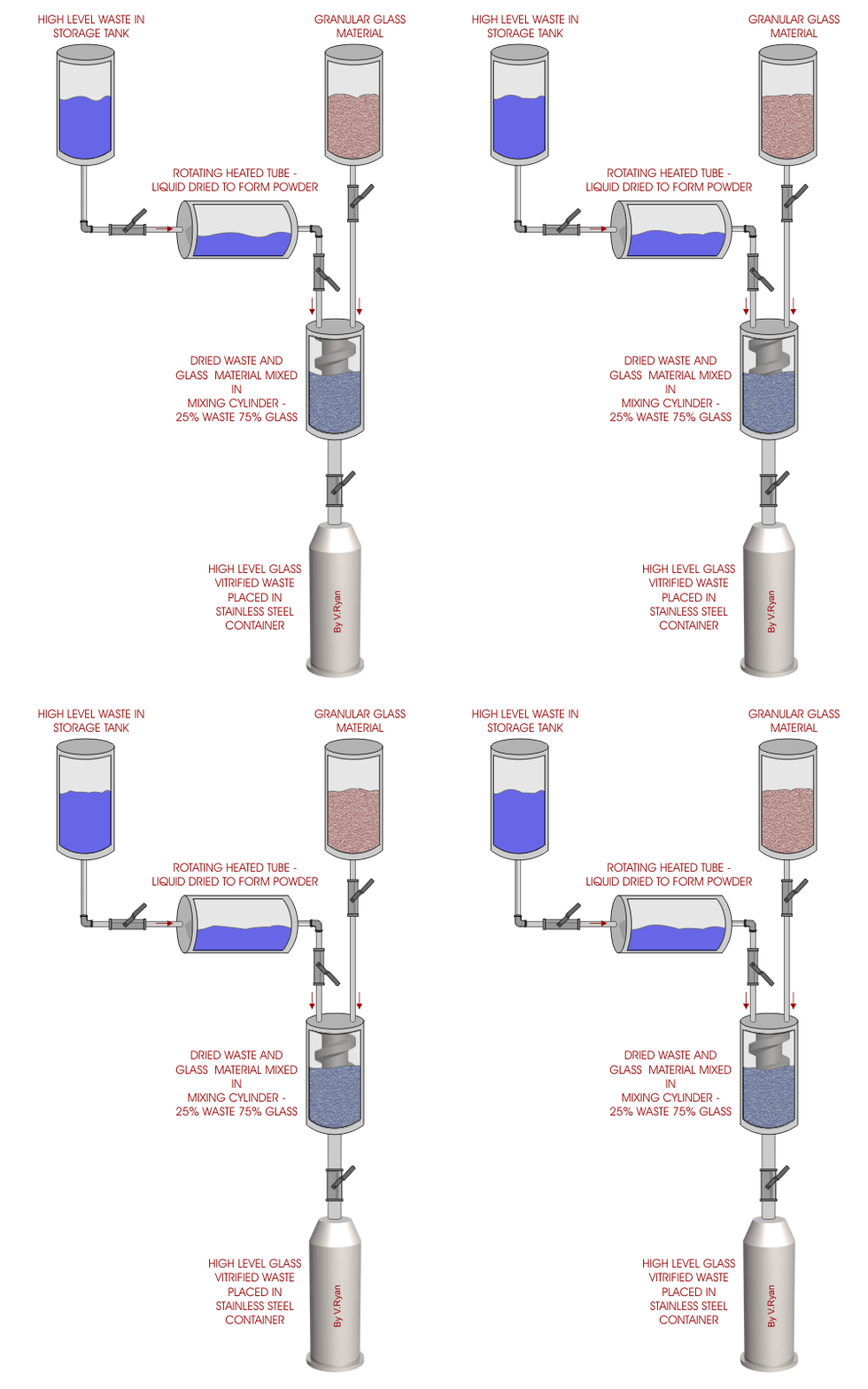
What causes nuclear waste glass to dissolve? Phys Org, University of Houston October 10th, 2018 Immobilizing nuclear waste in glass logs—a process known as vitrification—is currently used in the United States to safeguard waste from sites associated with defense activities. Some other countries also use the process to capture waste from nuclear power plants.
Researchers know, however, that the glass can begin to dissolve after a long period of time, and the durability of these glass logs remains an active area of research.
Researchers from the University of Houston, the Department of Energy’s Pacific Northwest National Laboratory and the University of Pittsburgh are working on one of the most pressing issues—what causes the glass to begin to deteriorate relatively quickly at some point, potentially releasing radioactive waste at levels exceeding regulatory thresholds?……….”We have long observed from laboratory studies that zeolite formation in glass corrosion tests resulted in an increase in the glass corrosion rate,” said Neeway, a researcher at PNNL. ………
Zeolite P, the zeolite that forms from the glass, is affected by temperature—Rimer said researchers synthesize it in the lab at 100 °C—but they don’t yet know how crystallization proceeds at lower temperatures and they don’t have methods to deter its formation. But controlling temperatures in the geologic formations designated as nuclear waste repositories is not necessarily practical, thus researchers are looking for other factors that might affect crystal growth, including components of the glass. https://phys.org/wire-news/300629772/what-causes-nuclear-waste-glass-to-dissolve.html
UN group responds to Scott Morrison’s statement that Australia won’t be ‘throwing money’ into fund, https://www.theguardian.com/environment/2018/oct/10/poor-countries-urge-australia-to-honour-green-climate-fund-commitments, Graham Readfearn, An official United Nations grouping of 47 of the world’s poorest countries has urged Australia to “honour its international commitments” after the prime minister, Scott Morrison, said the country would not be “throwing money” into a key international climate change fund.Australia has previously pledged $200m to the Green Climate Fund (GCF), set up through the UN’s climate convention to help developing countries adapt to the impacts of climate change and cut their own greenhouse gas emissions.
One international climate expert said that geopolitically it was “mildly insane” that Australia was backing out of the GCF.
In a statement to Guardian Australia, Ethiopian Gebru Jember Endalew, the chair of the Least Developed Countries (LDC) Group, said: “Funding from wealthy nations such as Australia is key to enabling an effective global response.
“LDCs and other developing countries have made ambitious plans, but these plans cannot be implemented without sufficient tools and resources being mobilised. The Green Climate Fund plays an integral role in delivering these funds and continues to be underresourced.”
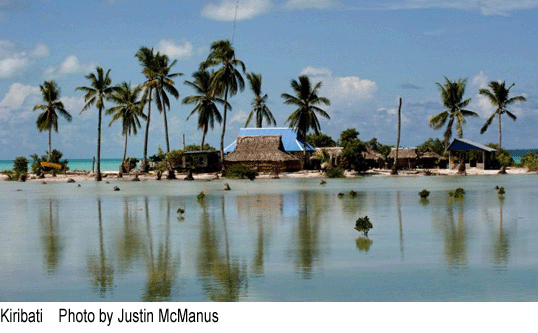
The LDC Group represents 47 countries at UN climate negotiations and says its members are “specially vulnerable to climate change but have done the least to cause the problem”. African nations dominate the LDC group, alongside Pacific and East Asian countries Timor-Leste, Kiribati, Vanuatu and Tuvalu. Continue reading →
Opinion: ¶ “Why You Have (Probably) Already Bought Your Last Car” • You may be scoffing in disbelief at this article’s title, but bear with me. A growing number of tech analysts are predicting that in under 20 years we will all have stopped owning cars, and the internal combustion engine will have been consigned to […]
Two new wind farm developments supported by the Andrews Labor Government’s Victorian Renewable Energy Targets (VRET) reverse auction are delivering new industries and jobs for Geelong. The post New wind farm developments bring jobs to Victoria appeared first on RenewEconomy.
AEMO’s Zibelman says exiting coal fired generation does not mean the lights going out. The post AEMO’s Zibelman: Transition out of coal does not mean lights going out appeared first on RenewEconomy.
Hurricane Michael On Path of Several Nuclear Reactors, Latest Maps, Charts, Live Data, Flooding
(Put up with the annoying advertising stuff at the beginning of this video)
Nearly 3,000 Georgia Power personnel ready to respond to Hurricane Michael
Company reminds customers to stay informed and safe during and after storm Ciston PR Newswire ATLANTA, Oct. 10, 2018 /PRNewswire/ — As Hurricane Michael impacts the Gulf Coast, Georgia Power is ready to respond to power outages as quickly and safely as possible with nearly 3,000 personnel from the company and assisting utilities. Crews are continuing to mobilize from unaffected areas across Georgia over the next 24 hours and are strategically positioning throughout the state ready to re-enter central and south Georgia, and other areas, as Hurricane Michael subsides.
Hurricane Michael enters Georgia, 65,000 customers without power, Ciston PR Newswire Extensive damage and extended power outages in South Georgia expected to continue over next 24 hours due to high winds and falling trees
NEWS PROVIDED BY
Georgia Power ATLANTA, Oct. 10, 2018 /PRNewswire/ — Hurricane Michael arrived in Georgia this evening and is impacting service to Georgia Power customers. The company is prepared to respond with approximately 3,900 personnel from the company, other Southern Company operating companies and assisting utilities ready to restore power as quickly and safely as possible following the storm. All of Georgia Power’s resources are being held and dedicated to storm restoration efforts in the state following Hurricane Michael.
Georgia Power expects damage due to high winds, heavy rain and fallen trees. Once the storm passes, the company must wait until conditions are safe for damage assessment teams to enter the impacted zones and begin the restoration process, followed by repair crews, which could take several days, depending on the amount of damage and safe access to the area. As weather conditions improve, restoration efforts will accelerate, but it could take an extended period of time for all customers to be restored…….
Dave Sharma says Liberals ‘doing enough’ on climate after Hewson attack
The Wentworth candidate rejects former leader’s view that party’s policy on emissions is inadequate, Guardian, Anne Davies, @annefdavies 10 Oct 2018 The Liberal candidate for Wentworth, Dave Sharma, said his party is “doing enough” and has “a good record” on climate change, after a blistering attack from former leader John Hewson, who said the party deserved a “drubbing” over its inaction on the issue…….Hewson has accused the Liberals of putting their heads in the sand on the issue and kicking the issue down the road for future generations.
The former prime minister Malcolm Turnbull dropped plans for a national energy guarantee that would have imposed emissions reduction targets and then was dumped by his own party, which was deeply divided over his plan……
the economy has been growing and so too have overall emissions.
Australia is on a trajectory that will see it miss its Paris climate targets – a reduction of 26% to 28% based on 2005 levels – according to figures from the consultants, NDEVR Environmental, for the year up to the end of June 2018.
The NDVER figures showed Australia’s emissions were again the highest on record when unreliable data from the land use and forestry sectors was excluded. This was the third consecutive year for record-breaking emissions.
Despite this, Frydenberg claimed that the nation is on track to meet its Paris commitments – even without the Neg, which he had supported. He also lauded the Coalition’s record on investment in renewables…….
At its recent General Assembly in Iceland the World Medical Association passed an unequivocal call for nations to adopt and implement the UN Treaty on the Prohibition of Nuclear Weapons.
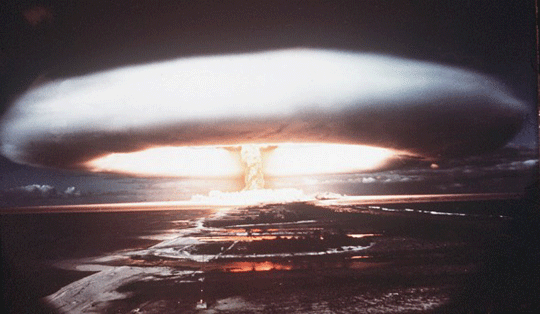
France is being taken to the International Criminal Court for nuclear weapons tests in French Polynesia. France has long denied responsibility for the impacts of the tests and only recently began compensating civilians. France is being taken to the International Criminal Court (ICC) for carrying out nuclear weapons tests in French Polynesia, a Polynesian opposition leader announced on Tuesday.
Oscar Temaru, the archipelago’s former president and current leader of the Tavini Huiraatira Party, announced the move during a United Nations committee dealing with decolonization.
Temaru accused France of “crimes against humanity” and said that he hopes to hold French presidents accountable for the nuclear tests with the ICC complaint.
“We owe it to all the people who died from the consequences of nuclear colonialism,” he told the UN committee.
Maxime Chan from Te Ora Naho, an association for the protection of the environment in French Polynesia, told the UN that there had been 368 instances of radioactive fallout from the tests and that radioactive waste had also been discharged into the ocean — violating international rules.
Three decades of nuclear tests
The French territory, currently home to 290,000 people, is best known for the popular tourist island of Tahiti, but its atolls of Mururoa and Fangataufa were used for decades for nuclear tests.
France carried out 193 nuclear weapons tests on islands in the archipelago between 1960 and 1996 until French President Jacques Chirac halted the program.
Around 150,000 military and civilian personnel were involved in France’s nuclear tests, with thousands of them later developing serious health problems.
France has long denied responsibility for the detrimental health and environmental impacts of the tests, fearing that it would weaken the country’s nuclear program during the Cold War.
In 2010, France passed a law allowing military veterans and civilians to be compensated if their cancer could be attributed to the nuclear tests. Out of approximately 1,000 people who have filed complaints against France, only 20 have been compensated.
news.com.au , 10 Oct 18, IT WAS Australia’s big hope for cutting your electricity bills and ending the climate wars but today it’s been confirmed that’s not going to happen. EVERYONE has been crying out for the major parties to agree on an energy policy for Australia but it’s becoming clear this is probably not going to happen.
At an energy forum being held in Sydney today, new Federal Energy Minister Angus Taylor dismissed suggestions a bipartisan agreement was the way forward and pointed to the huge difference in the policies of the major parties.
“I don’t know how we’re going to get bipartisanship given we have a 26 per cent emissions reduction target … and the other side has 45 per cent,” Mr Taylor told the AFR Energy Forum 2018.
Australia’s energy policy is in tatters after the National Energy Guarantee was abandoned by the Coalition after Malcolm Turnbull lost the prime ministership.
Now even Labor’s shadow minister for climate change and energy Mark Butler has acknowledged defeat. Speaking after Mr Taylor, he said the idea of developing a bipartisan “market mechanism” to address climate and energy policy would not happen.
“We need to recognise that the solution we’ve been banking on now for a number of years … has been snatched away,” he told the forum.
“They (the Coalition) have walked away from the table because they’ve said they can’t countenance any agreement with Labor over climate and energy policy.”
Mr Butler noted the two parties got close in 2016 with the emissions intensity scheme, then again in 2017 with the clean energy target and most recently with the NEG this year, but each time the policies were taken off the table largely due to revolt within the Coalition party room led by Tony Abbott, despite the policies having broad support among state and territory governments as well as the business community.
“Now we confront a position … where investors are left with no rules to guide their investment decisions once the renewable energy target starts to taper off in coming months.”
As Australia heads towards its next federal election — likely to be held next year — Mr Butler noted there were warnings electricity prices would rise if the NEG was not passed and the futures market was already predicting hikes next year.
But he acknowledged there was no quick fix and said getting the unit price of electricity would be difficult. He said Labor would focus on policies to reduce consumption as a way of lowering bills. It has already announced plans to help businesses with tax write-offs for capital upgrades and software to make them more energy efficient.
He said Australia’s energy efficiency and productivity was already lower than average compared to some other OECD countries and China, which haven’t enjoyed low prices in the past like Australia has.
“The pathway for really substantial reductions to energy bills for business and households, I think, lie more in an aggressive approach to energy efficiency and productivity,” Mr Butler said.
When it comes to the Coalition’s approach, Mr Taylor said Prime Minister Scott Morrison had given him one KPI (Key Performance Indicator) and that was to lower power prices while keeping the lights on………
Opposition Leader Bill Shorten says a lack of policy is preventing Australia from becoming a renewable energy superpower, but admits coal will be part of the mix for the foreseeable future.
“What we need to do is create investment certainty, write out what the rules are so we can get more renewable energy,” he told reporters in Melbourne on Wednesday.
Renewable energy “is getting cheaper and I want to make it more accessible to small business and consumers.”
Apr 15, 2026 01:00 AM in Canberra, Melbourne, Sydney
Join the International Physicians for the Prevention of Nuclear War (IPPNW) on Tuesday, April 14th for a timely webinar exploring the risks associated with nuclear power and challenging the myth that it offers a simple, safe, carbon-free solution to the climate crisis
21 April Webinar: No Nuclear Weapons in Australia
Start: 2026-04-21 18:00:00 UTC Canberra, Melbourne, Sydney (GMT+10:00)
End: 2026-04-21 19:30:00 UTC Canberra, Melbourne, Sydney (GMT+10:00)
Event Type: Virtual A virtual link will be communicated before the event.






 Antinuclear