 Victoria’s largest solar farm goes ahead after “solving” connection Victoria’s largest solar farm goes ahead after “solving” connection  dilemma, REneweconomy, Giles Parkinson, 16 October 2018 The 200MW Kiamal solar farm in Victoria – the largest in the state to date – will be officially launched on Wednesday and begin construction this month after developer Total Eren says it has resolved connection issues that had already delayed the $300 million project.The Kiamal solar farm is located near the town of Ouyen – not far from Mildura in the state’s north west. But as RenewEconomy revealed in May, it is located in what could be described as the “rhombus of death”, a part of the network that doesn’t have the “system strength” to accommodate all the wind and solar projects planned for the area. dilemma, REneweconomy, Giles Parkinson, 16 October 2018 The 200MW Kiamal solar farm in Victoria – the largest in the state to date – will be officially launched on Wednesday and begin construction this month after developer Total Eren says it has resolved connection issues that had already delayed the $300 million project.The Kiamal solar farm is located near the town of Ouyen – not far from Mildura in the state’s north west. But as RenewEconomy revealed in May, it is located in what could be described as the “rhombus of death”, a part of the network that doesn’t have the “system strength” to accommodate all the wind and solar projects planned for the area.
|
October 16, 2018
Posted by Christina Macpherson |
solar, Victoria |
Leave a comment

 https://reneweconomy.com.au/washington-dc-pushes-100-renewable-energy-bill-48151/
Joshua S Hill 16 October 2018 A bill currently working its way through the Washington D.C. City Council will require all local utilities to source 100% of their electricity from renewable energy sources by 2032.
Like the Australian Capital Territory in Canberra, which has its own 100 per cent renewable energy target that will be met by 2020 – it is a strong and not-so-subtle reprimand to the occupant of the capital district’s most famous house.
The CleanEnergy DC Omnibus Amendment Act of 2018 was introduced to the Council of the District of Columbia (Washington D.C.) in July and has been working its way through procedures before the first of two public hearings was held last week.
In addition to increasing the District’s Renewable Portfolio Standard to 100% – which would mandate utilities operating in the District source all their electricity from renewable energy sources by 2032 – the omnibus bill also seeks to establish a solar energy standard and require utilities to procure at least 5 per cent of their power from solar by 2032.
In a move obviously intended to increase solar development in the area, the bill includes an interesting wrinkle which proposes to increase the mandated share of solar, up until a limit of 1.68GW.
“The fight to reduce the impacts of climate change is the most important environmental issue of our time,” said council member Mary M. Cheh (D-Ward 3) in July, who drafted the bill.
“The District has been a leader in this fight, but we need to do much more if we wish to achieve the greenhouse gas reduction goals in the Sustainable DC Plan and in our commitment to the Paris Accords on Climate Change.
By changing the way we approach energy consumption and building emissions, we will have a clear path forward in the fight against the devastating effects of climate change.”
The first of two hearings comes at an opportune time for the successful passing if the omnibus bill, coming as it did only a day after the Intergovernmental Panel on Climate Change (IPCC) released a Special Report on global warming, which outlined “rapid, far-reaching and unprecedented changes in all aspects of society” are needed in order to limit global warming to 1.5°C.
“If passed, this will be the strongest clean energy and climate protection law in the nation,” said Mark Rodeffer, chair Sierra Club DC Chapter. “To meet DC’s pledge to reduce greenhouse gas emissions 50 percent by 2032 and 80 percent by 2050 and to protect our communities from the catastrophic effects of climate change, this kind of resolute action is needed.”
In addition to the aforementioned provisions in the omnibus bill, it also includes new building emissions standards, funding for local sustainability initiatives, and the promise of new rules on transportation emissions.
“This bill provides the bold action needed to match the urgency of the climate crisis,” added Cliff Majersik, Executive Director of the Institute for Market Transformation. “It builds on the Clean Energy DC plan and the District’s 12-year legacy of clean energy and green building policy achievement, again blazing a path for other cities to follow.
It will stimulate investments to cut energy costs, reduce the flow of money from the District for energy imports, and create jobs for DC residents advancing renewables and energy efficiency.”
October 16, 2018
Posted by Christina Macpherson |
General News |
Leave a comment
Dr Jim Green, Nuclear Monitor #867, 15 Oct 2018
 https://www.wiseinternational.org/nuclear-monitor/867/nuclear-monitor-867-15-october-2018
The UN’s Intergovernmental Panel on Climate Change (IPCC) has issued a landmark report warning that global warming must be kept to 1.5˚C, requiring “rapid and far-reaching” transitions in land, energy, industry, buildings, transport, and cities.1
The world must invest US$2.4 trillion in clean energy every year through 2035 and cut the use of coal-fired power to almost nothing by 2050 to avoid catastrophic damage from climate change, according to the IPCC. To put the US$2.4 trillion figure in context, about US$1.8 trillion was invested in energy systems globally in 2017, of which about 42% was invested in electricity generation and about 18.5% in renewables.2
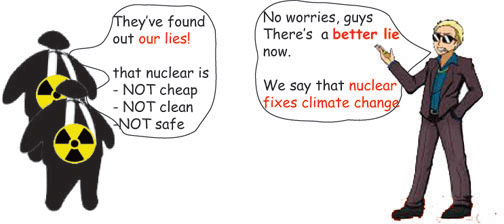
Unsurprisingly, the World Nuclear Association (WNA) used the IPCC report to promote nuclear power.
 WNA Director General Agneta Rising said the IPCC report “makes clear … the necessity of nuclear energy as an important part of an effective global response” to climate change and that it “highlights the proven qualities of nuclear energy as a highly effective method of reducing greenhouse gas emissions, as well as providing secure, reliable and scalable electricity supplies.”3 In a separate statement, the WNA falsely claimed that nuclear power increases under all of the IPCC scenarios compatible with limiting warming to 1.5˚C.4
Almost all of the WNA’s claims are false or exaggerated. The IPCC report raises numerous concerns about nuclear power (discussed below). In general terms, nearly all of the scenarios presented in the IPCC report envisage a decline in nuclear power generation to 2030 followed by an upswing.5 No logical rationale ‒ or any rationale at all ‒ is provided to support the upswing from 2030 to 2050.

The points that jump out from the IPCC’s low-carbon 1.5°C scenarios are that nuclear accounts for only a small fraction of energy/electricity supply (even if nuclear output increases) whereas renewables do the heavy lifting. For example, in one 1.5°C scenario, nuclear power more than doubles by 2050 but only accounts for 4.2% of primary energy whereas renewables account for 60.8%.6 In another 1.5°C scenario, nuclear nearly doubles by 2050 but its contribution to total electricity supply falls to 8.9%, compared to 77.5% for renewables.7
The IPCC report notes that: “Nuclear power increases its share in most 1.5°C pathways by 2050, but in some pathways both the absolute capacity and share of power from nuclear generators declines. There are large differences in nuclear power between models and across pathways … Some 1.5°C pathways no longer see a role for nuclear fission by the end of the century, while others project over 200 EJ / yr of nuclear power in 2100.”8
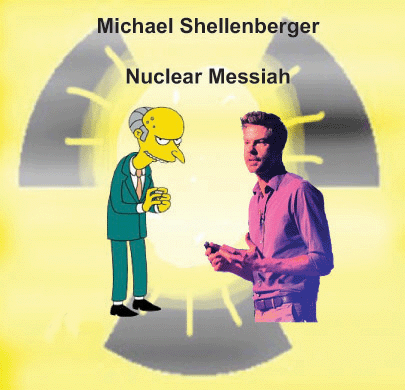
Nuclear lobbyist Michael Shellenberger has a very different take on the IPCC report to the WNA … and most of his claims are false as well.9 Shellenberger takes the IPCC to task for stating that nuclear power risks nuclear weapons proliferation.10,11 That is “unsubstantiated fear-mongering”, he claims, although Shellenberger himself has written at length about the manifold and repeatedly-demonstrated connections between nuclear power and weapons.12 “No nation has used its civilian nuclear plants to create a weapon”, Shellenberger now claims ‒ which is garbage.13
Shellenberger seems troubled by the IPCC’s claims about a possible connection between nuclear power and childhood leukemia ‒ but he doesn’t explain why. The IPCC’s comments are modest: “Increased occurrence of childhood leukaemia in populations living within 5 km of nuclear power plants was identified by some studies, even though a direct causal relation to ionizing radiation could not be established and other studies could not confirm any correlation (low evidence/agreement in this issue).”10 In fact the evidence of a link is stronger than the IPCC suggests.14,15
Shellenberger complains about “biased and misleading cost comparisons” in the IPCC report though the report simply notes that nuclear power provides an example of “where real-world costs have been higher than anticipated … while solar PV is an example where real-world costs have been lower”.16
Shellenberger claims that solar and wind contributed 1.3% and 3.9% to global electricity supply in 2017 ‒ the true figures are 1.9% and 5.6%.17 He fails to note that all renewables combined supplied 26.5% of global electricity supply in 2017 (2.5 times more than nuclear) or that renewable supply has doubled over the past decade while nuclear power has been stagnant.
References: Continue reading →
October 16, 2018
Posted by Christina Macpherson |
General News |
Leave a comment
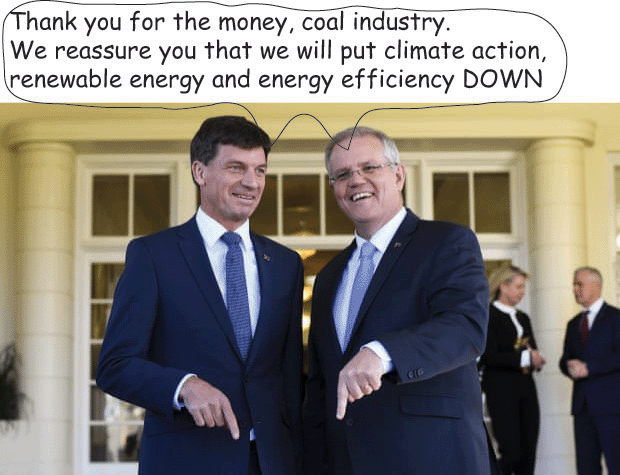
 The Australian Greens have warned against the Morrison government
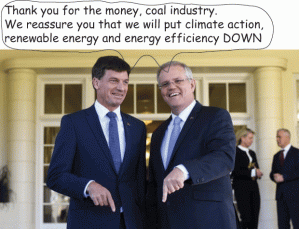 backing a coal-led energy policy over the Snowy Hydro 2.0 project. SBS, 15 Oct 18
 Greens MP Adam Bandt has warned the Coalition’s views on climate change and renewable energy will “kill people”.A major report released last week, referencing more than 6000 scientific studies, stated drastic changes are needed in global society to prevent world temperatures from rising by two degrees Celsius.
The Coalition Government says it will not renew or replace the Renewable Energy Target when it lapses in 2020.
Mr Bandt’s claim comes on the same day as former Deputy Prime Minister Barnaby Joyce declared the expected $4.5 billion cost for the Snowy 2.0 scheme would be better off used on funding new coal-fired power stations.
“The Coalition’s energy policy will kill people – it’s as simple as that,” Mr Bandt told reporters on Monday.
“Australia is going to be one of the countries worst hit by climate change and the Morrison government seems to not care how many people will die because of its policies.
“If Barnaby Joyce is concerned about farmers then he’d want to switch from coal to renewables.”
Mr Joyce told The Australian he would prioritise coal-fired power stations, two months ahead of a decision on the Snowy 2.0 scheme……https://www.sbs.com.au/news/coalition-s-climate-change-stance-will-kill-people-say-greens
October 16, 2018
Posted by Christina Macpherson |
AUSTRALIA - NATIONAL, climate change - global warming, politics |
Leave a comment
 Nuclear industry responds by calling those who disagree with the ICRP and IAEA in these matters “radiophobes”. The Japanese government responds to the disagreement coming from its people with more and more imposed secrecy, and greater compliance with international nuclear bodies. Looked at in another way, the Japanese government obeys the IAEA and ICRP.
It is little wonder theJapanese world nuclear industry via its local mouthpieces and puppets in every land continues to claim the effects of the nuclear disaster have no consequence. Nor is it any surprise that the nuclear industry continues to illegally diagnose opponents to its dictates and insults as being “radiophobic”.
Earthquake Damage At Fukushima – is Industry’s Narrative Truthful or Certain? Nuclear History, 16 Oct 18 “……..As I have pointed out previously, the declared extent of decontamination in Japan has enable some evacuees to return to their homes. The residual contamination remaining in those cleanup areas being about the same, roughly, as the Maralinga lands in South Australia after cleanup there. The risk of radiogenic cancer in the Maralinga Lands in 1 in 50,000 over 50 years. The owners of the Maralinga lands had been suffering forced removal from their lands from the 1950s until the 1990s, with full return of lands completed in the 21st century. Many people died waiting to return.
In Japan many people are concerned that they have been economically forced to return to places prior to a proper cleanup. In Australia, many people are concerned that the Maralinga cleanup was a dud, cheap, and insufficient. As usual vitrification in nuclear residues resulted in explosions and so elements including plutonium were simply buried in trenches.
In Japan, great piles of contaminated material, so active the piles have to be shielded with sand bag shielding in order to protected nuclear garbage workers, remain in the open air. A minority of the material is under cover in interim storage.
But all of this is claimed to be of no consequence according to the nuclear industry.
Since the 1990s, when the Maralinga cleanup was designed around the new intervention level proposed by the ICRP planned for the 21 century, many Australians have stated that the new levels allowed are too high. And that the risk at Maralinga is too high. The ICRP intervention level is 10 mSv. The actual level aimed at Maralinga was 5 mSv. Japan complies with the guidelines. And that fact is in actual reality no comfort for many many affected Japanese people. No comfort at all. Because those people do not trust either nuclear authorities or their own government. Continue reading →
October 16, 2018
Posted by Christina Macpherson |
AUSTRALIA - NATIONAL, spinbuster |
Leave a comment
|
 New Aust uranium deal for UK after Brexit https://www.sbs.com.au/news/new-aust-uranium-deal-for-uk-after-brexit, 15 Oct 18. New Aust uranium deal for UK after Brexit https://www.sbs.com.au/news/new-aust-uranium-deal-for-uk-after-brexit, 15 Oct 18.
Australia is working on a new deal for selling uranium to the United Kingdom once it leaves the European Union. Australia is working on a new nuclear deal with the United Kingdom once it leaves the European Union.One fifth of Australia’s uranium goes to the UK, but it cannot be used for military purposes, or sold to other countries who use it for their militaries.
Dr John Kalish, acting director general of the Australian Safeguards and Non-proliferation Office, says a new deal will have to be done with the UK to mirror the old one with the EU.
Under the old deal and the proposed one, the UK can only sell the uranium on to certain countries.
“Retransfers can only be made to third parties that have a nuclear cooperation agreement with Australia,” Dr Kalish told a parliamentary committee on Monday.
But Dr Kalish could not reveal which countries Australian uranium ends up in, citing “commercial in confidence”.
Liberal MP Andrew Wallace can’t understand why.
“I’m just trying to work out why the Australian people can’t be informed what third party countries the UK might reassign or retransfer uranium that comes out of this country?” he asked.
Dr Kalish said he could give the committee the names of the countries, but they would have to remain secret.
Meanwhile, Labor’s foreign affairs spokeswoman Penny Wong gave a speech to the Australian Institute of International Affairs on Monday, in which she called for Australia to take a greater role in banning nuclear weapons.
“A Shorten Labor government will seek to muster wide international support, including from the states that possess nuclear weapons, for a ‘No First Use’ declaration,” she said.
“For states with nuclear weapons to adopt a ‘No First Use’ policy would constitute a major step forward in reducing tensions and risks of accidental or mistaken use.”
Senator Wong says Labor will also use Australia’s strong relationships with nuclear weapons states to push for a reduction in their nuclear stockpiles.
“Dismantling 15,000 nuclear warheads and the security arrangements that rest upon them is not going to happen overnight,” she said.
|
|
October 16, 2018
Posted by Christina Macpherson |
AUSTRALIA - NATIONAL, business, politics international |
Leave a comment
 Modest member: Go nuclear for a clean energy future The modern nuclear reactor is small, modular, self-contained and safer than any other energy generation, Financial Review, by Amanda Stoker 14 Oct 18 Amanda Stoker is a Liberal National Party senator for Queensland
Australia must develop a nuclear energy industry. It promises to provide clean and reliable energy from a resource we have in abundance.
The modern nuclear reactor is small, modular, self-contained and safer than any other energy generation method. It provides flexible generation capacity, as it can increase or reduce electricity output to reflect demand. [Ed . Just a pity that it doesn’t exist – among other drawbacks]
Prime Minister Scott Morrison has acknowledged that all electricity generation options with the capacity to reduce electricity prices need to be considered……
For too long we have allowed nuclear energy to remain off-limits in the discussion about the security of Australia’s energy supply. What we need is an informed and rational debate that isn’t driven by fear.
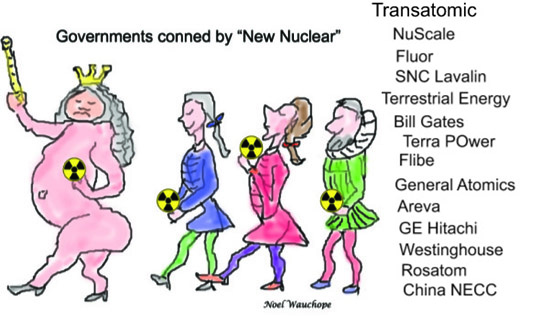
 While the high capital cost of traditional nuclear reactors makes them unattractive compared to coal and natural gas as a source of dispatchable baseload power, the advent of safer and cheaper small modular reactors (SMRs), for example the NuScale facility commissioned in Idaho, offer a competitive and cost-effective entry point for Australia to cutting edge nuclear energy technology.
The projected levelised cost of electricity (LCOE) of NuScale’s SMR is comparable to other forms of dispatchable generation in the pipeline. [ Ed. Wha..aaa,..t?
The Australian Nuclear Science and Technology Organisation (ANSTO) has said a nuclear energy industry built either on SMRs or Generation IV reactors is technically feasible in Australia, but we do not have the necessary expertise available…….
The Australian Radiation Protection and Nuclear Safety Act and the Environmental Protection and Biodiversity Conservation Act prohibit the approval, licensing, construction, or operation of a nuclear fuel fabrication plant, a nuclear power plant, an enrichment plant or a reprocessing facility.
These acts should be amended to enable a nuclear energy industry to develop in Australia……. https://www.afr.com/opinion/modest-member-go-nuclear-for-a-clean-energy-future-20181014-h16m17
October 16, 2018
Posted by Christina Macpherson |
AUSTRALIA - NATIONAL, politics |
Leave a comment
ABC, By Jane Bardon 16 Oct 18 A group of Indigenous traditional owners from remote parts of the Northern Territory will travel to Origin Energy’s annual general meeting in Sydney on Wednesday to tell shareholders they have not given permission for the company to frack their land for gas.
Key points:
- A group of Indigenous traditional owners will soon tell Origin Energy shareholders they did not give consent for its planned developments
- They will ask the company to review consent agreements
- But the company is confident traditional owners already gave consent
Origin Energy gained official approvals for gas exploration, including test fracking, in the gas-rich Beetaloo Basin, both from traditional owners through the Northern Land Council, and the Northern Territory Government.
But some of the traditional owners plan to tell the shareholder meeting they oppose fracking, and did not give their “free, prior and informed consent”.
They hope to tell the meeting when permission for fracking was sought by Origin Energy, they did not fully understand the company’s explanations of processes, or the potential size of developments potentially numbering hundreds of wells.
“The letter that we’re bringing up to Origin, we want that to be recognised, and to be respected for who we are,” Alawa traditional owner Naomi Wilfred said.
The Alawa traditional owner, whose country includes Nutwood Downs in the northern part of Origin Energy’s EP98 permit area, said she is worried about potential environmental impacts if production goes ahead……..http://www.abc.net.au/news/2018-10-16/indigenous-traditional-owners-origin-energy-fracking-consent/10379162
October 16, 2018
Posted by Christina Macpherson |
aboriginal issues, Northern Territory |
Leave a comment
The status of “Station Blackout” is a serious one.
“it will be many years before the Japanese people know exactly what happened at Fukushima Daiichi on 11 March 2011. One of the key mysteries was role, if any, the magnitude 9 earthquake played in damaging the plant’s reactor cooling systems. Until lethal levels of radiation inside the reactors fall and workers can carry out comprehensive investigations, the truth about the tremor’s impact will remain a subject of conjecture and contention”
Mr. Takamatsu states with expert authority that the pipes of cooling system ware not designed for the 50 second vibration of the magnitude quake. Barry Brook, kangaroo expert, disagrees and tells the world the quake caused no damage at Fukushima. Yet Mr. Brook must surely know the earthquake caused grid blackout. For reactors are all shut down by earthquakes. A solar plant would have kept generating until the last panel shattered. No one would have been evacuated from such a solar plant.
I submit that Prof. Barry Brook’s description of the effects of earthquake upon the Fukushima Diiachi on 11 March 2011 is totally ignorant of the facts as presented by many qualified experts and fly in the face of the independent commission set up by the Japanese Parliament (Diet). It is confirmed that expert investigators concern aspects of TEPCO’s explanations regarding the quake are “irrational”.
Thus any narrative based upon the nuclear industry view, in line with TEPCO’s may fairly be said to be “irrational”. For the industry view is that there is no possibility of quake damage to any structure or sub structure, such as coolant pipes and valves.
Earthquake Damage At Fukushima – is Industry’s Narrative Truthful or Certain? Nuclear History, 16 Oct 18 I am again going to contrast the statements made by Barry Brook in regard to the events and outcomes at Fukushima Daiichi in 2011 with the facts as presented by Mark Willacy. These facts are published in Willacy’s book, “Fukushima – Japan’s tsunami and the inside story of the nuclear meltdowns”, Willacy, M., Pan Macmillan, copyright 2013, Mark Willacy.
However, I will also include information related to the events which were first published and discussed in 2011. ………..
The earthquake generated the tsunami. What else did the earthquake cause?
In this blog I have included posts which give the IAEA considerations for the electrical grids which are connected to nuclear power plants. The IAEA states that the level of engineering and resilience built into such grids may be a significant additional cost for any nation considering generation to nuclear power.
It comes as no surprise then the electrical grid connected to the Fukushima Daiichi NPP failed for two reasons. 1. The earthquake caused all the nuclear reactors connected to the same grid to rapidly shut down. Thus the earthquake caused a blackout due to cessation of electrical generation. 2. The physical grid infrastructure – poles and wires – were damaged by the earthquake. At Fukushima this meant that more than one of the reactors was physically separated from the grid by the earthquake.
It can therefore be seen that the earthquake meant A. Fukushima Diiachi could not generate nuclear electricity as the quake had shut the reactors down. B. The Fukushima Diiachi Nuclear Power Plant was in Station Blackout for one reason: earth quake damage to nuclear infrastructure – the electrical grid. Continue reading →
October 16, 2018
Posted by Christina Macpherson |
AUSTRALIA - NATIONAL, spinbuster |
Leave a comment
BBC 15th Oct 2018 US President Donald Trump has accused climate change scientists of having a
 “political agenda” as he cast doubt on whether humans were responsible for
the earth’s rising temperatures. But Mr Trump also said he no longer
believed climate change was a hoax. The comments, made during an interview
with CBS’s 60 Minutes, come less than a week after climate scientists
issued a final call to halt rising temperatures. The world’s leading
scientists agree that climate change is human-induced.
https://www.bbc.co.uk/news/world-us-canada-45859325
October 16, 2018
Posted by Christina Macpherson |
General News |
Leave a comment











 Antinuclear