Climate Democrats to enter the fray and disrupt Australia’s politics — RenewEconomy

A new political party will appear on the scene tomorrow and will seek to disrupt the “politics as usual” that Australian voters do not like, but have become used to. The post Climate Democrats to enter the fray and disrupt Australia’s politics appeared first on RenewEconomy.
via Climate Democrats to enter the fray and disrupt Australia’s politics — RenewEconomy
Australian government’s hypocritical performance at UN Climate Summit
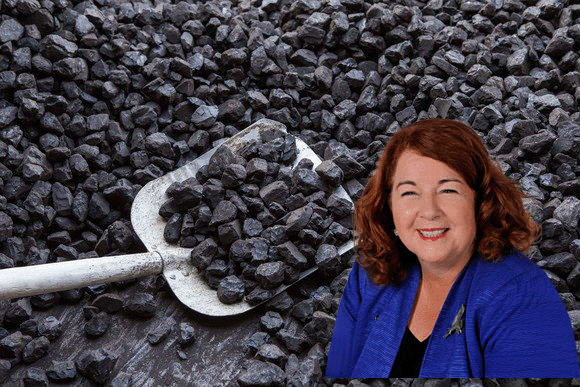
 ‘New energy future’: Minister touts Australia at climate summit, Brisbane Times, By Peter Hannam,13 December 2018 — Australia is moving “towards a new energy future”, powered by unprecedented investments in renewable energy, Environment Minister Melissa Price has told a summit in Poland even as the country earned a “fossil of the day award for its poor climate policies.
In a speech on Wednesday at the COP24 climate talks in Katowice, Ms Price said Australia was “committed to the Paris Agreement” and the development of a “robust rulebook” to implement the global pact agreed in 2015…….
Richie Merzian, a climate researcher with The Australia Institute, said Minister Price’s speech “relied almost entirely on policies her government tried to kill-off or water down”.
He also criticised the climate finance pledge, saying Prime Minister Scott Morrison “had trashed and cut support for UN’s key climate finance body, the Green Climate Fund”.
‘Fossil of the Day’
The network also raised the issue, first reported by the Herald, that Australia had “remained silent” about whether it planned to use any surplus from the Kyoto Protocol period – possibly 400 million tonnes worth – to count against its Paris target.
Ms Price’s Labor counterpart, Mark Butler, has also continued to not rule out the use of any Kyoto credits for its post-2020 targets.
“It’s not clear whether the so-called rulebook for the Paris Agreement will allow a carryover,” Mr Butler told Radio National on Thursday.
“If it does, we would have to consider any conditions about that,” he said, adding, “my bias is to steer very clear of cop-outs and accounting tricks when it comes to climate change policies.”
Greens climate spokesman Adam Bandt said: “It is disappointing that Mark Butler has left the door open to cooking the books to meet their Paris commitment. The analysis is clear that up to a quarter of Labor’s target could be met by fake Kyoto credits if they follow the Coalition and pull the same dodgy accounting tricks.” https://www.brisbanetimes.com.au/environment/climate-change/new-energy-future-minister-touts-australia-at-climate-summit-20181213-p50m3f.html
Some good news in the climate battle – over 1000 institutions to divest from fossil fuels
 Climate change: More than 1000 institutions pledge to withdraw investment from fossil fuels https://www.independent.co.uk/environment/fossil-fuels-divest-climate-change-global-warming-emissions-campaign-a8681931.html ‘This is a moral movement as well as a financial one,’ campaigners say Josh Gabbatiss Science Correspondent @josh_gabbatiss 14 Dec 18, Governments, universities and banks have quit fossil fuels in their hundreds after a global campaign to convince institutions to pull their investments. Climate change: More than 1000 institutions pledge to withdraw investment from fossil fuels https://www.independent.co.uk/environment/fossil-fuels-divest-climate-change-global-warming-emissions-campaign-a8681931.html ‘This is a moral movement as well as a financial one,’ campaigners say Josh Gabbatiss Science Correspondent @josh_gabbatiss 14 Dec 18, Governments, universities and banks have quit fossil fuels in their hundreds after a global campaign to convince institutions to pull their investments.
|
|
|
Want to solve climate problem? Nuclear isn’t the answer
 Want to solve climate problem? Nuclear isn’t the answer https://www.downtoearth.org.in/blog/energy/want-to-solve-climate-problem-nuclear-isn-t-the-answer-62428 Want to solve climate problem? Nuclear isn’t the answer https://www.downtoearth.org.in/blog/energy/want-to-solve-climate-problem-nuclear-isn-t-the-answer-62428
Alternatives to nuclear energy, in particular renewable sources of electricity like wind and solar energy, have become drastically cheaper. By M V Ramana December 2018 “It is nuclear power that will be the main tool to reduce emissions” said Poland’s Minister of Energy, Krzysztof Tchórzewski, in keynote remarks at a meeting during the 24th Conference of Parties to the United Nations Framework Convention on Climate Change (COP 24) being held in Katowice, Poland. There is more than a little irony in that statement. To start with, Poland, which is invested heavily in coal, has no nuclear power plants; its current plans call for starting nuclear power generation in 2030. That projection has to be taken with more than a pinch of salt. In 2002, even the International Atomic Energy Agency (IAEA), whose official objective is “to accelerate and enlarge the contribution of atomic energy”, concluded that nuclear power in Poland was not viable because of “insufficient economic competitiveness of nuclear plants, availability of cheaper alternatives and the absence of environmental motivation”. The second irony was that Tchórzewski was speaking at an event organised by an initiative called Nuclear Innovation: Clean Energy Future, that was set up in May 2018 by the country that is withdrawing from the Paris climate accord, the United States of America. The United States, under the Trump administration, has been engaged in the perverse pursuit of various efforts that will result in increased emissions. Such an administration touting nuclear power suggests a basis for scepticism about nuclear energy being a tool to reduce emissions. The final, and the most important, irony is that nuclear energy is fading in importance globally. The peak in nuclear power’s share of global electricity generation was 17.5 percent in 1996. Since then this fraction has steadily declined, reaching 10.3 percent in 2017. For a variety of reasons, the downward trend is expected to continue. Although nuclear energy’s share of electricity generation has been continuously declining, expectations for how nuclear energy will fare in the future went up in the first decade of this millennium, thanks to propaganda from nuclear advocates about an impending nuclear renaissance. That supposed resurgence came to a crashing halt after multiple devastating accidents at the Fukushima Daiichi nuclear plant in Japan that started in 2011, which reminded the world about the hazardous technology involved in the generation of nuclear power. Even the IAEA’s average projections for nuclear power for the year 2050 have decreased from 1,002 gigawatts (GW) as laid out in 2010 to 552 GW in its 2018 publication. This decline reflects the corresponding declines in future projections of nuclear power in many individual countries as exemplified by India and China. In 2010, the secretary of India’s Department of Atomic Energy (DAE) announced a target of 35 GW by 2020. The DAE is nowhere near that target and, as of December 2018, the current capacity is only 6.8 GW. If all the currently under-construction plants are ready in time, the total installed capacity will reach 13.5 GW by 2024-25, a far cry from earlier projections. In China, the country constructing the largest number of nuclear plants, the official target as of 2010 was 70 GW by 2020, and the expectation was that “reaching 70GW before 2020 will not be a big problem”. That proved not to be the case and China’s current target for 2020 is only 58 GW and it is unlikely to meet that target. India and China are often considered the poster children for nuclear energy growth—and even there the picture is quite dismal. The outlook in other countries is worse. Operating nuclear capacity in the two countries with the largest deployments of nuclear power plants, the United States and France, is expected to decline. What is behind this trend? Fukushima is only a minor part of the story. The primary reason is that nuclear power is no longer financially viable. Because they are hugely expensive, it has been known for a while that building new nuclear power plants makes little economic sense. What has changed in the last decade is that it is not just constructing new reactors, but just operating one, even one that is old and has its capital costs paid off, that has ceased to make economic sense. This is because alternatives to nuclear energy, in particular renewable sources of electricity like wind and solar energy, have become drastically cheaper. In contrast, just about every nuclear plant that was constructed in the last decade has proven more expensive than initially projected. This economic reality adds to the other well-known problems associated with nuclear energy—the absence of any demonstrated solutions to managing radioactive waste in the long run, the linkage with nuclear weapons, and the potential for catastrophic accidents. The bottom line is that nuclear power cannot be a tool to decrease emissions. If we want to solve the climate problem, we will have to look elsewhere. |
Between 340,000 and 690,000 Americans died from radioactive fallout from 1951 to 1973.
In the 1950s, the U.S. government downplayed the danger of radioactive fallout, asserting that all radioactivity was confined to the Nevada test site. Despite this, a national estimate attributed 49,000 cancer deaths to nuclear testing in the area.
But the results of new research suggest that this number is woefully inaccurate. Using a novel method, and today’s improved understanding of radioactive fallout, Keith Meyers from the University of Arizona  discovered that U.S. nuclear testing was responsible for the deaths of at least as many — and likely more — as those killed by the nuclear bombs in Hiroshima and Nagasaki.
Specifically, between 340,000 and 690,000 Americans died from radioactive fallout from 1951 to 1973.
At least 340,000 Americans died from radioactive fallout between 1951 and 1973 https://bigthink.com/politics-current-affairs/new-estimate-deaths-from-us-nuclear-tests?rebelltitem=2#rebelltitem2 Domestic nuclear testing wreaked havoc on thousands of families. MATTHEW DAVIS 14 December, 2018
- Hiroshima and Nagasaki resulted in the deaths of hundreds of thousands. But new research
 shows that domestic U.S. nuclear tests likely killed more.
 - The new research tracked an unlikely vector for radioactive transmission: dairy cows.
- The study serves as a reminder of the insidious and deadly nature of nuclear weapons.

When we think of nuclear disasters, a few names probably come to mind. There’s the Chernobyl disaster, which killed around 27,000 people, although estimates are fuzzy. After Fukushima, there were no deaths due to radiation poisoning, but this event occurred relatively recently, and radiation poisoning often kills slowly over decades. When the U.S. dropped atomic bombs on Hiroshima and Nagasaki, estimates put the death toll at around 200,000 people, but again, exact numbers are difficult to calculate.
One name that almost certainly didn’t come to mind is Nevada. When the Soviet Union detonated their first atomic bomb in 1949, the U.S. was shocked into action. America’s prior nuclear testing had been carried out in the Pacific, but it was logistically slow and costly to conduct tests there. In order to maintain dominance over the growing Soviet threat, the U.S. selected a 1,375 square-mile area in Nye County, Nevada. Continue reading
Time for the world to remember the movie “The Day After”
It’s Time to Face Up to Our Nuclear Reality
The made-for-TV movie The Day After had an enormous impact on America’s national conversation about nuclear weapons in 1983. Resuming that conversation today is essential, and the movie holds some lessons about what that would take. The Nation, By Dawn Stover– 14 Dec 18 This article originally appeared as part of a special section on The Day After at the Bulletin of the Atomic Scientists “…….The television movie The Day After depicted a full-scale nuclear war and its impacts on people living in and around Kansas City. Continue reading
Australia’s Liberal National govt will use tax-payer funds to promote new and existing coal mines
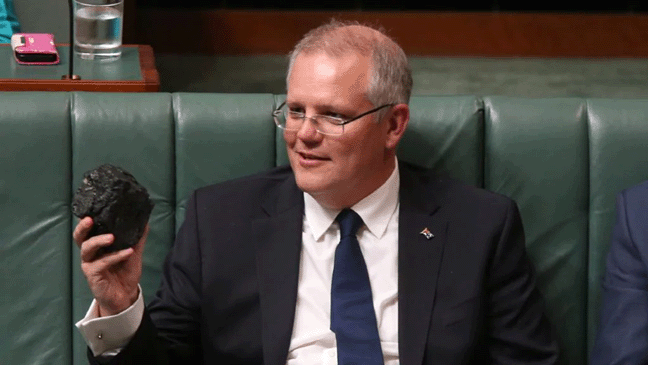
Coalition signals it will provide taxpayer support for new and existing coal plants. https://www.theguardian.com/environment/2018/dec/13/coalition-signals-it-will-provide-taxpayer-support-for-new-and-existing-coal-plants Katharine Murphy Political editor@murpharoo 13 Dec 2018
Morrison government specifies generation projects will need to be coal, gas, batteries or pumped hydro to be eligible for underwriting The Morrison government has sent a clear signal that it is prepared to provide taxpayer support for both new and existing coal plants, opening registrations of interest in its controversial new power generation underwriting program.
With the government accelerating to cover off major announcements before the Christmas break, the energy minister, Angus Taylor, will on Thursday use an event at a hydro power station in Tasmania to outline the terms of the new program and urge proponents to get their bids in over the summer break – before 23 January.
As well as finalising the criteria for the underwriting program, and calling for expressions of interest, the government is also expected to outline its response to the Ruddock review into religious freedom, and unveil its decision on Australian diplomatic facilities in Israel, before the end of the week.
Taylor will confirm on Thursday that the underwriting program – which has been criticised by business groupsand energy stakeholders – will potentially fund generation projects including new builds and brownfield projects, like upgrades or life extensions of existing coal generators.
Taxpayer support will be made available to projects through a range of financing options such as underwriting floor prices, underwriting cap prices, grants and loans – although the finalised program guidelines makes it clear that the amount of support available under each phase of the program, and the extent of taxpayer liability, will be capped.
The government has not published an upper limit on the size of eligible projects but the minimum eligible project size will be 30MW
The criteria makes it clear that the program is technology neutral but it also specifies that generation projects will need to be coal, gas, batteries or pumped hydro to be eligible for the government underwriting.
The document calling for expressions of interest does not supply any specific guidance on the emissions intensity of the projects. It says only that projects delivering an electricity product at a lower emissions intensity “will be deemed higher merit.”
It also makes clear the program will also be open to foreign investors in the event the proposal can clear Foreign Investment Review Board processes.
As to timing, the document suggests phase one is anticipated to commence in the first quarter of 2019 – which puts some of the decision making pre-election in the event the government goes to the polls in April.
Labor and the Greens are opposed to any taxpayer support for coal projects, and will continue efforts once parliament resumes next year to try and frustrate the Coalition’s program, potentially by attempting to amend the government’s “big stick” divestiture bill, which stalled in the final sitting week, to include a prohibition on power companies receiving commonwealth support.
As well as the underwriting, Taylor has also flagged the possible indemnification of projects from the future risk of a carbon price.
There is speculation around the energy sector that the government underwriting proposal could facilitate an extension of the Vales Point power station near Lake Macquarie in New South Wales. It is owned by Trevor St Baker, who was vocal during a stakeholder session last month convened to discuss the underwriting program.
Ahead of Thursday’s announcement, Taylor said: “This program will drive down electricity prices for householders by increasing competition and increasing supply in the market.”
He said the objective was to produce a pipeline of projects “that will allow us to bring targeted generation into the system in the right place at the right time”.
Climate change: global heating is drying soils, causing shrinking of world’s water supply
The long dry: why the world’s water supply is shrinking, EurekAlert, : 13-DEC-2018
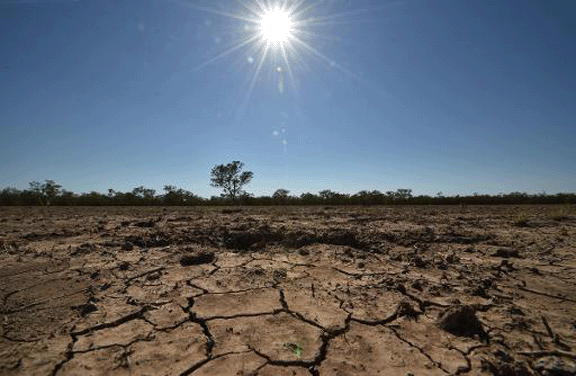 Global water supplies are shrinking, even as rainfall is rising; the culprit? The drying of soils due to climate change
UNIVERSITY OF NEW SOUTH WALES A global study has found a paradox: our water supplies are shrinking at the same time as climate change is generating more intense rain. And the culprit is the drying of soils, say researchers, pointing to a world where drought-like conditions will become the new normal, especially in regions that are already dry.
The study – the most exhaustive global analysis of rainfall and rivers – was conducted by a team led by Professor Ashish Sharma at Australia’s University of New South Wales (UNSW) in Sydney. It relied on actual data from 43,000 rainfall stations and 5,300 river monitoring sites in 160 countries, instead of basing its findings on model simulations of a future climate, which can be uncertain and at times questionable
“This is something that has been missed,” said Sharma, an ARC Future Fellow at UNSW’s School of Civil and Environmental Engineering. “We expected rainfall to increase, since warmer air stores more moisture – and that is what climate models predicted too. What we did not expect is that, despite all the extra rain everywhere in the world, is that the large rivers are drying out.
“We believe the cause is the drying of soils in our catchments. Where once these were moist before a storm event – allowing excess rainfall to run-off into rivers – they are now drier and soak up more of the rain, so less water makes it as flow.
“Less water into our rivers means less water for cities and farms. And drier soils means farmers need more water to grow the same crops. Worse, this pattern is repeated all over the world, assuming serious proportions in places that were already dry. It is extremely concerning,” he added.
For every 100 raindrops that fall on land, only 36 drops are ‘blue water’ – the rainfall that enters lakes, rivers and aquifers – and therefore, all the water extracted for human needs. The remaining two thirds of rainfall is mostly retained as soil moisture – known as ‘green water’ – and used by the landscape and the ecosystem.
As warming temperatures cause more water to evaporate from soils, those dry soils are absorbing more of the rainfall when it does occur – leaving less ‘blue water’ for human use.
“It’s a double whammy,” said Sharma. “Less water is ending up where we can store it for later use. At the same time, more rain is overwhelming drainage infrastructure in towns and cities, leading to more urban flooding.”
Professor Mark Hoffman, UNSW’s Dean of Engineering, welcomed Sharma’s research and called for a global conversation about how to deal with this unfolding scenario, especially in Australia, which is already the driest inhabited continent (apart from Antarctica).
“It’s clear there’s no simple fix, so we need to start preparing for this,” he said. “Climate change keeps delivering us unpleasant surprises. Nevertheless, as engineers, our role is to identify the problem and develop solutions. Knowing the problem is often half the battle, and this study has definitely identified some major ones.”
The findings were made over the past four years, in research that appeared in Nature Geoscience, Geophysical Research Letters, Scientific Reports and, most recently, in the American Geophysical Union’s Water Resources Research………..
Sharma said the answer was not just more dams. “Re-engineering solutions are not simple, they have to be analysed on a region-by-region basis, looking at the costs and the benefits, looking at the change expected into the future, while also studying past projects so mistakes are not repeated. There are no silver bullets. Any large-scale re-engineering project will require significant investment, but the cost of inaction could be monstrous.”
In urban areas, the reverse will be needed: flooding is becoming more common and more intense. Global economic losses from flooding have risen from an average of $500 million a year in the 1980s to around $20 billion annually by 2010; by 2013, this rose to more than US$50 billion. The Intergovernmental Panel on Climate Change expects this to more than double in the next 20 years as extreme storms and rainfall intensify and growing numbers of people move into urban centres.
Adapting to this is possible, but will require large-scale re-engineering of many cities, says Sharma. “Tokyo used to get clobbered by floods every year, but they built a massive underground tank beneath the city that stores the floodwater, and releases it later. You never see floods there now.” https://www.eurekalert.org/pub_releases/2018-12/uons-tld121118.php
Scott Morrison and the Business Council are pushing coal – but on what evidence?
 Guardian, 14 Dec 18
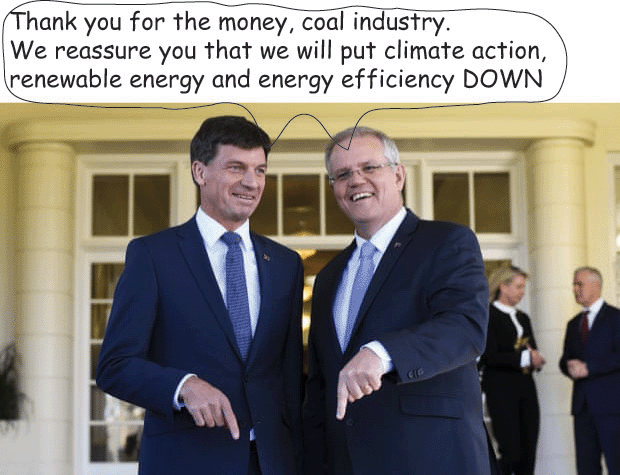
 Despite plummeting costs of renewables the government and the BCA insist that emissions reduction would be ‘economy wrecking’
Fresh from losing the economic fight about company tax cuts, the Coalition government is doubling down on an economic fight about renewable energy. And yet again, as they march into battle they have the Business Council of Australia as their key source of economic and political advice. What could go wrong?
The cost of renewable energy has fallen dramatically in the past 10 years and will continue to fall for years to come. By some accounts, new renewables with storage are already cheaper than coal fired power stations. Some argue that they aren’t quite there yet. But no one argues that in 30 years’ time a new coal-fired power station that has to buy coal will be able to compete with a solar farm that gets its sunshine for free.
Betting on the future cost of renewables is like catching a falling knife, but if there is one thing that unites the Coalition and the BCA it’s that they aren’t averse to self-inflicted wounds. At precisely the time when the costs of renewables and storage are plummeting and the world is meeting in Poland to discuss reductions in fossil fuel use, the Liberal government and the peak body for the biggest businesses in Australia are united in arguing that a 45% emissions reduction target by 2030 would be – in the words of BCA chief executive Jennifer Westacott – “economy wrecking”.
As with the failed campaign for company tax cuts, the nation’s prime minister is getting his talking points from the nation’s biggest lobbyists. In parliament last week Scott Morrison declared “a 45% target is economy wrecking”, adding to a scare-campaign designed to convince the Australian public that they have to choose between the environment they want for their kids and the jobs they want for them. It is sickening.
Not even the BCA’s own members believe the rhetoric of their peak body. Both Commonwealth Bank and Citi have renewable energy targets of 100% – Citi by 2020. Other BCA members like the CSIRO have put out a transition road map which includes 90% electricity generation from solar PV and wind by 2050 while maintaining reliability in the grid…………https://www.theguardian.com/commentisfree/2018/dec/13/scott-morrison-and-the-business-council-are-pushing-coal-but-on-what-evidence
Dreaming of a sustainable Christmas: How to reduce your ecological footprint this festive season
But the good news is that you can still live a little this festive season without having a big ecological impact.
Key points:
- Make sure your seafood is nice, not naughty — local fish is best
- Reduce or re-use plastic wrapping and decorations, or use paper alternatives
- Consider vouchers, jars of food or experiences as presents, rather than plastic gifts…….https://www.abc.net.au/news/2018-12-14/how-to-celebrate-a-sustainable-christmas/10617782
‘There should be no nuclear in climate financing’
 https://www.dw.com/en/there-should-be-no-nuclear-in-climate-financing/a-46740978
Prize-winning South African activist Makoma Lekalakala’s successful legal battle to stop a secret nuclear power deal in her homeland won her international acclaim. She tells DW about defending the environment in court.
Makoma Lekalakala: My major campaigning issue, it’s mitigation against climate change and with a specific focus on electricity generation in the country [South Africa] — it’s almost 90 percent from coal. And we know that coal is a major contributor of greenhouse gas emissions, so our campaign has been for a just transition towards a low carbon development.
We’re demanding a greater investment in renewable energy technologies, particularly that we can have a decentralized electricity system where solar and wind would play a major role. Continue reading
Regulator says AEMO made errors, but not to blame for South Australia blackout — RenewEconomy

Regulator report critical of AEMO’s actions in the lead-up to South Australia’s System Black in 2016, but says it was not to blame for state-wide blackout. The post Regulator says AEMO made errors, but not to blame for South Australia blackout appeared first on RenewEconomy.
via Regulator says AEMO made errors, but not to blame for South Australia blackout — RenewEconomy
December 14 Energy News — geoharvey

Opinion: ¶ “Two US Electric Utilities Have Promised to Go 100% Carbon-Free – and They Admit It Is Cheaper” • Two US electric utilities recently declared something remarkable: It’s cheaper to tear down their coal plants and build renewable-energy plants than to keep the old boilers running. Get ready for more, as economics and politics come to a […]
Schools out: striking students build momentum for disruption in 2019 —

Schools out: striking students build momentum for disruption in 2019 https://ift.tt/2LhX1Ar Today, thousands of German students are striking across at least fourteen cities as part of a global climate strike, they are demanding that their government initiate an immediate coal phase-out and ramp up action to tackle climate change. At the same time striking Polish […]
via Schools out: striking students build momentum for disruption in 2019 —
Australia Defence taps solar, battery storage for NT base, in push away from fossil fuels — RenewEconomy

Department of Defence tenders for 1-1.5MW solar plus battery storage for Jindalee Transmitting Site north-east of Alice Springs, to “reduce reliance on fossil fuels.” The post Australia Defence taps solar, battery storage for NT base, in push away from fossil fuels appeared first on RenewEconomy.
1 This month
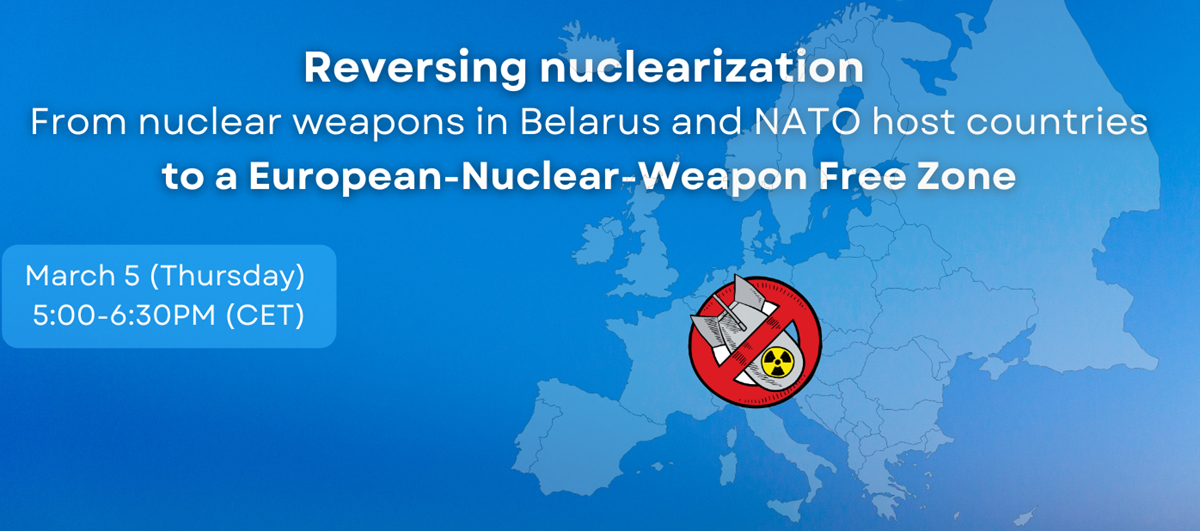
6 March -Online – Reversing nuclearization:
From nuclear weapons in Belarus and NATO host countries to a European-Nuclear-Weapon Free Zone
Mar 6, 2026 03:00 AM in Canberra, Melbourne, Sydney

of the week – Australians for War Powers Reform (AWPR)
To see nuclear-related stories in greater depth and intensity
 Antinuclear