15 January – climate and nuclear news in Australia this week
 I scratch around for good news on climate. Alex Smith, of Radio Ecoshock, notes that ‘several long-time climate bloggers and Facebook activists are “retiring” to their private lives.’ He quotes one: “I’m no longer interested in awakening the masses. The masses made it clear that they are not interested.”
The grand old man of coastal science Dr. Orrin Pilkey warns: start withdrawing from the coast-line now, or wait for the coming panic. As Australia’s government promotes coal mining and coal power, and avoids any action on climate change, every State and Territory in Australia is being hit with record heat. Decentralising the energy supply system – renewables are creating a new world order.
On the nuclear scene, the New Nuclear Arms Race remains the biggest threat in 2019. Meanwhile, as the nuclear industry fails economically, the mainstream media continues to pour out articles about “new nukes” – Small and Medium Nuclear Reactors (SMRs), Molten salt reactors. – articles that read like straight handouts from the nuclear lobby.
AUSTRALIA
Australia’s environment – a winner at National Labor Party Conference.
Australian Julian Assange in new danger as Ecuador caves in to USA pressure (and Australian govt does nothing)
NUCLEAR – UK “reviewing” files on nuclear bomb tests in Australia– this smacks of a cover-up. –Proposed nuclear waste dump in Flinders Ranges – an urgent issue for South Australians, and all Australians. From uranium mining to nature conservation – Kakadu National Park to get $216 million boost.
CLIMATE
Air conditioners make a massive contribution to global warming (Why not promote SOLAR air-conditioning?)
Bushfire in Adelaide Hills is still a threat. Victoria’s iconic Great Ocean Road at risk from sea level rise. Adani Contractor Locked Up and Blockaded.
RENEWABLE ENERGY
The problem of hazardous waste from discarded old solar panels. Australia’s “largest” wind farm wins planning approval for Victoria.
Matt Canavan’s ‘urgent’ new nuclear waste dump: The devil is in the detail

|
Matt Canavan’s ‘urgent’ new nuclear waste dump: The devil is in the detail https://www.foe.org.au/canavans_nuclear_waste_dump – Dave Sweeney, December 18 It is a national problem that has taken 60 years to make and will last 10,000 years, but according to Canberra, it will be soon be sorted. Radioactive waste management has been a challenge for successive federal governments, with communities across South Australia and the Northern Territory consistently rejecting plans for the dumping and storage of wastes in their region. Now the pressure is right back on regional South Australia, with a concerted federal push to locate a site either near Kimba on the Eyre Peninsula, or Hawker in the iconic Flinders Ranges. The plan sounds straightforward: take radioactive waste from around Australia to a central site, where low-level material would be disposed of and higher-level wastes stored, pending a final management decision. But, as ever, the devil is in the detail. Or in this case, in the profound lack of detail. Despite two years of promotional newsletters, shopfronts and drop-in centres, and publicly funded visits from pro-nuclear advocates, there remains a disturbing lack of clarity and deep concerns over the federal government’s plan and process. Radioactive waste is a complex policy area. The stuff lasts a long time, poses a real management challenge and, understandably, raises community concerns. Responsible decisions are best based on the “T” factor: talk, time, testing and trust. Sadly, the current federal push has failed to learn from this history and is replicating a failed formula. Despite plenty of talk about the benefits of the plan, the federal Government has actively refused to debate critics in open forums, key project assumptions have never been independently verified or tested, and many community members, Aboriginal landowners and wider stakeholders do not trust the process. Time is now running out on Minister for Resources and Northern Australia Matt Canavan’s long stated plan to make a siting decision this year. This timeline won’t be met ‒ largely due to legal action initiated by the Barngarla Determination Aboriginal Corporation. The Barngarla Traditional Owners have sought legal redress over their exclusion from the community ballot planned to assess public opinion in the Kimba region, arguing that this breaches the Racial Discrimination Act. Despite this delay the Minister still hopes to push ahead with the plan before the 2019 federal election, expected in May. The federal Government has been spending big and promising large, with job and community benefit estimates and assurances soaring since the ballot was announced. The Government is working to localise this issue and present it as an economic opportunity for a small region, but this plan is a national issue with profound and lasting implications. Around 95 per cent of the material planned to be moved to any new facility is currently managed at two secured federal sites. Low-level waste that needs to be isolated for 300 years is currently at the Woomera defence lands in South Australia’s north. The more problematic intermediate level waste, that needs isolation for 10,000 years, is stored where it was made at the Australian Nuclear Science and Technology Organisation’s (ANSTO) Lucas Heights facility in southern Sydney. Both sites have the physical, technical and regulatory capacity to continue to store these wastes for many years, and the current sense of federal urgency and pressure is being driven by politics and ANSTO’s corporate preferences, rather than by evidence or need. The federal nuclear regulator the Australian Radiation and Nuclear Safety Agency has repeatedly confirmed that there is no urgency to move the waste from ANSTO. In any discussion around radioactive waste management, a lot of airspace is devoted to the question of nuclear medicine. No one disputes either the importance or the need for secure access to nuclear medicine. The planned national radioactive waste facility is not expected to receive nuclear medicine waste from any hospital or medical clinic in Australia. These wastes would continue to be managed at these multiple sites on the current “store and decay” basis. A national radioactive waste facility would take nuclear reactor waste from the process that generated the nuclear medicine, but not nuclear medical waste. Importantly, this means that a national waste facility is not required to ensure access to nuclear medicine. Currently, Australia’s most serious radioactive waste is stored above ground at ANSTO. This makes sense, as the waste is already on site and Lucas Heights also has clear tenure, high levels of security and policing, the most advanced radioactive monitoring and emergency response capacity in the country, and it is the workplace of around 1,200 people. The federal Government’s plan is to move this material from this facility to one in regional South Australia with far less capacity and institutional assets. There is no radiological protection rationale to move this material from extended above ground storage in Sydney to extended above ground storage with far fewer checks and balances in regional South Australia. The current federal approach to the intermediate level waste is not consistent with international best practice and is merely kicking the can further down a less travelled road. The current federal plan is a retreat from responsibility, which is playing short-term politics with a long-term hazard. It is extraordinary that, after over six decades of making waste and two decades of sustained and successful community resistance to federal siting plans, Australia has never had an objective review of management practises and options. We need this now. Dave Sweeney works on nuclear issues with the Australian Conservation Foundation and was a member of the Federal advisory panel on radioactive waste. You can follow him on Twitter @nukedavesweeney Published in Chain Reaction #134, December 2018. National magazine of Friends of the Earth Australia. www.foe.org.au/chain_reaction |
|
Australia’s energy trends: we could be 100% renewable sooner than you think
 Australia could hit 100% renewables sooner than most people think, Guardian,
Not since the invention of the steam engine have we seen the pace of change occurring in energy systems around the world. In Australia our electricity system is changing rapidly, from new technologies and business models to changes in policy and perhaps even regulation. As the year begins, here are five energy trends you should expect to see in 2019.
1. More action towards 100% renewable energy
Last year was a boom year for renewables. Despite rhetoric from some political quarters talking up coal and talking down renewable energy, we installed more solar panels and wind turbines than ever before. There are at least 40 large-scale wind and solar projects in construction in Australia, totalling over 6000MWs of new generation capacity. This means renewables will continue on a steep growth curve as analysis by the Melbourne University Climate and Energy College shows.
This rapid growth in renewables and soon battery storage is at least in part driven by a corresponding reduction in cost. Bloomberg New Energy Finance analysis reveals a compound annual reduction in cost of battery storage of 21% over eight years. Facts such as these are the engine driving us towards 100% renewables at a pace much faster than most pundits think.
At a political level California has just legislated a move to 100% renewables, while at home South Australia, Tasmania and the ACT are on track to be net 100% renewables in the next few years. With everyone from tech billionaires to school students demanding 100% renewables, pressure for a more rapid shift to renewables is likely to continue to build.
In the corporate sector, global initiative The RE100 has arrived in Australia. This initiative which encourages companies to commit to 100% renewables has seen global companies headquartered outside of Australia such as Carlton United Breweries and Ikea lead the way. In late 2018 Commonwealth Bank became the first Australian company to join, signing a large power purchase agreement in the process.
2. Solar for renters and other locked-out energy users……..For a long time these households have been in the too-hard basket for policymakers and industry alike. However, there are signs that in 2019 this could be changing. The Victorian and South Australian governments have announced policies to support 50,000 rental properties to access solar, and for South Australia, batteries also. In NSW the government is trialling a program of solar for 15,000 low-income energy rebate customers. These are small steps, but if scaled could start to change the current trend towards solar energy haves and have-nots.
3. Community energy going gangbusters
Communities are also taking matters into their own hands, developing innovative community-owned clean energy projects and implementing plans to move to 100% renewables. Despite a lack of interest from mainstream energy players and little policy support, Australia’s community energy sector has grown to more than 105 groups and 174 operating projects. Most famously the communities of Yackandandah and Daylesford……
4. A battle between good and bad hydrogen
Hydrogen fuel is not a new idea, yet in 2019 hydrogen is likely to make significant strides towards becoming a major part of our global energy ecosystem……..
5. Clean energy elections
No 2019 trend article is complete without mentioning the upcoming elections. According to researcher Rebecca Huntly climate change is a top issue with the electorate and as such both the NSW and federal elections are going to have a focus on climate and energy policy whether politicians like it or not…….https://www.theguardian.com/commentisfree/2019/jan/14/australia-could-hit-100-renewables-much-sooner-than-most-people-think
Concerns in USA about Holtec managing nuclear wastes
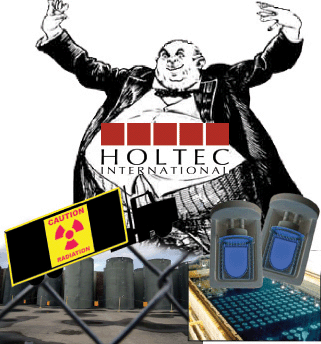 After the Shutdown: Oyster Creek Nuclear
 Generating Station Oyster Creek is done producing nuclear energy. Now comes the hard part: cleaning up five decades of radioactive waste. New Jersey Monthly, By Ian T. Shearn |
“………A CHANGE IN PLANS
Shortly after the shutdown, plant employees began the process of cooling down the reactor and removing all nuclear fuel for storage in the plant’s used-fuel pool, a bath of highly purified, chemically balanced, fresh water. The 40-foot-deep pool—with reinforced concrete walls 2-feet thick—contains 2,430 fuel assemblies, more than half of the spent fuel that has accumulated over five decades.
Exelon estimated decommissioning would take 60 years. Its method, a process known as SAFSTOR, includes waiting for the radiation—both in the fuel pool and the reactor—to diminish naturally over decades, reducing the contamination risk for workers dismantling the facility. That plan changed dramatically last summer when Exelon reached an agreement to sell the plant to Holtec International, which has a technology campus in Camden, and proposes to complete the task in less than eight years by expediting the transfer of the spent fuel from the pool to dry storage casks before its radiation has appreciably decayed. Holtec and Exelon have asked the U.S. Nuclear Regulatory Commission for an expedited approval of the sale by May 1, prompting concern among environmentalists.
“What’s the big hurry?” asks Janet Tauro, board chair of Clean Water Action NJ. “Holtec may be the best thing in the world, but we’re talking about 1.7 million pounds of nuclear waste.” Lacey Township, the Sierra Club and Concerned Citizens of Lacey have asked the NRC to hold a public hearing. Tauro and Clean Water Action New Jersey have asked the state attorney general for a review of the Exelon/Holtec deal.
“The NRC will try to complete a review of the application by May 1,” says NRC spokesman Neil Sheehan. “But we have made it clear to Exelon and Holtec that achieving that will be contingent upon us receiving the information we need.” That could include information about technical aspects of the decommissioning and adequacy of funding for the project.
Exelon and Holtec officials are nonetheless optimistic the deal will be approved on their timetable. Soon, the nuclear license and the 700-acre property would be transferred to Holtec—along with control of a nearly $1 billion decommissioning trust fund generated by utility ratepayers over decades. Holtec would assume all liability for the spent nuclear fuel—and any potential accidents.
Jeff Tittel, director of the New Jersey Sierra Club, says he’s fine with the expedited decommissioning schedule. “It’s very doable and it’s been done many times throughout the country,” he notes. But he would like to see the storage site for the nuclear waste elevated and upgraded to withstand potential flooding or a terrorist attack. According to an AP report, the Sierra Club and several community groups also say the $1 billion fund is insufficient for cleanup and storage.
Tittel is “most concerned,” however, about the transfer of Oyster Creek’s ownership from Exelon, an industry behemoth with deep pockets, to Holtec, a relatively small limited-liability company, which will subcontract the work to an even smaller subsidiary. “If there is some kind of accident, there will be no one to hold accountable,” he says. …….
What’s in it for Holtec? The company would, in effect, hire itself and its subsidiary to clean up the site by drawing fees from the decommissioning fund. Holtec also would purchase its own storage casks for the cleanup…..
Holtec’s decommissioning plan “is like burying a body without an autopsy,” says Paul Gunter, policy analyst and nuclear-reactor watchdog.
Gunter is also alarmed by Holtec’s partnership for the decommissioning work. SNC-Lavalin, Gunter says, currently faces federal corruption charges in Canada. Equally disturbing, he says, the company is “barred from doing any contractual work with the World Bank until 2023—again because of global corruption.”
SNC-Lavalin has had a legal cloud over its head since 2015 (the same year it began collaborating with Holtec) when allegations surfaced that former employees paid $150 million in bribes to officials in Libya to influence government policy and win contracts. ….. And in May, Canadian authorities filed charges against SNC-Lavalin after a multiyear probe related to illegal political contributions.
“Is this the company we want to be handling a $1 billion trust fund?” asks Gunter……..
The decommissioning project is not the only joint venture between Holtec and SNC-Lavalin. The two companies are also collaborating on the design and production of a small, nuclear and modular reactor, called SMR-160, at Holtec’s Technology Campus in Camden. The reactor is planned for operation by 2026.
Last February, Holtec signed an agreement in Camden that calls for the state-run nuclear operator in Ukraine to adopt the SMR-160 technology to meet its energy needs. Shortly after, Holtec announced that Ukraine may also become a manufacturing hub for SMR-160 components.
“Holtec is poised to….reinvigorate nuclear power,……” CEO Singh told World Nuclear News at the time. https://njmonthly.com/articles/politics-public-affairs/after-the-shutdown-oyster-creek-nuclear-generating-station-forked-river/
Disease – after-effects for uranium miners decades later
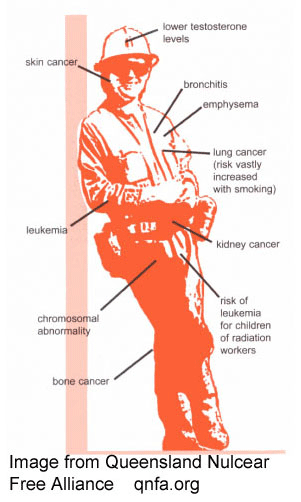 Uranium workers can face illnesses decades later. Many workers don’t know that help is available.Star Tribune, Heather Richards 307-266-0592, Heather.Richards@trib.com, Jan 14, 2019
Japan faces huge costs as nuclear reactors are scrapped
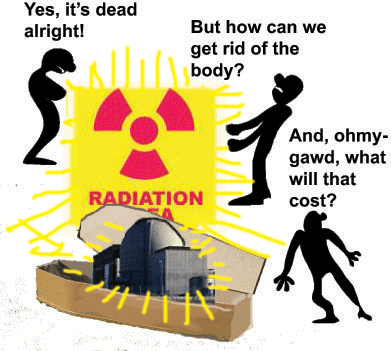 Japan News 14th Jan 2019 The total cost for scrapping the nation’s nuclear power facilities —
excluding Fukushima No. 1 nuclear power plants and other facilities under construction — is estimated to be about ¥6.72 trillion, according to a tally by The Yomiuri Shimbun.
The assessment only includes dismantlements of nuclear power facilities for which the cost can currently be estimated. Among these estimates, the cost for closing a spent nuclear fuel reprocessing plant now being built by Japan Nuclear Fuel Ltd. (JNFL) in Rokkasho, Aomori Prefecture, accounts for the largest amount at ¥1.6 trillion.
The cost for decommissioning 53 commercial nuclear reactors is estimated to total about ¥3.58 trillion, for an average at ¥57.7 billion per reactor. Of the 53 reactors, 19 reactors are scheduled or are likely to be scrapped.
http://the-japan-news.com/news/article/0005476533
UK’s “nuclear renaissance” now collapsing as Hitachi looks like dumping Moorside nuclear project
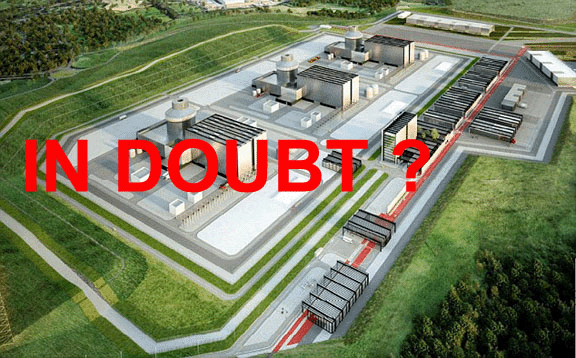
 FT 13th Jan 2019 Nick Butler: Who could blame the board of the Japanese company Hitachi if
its members decide at their meeting this week to scrap plans for a new nuclear power station at Wylfa on the North Wales island of Anglesey?
Hitachi has invested more than £840m in the project over the past six years. The technology has passed all the tests set by the UK’s nuclear regulator. But the company has been unable to get the government to put in place the clear and credible financial structure necessary to underpin the investment.
That failure has already led other investors to abandon the new plant planned at Moorside in Cumbria. Talk of scrapping the Wylfa project could be a bargaining tactic on the part of Hitachi but the reality is probably much simpler. Hitachi’s doubts have been well signalled during the
past few months and the company’s purchase of ABB’s power grid business at the end of last year gives it a range of investment choices.
Given Whitehall’s chronic indecision, the company is ready to use its capital elsewhere. Hitachi’s withdrawal would mark the collapse of the energy policy adopted in 2013 by the UK’s coalition government. Facing what were believed to be ever-rising energy prices the policy plumped for new nuclear, promising that 35 gigawatts of new capacity would be on stream by the mid 2030s – more than replacing the first generation of nuclear plants, which would by then have reached the end of their useful lives.
Because the price of gas seemed doomed to keep rising, new nuclear would come to look highly competitive over time as well as reducing dependence on imports. Since then much has changed, and the assumptions which underpinned the old policy now look laughably wrong.
The costs of all forms of energy (apart from nuclear) have fallen dramatically and there is no shortage of supply. Electricity demand is down thanks to efficiency gains and new technology.
The contract for the first new nuclear station being built at Hinkley Point in Somerset, which enjoys a guaranteed index-linked price for 35 years from the moment the plant is commissioned, looks exorbitant. The demise of Wylfa forces the need for a comprehensive review of energy policy.
Since the UK government is too busy preparing for Brexit to focus seriously on any other issue, the review should be conducted independently. Advances in energy technology offer more
possibilities each year. But those options will never be taken up unless the old outdated policy is scrapped and a more realistic approach put in place.
https://www.ft.com/content/7b33e9fa-1648-11e9-9e64-d150b3105d21
Desalination pours more toxic brine into the ocean than previously thought
|
https://www.sciencenews.org/article/desalination-pours-more-toxic-brine-ocean-previously-thought The supersalty water is a byproduct in producing potable water Technology meant to help solve the world’s growing water shortage is producing a salty environmental dilemma. Desalination facilities, which extract drinkable water from the ocean, discharge around 142 billion liters of extremely salty water called brine back into the environment every day, a study finds. That waste product of the desalination process can kill marine life and detrimentally alter the planet’s oceans, researchers report January 14 in Science of the Total Environment. “On the one hand, we are trying to provide populations — particularly in dry areas — with the needed amount of good quality water. But at the same time, we are also adding an environmental concern to the process,” says study coauthor Manzoor Qadir, an environmental scientist at the United Nations University Institute for Water, Environment and Health in Hamilton, Canada. Between human population growth and climate change, water is becoming increasingly scarce (SN: 8/18/18, p. 14). Desalination technology has become a viable solution to this problem and has grown exponentially in popularity since the 1980s. Almost 16,000 plants now operate worldwide. Desalination relies on evaporation or specialized membranes to either chemically or electrically separate pure water from a stream of saltwater. But two streams always flow out of the system: one that becomes water that people can use, and another with the leftover, extra-salty brine, which is released back into the environment. Previous evaluations didn’t assess how much brine these facilities produced, Qadir says. Scientists assumed that desalination facilities on average equally produced brine and pure water — one liter of brine for every liter of pure water. That turned out to be wrong. Using data on the water sources and technology used at desalination facilities around the globe, Qadir and his colleagues estimated for the first time how much brine is discharged daily. For every liter of pure water made, they found that on average 1.5 liters of highly concentrated brine is released back into the environment. Per day, that value translates to more than half the daily volume of water pouring over Niagara Falls, with 70 percent of it originating from desalination plants in arid North Africa and the Middle East. As brine re-enters the ocean, “it creates a kind of local environment,” Qadir says. The highly concentrated discharge, which can also contain metals and antifouling chemicals, is denser than seawater, so it flows as a salty plume to the seafloor and can poison marine organisms living nearby. Some brine can also still be hot from evaporative processes during desalination. Because hot water doesn’t hold oxygen as well as cold water, ocean areas where brine enters can become depleted of oxygen. An international standard requiring wastewater treatment and the use of environmentally friendly chemicals in desalination discharge does exist, says Yoram Cohen, a chemical engineer at UCLA. “But whether all people follow it, I don’t know.” Save for some scientific studies, not much is being done to resolve the issue, Qadir says. “At the government level, I don’t see that there is a serious attempt that has been made.” Suggestions have been proposed for repurposing the brine, including for watering salt-tolerant agricultural fields, extracting metals such as magnesium or uranium, or harvesting salt versus mining for it. In terms of technology, you can take the brine “and evaporate it to recover the salt,” Cohen says. “But the price is huge.” Depending on location and type of technology, desalination alone can cost between $0.50 and over $2 to produce 1,000 liters of drinkable water — about what two people in the United States use in a day. Further evaporating the brine waste only increases the cost. Modern desalination technologies, such as graphene oxides, are becoming more cost effective and releasing less brine discharge (SN: 8/20/16, p. 22). But they are not universally distributed and are uncommon in the Middle East where desalination is most used. “We need to make sure that with our efforts, we are able to use more of those types of technology which produce more desalinated water than brine,” Qadir says. |
|
Know your NEM: Looking forward, after looking back — RenewEconomy

The worm is starting to turn, as wind and solar power become widely acknowledged as the forthcoming mainstream suppliers of energy into the NEM. But can governments and regulators keep pace? The post Know your NEM: Looking forward, after looking back appeared first on RenewEconomy.
via Know your NEM: Looking forward, after looking back — RenewEconomy
Windscale/Sellefield Pt. 3 Research for a book length study — Nuclear Exhaust
Sources relating to the Black Report of 1984. 1. http://news.bbc.co.uk/onthisday/hi/dates/stories/july/23/newsid_4521000/4521673.stm BBC on this day 23 July 1984 A government report into cancer levels near the controversial nuclear plant at Sellafield in Cumbria has confirmed suspicions of higher-than-normal levels of leukaemia in the area. However, it says, too little research has been done to definitely link […]
via Windscale/Sellefield Pt. 3 Research for a book length study — Nuclear Exhaust
NSW waves through 900MW solar farm for construction in Riverina — RenewEconomy

Reach Solar’s 900MW Yarrabee Solar Farm, approved for construction in NSW Riverina, will have capacity to power a city nearly twice the size of Newcastle. The post NSW waves through 900MW solar farm for construction in Riverina appeared first on RenewEconomy.
via NSW waves through 900MW solar farm for construction in Riverina — RenewEconomy
National Electricity Market year in review: Wholesale electricity prices — RenewEconomy

First instalment of three-part series looking back at what the past year of energy policy turmoil has meant for the National Electricity Market (NEM). The post National Electricity Market year in review: Wholesale electricity prices appeared first on RenewEconomy.
via National Electricity Market year in review: Wholesale electricity prices — RenewEconomy
January 14 Energy News — geoharvey

Opinion: ¶ “ScottishPower: the Journey to Renewables” • ScottishPower, one of the UK’s biggest utilities, announced it will switch to 100% renewable energy. The move is hailed as touchstone moment and a good example for any big utility seeking to shed its fossil fuel legacy, but does the move make economic sense, and if so […]
1 This month

of the week – Australians for War Powers Reform (AWPR)
To see nuclear-related stories in greater depth and intensity
 Antinuclear