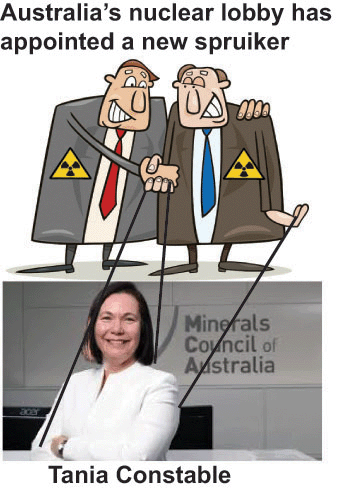
Australia’s coal and nuclear lobbies have just recruited a new puppet, Independent Australia, 25 January 2019, Newly-appointed Mining Council CEO Tania Constable has been championing nuclear power at a time when we should be discussing renewables, writes Noel Wauchope.WHAT BAD TIMING. Only in dictatorships – Russia and China – is nuclear power thriving. In the Western world, it’s problematic due to costs and waste issues. As for coal, even China is working to phase it out.
In Australia, renewable energy is going ahead in leaps and bounds. Our coal-loving Liberal Coalition Government is so on the nose, they’ll be forgotten men within a few months.
But never mind, Australia’s fossil fuel and nuclear lobbies are on the propaganda trail and they’ve just recruited a new puppet, Tania Constable. Appointed as CEO of the Mining Councilin July last year, Ms Constable’s first job is to mouth the standard pro-coal and nuclear platitudes. Here she goes.
A headline in the 22 January edition of The Daily Telegraph reads: ‘Heatwaves proof positive Australia needs nuclear’.
In the article, Constable says:
“Energy costs are rising and renewables can’t meet all our needs but a new generation of clean reactors could.”
‘Heatwaves proof positive Australia needs nuclear’?No, Tania, proof positive that Australia needs solar air conditioners. She seems unaware of the fact that nuclear power is highly water intensive, and subject to shutdowns due to hot weather.
Ms Constable mourns that:
“The influx of part-time power sources such as wind and solar which make it more difficult for older baseload power stations to operate will likely see the early closure of a number of them well before 2030.”
So, it’s renewable energy’s fault that coal is not doing well? She goes on to enthuse about “baseload” power — coal, of course. But that’s seen as a myth, nowdays, as reliable power is no longer synonymous with coal.
“The removal of four words — ‘a nuclear power plant’ — in Section 140A(1) (b) would allow nuclear industries to be considered for development in Australia.”
[She goes on to praise “new nukes’ – Small Modular Nuclear Reactors, singling out Terra Power and Transatomics, – But]
First of all, Bill Gates has just had the door slammed on his TerraPower project. He’s closed it down for now, but hopes to find a country that will back it.
Swedish school strike activist demands economists tackle runaway global warming. Read her Davos speech here,
Our house is on fire. I am here to say, our house is on fire.
According to the IPCC (Intergovernmental Panel on Climate Change), we are less than 12 years away from not being able to undo our mistakes. In that time, unprecedented changes in all aspects of society need to have taken place, including a reduction of our CO2 emissions by at least 50%.
And please note that those numbers do not include the aspect of equity, which is absolutely necessary to make the Paris agreement work on a global scale. Nor does it include tipping points or feedback loops like the extremely powerful methane gas released from the thawing Arctic permafrost.
At places like Davos, people like to tell success stories. But their financial success has come with an unthinkable price tag. And on climate change, we have to acknowledge we have failed. All political movements in their present form have done so, and the media has failed to create broad public awareness.
But Homo sapiens have not yet failed.
Yes, we are failing, but there is still time to turn everything around. We can still fix this. We still have everything in our own hands. But unless we recognise the overall failures of our current systems, we most probably don’t stand a chance.
We are facing a disaster of unspoken sufferings for enormous amounts of people. And now is not the time for speaking politely or focusing on what we can or cannot say. Now is the time to speak clearly.
Solving the climate crisis is the greatest and most complex challenge that Homo sapiens have ever faced. The main solution, however, is so simple that even a small child can understand it. We have to stop our emissions of greenhouse gases.
Either we do that or we don’t.
You say nothing in life is black or white. But that is a lie. A very dangerous lie. Either we prevent 1.5C of warming or we don’t. Either we avoid setting off that irreversible chain reaction beyond human control or we don’t.
Either we choose to go on as a civilisation or we don’t. That is as black or white as it gets. There are no grey areas when it comes to survival.
We all have a choice. We can create transformational action that will safeguard the living conditions for future generations. Or we can continue with our business as usual and fail.
That is up to you and me.
Some say we should not engage in activism. Instead we should leave everything to our politicians and just vote for a change instead. But what do we do when there is no political will? What do we do when the politics needed are nowhere in sight?
Here in Davos – just like everywhere else – everyone is talking about money. It seems money and growth are our only main concerns.
And since the climate crisis has never once been treated as a crisis, people are simply not aware of the full consequences on our everyday life. People are not aware that there is such a thing as a carbon budget, and just how incredibly small that remaining carbon budget is. That needs to change today.
No other current challenge can match the importance of establishing a wide, public awareness and understanding of our rapidly disappearing carbon budget, that should and must become our new global currency and the very heart of our future and present economics.
We are at a time in history where everyone with any insight of the climate crisis that threatens our civilisation – and the entire biosphere – must speak out in clear language, no matter how uncomfortable and unprofitable that may be.
We must change almost everything in our current societies. The bigger your carbon footprint, the bigger your moral duty. The bigger your platform, the bigger your responsibility.
Adults keep saying: “We owe it to the young people to give them hope.” But I don’t want your hope. I don’t want you to be hopeful. I want you to panic. I want you to feel the fear I feel every day. And then I want you to act.
I want you to act as you would in a crisis. I want you to act as if our house is on fire. Because it is.
This is an edited version of a speech given by Greta Thunberg at Davos this week.
NUCLEAR POWER STATIONS ARE NOT APPROPRIATE FOR AUSTRALIA – AND PROBABLY NEVER WILL BE by Climate Council / 23 January 2019
Periodically, as with the changing of the seasons, various individuals appear in the media extolling the virtues of nuclear energy, promising a panacea of clean and reliable electricity to solve Australia’s energy crisis. But the truth is far less rosy.
…….steps involved in producing nuclear power (from mining, to construction, decommissioning and waste management) result in greenhouse gas pollution. Greenhouse gas pollution associated with nuclear power could be similar to a gas power station, with estimates ranging from 80 – 437 kg/MWh.
But nuclear energy is not “renewable”. Uranium is a finite resource just like coal or gas……
Nuclear energy doesn’t make sense in Australia
…..there are a number of reasons why nuclear power is not appropriate for Australia.
Nuclear power stations are highly controversial, can’t be built under existing law in any Australian state or territory, are a more expensive source of power than renewable energy, and present significant challenges in terms of the storage and transport of nuclear waste, and use of water.
Australia is one of the sunniest and windiest countries in the world, with enough renewable energy resources to power our country 500 times over. When compared with low risk, clean, reliable and affordable renewable energy and storage technology in Australia, nuclear power makes no sense.
Nuclear power stations are expensive
Nuclear power stations are extremely expensive to build. For example, the Hinkley nuclear power station under construction in the UK will cost 20 billion pounds (AU$36 billion). Nuclear cannot compete on a cost basis with wind and solar, which are the cheapest forms of new generation. The cost of energy from the Hinkley Power station is significantly higher than large-scale solar, wind and offshore wind energy in the UK.
On average, nuclear power stations take a decade to build
The Hinkley power station will take nine years to build. The global average is 9.4 years. This would be even longer in Australia given there is currently no nuclear industry here. It is not unusual for nuclear power stations to take over a decade between the start of approvals and coming online. For comparison, wind and solar farms take just one to three years.
Australia cannot wait this long to replace our ageing fleet of coal power stations, which are already struggling to cope with extreme heat.
Nuclear power stations are inflexible and ill-suited to a modern grid
Nuclear power stations are inflexible – that is, they cannot quickly increase or decrease the amount of electricity they produce.
Nuclear power generation is not well suited to modern, fast and flexible electricity grids with large amounts of wind and solar generation. Unlike inflexible nuclear, fast response technologies such as batteries, pumped hydro and solar thermal can be turned on and off, or ramped up and down to balance electricity supply and demand.
Nuclear power stations require massive quantities of water to operate. In a dry continent like Australia, prone to hot summers and drought conditions which are only likely to get more severe as climate change worsens, it would be reckless to rely on a water-hungry power source like nuclear.
The bottom line is this: it makes no sense to build nuclear power stations in Australia.
January 21, 2019, “RISE: Refugees, Survivors and eX-detainees – the FIRST self-determined advocacy and welfare organisation in Australia run by Refugees for Refugees – makes a public call for a boycott of “Australia Day”, for the seventh year in a row.
We eX-detainees, Asylum Seekers and Refugees from RISE condemn any group or individual who claims to be pro-refugee but celebrates “Australia Day” on the 26th of January 2019. Instead, RISE encourages all Refugees, eX-detainees, Asylum Seekers and allies to support First Nations peoples in their actions against “Australia Day”.
RISE represents over 30 refugee community groups in Australia and is the first (and one of the few) self-determined, registered, non-profit refugee organisations in Australia governed and managed by eX-detainees, Asylum Seekers and Refugees. As eX-detainees, Asylum Seekers and Refugees in Australia, we acknowledge that the land we seek protection on is the land of Aboriginal and Torres Strait Islander Peoples whose sovereignty was never ceded. ‘Always was, always will be Aboriginal land’.
We believe the systemic abuse of Aboriginal and Torres Strait Islander peoples is a result of over 200 years of discrimination as part of the white colonial genocide strategy that continues to this day and this template is now being used against our own refugee communities. How can we dismantle the white Australian government’s refugee torture camps built within and outside its colonial borders without addressing the root cause of this criminal abuse?
RISE fully supports Aboriginal and Torres Strait Islander peoples’ sovereignty and self-determination and stands in solidarity with them every day in our commitment to fighting for justice on this land on their terms.”
Adelaide now hottest capital city on record as temperatures soar throughout SA, ABC News, By Sarah Scopelianos and Camron Slessor– 26 Jan 19
Adelaide has hit a sweltering 46.6 degrees Celsius, surpassing the previous record set in Melbourne a decade ago to officially become the hottest capital in the country.
Key points:
More than 20 locations hit record temperatures in South Australia on Thursday
Meteorologist Hilary Wilson said records had been broken right across the state
The CFS warned communities were at risk during extreme heat
Earlier on Thursday, Adelaide topped its 1939 heat record after hitting 46.2C.
The temperature then climbed up to 46.6C, topping the previous capital city record of 46.4C set in Melbourne in 2009.
More than 20 locations hit record temperatures in South Australia on Thursday, including Adelaide Airport, Minlaton, Noarlunga, Snowtown and Port Lincoln.
Ceduna set a record for the second day in a row, reaching 48.6C.
Meteorologist Hilary Wilson said records had been broken right across the state……….
‘Incredibly high’ temperatures overnight for Victoria
Welcome to “The New Abnormal” Bulletin of the Atomic Scientists By Bulletin Staff, January 24, 2019 A new abnormal: It is still 2 minutes to midnight Humanity now faces two simultaneous existential threats, either of which would be cause for extreme concern and immediate attention. These major threats—nuclear weapons and climate change—were exacerbated this past year by the increased use of information warfare to undermine democracy around the world, amplifying risk from these and other threats and putting the future of civilization in extraordinary danger.
There is nothing normal about the complex and frightening reality just described.
WASHINGTON, D.C. – January 24, 2019 – Citing lack of progress on nuclear risks and climate change dangers as “the new abnormal,” the Doomsday Clock remains at 2 minutes to midnight, as close to the symbolic point of annihilation that the iconic Clock has been since 1953 at the height of the Cold War. The decision announced today to keep the Doomsday Clock at two minutes before midnight was made by the Bulletin of the Atomic Scientists’ Science and Security Board in consultation with the Board of Sponsors, which includes 14 Nobel Laureates.
We are in a strong position where electricity supplies are secure and costs are falling, says Greg Clark, in a letter to the Financial Times this week. He should know since he is the UK’s business secretary. Never mind that the contractors behind two nuclear power stations have pulled out because they dare not take the risk, while a third promises to be an epic financial disaster, and that the remaining two on the drawing board seem increasingly likely to stay there.
Mr Clark is relentlessly upbeat: “Britain’s electricity requirement for the 2030s is not a problem of shortages but the much better challenge of abundance.” This challenge has already translated into a rise of 8 per cent last year in the cost of domestic electricity, and a looming 11 per cent rise in the absurd “price cap”, as the cost of subsidies for “green” energy slides sneakily into household bills. However, he is right about abundance. The fracking revolution has utterly changed the balance for both oil and gas supplies, and made a nonsense of the UK government’s decade-old assumptions about ever-increasing prices.
As Dieter Helm, Mr Clark’s go-to expert on energy costs, argues in a paper this week, the trouble dates back to when the Liberal Democrats were tossed the energy brief in the coalition government. Chris Huhne and Ed Davey were achingly green, but because they assumed oil was running out, the pair reluctantly supported new nukes, laying the foundations for today’s meltdown.
The grim truth is that these huge projects are a financial dead end, driven there by changing technology along with escalating safety requirements and the costs of decommissioning. As Mr Helm argues, there is a powerful case for abandoning nuclear altogether. Mr Pollyanna Clark, meanwhile, promises yet another energy white paper this summer. Oh dear.
Newer coal-fired power stations break down more often per gigawatt than older power generators, the Australia Institute has found.
The reliability of “high efficiency low-emissions” coal fired power plants is being questioned, with a new report finding they break down more often per gigawatt than older generators.
Australia’s newest coal power station, the 12-year-old Kogan Creek Power Station in Queensland, broke down six times last year, the Australia Institute found.
“These new supercritical coal plants are touted by proponents as ‘high efficiency, low emissions’ coal plants, but this could not be further from the truth … they are more emissions-intensive than renewable energy and even gas,” the Australia Institute’s Richie Merzian said.
Bill Gates comes to Washington — selling the promise of nuclear energy, WP, By Steven Mufson, January 25
Bill Gates thinks he has a key part of the answer for combating climate change: a return to nuclear power. The Microsoft co-founder is making the rounds on Capitol Hill to persuade Congress to spend billions of dollars over the next decade for pilot projects to test new designs for nuclear power reactors.
Gates, who founded TerraPower in 2006, is telling lawmakers that he personally would invest $1 billion and raise $1 billion more in private capital to go along with federal funds for a pilot of his company’s never-before-used technology, according to congressional staffers…….
Gates said in his year-end public letter. “The problems with today’s reactors, such as the risk of accidents, can be solved through innovation.” …..
But many nuclear experts say that Gates’s company is pursuing a flawed technology and that any new nuclear design is likely to come at a prohibitive economic cost and take decades to perfect, market and construct in any significant numbers.
Lawmakers are listening to him. Through the Energy Department, Congress approved $221 million to help companies develop advanced reactors and smaller modular reactors in fiscal 2019, above the budget request. But Gates and TerraPower, which received a $40 million Energy Department research grant in 2016, are looking for more. …….
Edwin Lyman, a nuclear expert at the Union of Concerned Scientists, said TerraPower is one of many companies that is raising the public’s hopes for advanced nuclear reactor designs even though they’re still on the drawing boards and will remain unable to combat climate change for many years.
“We think the vendors of advanced nuclear power designs are saying they can commercially deploy them in a few years and all over the world,” Lyman said. “We think that is counterproductive because it is misleading the public on how fast and effective these could be.” ……
Many nuclear power experts say that the technology Gates is promoting — called a “traveling wave reactor” — does not work as advertised, at least not yet. “These designs . . . require advances in fuel and materials technology to meet performance objectives,” a Massachusetts Institute of Technology report said last year.
TerraPower has changed key elements of its design and has still not resolved critical problems, experts say……
critics say TerraPower has been stumbling over a handful of obstacles.
First, TerraPower has discovered that the traveling wave didn’t travel so well and that it would not evenly burn the depleted uranium in the “candle.” Second, and partly as a result, it needed to change the design to reshuffle the fuel rods — and do that robotically while keeping the reactor running. Third, it has struggled to find a metal strong enough to protect the fuel rods from a bombardment of neutrons more intense than those commonly used in reactors — and for a much longer period of time…….
In many ways, TerraPower’s design resembles fast breeder reactors. Fast breeders have faster moving neutrons, the subatomic particles that trigger fission.
Allison Macfarlane, former chairman of the Nuclear Regulatory Commission, said earlier versions of fast breeder reactors have turned in a “dismal performance.” The United States built two small reactors at a government laboratory in Idaho, Japan built a commercial unit called Monju, and France built two called Phenix and Superphenix — and all of them have been shut down.
………TerraPower has also been working with the Energy Department on another reactor. If it moved ahead, it could obtain federal funds for 60 percent of the cost of a test reactor, Burkey said. That design would rely on molten salt as both coolant and fuel. TerraPower believes an advanced molten salt reactor could be more efficient and produce less waste than current models.
by Greenpeace International 22 January 2019 Tokyo, 22 January 2019 – The nuclear water crisis at the Fukushima Daiichi plant has been compounded by multiple technical failures and flawed decision making driven by short term cost cutting by the Japanese government and TEPCO, a new Greenpeace Germany analysis concludes. The report details how plans to […]
Jan 20, 2019 With the decision by Hitachi Ltd. to “freeze” its plan to build two nuclear power reactors in the United Kingdom, all of the overseas nuclear power plant projects pursued by Japanese firms — with the backing of the government seeking to promote export of nuclear power technology as a key pillar of […]
Opinion: ¶ “Renewable Energy: Will China Be The Superpower?” • Having led the International Renewable Energy Agency over the past eight years with an insider view of the energy transition, I have become convinced that a new geopolitical reality is taking shape. The result will be a fundamentally different map of energy geopolitics. [Newsweek] Science […]
Extreme heat plus coal outages have made it a rough couple of days for the Australian grid operator. But there are some of good news energy market stories to come out of this heatwave, too. The post Grid held together by solar, load management, as coal fails in heat appeared first on RenewEconomy.
The top eight reasons why federal government funding for new HELE coal power plants stinks worse than a river full of dead fish. The post Will Morrison kick off 2019 with massive own-coal? appeared first on RenewEconomy.
Recent advances in energy storage technology, especially batteries, coupled with dramatic cost declines is making storage increasingly attractive. The post Battery storage as substitute for gas peakers – better performance, lower cost appeared first on RenewEconomy.








 Antinuclear