The week that has been, in nuclear and climate news Australia
 Well, Donald Trump and Kim Jong had a nice little photo-shoot in Vietnam. Nothing actually came of it. But , look on the bright side. It could have been a lot worse. Meanwhile USA and South Korea officially call off annual military exercises amid nuclear talks with North Korea.
Climate change’s impact on the oceans is already affecting marine life, and the world’s seafood stocks are declining. How to face what is happening – global environmental collapse. Good news – The young are stepping up to the climate challenge – The Sunrise Movement
AUSTRALIA
- Victoria’s major bushfires still out of control. Over 2000 firefighters working to contain bushfires around Victoria. How bushfires generate their own weather.
- Warm autumn likely to follow Australia’s hottest summer on record. Climate crisis – heating oceans affecting Tasman Sea marine life, and seafood industries. Drought wipes billions from Australian farm production.
- Climate experts warn the Australian government about the nations climbing greenhouse has emissions. Unique to Australia – the use of climate funding for upgrading COAL -FIRED plants !! New South Wales election – 3 Independent MP’s gather strength for climate action. Australia’s Energy Minister, Angus Taylor, lying about Australia’s greenhouse emissions.
NUCLEAR. Friends of the Earth congratulates “The Advertiser” on its coverage of the safety dangers of Kimba nuclear waste dump plan. Minister Canavan incorrect in saying that terrorism risks had not been raised. Matt Canavan, Minister for Resources (not very bright) , got very flustered about nuclear waste dump safety issues. Dept of Industry Innovation and Science promoting nuclear waste dump to Aboriginal group. Three people treated at Sydney’s Lucas Heights nuclear facility after chemical spill.
Olympic Dam Uranium Mine Major Development Declaration
Long delayed realisation of Australia’s brutal history of massacres of Aboriginal people.
RENEWABLE ENERGY. It’s time for Australia’s renewables industry to go all in. South Australia’s second biggest solar farm begins production.
Climate experts warn the Australian government about the nations climbing greenhouse has emissions
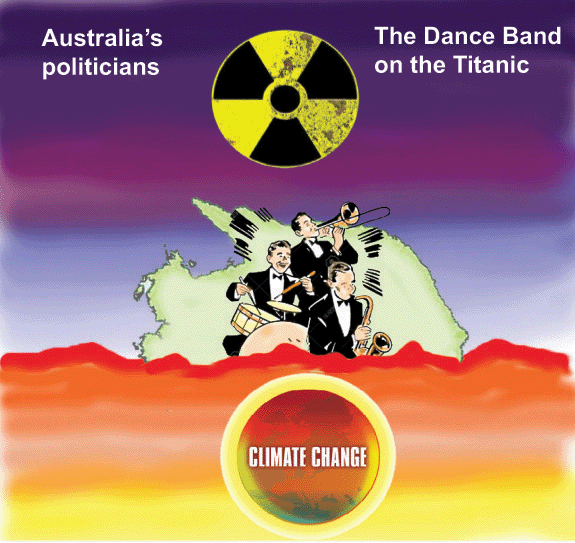 Coalition’s climate armour takes beating, SBS, News 4 Mar 19, A group of climate experts has issued a joint statement to the government, calling for a 45-to-65 per cent emissions reduction target on 2005 levels by 2030. A group of climate science experts has warned the government Australia needs more policies to cut greenhouse gas pollution in line with international obligations.
“Climate change is becoming an economic wrecking ball and it’s already having an impact,” the Climate Council’s Will Steffen said on Monday, calling for an emissions reduction target of 45-to-65 per cent below 2005 levels by 2030, instead of 26-to-28 per cent.
The joint statement was released after the government’s emissions data revealed last week showed a 0.9 per cent increase on levels in the September quarter compared to the previous year.
While emissions are declining in the electricity sector, this progress is outweighed by rises in transport and industrial energy, fuelled by a 19.7 per cent increase in LNG exports.
Climate Council spokesman and former head of BP Australasia Greg Bourne says the government’s recent policy announcements – including $2 billion for the Climate Solutions Fund – are unlikely to make a significant difference.
“Pollution has increased year on year under the government’s recently re-badged Emissions Reduction Fund,” he said.
“This is a failed policy because it does not effectively tackle pollution from fossil fuels, which contribute the lion’s share to the climate problem.”……. https://www.sbs.com.au/news/coalition-s-climate-armour-takes-beating
A climate-changed future – Australia’s marine heatwave disrupting ocean life
In the summer of 2017-18, the intense marine heatwave was combined with a land-based heatwave, together covering four million sq km. Scientists foundthe extreme weather event caused unprecedented loss of glacial ice in the New Zealand Southern Alps, changes to wine-grape harvests, and major disruption of marine ecosystems including kelp habitat loss, new species invasions and fisheries season changes.
This year the National Institute of Water and Atmospheric Research in New Zealand reported that sea surface temperatures in the Tasman were again above average.
Like coral reefs and tropical rainforests, the ocean suffers the slow torture of climate change peppered with high-intensity hits from extreme weather.
A window into the future
Marine heatwaves are generally out of sight and out of mind until one gets so bad it becomes impossible to ignore, says CSIRO research scientist Alistair Hobday.
A marine heatwave happens when the ocean temperature is much warmer than usual for the time of year from sunlight heating the surface water or warm water being brought via ocean currents – or both.
Climate change is causing marine heatwaves to happen more frequently and with more intensity. There may not be scorched earth or destroyed homes left in its wake, but a marine heatwave impacts our future in different ways – and serves as a warning. ……… https://www.theguardian.com/environment/2019/mar/05/australias-marine-heatwaves-provide-a-glimpse-of-the-new-ecological-order
Drought wipes billions from Australian farm production
ABC Rural By national rural reporter Kath Sullivan 4 Mar 19.The value of all that is farmed in Australia has fallen to $58 billion, from $63.8 billion two years ago.
In its latest commodity report, released today, ABARES found improved commodity prices and the low Australian dollar had softened the decline, largely driven by drought.
“Drought in the eastern states significantly reduced the 2018–19 winter crop, but one of the largest Western Australian harvests on record has provided a buffer to the national total,” it said.
Livestock industries also contributed to the decline, with ABARES reporting the volume of livestock products dropped by 2 per cent this year.
“Milk and wool production have been affected by the drought, and a significant decline in live animal exports also contributed to the fall,” it said.
“This is largely because of cessation in live sheep exports during the northern hemisphere summer months.”
ABARES reported that floods in Queensland last month could further reduce the volume of live cattle exports…….. https://www.abc.net.au/news/2019-03-05/value-of-australian-farm-production-drops-abares-figures/10867294
1 This month

of the week – Australians for War Powers Reform (AWPR)
To see nuclear-related stories in greater depth and intensity
 Antinuclear