3 decades later, many believe that this horrendous murder was done to protect the nuclear industry
Robert isn’t alone. He has documented the harassment and even murder of other whistleblowers who spoke out about contentious nuclear issues, or attempted to supply him with sensitive information.
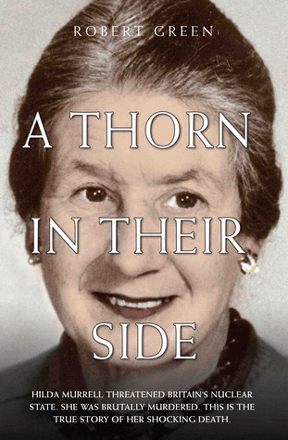 Was The Murder of British Anti-Nuclear Campaigner State Sanctioned? For many, the questions of who brutally murdered a 78-year-old rose-grower turned anti-nuclear campaigner outside her home town of Shrewsbury, England 34-years ago, and why, lack any satisfactory resolution, more than three decades after the tragic event. Speaking exclusively to Sputnik, her nephew Robert Green updates Kit Klarenberg on his search for the truth. Sputnik News 14 Mar 19 Was The Murder of British Anti-Nuclear Campaigner State Sanctioned? For many, the questions of who brutally murdered a 78-year-old rose-grower turned anti-nuclear campaigner outside her home town of Shrewsbury, England 34-years ago, and why, lack any satisfactory resolution, more than three decades after the tragic event. Speaking exclusively to Sputnik, her nephew Robert Green updates Kit Klarenberg on his search for the truth. Sputnik News 14 Mar 19
On the morning of March 21 1984, Hilda Murrell was preparing to make a presentation to the Sizewell B Inquiry, the first public planning investigation into the launch of a new nuclear power plant in the UK.
A lifelong environmentalist, over the previous decade she’d become extremely concerned about hazards posed by nuclear power in both its energized and weaponized forms, and campaigned with ever-increasing fervor against its proliferation. Hilda’s presentation was prepared with support from dissident scientists and activists, and offered expert insight on the risks posed by nuclear power and radioactive waste management. Hilda had been beaten and stabbed multiple times before being left to die from hypothermia sometime later. The resultant police investigation produced no leads or suspects – at least officially – and was widely criticized as negligent and superficial.
Alternative theories quickly proliferated among Hilda’s friends and family, the media and even members of parliament. Most commonly, it was suggested she was murdered due to her prominent anti-nuclear activities and opposition to the 1982 Falklands War – whether by individuals acting on behalf of the industry, or members of the security services. The latter theory was ardently supported by Labour MP Tam Dalyell, who repeatedly raised the issue in the House of Commons.
“Whoever was in [Hilda’s] house had clearly been looking for something. [It] had been carefully searched and her papers gone through in an orderly manner. Her telephone had been cut off in such a way that, although it was dead from inside the house, anyone calling would hear it ringing out. The police agree that is a sophisticated way of doing things – not the actions of a common burglar taking a chance. I am certain persons in Westminster and Whitehall know a great deal more about the violent death of Hilda Murrell than they have so far been prepared to divulge,” Dalyell said December 19 1984. Ever since, the intrepid rose-grower has rarely strayed very far from public consciousness. Her case has been dissected and immortalized in books, documentaries, plays and films, and as of 2018, it remains an enduring mystery, perhaps the most bizarre and baffling murder in the history of 20th century Britain – despite the conviction in May 2005 of Andrew George for Hilda’s abduction and murder.
Innocent Man Framed
George, a laborer in Shrewsbury who at the time of her killing was a 16-year-old truant from a foster home who couldn’t drive, was arrested June 2003 after a police review uncovered DNA and fingerprint evidence linking him with the crime. At his trial, he admitted being in Hilda’s house, but denied abducting or murdering her. The jury didn’t believe him, and he was sentenced to life imprisonment with a recommended minimum term of 15 years. Many, however, do believe George – among them Robert Green, a noteworthy anti-nuclear campaigner in his own right. He believes George – “a petty thief kind to old people” – was unjustly incarcerated, and DNA evidence withheld from the jury would not only likely acquit him, but establish beyond reasonable doubt at least one other male, whom Hilda scratched, and possibly another whose semen was on her cardigan, were involved in her murder. Robert believes MI5 and/or the nuclear industry, with potential assistance from a private security agency, abducted Hilda and took her to a ‘safe house’ to interrogate her and retrieve any sensitive information she may have possessed, then identify its sources and neutralize them – but not before permanently silencing and disposing of her. “Years ago I met a former IRA member, who said the abduction strongly echoed ‘snatch squad’ operations in Northern Ireland – the victim would be taken away for interrogation while someone disguised as the victim was driven in their own car as publicly as possible, to cause confusion and distract attention from abductors. The operation was made to look botched and amateurish – the cover of a bungling, sexually perverted burglar would help discredit any notion of state involvement.”
Robert Green,Hilda’s Nephew says:
“Chillingly, the former IRA operative later suggested such snatch squads were occasionally housed at Sir John Moore Army Barracks in central Shrewsbury – not far from Hilda’s home. A 28th anniversary meeting in the town yielded yet further troubling revelations. After the meeting, a man said his friend had explosive information to impart, but was too nervous to talk because he was subject to the Official Secrets Act.”
He said that early on the morning of March 21 1984, his friend had been helping guard the main gate of RAF Shawbury, not far from where Hilda was found. Four Dutch or Swiss agents who spoke perfect English came out of the base having been flown in. Claiming to be electrical engineers, they were “muscly, fit and scary to look at'” and spent no time in the base where they were supposed to be working. They returned four days later and were flown out. Moreover, he alleged the nearby Sundorne Territorial Army Centre, which was closed on dates coinciding with Hilda’s abduction and the discovery of her body, was where she was held. ……….
As a result of his attempts to bring his findings to public attention, Robert has been subjected to concerted harassment and surveillance by security services in both the UK and New Zealand, where he currently lives – a campaign that stepped up significantly when he began researching and writing A Thorn In Their Side, his book about the case. ……….
Robert isn’t alone. He has documented the harassment and even murder of other whistleblowers who spoke out about contentious nuclear issues, or attempted to supply him with sensitive information. …….https://sputniknews.com/europe/201805041064116385-hilda-murrell-mi5-conspiracy/?fbclid=IwAR1Nul9tNuXD2Iq82-vtigoEHHIKo5MuZUHWZRvZdDCuWc3UuN6CFvAPhKc
|
|
No comments yet.
1 This month
15 April – Zoom –Nuclear Power is Not the Solution
Apr 15, 2026 01:00 AM in Canberra, Melbourne, Sydney

Join the International Physicians for the Prevention of Nuclear War (IPPNW) on Tuesday, April 14th for a timely webinar exploring the risks associated with nuclear power and challenging the myth that it offers a simple, safe, carbon-free solution to the climate crisis

of the week – Australians for War Powers Reform (AWPR)
To see nuclear-related stories in greater depth and intensity
 Antinuclear
Leave a comment