Scott Morrison’s hypocrisy, chops and changes about nuclear power
 No plans to change law to allow nuclear power stations, says PM https://www.theaustralian.com.au/nation/politics/nuclear-energy-not-not-on-agenda-scott-morrison-says/news-story/01787095343ff0f68cfe60573aa41203, RICHARD FERGUSON, APRIL 18, 2019
Scott Morrison has clarified comments suggesting he was open to nuclear power.
The Prime Minister earlier today said nuclear power was “not ‘not’ on the agenda” and he was “fine” with energy generation “wherever it comes from.”
 But after backlash from Labor, Mr Morrison moved on Twitter to declare he had no plans to change the law to allow nuclear power stations.
“Labor are getting desperate, and we are only 8 days in. This is not our policy and we have no plans to change that,” he tweeted.
Mr Morrison’s original comments came on Tasmanian radio on Thursday morning.
When pushed on whether he would be happy to take proposals from the nuclear industry on going ahead with power projects, the Prime Minister said it would be allowed to do so.
“It’s not ‘not’ on the agenda, wherever it can come from is fine, but it has to be self-sustaining,” Mr Morrison told Launceston FM.
“If they want to put them forward they can. (Nuclear physicist) Ziggy Switkowski did a major report for the Howard Government on this issue, and it came back and it didn’t say it could support itself.”
Nuclear power has been an almost untouchable issue in Australian politics for decades and Labor was quick to leap on the Prime Minister’s comments.
Opposition environment spokesman Tony Burke said Mr Morrison would need to change the law if he were ever to accept a nuclear power station proposal.
“Nuclear power is against the law in Australia. It is extraordinary that Scott Morrison is now contemplating changing the law to allow nuclear power stations in Australia,” he said.
“Several places have been identified in the past for nuclear power stations — like Jervis Bay, Townsville, Bribie Island, Mackay.
“Where is Morrison proposing to put his nuclear power plants? Which coastal community is under threat?”
Daunting task faces Japan as removal of Fukushima’s radioactive fuel rods is commenced
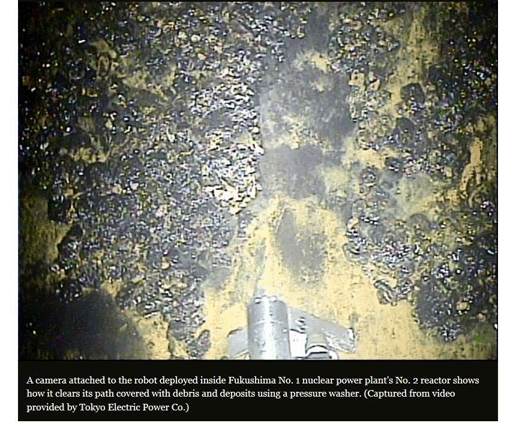
Nuclear fuel removal is small step in cleanup at Fukushima http://www.asahi.com/ajw/articles/AJ201904190031.html
April 19, 2019 Tokyo Electric Power Co., the operator of the crippled Fukushima No. 1 nuclear power plant, has started removing radioactive fuel rods from the fuel storage pool for one of the three reactors that melted down in the 2011 nuclear disaster.
Massive amounts of melted nuclear fuel debris remain in the cores or containment vessels of the No. 1 to No. 3 reactors, which melted down. In addition, many fuel rods, batched into assemblies, are stored in storage pools within the reactor buildings.
These pools could be seriously damaged if the plant is hit by another big earthquake or tsunami. Moving spent fuel from these pools to the safe common pool within the premises is an important step to preventing accidents and ensuring steady progress in the process of decommissioning the reactors.
All the 1,535 nuclear fuel assemblies that were in the No. 4 reactor building, which did not melt down because it was shut down at the time of the accident, were removed by the end of 2014. Since workers could enter the building, the operation was conducted in a normal manner.
By contrast, areas around the fuel storage pool for the No. 3 reactor remain inaccessible due to high levels of radiation. The situation requires the removal operation to be remotely conducted from a control room about 500 meters from the No. 3 reactor building.
The work involves putting nuclear fuel assemblies into special containers under water and lifting them up with a crane and putting them down onto the ground for transportation to the common pool. This is a tricky and risky mission that has to be carried out with great care and caution by using a monitor.
Initially, the process of removing the fuel rods from the storage pool for the No. 3 reactor was scheduled to start at the end of 2014. But it has been repeatedly postponed due to technical mishaps and other reasons. It was finally started after a delay of more than four years.
The plant operator, known as TEPCO, plans to relocate all 566 nuclear fuel assemblies that have been kept in the storage pool in the No. 3 reactor building by the end of March 2021.
To reduce the risks posed to the process by possible earthquakes and tsunami, it is desirable to carry out the work quickly. But making undue haste could cause problems and accidents that disrupt the process. Meeting the schedule should not be the top priority.
Experience and expertise to be accumulated through the work with the No. 3 reactor will come in handy for the same fuel removal work with the Nos. 1 and 2 reactors, which could be initiated as early as in fiscal 2023, which starts in April 2023.
The other two reactors, however, will pose even tougher challenges. The debris situation of the No. 1 reactor building is worse, while radiation levels within the No. 2 reactor building are higher.
It is vital to obtain sufficient experience and know-how through the process of removing fuel rods from the No. 3 reactor.
TEPCO needs to ensure steady progress in the process through effective and close information sharing with related manufacturers and other actors involved.
No decision has yet been made as to what to do with the spent fuel after being transferred to the common pool. This is a complicated and knotty issue that does not lend itself to an easy, quick solution, just like the problem of a rapidly increasing amount of radiation-contaminated water the plant is generating as the reactors are being flooded to cool the melted fuel debris and underground water keeps flowing in the reactor buildings.
In 2021, the utility plans to launch the even more challenging mission of removing melted fuel debris from one of the three reactors.
Prime Minister Shinzo Abe recently visited the Fukushima No. 1 nuclear plant for the first time in five years and promised the government’s committed leadership for the efforts to decommission the reactors and deal with polluted water.
The Abe administration should provide really strong and effective leadership for the long, grueling process in line with the prime minister’s pledge.
Both the government and TEPCO have a duty to move the decommissioning process steadily forward while winning support from the local communities through sincere and serious dialogue.
Cory Bernardi sulks as Scott Morrison, inn election campaign, abruptly reverses his support for nuclear power
 Cory Bernardi says PM got his ‘hopes up’ on nuclear power, HTTPS://WWW.2GB.COM/CORY-BERNARDI-SAYS-PM-GOT-HIS-HOPES-UP-ON-NUCLEAR-POWER/
Senator Cory Bernardi has backed nuclear power after the Prime Minister said he is not considering the energy alternative. Nuclear power plants are illegal in Australia but experts say [these “experts” turn out to be the Australian Nuclear Association] it could be the answer to Australia’s energy concerns.
Senator Cory Bernardi had introduced a bill last year to remove a ban on nuclear energy.
He tells Luke Grant he was hopeful when he heard Scott Morrison had been open to the idea.
“The Prime Minister got my hopes up when he said nuclear energy might be a part of the mix if it stacks up on its own two feet. But within 48 hours all the usual suspects come out and monster him into a position which is basically ‘oh no it’s not on the table’.
“Any idea that’s not driven by the left is outrageous and terrible and awful.”
Australian Nuclear Association’s Rob Parker continues to make absurd pro nuclear claims
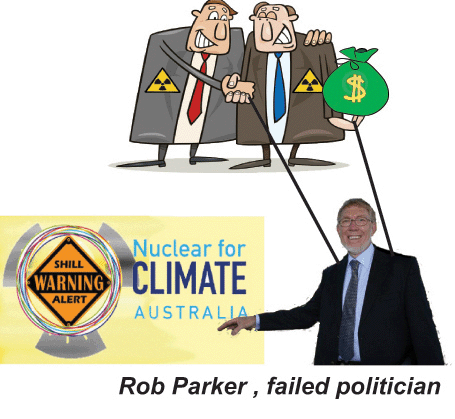 ‘Safest form of power generation’: Calls for nuclear to be put back on the table, HTTPS://WWW.2GB.COM/SAFEST-FORM-OF-POWER-GENERATION-CALLS-FOR-NUCLEAR-TO-BE-PUT-BACK-ON-THE-TABLE/ 16/04/2019, NATALIE PETERS & ERIN MOLAN , Nuclear power plants are illegal in Australia but experts [?] say it could be the answer to Australia’s energy concerns.
Many are calling for the construction of High-Efficiency Low Emission (HELE) coal power plants, in order to avoid outages and soaring power prices.
But Australian Nuclear Association Vice President Rob Parker tells Natalie Peters and Erin Molan nuclear energy is the most environmentally friendly and cost-effective option.
“When we look at nuclear energy we find that it is established as being the safest form of power generation that we have on the planet.
“It is safer than coal, safer than oil, safer than anything, including solar and wind. “We have established that we can have a clear low carbon, low-cost, future using nuclear energy.”
Nuclear power plants not designed, not built, to cope with climate change

U.S. Nuclear Power Plants Weren’t Built for Climate Change, [excellent pictures on original] Bloomberg , By Christopher Flavelle and Jeremy C.F. Lin, April 18, 2019
In 2011, after an earthquake and tsunami caused a meltdown at Japan’s Fukushima-Daiichi power plant, Gregory Jaczko, then the chairman of the U.S. Nuclear Regulatory Commission, had to worry about two things: whether radioactive fallout would harm the U.S. and whether a similar accident could befall an American plant. The answer to the first question turned out to be no. The second question preoccupies him still.
The NRC directed the operators of the 60 or so working U.S. nuclear power plants to evaluate their current flood risk, using the latest weather modeling technology and accounting for the effects of climate change. Companies were told to compare those risks with what their plants, many almost a half-century old, were built to withstand, and, where there was a gap, to explain how they would close it.
That process has revealed a lot of gaps. But Jaczko and others say that the commission’s new leadership, appointed by President Donald Trump, hasn’t done enough to require owners of nuclear power plants to take preventative measures—and that the risks are increasing as climate change worsens.
….. After Fukushima, U.S. regulators told operators to calculate their exposure to various flood risks and compare that with what the plant was designed for. Ninety percent of plants had at least one risk exceeding their design.
According to a Bloomberg review of correspondence between the commission and plant owners, 54 of the nuclear plants operating in the U.S. weren’t designed to handle the flood risk they face. Fifty-three weren’t built to withstand their current risk from intense precipitation; 25 didn’t account for current flood projections from streams and rivers; 19 weren’t designed for their expected maximum storm surge. Nineteen face three or more threats that they weren’t designed to handle.
The industry argues that rather than redesign facilities to address increased flood risk, which Jaczko advocates, it’s enough to focus mainly on storing emergency generators, pumps, and other equipment in on-site concrete bunkers, a system they call Flex, for Flexible Mitigation Capability. Not only did the NRC agree with that view, it ruled on Jan. 24 that nuclear plants wouldn’t have to update that equipment to deal with new, higher levels of expected flooding. It also eliminated a requirement that plants run Flex drills………
The commission’s three members appointed by President Trump wrote that existing regulations were sufficient to protect the country’s nuclear reactors. Jaczko disagrees. “Any work that was done following Fukushima is for naught because the commission rejected any binding requirement to use that work,” he says. “It’s like studying the safety of seat belts and then not making automakers put them in a car.”
The commission “is carrying out the Trump deregulatory philosophy,” says Edwin Lyman, head of the Nuclear Safety Project at the Union of Concerned Scientists. “The NRC basically did everything the industry wanted.” The two Democratic appointees objected to the NRC’s ruling. “The majority of the commission has decided that licensees can ignore these reevaluated hazards,” commissioner Jeff Baran wrote in dissent. His colleague Stephen Burns called the decision “baffling.” Through a spokesman, the Republican appointees declined to comment.
“Nuclear power is weird—it exists to produce electricity, and at the same time it can’t exist without electricity,” says Allison Macfarlane, who chaired the NRC from 2012 through 2014. Plants need constant power to pump cool water into a reactor’s core; if flooding interrupts that power supply for long enough, as happened in Fukushima, the core can overheat, melting through its container and releasing deadly levels of radiation.
The true risk to U.S. nuclear facilities may be even greater than what the documents from the nuclear commission show. The commission allowed nuclear plant operators not only to perform their own estimates of current flood risk but also to decide what assumptions to make—for example, the maximum likely hurricane speed or how much rain would fall in an extreme storm. (The commission reviews that work.) The commission also rejected a recommendation by their own staff that would require nuclear power plants to update their risk assessments periodically to reflect the advancing threat of climate change.
While plant owners weren’t required to project their future storm surge risk, the Union of Concerned Scientists has done its own estimates for some of those regions. The images included here show that projected increase.
Turkey Point Nuclear Generating Station, 35 miles south of Miami, was designed to withstand a storm surge of 16 feet, according to documents submitted to regulators by its owner, Florida Power & Light Co. But the updated storm surge is expected to range from 17.4 feet to 19.1 feet at different parts of the plant. Last year, Florida Power & Light sought permission from regulators to extend Turkey Point’s operating license until 2053.
……….. The Waterford power plant, a half-hour drive up the Mississippi River from New Orleans, was designed to withstand a maximum storm surge of 23.7 feet above sea level, according to documents provided to the NRC by Entergy Corp., which owns the plant. The company told regulators that a combination of storm surge and river flooding would create a maximum surge of 31.8 feet.
……… One of the largest gaps in storm surge protection is at Dominion Energy Inc.’s Surry Power Station, whose two reactors sit on a peninsula jutting into the James River just north of Norfolk, Va. The plant’s east side, which is most exposed to a potential storm surge, was designed to withstand a wall of water as high as 28.6 feet above sea level, Dominion told regulators. The company found that under current conditions, a storm surge combined with river flooding would bring a surge of as much as 38.8 feet. “
…… Dominion asked the NRC to extend its license for Surry to 2053. The commission has yet to rule on that request.
…….. According to documents provided to the commission by Exelon Corp., which owns Peach Bottom, the plant wasn’t designed for its current flood risk from heavy precipitation, storm surge, ice-induced flooding, or a standing wave called a seiche.
The fight over regulation and climate change comes when the nuclear industry, under pressure from cheap natural gas and still viewed with suspicion by many environmentalists, can least afford it, according to Peter Bradford, a former commissioner. “Anything that increases their costs now threatens their existence,” he says.
…… Macfarlane, the former NRC chairman, says the lesson of Fukushima is that the nuclear industry, including regulators, needs to prepare for seemingly unlikely threats. “Boy, did we misjudge natural hazards,” she says. “If something happens and you don’t learn from it, woe unto you.”https://www.bloomberg.com/graphics/2019-nuclear-power-plants-climate-change/
April 19 Energy News — geoharvey

Opinion: ¶ “The Largely Ignored Problem Of Global Peak Oil Will Seriously Hit In A Few Years” • Data from the International Energy Agency shows that with no new investment global oil production will drop by 50% by 2025. That includes oil from all unconventional sources, and new oil exploration is at the lowest level […]
Work begins on Warwick solar farm – UQ’s ticket to 100% renewables — RenewEconomy

Works begin on University of Queensland-owned solar farm that will make UQ world’s first major university to offset 100% of its electricity through its own renewables assets. The post Work begins on Warwick solar farm – UQ’s ticket to 100% renewables appeared first on RenewEconomy.
via Work begins on Warwick solar farm – UQ’s ticket to 100% renewables — RenewEconomy
Bottom line is that electric vehicles in Australia still face barriers — RenewEconomy

Australia can do much better on EVs – mass popularity is likely to take years. And that’s a shame, because in economic terms, EVs beat ICE cars hands down. The post Bottom line is that electric vehicles in Australia still face barriers appeared first on RenewEconomy.
via Bottom line is that electric vehicles in Australia still face barriers — RenewEconomy
Solar industry vents its anger at Queensland government, pleads for review — RenewEconomy

Solar industry confronts Queensland government over new installation rules, with warnings that it could threaten state’s 50% renewables target. The post Solar industry vents its anger at Queensland government, pleads for review appeared first on RenewEconomy.
via Solar industry vents its anger at Queensland government, pleads for review — RenewEconomy
UNSW looks to solar-powered desalination to help bust droughts josh — RenewEconomy

UNSW researchers are combining desalination technology with solar, targeting those in need of secure supplies of fresh water who are also disconnected from electricity grids. The post UNSW looks to solar-powered desalination to help bust droughts josh appeared first on RenewEconomy.
via UNSW looks to solar-powered desalination to help bust droughts josh — RenewEconomy
Global solar capacity surpassed 500GW in 2018 — RenewEconomy

Booming national markets – including Australia’s – helped deliver nearly 100GW of new PV installations in 2018, and took the global total past the 500GW mark. The post Global solar capacity surpassed 500GW in 2018 appeared first on RenewEconomy.
via Global solar capacity surpassed 500GW in 2018 — RenewEconomy
1 This month
15 April – Zoom –Nuclear Power is Not the Solution
Apr 15, 2026 01:00 AM in Canberra, Melbourne, Sydney

Join the International Physicians for the Prevention of Nuclear War (IPPNW) on Tuesday, April 14th for a timely webinar exploring the risks associated with nuclear power and challenging the myth that it offers a simple, safe, carbon-free solution to the climate crisis

of the week – Australians for War Powers Reform (AWPR)
To see nuclear-related stories in greater depth and intensity
 Antinuclear