A Gripping History of the Nuclear Disaster at Chernobyl
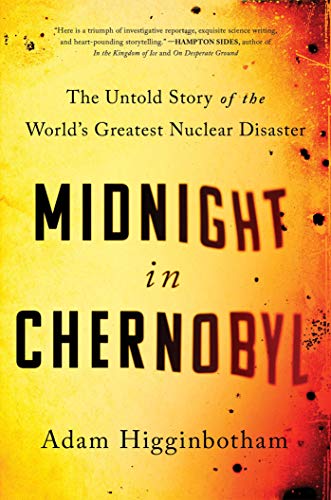 In “Midnight in Chernobyl,” Adam Higginbotham offers a thorough and readable account of one awful night in the Ukraine and its consequences. UnDark, 04.26.2019 / BY Henry Fountain, In “Midnight in Chernobyl,” Adam Higginbotham offers a thorough and readable account of one awful night in the Ukraine and its consequences. UnDark, 04.26.2019 / BY Henry Fountain, WHEN A REACTOR at the Chernobyl nuclear power plant exploded and burned 33 years ago, it generated a radioactive cloud that contaminated parts of the Soviet Union and Europe before dissipating. But the accident also created a fog of misunderstanding and confusion — in large part the result of a deliberate coverup by Soviet authorities — that has been slower to lift. Even three decades later, thorough authoritative accounts of the world’s worst atomic-power disaster are few and far between .
A new book offers perhaps the clearest, and fullest, look at the catastrophe yet. Adam Higginbotham’s “Midnight in Chernobyl,” is a compelling and comprehensive account of one awful night in Ukraine and the consequences that were felt worldwide. Higginbotham’s observations, and his writing, are so sharp there is no need to overdo anything for dramatic effect. Told so clearly and in such detail, the story is dramatic — and horrific — enough. ….
Over the years, a few chronicles of the disaster by Soviet writers have reached Western readers, most notably “The Truth About Chernobyl,” by Grigori Medvedev, a former engineer at the plant, published in 1991. ……
That began to change last year when Serhii Plokhy, a Harvard historian, weighed in with “Chernobyl: The History of a Nuclear Catastrophe.” But Plokhy’s work focused more on the political aftermath, including the downfall of the Soviet Union that followed just five years later, than on the details of the accident. Higginbotham, a British journalist, takes account of the political fallout as well, but the bulk of his book is about the accident and the response and cleanup — primarily the first seven months, which culminated with the rushed completion of the concrete-and-steel sarcophagus that entombed the remains of Unit 4. The author clearly has been captivated by the disaster for years. His interviews for the book began more than a decade ago, and include some of the key surviving characters. He was also aided by the recent declassification of much archival material, especially the deliberations of the various government tribunals that managed (or, more accurately, mismanaged) the response. Higginbotham introduces us to a few people who have never received much notice. Chief among these is Maria Protsenko, the architect of Pripyat, the city of nearly 50,000 that was built for the Chernobyl workers. Like most of the Soviet Union’s privileged atomic cities, Pripyat was a clean, comfortable place, a glorious testament to the Soviet system, and Protsenko’s job for seven years had been to make it even more glorious. Her world changed in an instant when the reactor exploded. Pripyat, just a few miles away, was heavily contaminated immediately, though it took the authorities a day and a half to order an evacuation. (This was just one of many examples of Soviet officialdom’s callousness and irresponsibility in handling the disaster. Another was telling the evacuees to plan to be away for a few days; in reality they would be gone forever.) It’s hard not to feel sorry for Protsenko, who in the space of 36 hours went from proudly planning Pripyat’s expansion to calculating how many buses would be needed to get its residents to safety. (Precisely 1,225, as it turned out.) Ever the dutiful technocrat, she rode the last one, zig-zagging across the ghost city to pick up stragglers. It’s this kind of detail that makes Higginbotham’s book so gripping. His accounts of the “liquidators,” or clean-up workers, are especially riveting — including the “bio robots,” men who had to clean lethally radioactive debris off the roof of the plant by hand after mechanical robots failed, and the workers whose job was to enter the destroyed reactor building itself, hunting for the remaining uranium fuel in an effort to allays fears that another, potentially worse, explosion was possible. No aspect of the disaster and its aftermath are ignored. Higginbotham describes how members of a hunting and fishing association were enlisted to exterminate the dogs and other pets Pripyat residents were forced to leave behind. He recounts the woeful tales of plant operators and first-responding firefighters who lived their final days in a Moscow hospital, having been so heavily irradiated during the accident that they had no chance of survival. He devotes a full chapter to the unprecedented job of building the sarcophagus, which was constructed by thousands of workers, many of whom only toiled for a short time before being sent home, having reached radiation exposure limits. One task was almost suicidal: finding solid supports among the radioactive ruins for the massive roof beams that were lifted by crane operators working behind lead shields. …….. https://undark.org/article/a-gripping-history-of-the-nuclear-disaster-at-chernobyl/ |
|
No comments yet.
1 This month

of the week – Australians for War Powers Reform (AWPR)
To see nuclear-related stories in greater depth and intensity
 Antinuclear
Leave a comment