To May 1st – Climate and Nuclear News – Australia
On climate change – where to start? Dahr Jamail– covers the world-wide impacts that are already happening. It seems that only the very young, Greta Thunberg, and the very old, David Attenborough, are able to get the message across. So many different impacts – the latest big one is another cyclone, followed by flooding, in Mozambique.
On nuclear issues, also, where to start? With the stalemate in nuclear weapons negotiations, in several countries, and India and Pakistan on the tightrope? Or with the nuclear financial messes in USA and UK?
Perhaps it’s best to find a note of optimism. Izumi Nakamitsu, the UN High Representative for Disarmament Affairs, spoke convincingly, in Tokyo, about improving prospects for progress in nuclear disarmament.
$70 trillion cost predicted, as Arctic permafrost thaws.
Across the world, Extinction Rebellion climate activists stage “die-in“. Secretive Fossil Fuel Lobby Group, “Global Climate Coalition”, Manipulated UN Climate Programs.
UN assesses world environment in new report – it’s a grim story.
Reviewing the state of the Treaty on the Non-Proliferation of Nuclear Weapons. New report warns that world is dangerously close to increased use of nuclear weapons. Use of Artificial Intelligence in Nuclear Weapons Command and Control.
AUSTRALIA
Nuclear power, climate change, and the Australian election.
CLIMATE. 2019: the climate election. Liberal Coalition gets a poor rating on climate policy. Australian children want Australia to take action on climate change: it’s about their future! Labor commits $10M to boost CSIRO climate science centre capabilities. Pauline Hanson denies humans behind climate change, blames ‘fearmongering’
The Adani coal mine is a test of Australia’s environmental intelligence – Bob Brown. Coalition slammed over ‘misleading’ Adani billboard. Adani coal mine expansion has become a decisive issue for Queensland’s marginal seats. Adani’s bid to bankrupt traditional owner hits court.
NUCLEAR. “Australia’s nuclear waste is a national issue and putting the burden on two semirural communities isn’t fair”.Labor remains silent on the issue. Petition to stop federal government’s plans to build a nuclear waste facility in Kimba or Hawker. Voters in South Australia’s Grey Electorate angry over 3 years of federal radioactive waste plan. South Australian aborigines again face a nuclear threat – as Federal Government plans a nuclear waste dump. Australian Radiation Protection and Nuclear Safety Agency righteous about possibly radioactive jewellery, silent on nuclear threats
Maralinga nuclear bomb test survivor reveals truth of what happened in the SA desert.
Federal Environment Minister, Melissa Price, fails the environment with secretive Yeelirrie uranium approval. Clandestine approval for controversial uranium mine is evidence Australia needs better environment laws. Morrison govt approved Yeelirrie uranium mine just the day before calling the election. Bill Shorten questions Environment Minister Melissa Price’s shonky Yeelirrie uranium deal. Yeelirrie uranium mine approval all pain no gain for Coalition. Uranium to be transported across Nullarbor Plain all the way from Yeelirrie to Port Adelaide – The yellowcake highway to Port Adelaide. Uranium miner coaxed government to water down extinction safeguards. Yeelirrie has a low grade of uranium, and Cameco has closed McArthur River mine with a much higher grade. It’s not worth wiping out a species for the Yeelirrie uranium mine.
Lynas’ rare earths miner: its troubles are a reminder that even renewables technologies involve radioactive trash.
RENEWABLE ENERGY S.A. begins search for energy provider after failure of solar tower project. CopperString is back, with plan to unlock outback wind and solar. Australian wave power technology tapped to power Spanish Canary Island. Tesla driver clocks almost 1000km in Australian outback in one day. Victorian water utilities join forces to source cheap solar power.
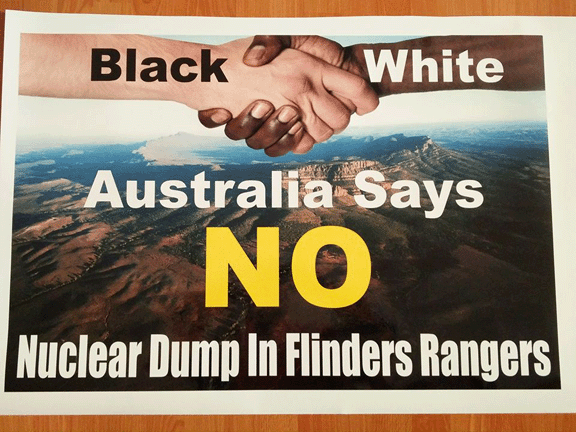
“Australia’s nuclear waste is a national issue and putting the burden on two semirural communities isn’t fair”
|
Thousands call for SA nuclear dump plans to be scrapped, as Labor remains silent on the issue, The Adelaide Advertiser , 29 Apr 19, More than 3000 people have signed a petition urging the Federal Government to scrap plans for a nuclear dump at Kimba or Hawker. It comes as Federal Labor remains silent on whether it would push ahead with the stalled plans, if it came to power next month. The Hawker and Kimba communities say they are in a “holding pattern” as they await progress on work to select a nuclear dump site, which has ground to a halt amid a legal battle. No Dump Alliance’s Mara Bonacci said campaigners would tomorrow give Grey MP Rowan Ramsey a petition calling for the Government to take sites at Hawker and Kimba off the table. Ms Bonacci said it should introduce “an independent process to look at the best place for waste in SA”. “Australia’s waste is a national issue and putting the burden on two semirural communities isn’t fair,” she said. “They haven’t consulted anybody properly. They’re looking for a postcode, and not the best process.”
However, it was unclear whether a potential change of government might result in an overhaul of the trouble-plagued planning process, as Labor did not respond to The Advertiser’s repeated inquiries about the issue. Aboriginal associations in Hawker and Kimba have opposed a move to set up a radioactive waste dump in their traditional lands. The Barngarla Determination Aboriginal Corporation complained that Kimba Council’s plan to run a community ballot about whether it supported the dump, was discriminatory. It launched Federal Court action, taking issue with the council’s plan to exclude native-title owners from the ballot because they did not live in the district. Kimba Council chief executive Deborah Larwood in January gave evidence in court, but since then, has heard nothing about future proceedings. From the council’s perspective we’re basically in a holding pattern,” Ms Larwood said.
In Hawker, Flinders Ranges Mayor Peter Slattery said his district, too, was “in limbo” until court action — both the Barngarla case and another flagged by the Adnyamathanha Traditional Lands Association (ATLA) — was settled. “I think we’re looking at a pretty long hiatus,” Mr Slattery said. The dump debate had been a “divisive” issue. “Regardless of what happens, there’s not going to be a decision in the next six months and it could be much longer,” Mr Slattery said. The protracted debate was generating “growing frustrations” on both sides of the fence. “Everyone is wearying of the process and the antagonism it’s generated,” Mr Slattery said. Maurice Blackburn senior associate Nicki Lees, representing ATLA, said the Hawker ballot would have excluded a significant number of Adnyamathanha people. The organisation in December lodged a complaint in the Australian Human Rights Commission and was awaiting conciliation. It also claims Commonwealth contractors carried out ground disturbing work in the area, which desecrated land sacred to Adnyamathanha women, causing them “great distress”. Ms Lees said it made sense to await the outcome of the Kimba case before potentially launching ATLA’s own court action. Resources Minister Matt Canavan said the Hawker and Kimba ballots were due last year. “As this matter is before the courts, the Government cannot speculate on when any community ballot may be held,” Mr Canavan said.
|



Petition to stop federal government’s plans to build a nuclear waste facility in Kimba or Hawker
 Alliance petition government over nuclear https://www.whyallanewsonline.com.au/story/6094410/alliance-petition-government-over-nuclear/, Louis Mayfield , 29 Apr 19,
A community postcard opposing the federal government’s plans to build a nuclear waste facility in Kimba or Hawker will be delivered to the Whyalla Office of Member for Grey Rowan Ramsey on Tuesday.
The postcard, which urges the federal government to ‘investigate all safe options before proceeding with this current plan’ has been put together by the No Dump Alliance, a group that represents community opposition to the nuclear waste dump.
Flinders Rangers Adnyamathanha woman Vivianne McKenzie said ‘there are many people in the community who have opposed this nuclear waste dump since it was first announced’.
Monday marked three years since Wallerberdina Station in the Flinders Ranges was named as the federal government’s preferred site for a national radioactive waste facility.
Currently three sites are under federal consideration: two near Kimba on the Eyre Peninsula and one near Hawker in the Flinders Ranges.
Doctor Susi Andersson from Hawker said most people, for or against the facility, felt that three years of uncertainty was too long.
“The process of finding a site for a NRWMF is dividing and harming our community,” she said.
Kimba farmer Peter Woolford said jobs were at risk because of the government’s ‘unpopular and unnecessary’ plan.
“We will not sit quietly and allow a flawed plan to have a lasting negative impact on our way of life,” he said.
 Member for Grey Rowan Ramsey said he totally agreed that three years was too long for the site selection process – however he noted that the nuclear proposal was tied up in a court case launched by the Barngarla Determination Aboriginal Corporation.
“While we’re still waiting for the judge’s decision there’s nothing we can do in that space,” he said.
“There are differing views (on nuclear) in each community, I am aware of that. From day 1 my government made a commitment that we wouldn’t be forcing this facility on a community that does not want it.
“The towns of Hawker and Kimba are without a doubt the best educated communities in Australia on this issue and should be left to have their say in a voting mechanism.”
Mr Ramsey said he would pass on the postcard from the No Dump Alliance to Minister Canavan.
The impacts of climate change on WATER
 The Last Time There Was This Much CO2, Trees Grew at the South Pole, Dahr Jamail, Truthout , 29 April 19, “……… Water
As usual, there continue to be ample examples of the impacts of climate disruption in the watery realms of the planet.
In oceans, most of the sea turtles now being born are female; a crisis in sea turtle sex that is borne from climate disruption. This is due to the dramatically warmer sand temperatures where the eggs are buried. At a current ratio of 116/1 female/male, clearly this trend cannot continue indefinitely if sea turtles are to survive.
An alarming study showed recently that the number of new corals on the Great Barrier Reef has crashed by 89 percent after the mass bleaching events of 2016 and 2017. With coral bleaching events happening nearly annually now across many of the world’s reefs, such as the Great Barrier, we must remember that it takes an average of a decade for them to recover from a bleaching event. This is why some scientists in Australia believe the Great Barrier Reef to be in its “terminal stage.”
The UN recently sounded the alarm that urgent action is needed if Arab states are to avoid a water emergency. Water scarcity and desertification are afflicting the Middle East and North Africa more than any other region on Earth, hence the need for countries there to improve water management. However, the per capita share of fresh water availability there is already just 10 percent of the global average, with agriculture consuming 85 percent of it.
Another recent study has linked shrinking Arctic sea ice to less rain in Central America, adding to the water woes in that region as well.
In Alaska, warming continues apace. The Nenana Ice Classic, a competition where people guess when a tripod atop the frozen Nenana River breaks through the ice each spring, has resulted in a record this year of the earliest river ice breakup. It broke the previous record by nearly one full week.
Meanwhile, the pace of warming and the ensuing change across the Bering Sea is startling scientists there. Phenomena like floods during the winter and record low sea ice are generating great concern among scientists as well as Indigenous populations living there. “The projections were saying we would’ve hit situations similar to what we saw last year, but not for another 40 or 50 years,” Seth Danielson, a physical oceanographer at the University of Alaska Fairbanks, told The Associated Press of the diminishing sea ice.
In fact, people in the northernmost community of the Canadian Yukon, the village of Old Crow, are declaring a climate disruption State of Emergency. The chief of the Vuntut Gwitchin First Nation in the Yukon, Chief Dana Tizya-Tramm, has stated that his community’s traditional way of life is at stake, including thawing permafrost and rivers and lakes that no longer freeze deeply enough to walk across in the winter, making hunting and fishing difficult and dangerous. He said that declaring the climate emergency is his community’s responsibility to the rest of the planet.
Other signs of the dramatic warming across the Arctic abound. On Denali, North America’s highest mountain (20,310 feet), more than 66 tons of frozen feces left by climbers on the mountain are expected to begin thawing out of the glaciers there as early as this coming summer.
Another study found that tall ice cliffs around Greenland and the Antarctic are beginning to “slump,” behaving like soil and rock in sediment do before they break apart from the land and slide down a slope. Scientists believe the slumping ice cliffs may well be an ominous sign that could lead to more acceleration in global sea level rise, as far more ice is now poised to melt into the seas than previously believed.
In New Zealand, following the third hottest summer on record there, glaciers have been described by scientists as “sad and dirty,” with many of them having disappeared forever. Snow on a glacier protects the ice underneath it from melting, so this is another way scientists measure how rapidly a glacier can melt — if the snow is gone and the blue ice underneath it is directly exposed to the sun, it’s highly prone to melting. “Last year, the vast majority of glaciers had snowlines that were off the top of the mountain, and this year, we had some where we could see snowlines on, but they were very high,” NIWA Environmental Science Institute climate scientist Drew Lorrey told the New Zealand Herald. “On the first day of our survey, we observed 28 of them, and only about six of them had what I would call a snowline.”
Lastly in this section, another study warned that if emissions continue to increase at their current rate, ice will have all but vanished from European Alpine valleys by 2100. The study showed that half of the ice in the Alps’ 4,000 glaciers will be gone by 2050 with only the warming that is already baked into the system from past emissions. The study warned that even if we ceased all emissions at this moment, two-thirds of the ice will still have melted by 2100……… https://truthout.org/articles/the-last-time-there-was-this-much-co2-trees-grew-at-the-south-pole/
Norway to close permanently its nuclear research reactor (Australia should, too)
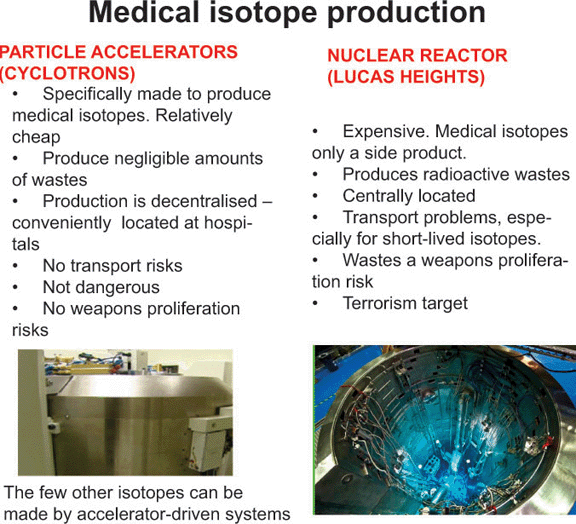 Norway’s last nuclear research reactor to close permanently https://www.reuters.com/article/norway-nuclear/norways-last-nuclear-research-reactor-to-close-permanently-idUSL5N22789V, OSLO, April 25 (Reuters) – Norway’s last nuclear research reactor will shut permanently and be decommissioned after more than 50 years of operations, the country’s Institute for Energy Technology (IFE) said on Thursday.
The JEEP II research reactor at Kjeller near Oslo has been shut for scheduled maintenance since last December and corrosion was found on several important safety components during an inspection.
The institute said it would be too costly to repair the reactor.
“The board of directors has decided, based on an overall assessment, that the reactor will not be restarted. IFE will consequently initiate work to prepare the decommissioning of the reactor,” the institute said in a statement.
Nuclear fuel and heavy water have been already removed, meaning that the reactor poses no danger to the environment, it added.
The rector, some 20 kilometres away from Oslo, has been used by researchers in physics, materials, cancer medicine, renewable energy and nuclear disarmament since starting operations in 1967, the IFE said.
In June 2018, Norway’s research reactor in Halden was shut down after 60 years of operation.
“Both Norwegian nuclear reactors are now closed and Norway will enter into a new era with decommissioning of the national nuclear programme which was started in 1948,” the IFE said.
Norway has no commercial nuclear reactors, and generates more than 90 percent of its electricity at hydropower plants. (Reporting by Nerijus Adomaitis. Editing by Jane Merriman)
Human rights concerns, as foreign workers have poor working conditions at Fukushima nuclear cleanup
Japan needs thousands of foreign workers to decommission Fukushima plant, prompting backlash from anti-nuke campaigners and rights activists, SCMP Julian Ryall , 26 Apr, 2019
Activists are not convinced working at the site is safe for anyone and they fear foreign workers will feel ‘pressured’ to ignore risks if jobs are at risk
Towns and villages around the plant are still out of bounds because radiation levels are dangerously high
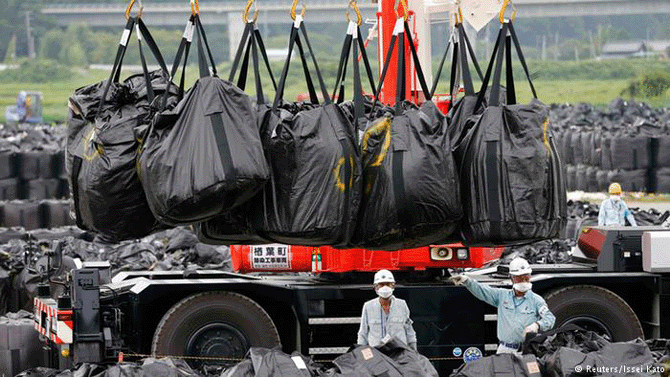
Tokyo Electric Power Co (TEPCO) has announced it will take advantage of the government’s new working visa scheme, which was introduced on April 1 and permits thousands of foreign workers to come to Japan to meet soaring demand for labourers. The company has informed subcontractors overseas nationals will be eligible to work cleaning up the site and providing food services.
About 4,000 people work at the plant each day as experts attempt to decommission three reactors that melted down in the aftermath of the March 2011 Great East Japan Earthquake and the huge tsunami it triggered. Towns and villages around the plant are still out of bounds because radiation levels are dangerously high.
Activists are far from convinced working at the site is safe for anyone and they fear foreign workers will feel “pressured” to ignore the risks if their jobs are at risk.
“We are strongly opposed to the plan because we have already seen that workers at the plant are being exposed to high levels of radiation and there have been numerous breaches of labour standards regulations,” said Hajime Matsukubo, secretary general of the Tokyo-based Citizens’ Nuclear Information Centre. “Conditions for foreign workers at many companies across Japan are already bad but it will almost certainly be worse if they are required to work decontaminating a nuclear accident site.”
Companies are desperately short of labourers, in part because of the construction work connected to Tokyo hosting the 2020 Olympic Games, while TEPCO is further hampered because any worker who has been exposed to 50 millisieverts of radiation in a single year or 100 millisieverts over five years is not permitted to remain at the plant. Those limits mean the company must find labourers from a shrinking pool.
“It has been reported that vulnerable people have been illegally deceived by decontamination contractors into conducting decontamination work without their informed consent, threatening their lives, including asylum seekers under false promises and homeless people working below minimum wage,” the statement said. “Much clean-up depends on inexperienced subcontractors with little scrutiny as the government rushes decontamination for the Olympic Games.”
Cade Moseley, an official of the organisation, said there are “very clear, very definite concerns”.
“There is evidence that foreign workers in Japan have already felt under pressure to do work that is unsafe and where they do not fully understand the risks involved simply because they are worried they will lose their working visas if they refuse,” he said……
With Olympics in mind, Japan trying to put population back into Fukushima ghost towns
|
Japan’s nuclear horror relived as people return to Fukushima’s ghost towns,
It is eight years since a devastating tsunami caused three reactors to meltdown at the Fukushima Daiichi nuclear power station on the north-east coast of Japan Mirror UK, Emily RetterSenior Feature Writer, Mirror UK, 29 Apr19
Only wild animals, and the 6ft weeds, which have rampaged through deserted homes and businesses, suffocating once-chatty barbers shops and bustling grocery stores; strangling playgrounds and their rusting rides which lie empty and eerily still. Once unextraordinary, mundane symbols of everyday lives have taken on the appearance of a horror film set in these areas closest to the Fukushima Daiichi nuclear power station on the coast of north-east Japan, eight years after the devastating tsunami which caused a meltdown at three of the plant’s reactors, forcing tens of thousands to flee. The earthquake on March 11, 2011, claimed 19,000 lives, and triggered the world’s largest nuclear disaster since Chernobyl. Radiation leaking in fatal quantities forced 160,000 people to evacuate immediately, and most to this day have not returned to their toxic towns and villages……. The official mandatory evacuation order was lifted, and while reports reveal just 367 residents of Okuma’s original population of 10,341 have so far made the decision to return, and most of the town remains off-limits, the Japanese government is keen this be seen as a positive start to re-building this devastated area……. The Japanese Prime Minister, Shinzo Abe, visited to mark the milestone.
Six Olympic softball games and a baseball game will be staged in Fukushima, the capital of this prefecture, which is free of radiation. The torch relay will even begin at J Village, which was once the base for the crisis response team. Hearteningly, it is now back to its original function, a football training centre. But the truth is, it is mainly older residents who have decided to return to their homes. Seimei Sasaki, 93, explained his family have roots here stretching back 500 years. His neighbourhood in Odaka district now only contains 23 of its original 230. “I can’t imagine what this village’s future looks like,” he admitted. Young families are few and far between – these areas are still a terrifying prospect for parents. But the re-built schools are slowly filling a handful of classroom seats. Namie Sosei primary and middle school, less then three miles from the plant, has seven pupils. One teacher said: “The most frustrating thing for them is that they can’t play team sports.” A sad irony as the Olympics approach. And with so many residents still fearful, so the deadly clean-up operation continues. Work to make the rest of Okuma safe is predicted to take until 2022. The area which was its centre is still a no-go zone. In the years following the disaster, 70,000 workers removed topsoil, tree branches, grass and other contaminated material from areas near homes, schools and public buildings.
Millions of cubic metres of radioactive soil has been packed into bags. By 2021 it is predicted 14million cubic metres will have been generated. The mass scale operation uses thousands of workers. Drivers are making 1,600 return trips a day. But residents understandably want it moved out of Fukushima for good. As yet, no permanent location has agreed to take it, but the government has pledged it will be gone by 2045. At Daiichi itself, the decontamination teams are battling with the build up of 1m tonnes of radioactive water. …..https://www.mirror.co.uk/news/world-news/japans-nuclear-horror-relived-people-14420671 |
|
|


The thorium nuclear reactor dream – still as far away a fantasy as ever
 Thorium nuclear power? go Green instead https://www.westerntelegraph.co.uk/news/17600300.letter-thorium-nuclear-power-go-green-instead/ Reporter,Western Telegraph April 17, CHRISTOPHER JESSOP, F Harbud wrote: “With all the letters on green energy appearing in the press, I wonder why there is no mention of the thorium reactors under development?”
Uranium waste in New Mexico puts lie to ‘carbon free’
The Public Service Company of New Mexico, which has made an incredible indelible scar of industrial consequence on New Mexico and the Earth, now wants to add more nuclear to its portfolio. By doing so, PNM will only amplify this consequence. Some say that nuclear-generated electricity should be allowed because it is “carbon-free.” From a life-cycle perspective, it is not carbon-free. The semantics are irrelevant; what matters is the eventual and permanent negative impact and consequence to the land, the people and our planet Earth.
(In honor of) this Earth Day, it is imperative we acknowledge the damage done to the integrity of the life of Earth. The seemingly insurmountable effect from the cause of the extractive industry demands our attention. We have a climate crisis that is ebbing the life of our planet. The delicate balance of the equilibrium of the Earth and its life systems have been dangerously upset. We cannot further aggravate this great dilemma with more uranium exploitation and continue to destroy the sanctity of our Earth Mother and all life upon and within her.https://www.abqjournal.com/1307342/uranium-waste-in-nm-puts-lie-to-carbon-free.html
The impact of high carbon emissions on the land
The Last Time There Was This Much CO2, Trees Grew at the South Pole, Dahr Jamail, Truthout , 29 April 19,
“……… Earth
The impact of runaway emissions is already upon us. Several cities in the northern U.S., such as Buffalo, Cincinnati and Duluth, are already preparing to receive migrants from states like Florida, where residents are beset with increasing flooding, brutal heat waves, more severe and frequent hurricanes, sea level rise, and a worse allergy season. City planners in the aforementioned cities are already preparing by trying to figure out how to create jobs and housing for an influx of new residents.
Indications of the climate disruption refugee crisis are even more glaring in some other countries.
Large numbers of Guatemalan farmers already have to leave their landdue to drought, flooding, and increasingly severe extreme weather events.
In low-lying Bangladesh, hundreds of thousands of people are already in the process of being displaced from coastal homes, and are moving into poverty-stricken areas of cities that are already unprepared to receive the influx of people. Given that 80 percent of the population of the country already lives in a flood plain, the crisis can only escalate with time as sea level rise continues to accelerate.
Meanwhile, diseases spread by mosquitoes are also set to worsen in our increasingly warm world. A recently published study on the issue shows that over the next three decades, half a billion more people could be at risk of mosquito-delivered diseases.
Other migrations are occurring as well. In Canada’s Yukon, Indigenous elders told the CBC that caribou and moose are moving further north than ever before in order to escape the impacts of climate disruption like warmer summers, lakes and rivers that don’t freeze, and adjusting their migrations to find more food. This has deep impacts on the survival and culture of the area’s Indigenous residents.
In economic news, a researcher for the Federal Reserve Bank recently penned a letter urging central banks to note the financial risks, and possibly an impending financial crisis, brought about by climate disruption. “Without substantial and sustained global mitigation and regional adaptation efforts,” read the letter, “climate change is expected to cause growing losses to American infrastructure and property and impede the rate of economic growth over this century.”
Another report showed that climate disruption is already negatively impacting fruit breeders, and consumers will soon feel the pain of higher prices. “We are seeing industries that may not survive if we don’t find a solution, and we are only just seeing the consequences of climate change,” Thomas Gradziel, of the University of California at Davis, told The Washington Post.
Underscoring all of this, the Global Seed Vault in Svalbard, Norway, known as the “Doomsday Vault,” has already been altered by climate disruption impacts. The primary impacts thus far have been floodingaround the vault, given how warm temperatures have become across the Arctic. The Doomsday Vault holds nearly one million seeds from around the globe, and functions as a backup in case climate disruption, war, famine, or disease wipes out certain crops. In other words, it’s a backup plan to backup plans. A recent report showed that climate change’s impacts on the seed vault could get worse as snow season shortens, heavier and more frequent rainfalls escalate, and avalanches and mudslides near the vault become more common.
Lastly in this section, researchers recently warned that the Arctic has now entered an “unprecedented state” that is literally threatening the stability of the entire global climate system. Their paper, “Key Indicators of Arctic Climate Change: 1971–2017,” with both American and European climate scientists contributing, warned starkly that changes in the Arctic will continue to have massive and negative impacts around the globe.
“Because the Arctic atmosphere is warming faster than the rest of the world, weather patterns across Europe, North America, and Asia are becoming more persistent, leading to extreme weather conditions,” Jason Box, the lead author of the paper said. ……….. https://truthout.org/articles/the-last-time-there-was-this-much-co2-trees-grew-at-the-south-pole/
How Climate Change is Making Storms Stronger — Evaporation, Precipitation, Instability — robertscribbler

With Cyclones Idai and Kenneth generating record breaking, back-to-back landfalls in Mozambique, with new studies indicating an increase in U.S. tornado activity and a general movement of tornadoes eastward, and with many air travelers recently grounded, it’s a good time to revisit climate change’s overall effects on extreme weather. (Kenneth was the strongest storm to […]
S.A. begins search for energy provider after failure of solar tower project — RenewEconomy

South Australia signals search for new projects and competitors to supply 100% of its electricity supply, after failure of the Aurora solar thermal project. The post S.A. begins search for energy provider after failure of solar tower project appeared first on RenewEconomy.
via S.A. begins search for energy provider after failure of solar tower project — RenewEconomy
CEFC invests $30 million in world-first Woolworths green bond — RenewEconomy

The CEFC has invested $30 million in the Woolworths Group green bond, the first certified green bond issued by an Australian retailer and by a supermarket business globally. The post CEFC invests $30 million in world-first Woolworths green bond appeared first on RenewEconomy.
via CEFC invests $30 million in world-first Woolworths green bond — RenewEconomy
April 29 Energy News — geoharvey

Video: ¶ “Finland’s New Generation Of Climate Heroes” • The town of Ii in northern Finland wants to be the world’s first zero-waste community. They stopped using fossil fuels, and the community is reducing CO₂ emissions faster than any other in Finland. Their target is to reduce carbon emissions by 80% by 2020, 30 years ahead […]
The Last Time There Was This Much CO2, Trees Grew at the South Pole
Dahr Jamail, Truthout , 29 April 19, It is palpable now. Even the most ardent deniers of human-caused climate disruption can feel the convulsions wracking the planet…..
The signs of our overheated planet abound, and another collection of recent reports and studies shows things are only continuing to accelerate as human-caused climate disruption progresses.
A recently published study showed that Earth’s glaciers are now melting five times more rapidly than they were in the 1960s.“The glaciers shrinking fastest are in central Europe, the Caucasus region, western Canada, the U.S. Lower 48 states, New Zealand and near the tropics,” lead author Michael Zemp, director of the World Glacier Monitoring Service at the University of Zurich told Time Magazine. Glaciers in those places are losing an average of more than 1 percent of their mass each year, according to the study. “In these regions, at the current glacier loss rate, the glaciers will not survive the century,” added Zemp.
Meanwhile, the World Meteorological Organization announced that extreme weather events impacted 62 million people across the world last year. In 2018, 35 million people were struck by flooding, and Hurricanes Florence and Michael were just two of 14 “billion-dollar disasters” in 2018 in the U.S. More than 1,600 deaths were linked to heat waves and wildfires in Europe, Japan and the U.S. The report also noted the last four years were the warmest on record.As an example of this last statistic, another report revealed that Canada is warming at twice the global rate. “We are already seeing the effects of widespread warming in Canada,” Elizabeth Bush, a climate science adviser at Environment Canada, told The Guardian. “It’s clear, the science supports the fact that adapting to climate change is an imperative.”
Another recent report showed that the last time there was this much CO2 in the atmosphere (412 ppm), in the Pliocene Epoch 5.3 to 2.6 million years ago, sea levels were 20 meters higher than they are right now, trees were growing at the South Pole, and average global temperatures were 3 to 4 degrees Centigrade (3°-4° C) warmer, and even 10°C warmer in some areas. NASA echoed the report’s findings.
And if business as usual continues, emissions will only accelerate. The International Energy Agency announced that global carbon emissions set a record in 2018, rising 1.7 percent to a record 33.1 billion tons……….. https://truthout.org/articles/the-last-time-there-was-this-much-co2-trees-grew-at-the-south-pole/
1 This month
To see nuclear-related stories in greater depth and intensity
– go to https://nuclearinformation.wordpress.com/


 Antinuclear