Queensland Coalition MPs push for inquiry to lift Australia’s nuclear power ban, Guardian, 2 June 19,
Keith Pitt and James McGrath behind move, saying ‘we have to be able to investigate all options’ A group of Queensland Liberal National party MPs reportedly want parliament to consider the feasibility of nuclear power in Australia.The energy source is banned as a source of power but several Coalition MPs will put forward a motion in the Senate to create a committee to investigate using nuclear power in the energy mix.
Queensland MP Keith Pitt and his Senate colleague James McGrath are behind the push, the Sunday Telegraph reports.……
The MP says nuclear energy has helped to reduce carbon emissions and power prices in Europe, while also being a reliable source of power. ……
But Labor’s new shadow treasurer, Jim Chalmers, said an inquiry was not a good idea.
“I invite them now to put their hands up for which communities that they would like to see nuclear power stations built in,” he told reporters in Brisbane on Sunday.
“Rather than these just being thought bubbles for the opposition to respond to, the onus is on them to outline their plans for nuclear power stations for our suburbs.”
Assange won’t face charges over role in devastating CIA leak The decision surprised national security experts and some former officials, given prosecutors’ recent decision to go after the WikiLeaks founder on Espionage Act charges.
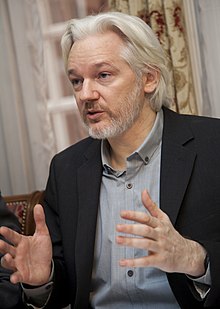
WikiLeaks founder Julian Assange will not face charges for publishing Vault 7, a series of documents detailing the CIA’s arsenal of digital code used to hack devices Politico, By NATASHA BERTRAND, 6/2/19
The U.S. Justice Department has decided not to charge Julian Assange for his role in exposing some of the CIA’s most secret spying tools, according to a U.S. official and two other people familiar with the case.
It’s a move that has surprised national security experts and some former officials, given prosecutors’ recent decision to aggressively go after the WikiLeaks founder on more controversial Espionage Act charges that some legal experts said would not hold up in court. ……
Prosecutors were stymied by several factors. First, the government is facing a ticking clock in its efforts to extradite Assange to the United States from the United Kingdom, where he is being held. Extradition laws require the U.S. to bring any additional charges against Assange within 60 days of the first indictment, which prosecutors filed in March, accusing Assange of helping former Army intelligence analyst Chelsea Manning hack into military computers.
WikiLeaks founder Julian Assange will not face charges for publishing Vault 7, a series of documents detailing the CIA’s arsenal of digital code used to hack devices | Daniel Leal-Olivas/AFP via Getty Images
The U.S. Justice Department has decided not to charge Julian Assange for his role in exposing some of the CIA’s most secret spying tools, according to a U.S. official and two other people familiar with the case.
It’s a move that has surprised national security experts and some former officials, given prosecutors’ recent decision to aggressively go after the WikiLeaks founder on more controversial Espionage Act charges that some legal experts said would not hold up in court. The decision also means that Assange will not face punishment for publishing one of the CIA’s most potent arsenals of digital code used to hack devices, dubbed Vault 7. The leak — one of the most devastating in CIA history — not only essentially rendered those tools useless for the CIA, it gave foreign spies and rogue hackers access to them.
Prosecutors were stymied by several factors.
First, the government is facing a ticking clock in its efforts to extradite Assange to the United States from the United Kingdom, where he is being held. Extradition laws require the U.S. to bring any additional charges against Assange within 60 days of the first indictment, which prosecutors filed in March, accusing Assange of helping former Army intelligence analyst Chelsea Manning hack into military computers.
Second, prosecutors were worried about the sensitivity of the Vault 7 materials, according to an official familiar with the deliberations over whether to charge Assange. Broaching such a classified subject in court risks exposing even more CIA secrets, legal experts said. The CIA has never officially confirmed the authenticity of the leaked documents, even though analysts widely believe them to be authentic……
The Uranium Conference is on in Adelaide on July 4th and 5th. The conference will be addressed by
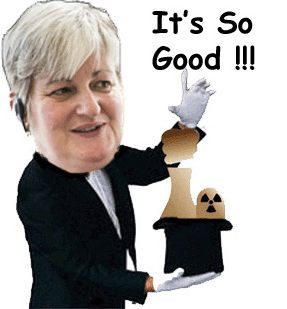
Hon Dan van Holst Pellekaan MP, South Australian Minister for Energy and Mining. The keynote speaker will be Professor Geraldine Thomas, from Imperial College . She will also speak later on Radiation: Science, Protection and Communication.
A quaint choice, for importing a “radiation expert”, as Prof Thomas is well known as the nuclear lobby’s favourite radiation propagandist, and also well known as not a reliable source for radiation knowledge.
This is part of a very important article, in which Dr Baverstock thoroughly refutes the claims of Professor Geraldine Thomas’ made in a BBC interview, about Fukushima ionising radiation not being much to worry about. The BBC has since withdrawn her statements.
But that hasn’t stopped the South Australian government bringing Thomas out here to spin her stuff, in support of Weatherill’s push for SA as the global nuclear waste dump.
Thomas’ comments in the video were insulting to the intelligence of the Japanese authorities and their advisors, and extremely ill-judged from a professional radiological point of view. The BBC was right to withdraw her comments as incorrect
‘This was quite clearly scientific misconduct’by Dr Keith Baverstock, Fissiononline 23 Sept 16 . I will take the BBC interview first. In this interview Thomas questions the whole basis of the Japanese response to the Fukushima accident in terms of its evacuation policy. Is one to imagine that those authorities and the Japanese scientific establishment are so stupid as not to recognise that there is no risk entailing living in those areas?
The internationally agreed public dose limit is 1 mSv per year in addition to approximately 2 mSv per year from natural background radiation. The single measurement made in that television interview indicate 2.8 microsieverts per hour, which is close to 25 mSv per year. That includes the natural background doses o at that point the dose rate is at least 20 times the public dose limit.
Surely Thomas can recognise that this must demand serious consideration by the appropriate authorities as to the safety of those who would live there? Continue reading →
Is this a problem for human health? You bet it is. The question no-one asked is what is causing the excess dose? The answer is easy: radioactive contamination, principally of Caesium-137. On the basis of well-known physics relationships we can say that 3Sv/h at 1m above ground represents a surface contamination of about 900,000Bq per square metre of Cs-137. That is, 900,000 disintegrations per second in one square metre of surface: and note that they were standing on a tarmac road which appeared to be clean. And this is 5 years after the explosions. The material is everywhere, and it is in the form of dust particles which can be inhaled; invisible sparkling fairy-dust that kills hang in the air above such measurements.
The particles are not just of Caesium-137. They contain other long lived radioactivity, Strontium-90, Plutonium 239, Uranium-235, Uranium 238, Radium-226, Polonium-210, Lead-210, Tritium, isotopes of Rhodium, Ruthenium, Iodine, Cerium, Cobalt 60. The list is long.
the Japanese government wants to send the people back there. It is bribing them with money and housing assistance. It is saying, like Gerry Thomas, there is no danger. And the BBC is giving this misdirection a credible platform.
They keep the lid on the truth using ill-informed individuals like Geraldine Thomas.
Fukushima is far from being over, and the deaths have only just begun.
On the 5th Anniversary of the catastrophe, Prof Geraldine Thomas, the nuclear industry’s new public relations star, walked through the abandoned town of Ohkuma inside the Fukushima exclusion zone with BBC reporter Rupert Wingfield-Hayes.
Thomas was described as “one of Britain’s leading experts on the health effects of radiation”. She is of the opinion that there is no danger and the Japanese refugees can come back and live there in the “zone”. Her main concern seemed to be how untidy it all was: “Left to rack and ruin,” she complained, sadly.
At one point, Rupert pulled out his Geiger counter and read the dose: 3 microSieverts per hour. “How much radiation would it give in a year to people who came back here,” he asked. Thomas replied: “About an extra milliSievert a year, which is not much considering you get 2mSv a year from natural background”.
“The long term impact on your health would be absolutely nothing.”
Now anyone with a calculator can easily multiply 3 microSieverts (3 x 10⁻⁶ Sv) by 24 hours and 365 days. The answer comes out to be 26 mSv (0.026Sv), not “about 1mSv” as the “leading expert on the health effects of radiation” reported.
I must personally ask if Gerry Thomas is a reliable expert; her CV shows she has published almost nothing in the way of original research, so we must ask how it is the BBC has taken her seriously. Continue reading →
Capitalism, Fukushima, Creative Reconstruction & The History Of Olympics by Labor Video Project Monday May 27th, 2019
Professor George Wright discusses the history of the Olympics and how privatization and control by the corporations of the world have led to in allowing the Olympics going to Japan and the contaminated Fukushima. The three broken nuclear reactors still have melted nuclear rods which must be cooled with water. He discusses the systemic corruption of the Olympic Committee and how it is now ignored the safety of the athletes and the public.
Capitalism, Fukushima, Creative Reconstruction & The History Of Olympics with Professor George Wright
The Japanese Prime Minister Abe with the support of the Internatonal Olympics Committee is planning to have the 2020 Olympics in Japan with the baseball games and para-olympics taking place in Fukushima.
Professor George Wright looks at the history of Olympics and how the commericalization for profit of the Olympics has led to the Olympics Committee approving the having part of the 2020 Olympics in the still contaminated Fukushima. He talks about “created reconstrucation” and how Olympics are driven by political and corporate agendas.
Although Prime Minister Abe has told the Olympic Committee that Fukushima has been “decontaminated” the melted nuclear rods have still not been removed from the broken reactors and there is over one million tons of radioactive water in tanks surrounding the nuclear reactors.
Additionally there are tens of thousand of bags full of radioactive material in bags spread throughout the Fukushima region.
This forum was presented by No Nukes Action on Sunday May 26th, 2019. ……..
Thomas Bach, the head of the Olympics knows about the contamination in Fukushima and the lies by Japan PM Abe about the “decontamination” of Fukushima but continues to move forward with the games in Fukshima. The television companies and other sponsors control the agenda of the Olympic committee.
by Labor Video Project Monday May 27th, 2019 6:30 PM
The Japanese. government is spending tens of millions of dollars to refurbish the Azuma stadium for the Olympic games in Fukushima to whitewash the dangers of the contaminated region. The Olympic Committee is helping to propagandize the people of the world that Fukushima is “safe”. https://www.indybay.org/comment.php?top_id=18823644
Greens demand answers and the Climate Council slams the Government for once again sitting on greenhouse emissions data, ignoring release deadline. The post Morrison government fails first climate test – Greens demand answers on missing emissions data appeared first on RenewEconomy.
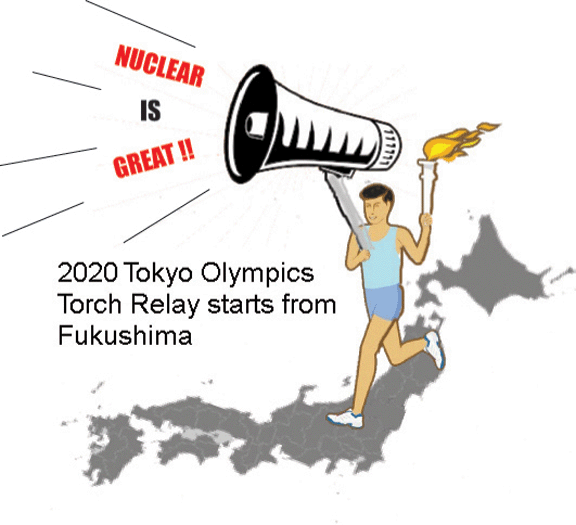
Tokyo 2020 reveals Olympic Torch route will begin in Fukushima, Inside the Games, By Matthew Smith, 1 June 2019
The Tokyo 2020 Organising Committee has revealed the Olympic Torch Relay route, which will take in many of Japan’s most historic and famous sites – and also areas touched by tragedy.
The Flame will be taken all over Japan inside 121 days, culminating in the Olympic Games next summer.
It will begin the final leg of its journey on March 26, 2020 from the J-Village National Training Centre in Fukushima, the training facility of the Japan football team.
The Flame will travel to all 47 prefectures of Japan, with the Organising Committee claiming around 98 per cent of Japan’s population live within one hour’s travel of the proposed route.
The route will take in World Heritage Sites such as Mount Fuji and Itsukushima Shrine, but will also visit areas affected by recent disasters.
Fukushima has been chosen as a start point after the Tohoku region was struck by an earthquake and tsunami in 2011, which also caused a nuclear incident at the Fukushima Daiichi Nuclear Power Plant.
As well as revealing the route, Tokyo 2020 also unveiled the Torchbearer uniforms and how members of the public could apply to take part in the Relay.
The uniform features the Relay emblem on the front and the Olympic symbol on the back.
The most notable design feature is a diagonal red stripe, echoing the sash used in place of batons in Ekiden, Japan’s historic long-distance relays…….
“In Japan, these Games are being referred to as ‘the Recovery Games’ and so the Olympic Flame will start its journey from an area affected by recent natural disasters……
And today’s announcement comes amid Mr Palmer’s federal election campaign…..
Climate change is the biggest threat to wellbeing and to industries in this region.
“If we build new coal-fired power stations and pump more greenhouse gases into the atmosphere then that’s going to make it worse.” The Australia Institute (AI) predicts that by 2070 there will be 35-day heatwaves and a 50 per cent reduction in rainfall in Capricornia due to climate change.
AI spokesman Mark Ogge said in light of the report, Mr Palmer’s announcement was dangerous.
“It’s just crazy at this point in time when we’re facing a huge threat from climate change,” Mr Ogge said.
the most fundamental problem may lie within the Adani group itself. The A$2 billion required from the project will ultimately come, in large measure, from chairman Gautam Adani’s own pocket.Adani Group founder Gautam Adani.Wikimedia,
With an estimated wealth of A$7 billion, he can certainly afford to pay if he chooses to. But it would represent a huge bet on the long-term future of coal-fired electricity, at very bad odds.
On Friday the Queensland government approved Adani’s plan to protect a rare bird, apparently leaving it with just final regulatory hurdle: approval for its plan to manage groundwater.
But several big obstacles remain. Even after governments are out of the way, it will have to deal with markets and companies that aren’t keen on the project.
Obstacles aplenty
First up, there’s the problem of access to Aurizon’s rail line. Adani originally planned to build its own 388km railway from the Galilee Basin to its coal terminal at Abbot Point.
However, in the scaled-down version of the project announced last year, Adani plans to build only 200km of track, before connecting to the existing Goonyella line owned by the rail freight company Aurizon.
That requires an agreement of access pricing and conditions. Aurizon is legally obliged to negotiate with Adani, but has shown itself to be in no hurry to reach a deal.
Then there’s insurance. Faced with rejection by every major bank in the world, Adani announced it would fund the project from its own resources. But now insurers, including nearly all the big European firms and Australia’s own QBE, are saying the same sort of thing as the financiers.
Without insurance the project can’t proceed, and the pool of potential insurers is shrinking all the time.
Not particularly financial
But the most fundamental problem may lie within the Adani group itself. The A$2 billion required from the project will ultimately come, in large measure, from chairman Gautam Adani’s own pocket.Adani Group founder Gautam Adani.Wikimedia, CC BY
With an estimated wealth of A$7 billion, he can certainly afford to pay if he chooses to. But it would represent a huge bet on the long-term future of coal-fired electricity, at very bad odds.
In my analysis of the original Carmichael mine proposal in 2017 I concluded that the profit from operating the coal mine would be around A$15 per tonne.
A recent analysis of the revised project by David Fickling for Bloomberg yielded a marginally more favorable estimate of US$16 per tonne, or US$160 million a year for the initial output of 10 million tonnes a year.
That’s an 8% rate of return on $US2 billion, before considering overheads and depreciation.
It’d need a long life…
Such an investment could only be profitable on the basis of a mine with a long life and substantial potential for future expansion. How likely is that? When the start of construction was re-announced last November, it was suggested the coal might be shipped by 2021. With six months’ delay, and the insurance problem noted already, 2022 seems like the earliest possible date.
But by that time, the current construction pipeline for coal-fired plants in India will have been worked through, and very few new ones will be being commissioned. A mere 8 gigawatts of new coal-fired power was commissioned in 2017-18, partly offset by 3.6GW of coal-fired power stations that closed down.
The Indian government has stated that no new coal plants will be needed after 2022, or 2027 at the latest.
…which it might not get
In these circumstances, newly opened coal mines will be able to sell coal only if they can displace existing suppliers. This suggests prices will have to fall to a level sufficient to ensure further closures of existing mines. Such a fall would erode or eliminate Adani’s already thin margins.
By 2030, with the project still in its relatively early stages, most developed countries will have stopped using coal-fired power. The others will be moving fast in that direction. So far under President Trump, the United States has closed 50 coal-fired power stations, and will almost certainly never build another.
The only glimmer of hope for coal has been in less developed countries in Asia. But over the course of this year, even these hopes have dimmed. Major banks in Japan and Singapore have withdrawn from funding new coal projects, following the lead of the global banks based in Europe and the US.
That leaves South Korea and China as potential sources of funding. Korea is already phasing out coal-fired power domestically and its banks are being pressured to divest globally. The option of relying solely on China is problematic to say the least.
To sum up, unless current trends change dramatically, the economic life of the Carmichael mine is unlikely to be more than a decade – nowhere near enough to recover a A$2 billion investment.
The only glimmer of hope for coal has been in less developed countries in Asia. But over the course of this year, even these hopes have dimmed. Major banks in Japan and Singapore have withdrawn from funding new coal projects, following the lead of the global banks based in Europe and the US.
Japan, U.S., Australia urge North Korea to return to nuclear talks, Japan Times , 2 June, 19, KYODO SINGAPORE – The Japanese, U.S. and Australian defense chiefs on Saturday agreed to cooperate on denuclearizing the Korean Peninsula and urge North Korea to return to disarmament negotiations that have remained at a standstill since the collapse of a second summit between Washington and Pyongyang in late February.
we just don’t know what exactly is going on, and therefore we should be cautious.
5G is being rolled out in Australia. Is the radiation safe? ABC 23 MAY 2019 By the end of this year, a new super-fast mobile network will be operating in all major capital cities and regional areas in Australia.
5G represents the fifth generation of mobile network technology, and it promises to be as much of a leap forward as 4G mobile broadband was back in 2011.
As the rollout proceeds, however, it’s become a focal point for longstanding concerns about the health effects of electromagnetic radiation.
“I’m very concerned about 5G. I already get headaches from 4G and wifi,” Oliver in Mackay wrote in to Hack.
A Sydney resident told the ABC recently: “We don’t want it here. It causes us great anxiety that this thing is going to be running 24-7.”……
Australian and many other national health regulators say 5G is safe, while some recognised researchers urge caution.
What is 5G?
As with previous generational upgrades, the new tech is much faster than the existing network: Telstra recently achieved network speeds of around 3Gbps – about 60 times faster than 4G.
It’s likely to be used for driverless cars and virtual reality, as it allows much larger amounts of data to be transferred with less time between the signal being sent and received.
It achieves this speed and bandwidth partly through using higher frequencies of electromagnetic waves than 4G or any of the previous mobile networks.
To understand what this means, let’s go back to high school physics: Mobile phones and mobile towers emit radiation, as do radios, microwaves, X-ray machines, and the sun.
Radiation can be broadly divided into ionising and non-ionising types.
Ionising radiation is powerful enough to damage DNA, which is why you have to be careful about too much sunlight or too many X-rays.
Non-ionising radiation doesn’t have enough energy to break our DNA, and therefore we have traditionally thought it cannot cause cancer.
5G-type electromagnetic waves are a higher frequency than 4G (and therefore further up the spectrum towards X-rays) but still on the non-ionising side.
Because they have shorter wavelengths, the waves are less able to penetrate solid objects (e.g. sunlight can’t go through a wall, but radio waves can).
For this reason, 5G requires heaps of suitcase-size cell boxes to boost the signal and direct it around corners and other obstacles. These will be a lot more numerous than 4G towers.
Leszczynski says these studies are evidence it also has a non-thermal effect.
If that’s true, it would overturn the scientific basis of our current limits on mobile phone radiation exposure.
However, these studies are limited. As Leszczynski says: “This result is from epidemiological studies that can show only whether there’s an increase or not an increased risk of developing disease.
“They cannot demonstrate in particular this radiation has caused this cancer.”
His point is that we just don’t know what exactly is going on, and therefore we should be cautious.
What effect does it have?
One reason we don’t know is because it’s very difficult to study the long-term effect of cellphone radiation on humans. Unlike, say, smoking, we’re unable to expose one group to radio frequencies, and then compare their health with the non-exposed population.
Cellphone radiation is already everywhere, plus the frequency of radiation has changed rapidly over a relatively short period of time. The way we use our phones has also changed (for example, now children are more likely to use phones than before).
That leaves studies on animals: In 1999, the US FDA asked the National Toxicology Program (NTP) to study the toxicity and cancer-causing capability of cellphone radio-frequency radiation.
This was a US$30 million undertaking. The scientists had to have special chambers built in Switzerland so they could control exactly how much radiation the animals were getting.
The draft findings came out nearly 20 years later, in 2018.
It found that several rats and mice that had been blasted with with large amounts of radiofrequency electromagnetic radiation for two years exhibited tumours.
“We believe that the link between radio frequency radiation and tumors in male rats is real, and the external experts agreed,” said NTP’s John Bucher in a statement.
But the researchers struggled to form conclusions from the study.
The rodents were exposed to much greater levels of radiation than a person would using a mobile phone or another consumer device.
There was also no clear linear relationship between higher radiation exposure and more cancer.
Also, humans absorb radiation differently to rats and mice.
Given this uncertainty, it’s a big leap to pause the technology without any evidence of ill-effects.
A huge chunk of the population has been using mobile phones for over two decades, and there hasn’t been an observed increase in cancer rates.
Professor Rodney Croft from the Australian Centre for Electromagnetic Bioeffects Research at the University of Wollongong argues we can be confident in the relative safety of non-ionising radiation.
“The reality is we know a lot about the mechanisms involved with the interactions with electromagnetics fields and the body,” he told Hack.
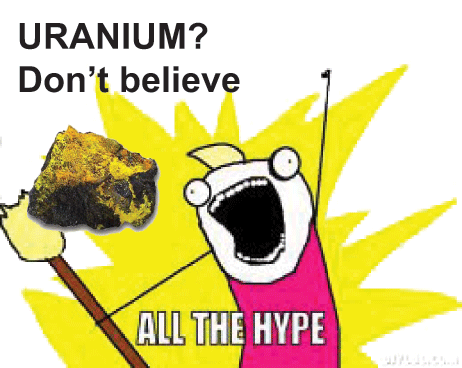
Vimy Resources eyes US uranium fix, Stuart McKinnon, The West Australian 1 June 2019Vimy Resources managing director Mike Young refers to himself as a “silver-lining guy” and jokingly admits “you have to be … in uranium”.
The Andrew Forrest-backed Vimy has a completed definitive study for its $493 million Mulga Rock uranium project 200km east of Kalgoorlie, has two granted mining leases and other key approvals in place. It just needs the price of yellowcake to roughly treble so it can push the button.
The spot price of uranium has been in the doldrums since the 2011 Fukushima nuclear disaster in Japan, which prompted a phasing out of nuclear power in western countries, particularly in Europe.
Despite several false dawns, sentiment for the commodity has remained stubbornly low for the past eight years.
But the forthright Mr Young and Vimy’s chief nuclear officer Julian Tapp are hopeful the market might be approaching an inflection point.
They see a looming decision of the US Government as a potential catalyst to move uranium prices higher.
President Donald Trump is expected to decide next month whether to introduce trade restrictions to protect US-based uranium producers……..
If a quota is introduced, the company is hopeful Australia’s close relations with the US could win the country key concessions as it has done with aluminium and steel.
But whatever the outcome, Vimy believes a decision will provide clarity to a market starved of certainty for the past 18 months. US utilities, representing nearly a third of the global uranium demand, have effectively been on a buying strike since the start of last year.
…… “Politically, people are now thinking of nuclear as an avenue to emissions-free, dispatchable power 24/7 in all weather conditions,” Young said. “There’s still an anti-nuclear lobby, but by and large mainstream environmental scientists are getting on board nuclear power.” ….. https://thewest.com.au/business/spinifex/vimy-resources-eyes-us-uranium-fix-ng-b881212458z
Youth climate activists set for nationwide rallies ahead of landmark case, Guardian, Lee van der Vooin Oregon, 2 June 19 Young people to hold day of action on Saturday highlighting lawsuit as youth-driven climate movement grows, Students in Austin, Texas, want you to veg out. Kids in Westport, Connecticut will screen a film. And in rural North Carolina, activists will draw on a toxic spill to commemorate the environmental justice movement.
All of these rallies will be part of an international campaign on Saturday to spotlight environmental issues. Their message: I Am Juliana.
The slogan refers to the landmark court case in Oregon in which 21 youths are suing the United States government over climate change.
Named for Kelsey Juliana, a 23-year-old activist and college student, the case was filed in 2015 and is headed back to court on Tuesday. The campaign to raise its profile – dubbed #IAmJuliana or #AllEyesOnJuliana – is the brainchild of Our Children’s Trust, the organization behind the lawsuit, and Future Coalition, the not-for-profit network forged to empower youth after the Parkland shooting.
June 2, 2019 Former Congressman and presidential candidate Ron Paul says Julian Assange could die in prison and blames the apparent deterioration in the WikiLeaks founder’s heath on how he is being treated by the US and UK governments.
Speaking on ‘Ron Paul Liberty Report, the 83-year-old accuses the US government of pursuing Assange and says they would like to either challenge him with a death penalty or a life time in prison ‘for being a journalist.’
The Libertarian calls Assange’s a ‘tragic story’ and describes his health as ‘very very bad,’ commenting that friends of the whistleblower are worried that his health may not hold up.
Assange, 47, has been moved to the hospital wing at Belmarsh prison and has been found too unwell to appear by video-link as scheduled at Westminster magistrates’ court.
His lawyers reported it was not possible to have a normal conversation with him.
U.S. authorities accuse Assange of violating the Espionage Act over the publication of secret documents.
Sweden wants to question him about sexual misconduct allegations.
Paul also compares Assange’s plight to the case of Otto Frederick Warmbier, an American college student imprisoned in North Korea in 2016.
In June 2017, Warmbier was released by North Korea in a vegetative state and died soon afterward.
Paul goes on to ask what the ramifications would be if Assange is much sicker than is being revealed and dies in prison as the result of how his case has been handled by Washington and London.
‘If he had a terminal disease or something happens to him, good, bad, or whatever and he dies in the prison, how would we look a lot different to the North Koreans on the surface?’ Paul questions.
Paul’s claims come as an independent expert for the U.N.-backed Human Rights Council who visited Assange in prison says he ‘showed all symptoms typical for prolonged exposure to psychological torture.’
Nils Melzer, the special rapporteur on torture, visited Assange on May 9 with two medical experts in examining potential victims of torture and ill-treatment, as reported by The U.N. human rights office on Friday.
The UK, along with the US and Ecuador, has engaged in a ‘relentless and unrestrained campaign of public mobbing, intimidation and defamation against Mr Assange’, Melzer said.
He added it was ‘obvious’ that Assange’s health had been affected by ‘the extremely hostile and arbitrary environment’ he faced for years.
In ‘Ron Paul Liberty Report,’ Paul goes on to slam the American media and journalists for their lack of reporting on Assange’s health problems, adding that news of his ill health came out via a Swedish newspaper.
Paul adds there is ‘not much good journalism around any more’ and that by not doing more reporting on Assange, journalists ‘don’t want to protect their right to be a journalist.’
Paul defends Assange’s leaking of information saying it is ‘not like he spied for the enemy.’
‘His crime was telling us the truth,’ Paul says. ‘He was telling the truth, he was revealing information … he is a whistleblower in the form of a journalist,’ Paul added.
Assange lived in Ecuador’s Embassy in London in 2012 until he was arrested in April after Ecuadorean officials withdrew his asylum status.
Apr 15, 2026 01:00 AM in Canberra, Melbourne, Sydney
Join the International Physicians for the Prevention of Nuclear War (IPPNW) on Tuesday, April 14th for a timely webinar exploring the risks associated with nuclear power and challenging the myth that it offers a simple, safe, carbon-free solution to the climate crisis
21 April Webinar: No Nuclear Weapons in Australia
Start: 2026-04-21 18:00:00 UTC Canberra, Melbourne, Sydney (GMT+10:00)
End: 2026-04-21 19:30:00 UTC Canberra, Melbourne, Sydney (GMT+10:00)
Event Type: Virtual A virtual link will be communicated before the event.







 Antinuclear