Nuclear news, and some climate news – to 5 June
 It is clear that the climate crisis is the greatest threat to humans and other species. This week, Dahr Jamail and others have spelled out the intensity of the effects of ever accelerating global warming. One report gives a harrowing scenario analysis of how human civilization might collapse due to climate change.
Nevertheless, at this stage, I’ve decided to focus on the original purpose of this weekly summary – nuclear news.
Why? Two reasons:
1, I can’t keep up with the variety of climate change impacts happening, and with the overall understanding of communicators such as Dahr Jamail, climate researcher Paul Beckwith , https://www.youtube.com/watch?v=y9NvCwVDmFI and Radio Ecoshock.
2. The global nuclear lobby is peddling the untruth that nuclear power is essential to save the climate. And – journalists, politicians, and other influential people are buying into this fiction, without troubling to look into the full picture. The information on the climate chaos is out there, and its effects are visible (e.g. the melting ice). The lies about “new nuclear”, about “harmless , even benign” ionising radiation are being allowed to prevail in the media.
AUSTRALIA
Julian Assange a victim of torture: Australian government just let it happen. Swedish court rules in favour of Julian Assange: he will not be extradited to Sweden.
Australia joins with Japan and USA in urging North Korea to return to nuclear talks.
Concerns about the safety of 5G mobile network technology.
NUCLEAR. New Labor leader Anthony Albanese supports UN Nuclear Weapons Ban Treaty : News Corpse doesn’t like him! Queensland National Party MPs keen for nuclear power in Australia. Anthony Albanese keeps Mark Butler in climate and energy portfolio, as COALition renews call for nuclear. Australia’s uranium lobby imports a very unreliable “radiation expert” to spruik at Adelaide conference. Vimy Resources managing director Mike Young talks up uranium industry, despite its gloomy market.
Rare Earths. Lynas still struggling to deal with its Malaysian radioactive waste problem.
CLIMATE.
- Morrison government fails first climate test – Greens demand answers on missing emissions data. Resources Minister Canavan enthuses for coal, Labor leader Albanese points out coal market problems. Galilee Basin “carbon bomb” about to explode as coal and gas developers rush in.
- Adani edges closer to coal mine start as Queensland accepts plans for endangered finch. COURT STATEMENT: WANGAN and JAGALINGOU COUNCIL – on the Adani coal project and Aboriginal rights. Adani coal project has a doubtful financial future. Clive Palmer’s plan for new coal-fired power station in Galilee Basin. Why the coal lobby has misled Queensland on value of thermal coal.
- Australian companies, later, governments, may face legal action over climate issues. Rising seas threaten Australia’s major airports – and it may be happening faster than we think.
RENEWABLE ENERGY Western Australian councils urge state to step up on clean energy . Relief as “common sense” and Supreme Court prevail over Queensland solar rule change . Off the grid: AEMC paves way for stand alone systems to replace poles and wires. Wind energy sets new records as strong investment and windy weather combine.
Energy transition has only just begun, but solar has already changed the game. New APVI solar tool shows daily, time-based forecast for each state. .Solar farms push 2019 PV tally past 1.5GW. Electricity emissions fall sharply as renewable energy continues heavy lifting. AEMO pushes solar register as rooftop installations head to 56GW. Gupta secures China EPC contract for $350 million Cultana solar farm. Two new solar farms connect to the grid in Queensland. Queensland electric super highway will soon have 50+ EV chargers. Mirvac taps Melbourne start-up for shared solar at new apartments.
INTERNATIONAL
Nuclear industry and governments colluded to obscure the health effects of the Chernobyl nuclear accident. “Energy for Humanity”, “Nuclear Pride” – the greenwashing of Fukushima, Chernobyl, and the global nuclear industry. Nuclear Pride Coalition and Michael Shellenberger: Greenwash and Propaganda 2019. Panicky nuclear lobby produces a propaganda book, desperate to win public support
Nuclear power, useless against climate change, is itself threatened by climate change‘s weather extremes.
Nuclear weapons even more risky in this age of Artificial Intelligence, Cyberattacks.
Ionising radiation in space will kill astronauts headed for Mars.
Record viewing of HBO miniseries “Chernobyl”. Breathtaking series on Chernobyl nuclear catastrophe. Accuracy of HBO’s “Chernobyl” mini series. https://www.youtube.com/watch?v=4Wk9JRbTTqc
Problems in nuclear fusion, radiation risks – some active wastes, intermittency.
Continuing glum lookout for the uranium market.
Edward Snowden warns of greatest social control scheme in history .
Volcanoes not the major cause of global warming. A new way to remove CO2 from the air – (perhaps – or too good to be true?)
Swedish court rules in favour of Julian Assange: he will not be extradited to Sweden
Sweden’s Uppsala District Court has found in favour of Assange: the court ruled NOT to detain Assange in absentia. The preliminary investigation can proceed without Assange’s extradition to Sweden. This was always the case as Assange has always cooperated with the investigation.
Suzie Dawson on Julian Assange’s mistreatment #FreeAssange
“Chernobyl” miniseries more viewed than “Game of Thrones”
CHERNOBYL premieres Wednesday, June 12 at 8.30pm AEST on FOX SHOWCASE
New episodes are available to stream now on the Foxtel Now platform
CHERNOBYL Official Trailer
Sky 2nd June 2019 , Without fanfare, Chernobyl has become unmissable TV. The Sky Atlantic show,
which concludes on Tuesday, is harrowing and unrelentingly bleak, with some
complicated science to get to grips with.
It is also a western-made drama about a disaster that occurred in the Soviet Union more than 30 years ago,
of which details such as the number of deaths are still debated. There was
much that could go wrong. And ultimately, we know how the story pans out.
But seemingly from nowhere, this five-part mini-series is now the show that
everyone is talking about. (Sorry, Game Of Thrones). After just three
episodes, Chernobyl topped film and TV database IMDB’s list of the greatest
250 TV shows of all time. It currently has a score of 9.7, based on more
than 96,000 votes. Fan-voted charts obviously have their problems and are
by no means definitive, but it is still quite an accolade for a drama
series just four weeks and four episodes old.
https://news.sky.com/story/how-chernobyl-quietly-topped-the-tv-charts-11732879
Solar farms push 2019 PV tally past 1.5GW — RenewEconomy

A total of 1.5GW of large- and small-scale solar has been installed across Australia so far in 2019, making it the biggest year for PV installs excluding 2018. The post Solar farms push 2019 PV tally past 1.5GW appeared first on RenewEconomy.
via Solar farms push 2019 PV tally past 1.5GW — RenewEconomy
Space travel: journey to Mars a killer, due to ionising radiation

The radiation showstopper for Mars exploration https://phys.org/news/2019-06-showstopper-mars-exploration.html, by European Space Agency 3 June 19, An astronaut on a mission to Mars could receive radiation doses up to 700 times higher than on our planet—a major showstopper for the safe exploration of our solar system. A team of European experts is working with ESA to protect the health of future crews on their way to the Moon and beyond.
Earth’s magnetic fieldand atmosphere protect us from the constant bombardment of galactic cosmic rays—energetic particles that travel at close to the speed of light and penetrate the human body.
Cosmic radiation could increase cancer risks during long duration missions. Damage to the human body extends to the brain, heart and the central nervous system and sets the stage for degenerative diseases. A higher percentage of early-onset cataracts have been reported in astronauts.
“One day in space is equivalent to the radiation received on Earth for a whole year,” explains physicist Marco Durante, who studies cosmic radiation on Earth.
Marco points out that most of the changes in the astronauts’ gene expression are believed to be a result of radiation exposure, according to the recent NASA’s Twins study. This research showed DNA damage in astronaut Scott Kelly compared to his identical twin and fellow astronaut Mark Kelly, who remained on Earth.
A second source of space radiation comes from unpredictable solar particle events that deliver high doses of radiation in a short period of time, leading to “radiation sickness” unless protective measures are taken.
Europe’s radiation fight club
“The real problem is the large uncertainty surrounding the risks. We don’t understand space radiation very well and the long-lasting effects are unknown,” explains Marco who is also part of an ESA team formed to investigate radiation.
Since 2015, this forum of experts provides advice from areas such as space science, biology, epidemiology, medicine and physics to improve protection from space radiation.
“Space radiation research is an area that crosses the entire life and physical sciences area with important applications on Earth. Research in this area will remain of high priority for ESA,” says Jennifer Ngo-Anh, ESA’s team leader human research, biology and physical sciences.
While astronauts are not considered radiation workers in all countries, they are exposed to 200 times more radiation on the International Space Station than an airline pilot or a radiology nurse.
Radiation is in the Space Station’s spotlight every day. A console at NASA’s mission control in Houston, Texas, is constantly showing space weather information.
f a burst of space radiation is detected, teams on Earth can abort a spacewalk, instruct astronauts to move to more shielded areas and even change the altitude of the station to minimize impact.
One of the main recommendations of the topical team is to develop a risk model with the radiation dose limits for crews traveling beyond the International Space Station.
ESA’s flight surgeon and radiologist Ulrich Straube believes that the model should “provide information on the risks that could cause cancer and non-cancer health issues for astronauts going to the Moon and Mars in agreement with all space agencies.”
Recent data from ExoMars Trace Gas Orbiter showed that on a six-month journey to the Red Planet an astronaut could be exposed to at least 60% of the total radiation dose limit recommended for their entire career.
“As it stands today, we can’t go to Mars due to radiation. It would be impossible to meet acceptable dose limits,” reminds Marco.
Measure to protect
ESA has teamed up with five particle accelerators in Europe that can recreate cosmic radiation by “shooting” atomic particles to speeds approaching the speed of light. Researchers have been bombarding biological cells and materials with radiation to understand how to best protect astronauts.
“The research is paying off. Lithium is standing out as a promising material for shielding in planetary missions,” says Marco.
ESA has been measuring the radiation dose on the International Space Station for seven years with passive radiation detectors in the DOSIS 3-D experiment. ESA astronauts Andreas Mogensen and Thomas Pesquet wore a new mobile dosimeter during their missions that gave them a real-time snapshot of their exposure.
The same European team behind this research will provide radiation detectors to monitor the skin and organ doses of the two phantoms traveling to the Moon onboard NASA’s Orion spacecraft.
UK Labour launches a national green jobs tour around the UK
 Business Green 3rd June 2019 Labour launched a national green jobs tour around the UK this
  weekend, in a
bid to ignite national support for its ‘Green Industrial Revolution’
agenda. Shadow Business Secretary Rebecca Long-Bailey visited Morecambe in
Lancashire on Saturday to discuss the area’s potential for “green jobs” in
sectors such as offshore wind, tidal power and community-owned renewable
energy.
and ideas of people throughout society”. “That’s why we’re talking to
unions, businesses and communities across the country to prepare detailed
and ambitious plans to deliver a Green Industrial Revolution,” she said.
Alongside the tour, Labour is hosting an online call for evidence, asking
for input from trade unions, businesses, public sector bodies, party
members, civil society groups and members of the public on its plans to
develop the green jobs market around the UK. The consultation is open until
the end of 2019.
https://www.businessgreen.com/bg/news/3076624/labour-launches-green-jobs-tour
New climate report – prediction of the collapse of civilisation
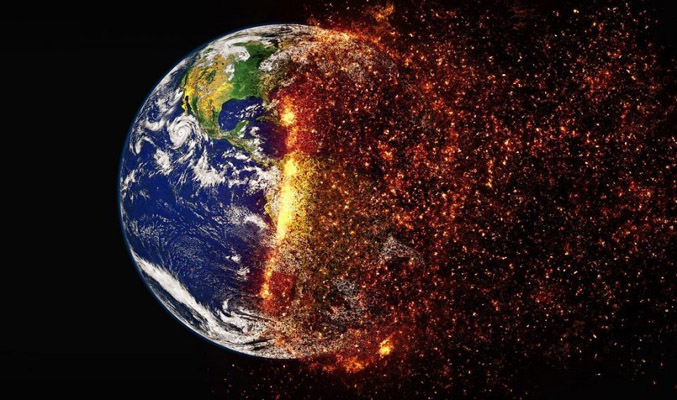
New Report Suggests ‘High Likelihood of Human Civilization Coming to an End’ in 2050 https://www.vice.com/en_us/article/597kpd/new-report-suggests-high-likelihood-of-human-civilization-coming-to-an-end-in-2050 3 June 19
The climate change analysis was written by a former fossil fuel executive and backed by the former chief of Australia’s military. A harrowing scenario analysis of how human civilization might collapse in coming decades due to climate change has been endorsed by a former Australian defense chief and senior royal navy commander.
The analysis, published by the Breakthrough National Centre for Climate Restoration, a think-tank in Melbourne, Australia, describes climate change as “a near- to mid-term existential threat to human civilization” and sets out a plausible scenario of where business-as-usual could lead over the next 30 years.
On our current trajectory, the report warns, “planetary and human systems [are] reaching a ‘point of no return’ by mid-century, in which the prospect of a largely uninhabitable Earth leads to the breakdown of nations and the international order.”
The only way to avoid the risks of this scenario is what the report describes as “akin in scale to the World War II emergency mobilization”—but this time focused on rapidly building out a zero-emissions industrial system to set in train the restoration of a safe climate.
The scenario warns that our current trajectory will likely lock in at least 3 degrees Celsius (C) of global heating, which in turn could trigger further amplifying feedbacks unleashing further warming. This would drive the accelerating collapse of key ecosystems “including coral reef systems, the Amazon rainforest and in the Arctic.”
The results would be devastating. Some one billion people would be forced to attempt to relocate from unlivable conditions, and two billion would face scarcity of water supplies. Agriculture would collapse in the sub-tropics, and food production would suffer dramatically worldwide. The internal cohesion of nation-states like the US and China would unravel.
Even for 2°C of warming, more than a billion people may need to be relocated and in high-end scenarios, the scale of destruction is beyond our capacity to model with a high likelihood of human civilization coming to an end,” the report notes.
The new policy briefing is written by David Spratt, Breakthrough’s research director and Ian Dunlop, a former senior executive of Royal Dutch Shell who previously chaired the Australian Coal Association.
In the briefing’s foreword, retired Admiral Chris Barrie—Chief of the Australian Defence Force from 1998 to 2002 and former Deputy Chief of the Australian Navy—commends the paper for laying “bare the unvarnished truth about the desperate situation humans, and our planet, are in, painting a disturbing picture of the real possibility that human life on Earth may be on the way to extinction, in the most horrible way.”
Barrie now works for the Climate Change Institute at Australian National University, Canberra.
Spratt told Motherboard that a key reason the risks are not understood is that “much knowledge produced for policymakers is too conservative. Because the risks are now existential, a new approach to climate and security risk assessment is required using scenario analysis.”
Last October, Motherboard reported on scientific evidence that the UN’s summary report for government policymakers on climate change—whose findings were widely recognized as “devastating”—were in fact too optimistic.
While the Breakthrough scenario sets out some of the more ‘high end’ risk possibilities, it is often not possible to meaningfully quantify their probabilities. As a result, the authors emphasize that conventional risk approaches tend to downplay worst-case scenarios despite their plausibility.
Spratt and Dunlop’s 2050 scenario illustrates how easy it could be to end up in an accelerating runaway climate scenario which would lead to a largely uninhabitable planet within just a few decades.
“A high-end 2050 scenario finds a world in social breakdown and outright chaos,” said Spratt. “But a short window of opportunity exists for an emergency, global mobilization of resources, in which the logistical and planning experiences of the national security sector could play a valuable role.”
Gupta secures China EPC contract for $350 million Cultana solar farm — RenewEconomy

Gupta signs contract with Shanghai Electric to undertake construction of the Cultana solar farm in Whyalla. The post Gupta secures China EPC contract for $350 million Cultana solar farm appeared first on RenewEconomy.
via Gupta secures China EPC contract for $350 million Cultana solar farm — RenewEconomy
Victoria Police add Tesla Model X to highway patrol fleet — RenewEconomy

Victoria Police unveils specially modified Tesla Model X SUV for state’s highway patrol, says fully electric cars the future for Australian road policing. The post Victoria Police add Tesla Model X to highway patrol fleet appeared first on RenewEconomy.
via Victoria Police add Tesla Model X to highway patrol fleet — RenewEconomy
Queensland cuts regional solar feed-in tariffs as renewables push prices down — RenewEconomy

The Queensland Competition Authority has cited strong investment in renewables as a reason for reducing solar feed-in-tariffs in regional Queensland. The post Queensland cuts regional solar feed-in tariffs as renewables push prices down appeared first on RenewEconomy.
via Queensland cuts regional solar feed-in tariffs as renewables push prices down — RenewEconomy
June 3 Energy News — geoharvey

Opinion: ¶ “China Is Eating Our Lunch, And What We Can Do About It” • Solar, wind, batteries, and their industrial mass production use common raw materials and processes that are available in most countries. There is nothing in them that is exclusive to China. And rare earth metals are not all that rare. But […]
1 This month
7 April – WEBINAR – Australia and the Doomsday Clock – Preventing nuclear war through NoFirstUse and other policies
Online | Tuesday April 7, 4:00-5:30pm, Australian Eastern Time / 8:00-9:30am Central Europe Time
– Access the registration link
15 April – Zoom –Nuclear Power is Not the Solution
Apr 15, 2026 01:00 AM in Canberra, Melbourne, Sydney

Join the International Physicians for the Prevention of Nuclear War (IPPNW) on Tuesday, April 14th for a timely webinar exploring the risks associated with nuclear power and challenging the myth that it offers a simple, safe, carbon-free solution to the climate crisis

21 April Webinar: No Nuclear Weapons in Australia
Start: 2026-04-21 18:00:00 UTC Canberra, Melbourne, Sydney (GMT+10:00)
End: 2026-04-21 19:30:00 UTC Canberra, Melbourne, Sydney (GMT+10:00)
Event Type: Virtual
A virtual link will be communicated before the event.
Host Contact Info: australia@icanw.org

of the week – Australians for War Powers Reform (AWPR)
To see nuclear-related stories in greater depth and intensity
 Antinuclear