Nuclear power exits Australia’s energy debate, enters culture wars
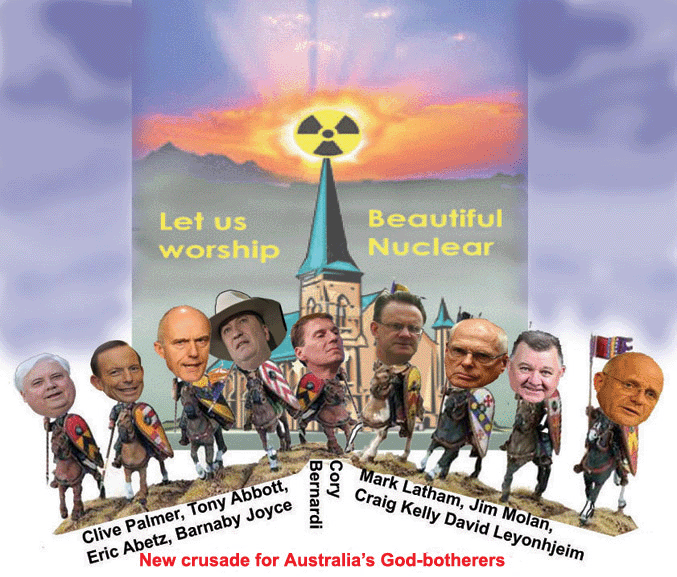
Nuclear power exits Australia’s energy debate, enters culture wars https://reneweconomy.com.au/nuclear-power-exits-australias-energy-debate-enters-culture-wars-47702/, 13 June 2019 What do these politicians and ex-politicians have in common: Clive Palmer, Tony Abbott, Cory Bernardi, Barnaby Joyce, Mark Latham, Jim Molan, Craig Kelly, Eric Abetz, and David Leyonhjelm?
Queensland clear way for Adani to begin work on Galilee basin “carbon bomb” — RenewEconomy

Queensland Government grants Adani approval for groundwater management plans, as project moves clears last major hurdle before construction commences. The post Queensland clear way for Adani to begin work on Galilee basin “carbon bomb” appeared first on RenewEconomy.
via Queensland clear way for Adani to begin work on Galilee basin “carbon bomb” — RenewEconomy
Energy Minister Angus Taylor contemplates reversing Australia’s nuclear energy ban
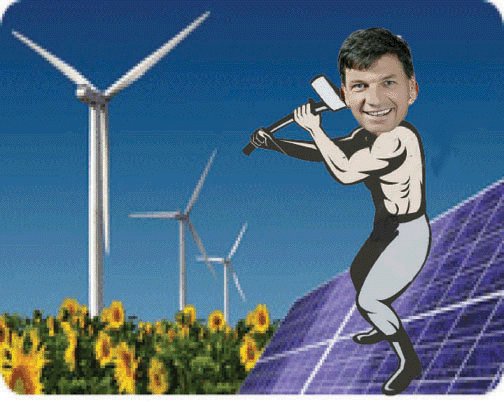 Angus Taylor won’t rule out reversing nuclear energy ban if business case stacks up Angus Taylor won’t rule out reversing nuclear energy ban if business case stacks up
Energy minister dodges questions about how Australia will meet its Paris emission reduction targets, Guardian, Amy Remeikis Angus Taylor has not ruled out reversing the nuclear energy ban and remains confident Australia will meet its Paris emission reduction targetsThe energy minister, Angus Taylor, has not ruled out the Morrison government reversing the nuclear energy ban, if a “clear business case” showed the economics were sound as he dodged questions about how Australia would meet its Paris agreement targets. The first energy battle of the new parliament comes from within the party room, with a group of Queensland MPs, emboldened by that state’s strong showing for the Coalition in the May election, leading a push to have nuclear energy reconsidered as part of Australia’s power plan. While a peak lobby group representing the sector says a carbon price would be needed for nuclear to be an economically viable alternative, Australia’s law against nuclear power is another impediment. But Taylor says the government would consider nuclear power if the economic case stacked up. I think, again, the prime minister has made many questions on this in the lead up to the election … right now it is illegal to build a nuclear power station and as he has said when there is a very clear business case which shows the economics of this can work, we are more than willing to consider it,” he said. Pushed on what that business case would look like, Taylor said he would not give “a lecture on business cases”. I mean it is pretty straight forward, I mean the prime minister answered this question on a number of occasions before the election, there needs to be a clear business case,” he said, before being asked directly if the government would change the law in the event a case presented itself. “As I say, let’s not put the cart before the horse, if there is a clear business case there is a clear business case,” he said. The nuclear question is not the only quandary facing the Morrison government in the energy space, as discussions over the rules for the Paris emissions reduction target continue within the international community. The main debate centres around whether countries which exceeded their Kyoto targets can use the excess abatement as credit towards their Paris targets. In Australia, that amounts to about 367 megatonnes, which Taylor has previously described as “relatively small” in terms of the nation’s carbon budget, but “apocalyptic” to the economy if not used. Repeatedly asked what the government’s plan was in the event it was decided carryover credits could not be used, Taylor did not have an answer and instead reiterated that Australia had met its past targets…….. https://www.theguardian.com/australia-news/2019/jun/12/angus-taylor-wont-rule-out-reversing-nuclear-energy-ban-if-business-case-stacks-up |
|
Nearly a billion people facing high exposure to climate change effects, Global Peace Index finds
 Nearly a billion people facing high exposure to climate change effects, Global Peace Index finds, ABC, Nearly a billion people facing high exposure to climate change effects, Global Peace Index finds, ABC,
Nearly a billion people are facing climate change hazards globally, with the Asia-Pacific region housing twice as many people living in areas with high exposure than all other regions combined, a new report has revealed. Key points:
In the annual Global Peace Index released on Wednesday, the Institute for Economics and Peace (IEP) said an estimated 971 million people — including more than 2.4 million Australians — live in areas with high or very high exposure to climate hazards including cyclones, floods, bushfires, desertification and rising sea levels. The top nine countries facing the highest risk of climate hazards were all Asian nations with the Philippines topping the list, followed by Japan, Bangladesh, Myanmar and China. IEP founder and executive chairman Steve Killelea told the ABC that many of the countries in the Asia-Pacific region also have weaker coping capacities for natural disasters.
In Australia, the main risks come from hurricanes and cyclones in the north, rising sea levels in the south and east, as well as drought and desertification which is already affecting thousands of farmers, he said. Climate hazards exacerbate conflict and migrationThe report — which ranks 163 countries by measuring internal safety and security, militarisation and ongoing conflict — included climate change risks for the first time this year to evaluate links between climate hazards and violence. It found climate pressures can adversely impact resource availability and affect population dynamics, which can impact socioeconomic and political stability. ……. https://www.abc.net.au/news/2019-06-12/climate-change-hazards-global-peace-index-report/11198144 |
|
Time’s up for Australia’s ignorant ‘old school’ climate denialists
 Why old-school climate denial has had its day, The Conversation, Associate professor in astronomy, Monash University, June 13, 2019 The Coalition has been re-elected to government, and after six years in office it has not created any effective policies for reducing greenhouse emissions. Does that mean the Australian climate change debate is stuck in 2013? Not exactly.While Australia still lacks effective climate change policies, the debate has definitely shifted. It’s particularly noticeable to scientists, like myself, who were very active participants in the Australian climate debate just a few years ago. Why old-school climate denial has had its day, The Conversation, Associate professor in astronomy, Monash University, June 13, 2019 The Coalition has been re-elected to government, and after six years in office it has not created any effective policies for reducing greenhouse emissions. Does that mean the Australian climate change debate is stuck in 2013? Not exactly.While Australia still lacks effective climate change policies, the debate has definitely shifted. It’s particularly noticeable to scientists, like myself, who were very active participants in the Australian climate debate just a few years ago.
The debate has moved away from the basic science, and on to the economic and political ramifications. And if advocates for reducing greenhouse emissions don’t fully recognise this, they risk shooting themselves in the foot. The old denialsOld-school climate change denial, be it denial that warming is taking place or that humans are responsible for that warming, featured prominently in Australian politics a decade ago. In 2009 Tony Abbott, then a Liberal frontbencher jockeying for the party leadership, told ABC’s 7.30 Report:
The theory and evidence base for human-induced climate change is vast and growing. In contrast, the counterarguments were so sloppy that there were many targets for scientists to shoot at.
Climate “sceptics” have always been very keen on cherrypicking data. They would make a big fuss about some unusually cold days, or alleged discrepancies at a handful of weather stations, while ignoring broader trends. They made claims of data manipulation that, if true, would entail a global conspiracy, despite the availability of code and data. Incorrect predictions of imminent global cooling were made on the basis of rudimentary analyses rather than sophisticated models. Cycles were invoked, in a manner reminiscent of epicycles and stock market “chartism” – but doodling with spreadsheets cannot defeat carbon dioxide. That was the state of climate “scepticism” a decade ago, and frankly that’s where it remains in 2019. It’s old, tired, and increasingly irrelevant as the impact of climate change becomes clearer. PartisansClimate “scepticism” was always underpinned by politics rather than science, and that’s clearer now than it was a decade ago. Several Australian climate contrarians describe themselves as libertarians – falling to the right of mainstream Australian politics. David Archibald is a climate sceptic, but is now better known as candidate for the Australian Liberty Alliance, One Nation and (finally) Fraser Anning’s Conservative National Party. The climate change denying Galileo Movement’s claim to be to be non-partisan was always suspect – and now doubly so with its former project leader, Malcolm Roberts, representing One Nation in the Senate. Given this, it isn’t surprising that relatively few Australians reject the science of climate change. Just 11% of Australians believe recent global warming is natural, and only 4% believe “there’s no such thing as climate change”.
Old-school climate change denial isn’t just unfounded, it’s also unpopular. Before last month’s federal election, Abbott bet a cafe patron in his electorate A$100 that “the climate will not change in ten years”. It reminded me of similar bets made and lost over the past decade. We don’t know whether Abbott will end up paying out on the bet – but we do know he lost his seat……
there are economic arguments against new coalmines and new mines may not deliver the number of jobs promised. Australian power companies, unlike government backbenchers and Clive Palmer, have little enthusiasm for new coal-fired power stations. But the fact remains that these economic issues are largely outside the domain of scientists. Debates about climate policy remain heated, despite the scientific basics being widely accepted. Concerns about economic costs and jobs must be addressed, even if those concerns are built on flawed assumptions and promises that may be not kept. We also cannot forget that climate change is already here, impacting agriculture in particular. Science should inform and underpin arguments, but economics and politics are now the principal battlegrounds in the Australian climate debate. https://theconversation.com/why-old-school-climate-denial-has-had-its-day-117752
|
|
|
Adani coalmine: minister loses legal challenge on water pipeline assessment
Australian Conservation Foundation says case shows federal government hasn’t scrutinised Carmichael project, Guardian, Lisa Cox, 12 June 19, The federal government will have to reassess water infrastructure for Adani’s Carmichael coalmine after conceding in a legal challenge that was lodged with the federal court.The Australian Conservation Foundation has succeeded in its appeal against the government’s assessment of Adani’s north Galilee water scheme, with the federal government admitting it failed to properly consider public responses to the proposal and even lost some submissions.
The new environment minister, Sussan Ley, will now have to reconsider the proposal, which would see a 100km-long pipeline constructed to transport 12.5bn litres of water a year from the Suttor river and Burdekin basin. The project would also expand an existing 2.2bn-litre dam to 10bn litres.
The government will need to reopen the project for public comment.
While the decision is a win for the environment movement in its fight against the project, it will not prevent Adani from commencing preliminary construction at the mine site if it receives approval for its groundwater plans from the Queensland government on Thursday.
But the ACF said the government’s concession in the case is a demonstration it has not properly scrutinised Adani’s plans…….
The ACF lodged the appeal last year, challenging Price’s decision not to apply the water trigger in her assessment of the water scheme.
Through the proceedings it became evident that the process leading to the minister’s approval hadn’t properly considered the more than 2,200 public submissions that had been made, with some even being lost.
As a result, the ACF amended the grounds to challenge the failure to consider those submissions and the government conceded.
The government could still face further legal challenge if it reapproves the project without applying the water trigger in its reassessment.
“The water trigger is in Australian law because water is scarce on our dry continent. It should be applied to every relevant proposal, including Adani’s plan to take billions of litres of Queensland’s precious water,” O’Shanassy said.
“ACF will continue to scrutinise all decisions around Adani’s proposal, including groundwater approvals that were rushed through on the eve of the election.”
A spokesperson for Ley said the decision had no bearing on the federal approval for the Carmichael coalmine itself…….
The outcome has some similarities to a 2015 challenge to Adani’s mine approval, which saw the then environment minister Greg Hunt’s decision to approve the mine set aside after he failed to consider advice about two threatened species, the yakka skink and the ornamental snake.
The mine was reapproved two months later. https://www.theguardian.com/environment/2019/jun/12/adani-coalmine-federal-government-loses-legal-challenge-on-water-assessment
Zali Steggall issues call to arms to renewables sector — RenewEconomy

Zali Steggall remains optimistic for the future of Australia’s clean energy sector, but says it needs to take up the polticial fight for strong policies. The post Zali Steggall issues call to arms to renewables sector appeared first on RenewEconomy.
via Zali Steggall issues call to arms to renewables sector — RenewEconomy
NSW promises details of solar and storage interest-free loans program soon — RenewEconomy

NSW says details of its promised zero-interest loan scheme for solar and battery storage should be released soon, and will aim to unlock billions in investment. The post NSW promises details of solar and storage interest-free loans program soon appeared first on RenewEconomy.
via NSW promises details of solar and storage interest-free loans program soon — RenewEconomy
Why networks think battery storage may be smarter choice than more poles and wires — RenewEconomy

Australia is poised for a transformation of its electricity system – but not in the ways you’ve heard before. In recent months, transmission companies around the world have been increasingly considering energy storage as the means to supplement a fundamental part of our electric power infrastructure: the poles and wires that carry high-voltage current from……
via Why networks think battery storage may be smarter choice than more poles and wires — RenewEconomy
Australia has to look forward on energy, says Zibelman: “We have no choice” — RenewEconomy

Australia’s energy market operator has warned Australia’s exit from from coal and transition to a renewable grid is coming faster than almost all of us would have predicted. The post Australia has to look forward on energy, says Zibelman: “We have no choice” appeared first on RenewEconomy.
via Australia has to look forward on energy, says Zibelman: “We have no choice” — RenewEconomy
Managing energy use is the key to transition to renewables — RenewEconomy

Other countries are delivering billions of dollars in savings on energy bills by managing how and when they use energy, but Australia has made almost no progress. The post Managing energy use is the key to transition to renewables appeared first on RenewEconomy.
via Managing energy use is the key to transition to renewables — RenewEconomy
June 12 Energy News — geoharvey

Media: ¶ “Leonardo DiCaprio Spotlights Urgency Of Climate Crisis In New Film” • Leonardo DiCaprio is weighing in on climate change this week with a documentary he co-produced, “Ice on Fire.” It is a better-than-most film on the topic that gets beyond the dire warnings to contemplating what can actually be done to help turn […]
1 This month

of the week – Australians for War Powers Reform (AWPR)
To see nuclear-related stories in greater depth and intensity
 Antinuclear