“Climate distress,” “climate grief,” “climate anxiety” – psychological effects on people
 Feeling Anxious About Climate Change? Therapists Say You’re Not Alone
There’s no official clinical diagnosis, but the psychiatric and psychological communities have names for the phenomenon of worrying about the Earth’s fate: “climate distress,” “climate grief,” “climate anxiety” or “eco-anxiety”, People, By Victoria Knight , July 15, 2019
Victoria government resists calls to rein in rooftop solar rebate — RenewEconomy

Calls to narrow the eligibility criteria for Victoria’s rooftop solar rebate rejected by state government, after entire first month’s quota filled in just three days. The post Victoria government resists calls to rein in rooftop solar rebate appeared first on RenewEconomy.
via Victoria government resists calls to rein in rooftop solar rebate — RenewEconomy
July 15 Energy News — geoharvey

Opinion: ¶ “A Pathway To 350 PPM Part 2: Carbon Farming Can Deliver” • Inefficiencies in how we obtain the energy to power the human body provide a lifeline for us to get out of the climate crisis. We have the land we need; we just have to use it better. By reducing the amount […]
Robert Parker of Australian Nuclear Association identifies 20 sites for nuclear reactors
Nuclear lobby identifies preferred sites for 20 nukes in Australia https://reneweconomy.com.au/nuclear-lobby-identifies-preferred-sites-for-20-nukes-in-australia-19298/?utm_source=RE+Daily+Newsletter&utm_campaign=11f2638fe2-EMAIL_CAMPAIGN_2019_07_15_03_5, 15 July 2019 National Party luminaries such as Barnaby Joyce and NSW deputy premier John Barilaro must be tickled pink. The electorates of these outspoken pro-nuclear advocates have been identified by the local nuclear lobby as some of the most prospective locations for their call to build 20 nukes in Australia’s main grid.
These areas include Joyce’s New England electorate, Barilaro’s state electorate of Monaro in southern NSW, and fellow booster Ken O’Dowd’s federal electorate of Flynn in central Queensland. Won’t their constituents be pleased!
Other towns and regions identified include the Latrobe Valley, the Gippsland region of Victoria, Albury, Whyalla and Port Augusta in South Australia, the mid-north coast of NSW, and a whole bunch of sites in south-east Queensland.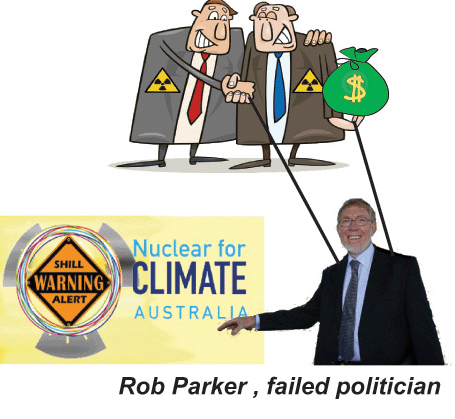 The Australian Nuclear Association last week gave a presentation to the Australian Institute of Energy in Victoria, in which ANA vice president Robert Parker outlined his hopes for the country to adopt nuclear and for the renewable energy industry to be stopped, quite literally, in its tracks.
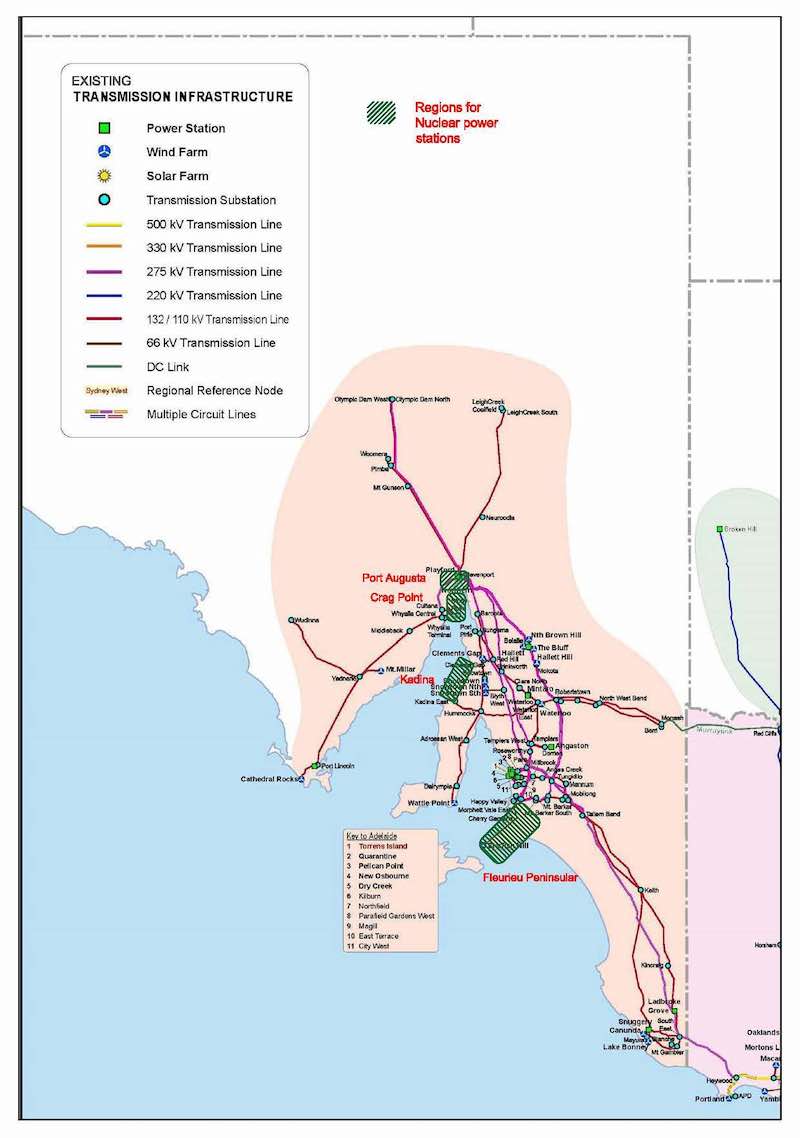
Parker included this map of Victoria and his idea that nukes should be located in and around the Latrobe Valley that currently hosts the main brown coal generators, and also Portland on the west coast, south and west Gippsland, and in northern Victoria at the Eildon and Dartmouth reservoirs, and near Albury-Wodonga.

The organisation’s website includes this map and others that outline preferred sites for nuclear plants in NSW, Queensland and South Australia. (See below.)
It comes as the Coalition faces intense pressure from its own MPs and Senators, and One Nation, and, of course, the conservative media, to allow nuclear to be built in Australia.
Most of the MPs behind this push – like Joyce, Barilaro, Keith Pitt and Mark Latham – either reject climate science outright, mock any moves to address it, and/or at the same time are pushing for the construction of new coal-fired generators. That shouldn’t surprise anyone. At an industry level, the push for nuclear also comes from the main coal lobby, the Minerals Council of Australia, whose former CEO and deputy CEO are key advisors in prime minister’s Scott Morrison’s office, and who, of course, also want the government to underwrite new coal-fired generators, and are ensuring the current government has no long-term policy or plan for renewables.The reason for this symbiotic relationship is that the coal and nuclear industries share a common enemy – wind and solar and distributed renewables plus storage that undermine the traditional energy system of centralised power generation and “base-load” power.
So, the nuclear lobby had dusted off its plans and ramped up its campaign to demonise the competition. Seminars are being held, reports are being released, and the trolls have been let loose on social media.
Parker’s presentation is interesting only because it gives warning to residents of where the nuclear proponents think they could build a nuclear power plant.
Of course, how and why Australia would build the 20 gigawatts of nuclear plants he suggests – and in the time-frames offered and at a cheap enough price – is not addressed by Parker, who often refers to renewables as “pixie dust”.
Dylan McConnell, from the Climate and Energy College, attended the presentation and tweeted his observation that neither cost nor social licence were addressed in the seminar. He said it “defied credulity” and further comments can be found here.
That the nuclear boosters don’t address this issue is not surprising, because these are the impossible questions for the nuclear industry.
A new study by the CSIRO and the Australian Energy Market Operator found nuclear to be by far the most expensive option for Australia’s main grid, and the very idea of new nuclear plants is laughed at by those with a serious interest in the electricity industry and its future.
Parker suggests – the EIA has published the slideshow – that a nuclear grid providing 82 per cent of Australia’s annual demand would deliver output that looks something like this:
It’s a fantasy, of course, and deliberately misleading, like much of what is said by the coal and nuclear lobbies and climate deniers.
Apart from not mentioning the enormous cost of nuclear, Parker simply wishes away wind energy, ignores the more than 10GW of large-scale wind and solar currently installed or committed to the main grid, not to mention the 9GW of rooftop solar, which is likely to total close to 30GW by 2030, when Parker heroically suggests the first nuclear plant could be completed.
Even South Australia is suggested for one or more nuclear plants, despite the fact that even the state’s conservative government suggests that the local grid will be “100 per cent net renewables” by that time, and the idea of trying to jam a nuclear plant into the local grid was rejected by the Nuclear Royal Commission.
That 10-year time-line for the first nuke in Australia, apparently based on approval being given last year, isn’t remotely realistic given the huge delays in every new reactor currently being built in the UK, Europe and north America, not to mention the huge cost blowouts.
At best, Australia is looking at a 20-year timeframe for its first nuclear reactor, should approval be given now. But by then, like South Australia, the rest of the main grid will be largely renewable, with close to 50 per cent delivered by distributed energy.
The centralised system will be rapidly becoming a thing of the past, as market operators around the world readily acknowledge.
So, in reality, the regions identified by the nuclear lobby should have nothing to worry about at all, apart from their elected representatives doing all they can to deprive them of the opportunities that might be presented in wind, solar and storage.

Wind energy sets new record output in Australia’s main grid — RenewEconomy

Wind output hit new record on Sunday night, average prices in South Australia fall into negative territory last Thursday. The post Wind energy sets new record output in Australia’s main grid appeared first on RenewEconomy.
via Wind energy sets new record output in Australia’s main grid — RenewEconomy
Australia’s military well aware of the security dangers of climate change
Defence lacks ‘overarching strategy’ to deal with climate change conflict, internal notes warn By Mark Willacy, ABC Investigations and Freedom of Information Editor Michael McKinnon, 14 July 19, Australia’s military has warned of a possible influx of climate refugees and an increased potential for conflict because of the effects of climate change.
Key points:
- A briefing note warns there is no “overarching strategy” to address climate change risks
- The Indo-Pacific region is projected to experience prolonged droughts and increased flooding from rising sea-levels
- Defence admits that their operations could be impacted by ocean acidification and extreme weather
Internal Australian Defence Force (ADF) briefing notes from last year, obtained by the ABC under Freedom of Information, also predict the military may be forced to increase patrols in Australia’s northern waters to deal with “sea-borne migration” sparked by rising sea levels in the Indo-Pacific.
One document warns that climate change could “exacerbate the potential for conflict” and contribute to “state fragility and the undermining of economic development in our immediate region”.
Former Defence Force chief Chris Barrie said Australia would be seen as the “land of opportunity” for many people affected by climate change………..
Climate change ‘may directly impact’ Defence operations
The ADF has refused to release documents relating to the impact of sea level rises and flooding on defence training areas, telling the ABC that it is not in the national interest.
“Release of this information could reasonably be expected to cause damage to the ability of the Defence Force to remain an effective force as well as potentially providing an avenue through which foreign incursions could significantly impact our critical infrastructure,” it said.
But one briefing note warns that the Indo-Pacific region is projected to experience challenges such as prolonged droughts and increased flooding from increased sea levels.
“Sea level rise, ocean acidification, increase in extreme temperatures and a forecast increase in intensity of bushfires and extreme weather events may directly impact Defence capabilities, personnel and equipment,” it read.
The ADF has already identified climate change as a challenge to Australia’s future security.
Its 2016 Defence White Paper predicted that Australia may be called on to conduct more humanitarian and disaster relief operations.
The internal notes obtained under freedom of information go further in warning about climate change risks.
“Further, an increase in illegal foreign fishing or sea-borne migration to Australia because of climate change effects may increase demands for Australian Defence Force patrols in Australia’s north waters,” the briefing note said.
 Admiral Barrie said Australia was “wide open” for climate refugees, using Bangladesh as an example — its border with India is already being heavily patrolled by the Indian military.
“Bangladesh — a very populated country — runs out of fresh water and also has problems with sea level rise. Where will all the Bangladeshis go?” he said.
‘Impacts are unavoidable’
The briefing documents include a report assessing the impact of sea level rises and flooding on “selected defence training areas and ranges”.
The report, by global infrastructure consultancy Aecom, says the “warming of the climate system is unequivocal…atmospheric concentrations of carbon dioxide, methane and nitrous oxide have increased to levels unprecedented in at least the last 800,000 years”.
It states that the warming of Australia’s mean air temperature could “reach 0.6 degrees Celsius to 5.1C depending on the emission scenarios”.
The report cites such impacts as increased flooding, coastal erosion, bushfires and heatwaves.
“Even with considerable reductions in global greenhouse gas emissions, the inertia of the global climatic system means that many of these impacts are unavoidable.”
Last year defence chiefs told the Senate’s Foreign Affairs, Defence and Trade committee that rising sea levels and coastal erosion could damage military bases “in the short to medium term”.
The committee’s report warned that “climate change may also eventually contribute to greater irregular migration pressure in vulnerable countries to Australia’s north, potentially becoming a substantial security threat to Australia”…….. https://www.abc.net.au/news/2019-07-15/defence-lacks-overarching-strategy-for-climate-change-conflict/11304954
Acute water shortage in rural Australia, as drought persists
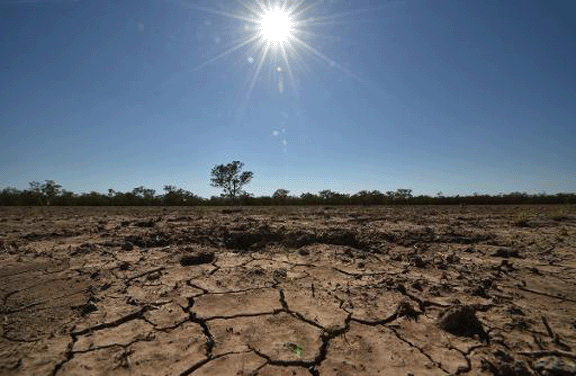
Country towns close to reaching ‘day zero’, as water supplies dry up in the drought, ABC News, By National Regional Affairs reporter Lucy Barbour 14 July 19, Across New South Wales and Queensland’s southern downs, country towns are approaching their own ‘day zero’, as water supplies dry up in the drought.
Pacific Islanders mourn nuclear bomb testing, withdraw from France’s memorial propaganda

Marchers in Tahiti ‘mourn’ French nuclear weapons test legacy https://asiapacificreport.nz/2019/07/05/marches-in-tahiti-mourn-french-nuclear-weapons-test-legacy/, By PMC Editor -July 5, 2019 , By RNZ Pacific
An estimated 2000 people have joined a march in French Polynesia this week to mark the 53rd anniversary of France’s first atomic weapons test in the Pacific.
The first test was on July 2, 1966, after nuclear testing was moved from Algeria to the Tuamotus.
Organisers of the Association 193 described it as a “sad date that plunged the Polynesia people into mourning forever”. The test on Moruroa atoll was the first of 193 which were carried out over three decades until 1996.
The march was to the Place Pouvanaa a Oopa honouring a Tahitian leader.
The march and rally were called by test veterans’ groups and the Maohi Protestant church to also highlight the test victims’ difficulties in getting compensation for ill health.
After changes to the French compensation law, the nuclear-free organisation Moruroa e Tatou wants it to be scrapped as it now compensates no-one. The Association 193 said it was withdrawing from the project of the French state and the French Polynesian government to build a memorial site in Papeete, saying it will only serve as propaganda.
Apart from reparations for the victims, the organisation wants studies to be carried out into the genetic impact of radiation exposure.
Scientists give serious warnings on Ukraine’s drive for Chernobyl tourism
The grounds remain coated with plutonium, cesium, strontium and americium — radionuclides (atoms that emit radiation) that could pose potentially serious health risks to those who touch or ingest them. Some areas are more radioactive, and therefore more dangerous, than others.
“Even though the accident occurred over 33 years ago it remains one of the most radiologically contaminated places on earth.”
Chernobyl tourists should avoid plant life, and especially the depths of the forests.
Those areas were not cleaned in the aftermath of the disaster and remain highly contaminated by radiation. Research has showed that the fungus, moss and mushrooms growing there are radioactive. Eating or drinking from the area is not safe.
Those who stay on the paved pathways, which officials cleaned, are much less likely to absorb harmful toxins.
Ukraine wants Chernobyl to be a tourist trap. But scientists warn: Don’t kick up dust. https://www.washingtonpost.com/travel/2019/07/12/ukraine-wants-chernobyl-be-tourist-trap-scientists-warn-dont-kick-up-dust/?utm_term=.5e82b547ceaf By Katie Mettler, July 12 2019
The tourists first started flocking to Chernobyl nearly 10 years ago, when fans of the video game S.T.A.L.K.E.R. wanted to see firsthand the nuclear wasteland they’d visited in virtual reality.
Next came those whose curiosity piqued when in 2016 the giant steel dome known as the New Safe Confinement was slid over the sarcophagus encasing nuclear reactor number four, which exploded in April 1986, spewed radiation across Europe and forced hundreds of thousands to flee from their homes.
Then in May, HBO’s “Chernobyl” miniseries aired, and tourism companies reported a 30 to 40 percent uptick in visitors to the Chernobyl Exclusion Zone, abandoned and eerily frozen in time.
Now the Ukrainian government — capitalizing on the macabre intrigue — has announced that Chernobyl will become an official tourist site, complete with routes, waterways, checkpoints and a “green corridor” that will place it on the map with other “dark tourism” destinations.
“We must give this territory of Ukraine a new life,” President Volodymyr Zelensky said during a visit to Chernobyl this week. “Until now, Chernobyl was a negative part of Ukraine’s brand. It’s time to change it.”
Zelensky, who was inaugurated in May, signed a decree July 10 to kickstart the Chernobyl Development Strategy, which the president hopes will bring order to the 19-mile Exclusion Zone that has become a hotbed for corruption, trespassing and theft. At the nuclear facility and in the nearby town of Pripyat, wildlife has returned and now roams freely. Flora and fauna grow up around decaying homes, playgrounds and an amusement park. Letters, dinner tables and baby dolls remain where their owners abandoned them 33 years ago.
Radioactive dust still coats it all. Continue reading
July 14 Energy News — geoharvey

Science and Technology: ¶ “Climate Crisis Weekly: Weekly Disasters, Flooding Forces Moves, Climate Review Off The Table, More” • Climate crisis disasters are happening at an average rate of one per week, the UN says, giving this feature of Electrek new definition. Many “lower-impact” disasters are happening in developing countries and draw relatively little attention. […]
Tropical Storm Barry July 14th 2019 Updates-Outlook-Relevant Info — Mining Awareness +

Multiple nuclear power stations are also at risk due to the possibility of wind-tree fall leading to power outages. Weirdly, nuclear power stations are dependent upon offsite power to operate. In the event of power outage they must depend upon backup diesel generators operating, which isn’t a given.
There will be more updates here: https://www.nhc.noaa.gov Below is information which we find relevant for understanding the impacts of this storm. One thing to recall is that this storm almost always appeared bottom heavy. Earlier reports said that wind sheer kept impacting it, and perhaps this is why. There are outer rain bands, tornadoes, and […]
via Tropical Storm Barry July 14th 2019 Updates-Outlook-Relevant Info — Mining Awareness +
US mayors call on candidates to declare their stance on nuclear weapons — Beyond Nuclear International

Existential threat of nuclear weapons ignored in debates
1 This month
Chernobyl: The Lost Tapes – A good documentary on Chernobyl on SBS available On Demand for the next 3 weeks– https://www.sbs.com.au/ondemand/tv-program/chernobyl-the-lost-tapes/2352741955560
15 April – Zoom –Nuclear Power is Not the Solution
Apr 15, 2026 01:00 AM in Canberra, Melbourne, Sydney

Join the International Physicians for the Prevention of Nuclear War (IPPNW) on Tuesday, April 14th for a timely webinar exploring the risks associated with nuclear power and challenging the myth that it offers a simple, safe, carbon-free solution to the climate crisis

21 April Webinar: No Nuclear Weapons in Australia
Start: 2026-04-21 18:00:00 UTC Canberra, Melbourne, Sydney (GMT+10:00)
End: 2026-04-21 19:30:00 UTC Canberra, Melbourne, Sydney (GMT+10:00)
Event Type: Virtual
A virtual link will be communicated before the event.
Host Contact Info: australia@icanw.org

of the week – Australians for War Powers Reform (AWPR)
To see nuclear-related stories in greater depth and intensity
 Antinuclear