Robert Parker of Australian Nuclear Association identifies 20 sites for nuclear reactors
Nuclear lobby identifies preferred sites for 20 nukes in Australia https://reneweconomy.com.au/nuclear-lobby-identifies-preferred-sites-for-20-nukes-in-australia-19298/?utm_source=RE+Daily+Newsletter&utm_campaign=11f2638fe2-EMAIL_CAMPAIGN_2019_07_15_03_5, 15 July 2019 National Party luminaries such as Barnaby Joyce and NSW deputy premier John Barilaro must be tickled pink. The electorates of these outspoken pro-nuclear advocates have been identified by the local nuclear lobby as some of the most prospective locations for their call to build 20 nukes in Australia’s main grid.
These areas include Joyce’s New England electorate, Barilaro’s state electorate of Monaro in southern NSW, and fellow booster Ken O’Dowd’s federal electorate of Flynn in central Queensland. Won’t their constituents be pleased!
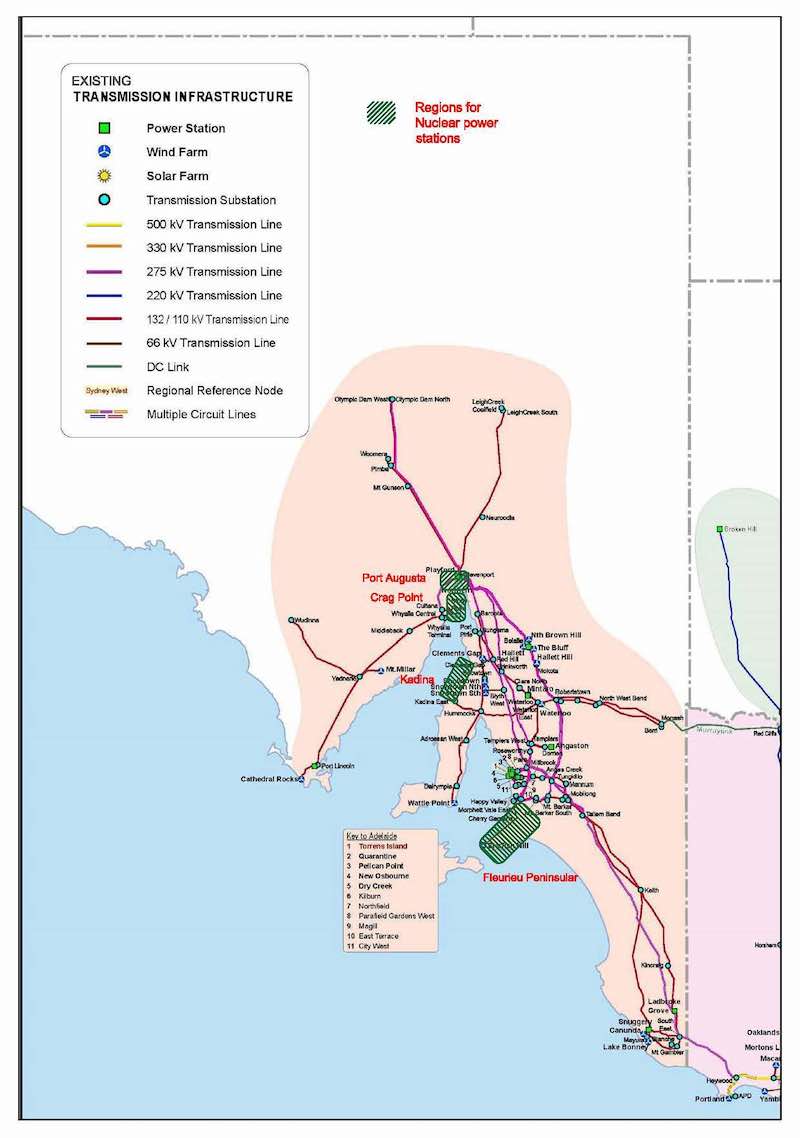
Other towns and regions identified include the Latrobe Valley, the Gippsland region of Victoria, Albury, Whyalla and Port Augusta in South Australia, the mid-north coast of NSW, and a whole bunch of sites in south-east Queensland. The Australian Nuclear Association last week gave a presentation to the Australian Institute of Energy in Victoria, in which ANA vice president Robert Parker outlined his hopes for the country to adopt nuclear and for the renewable energy industry to be stopped, quite literally, in its tracks.
Parker included this map of Victoria and his idea that nukes should be located in and around the Latrobe Valley that currently hosts the main brown coal generators, and also Portland on the west coast, south and west Gippsland, and in northern Victoria at the Eildon and Dartmouth reservoirs, and near Albury-Wodonga.

The organisation’s website includes this map and others that outline preferred sites for nuclear plants in NSW, Queensland and South Australia. (See below.)
It comes as the Coalition faces intense pressure from its own MPs and Senators, and One Nation, and, of course, the conservative media, to allow nuclear to be built in Australia.
Most of the MPs behind this push – like Joyce, Barilaro, Keith Pitt and Mark Latham – either reject climate science outright, mock any moves to address it, and/or at the same time are pushing for the construction of new coal-fired generators. That shouldn’t surprise anyone. At an industry level, the push for nuclear also comes from the main coal lobby, the Minerals Council of Australia, whose former CEO and deputy CEO are key advisors in prime minister’s Scott Morrison’s office, and who, of course, also want the government to underwrite new coal-fired generators, and are ensuring the current government has no long-term policy or plan for renewables.The reason for this symbiotic relationship is that the coal and nuclear industries share a common enemy – wind and solar and distributed renewables plus storage that undermine the traditional energy system of centralised power generation and “base-load” power.
So, the nuclear lobby had dusted off its plans and ramped up its campaign to demonise the competition. Seminars are being held, reports are being released, and the trolls have been let loose on social media.
Parker’s presentation is interesting only because it gives warning to residents of where the nuclear proponents think they could build a nuclear power plant.
Of course, how and why Australia would build the 20 gigawatts of nuclear plants he suggests – and in the time-frames offered and at a cheap enough price – is not addressed by Parker, who often refers to renewables as “pixie dust”.
Dylan McConnell, from the Climate and Energy College, attended the presentation and tweeted his observation that neither cost nor social licence were addressed in the seminar. He said it “defied credulity” and further comments can be found here.
That the nuclear boosters don’t address this issue is not surprising, because these are the impossible questions for the nuclear industry.
A new study by the CSIRO and the Australian Energy Market Operator found nuclear to be by far the most expensive option for Australia’s main grid, and the very idea of new nuclear plants is laughed at by those with a serious interest in the electricity industry and its future.
Parker suggests – the EIA has published the slideshow – that a nuclear grid providing 82 per cent of Australia’s annual demand would deliver output that looks something like this:
It’s a fantasy, of course, and deliberately misleading, like much of what is said by the coal and nuclear lobbies and climate deniers.
Apart from not mentioning the enormous cost of nuclear, Parker simply wishes away wind energy, ignores the more than 10GW of large-scale wind and solar currently installed or committed to the main grid, not to mention the 9GW of rooftop solar, which is likely to total close to 30GW by 2030, when Parker heroically suggests the first nuclear plant could be completed.
Even South Australia is suggested for one or more nuclear plants, despite the fact that even the state’s conservative government suggests that the local grid will be “100 per cent net renewables” by that time, and the idea of trying to jam a nuclear plant into the local grid was rejected by the Nuclear Royal Commission.
That 10-year time-line for the first nuke in Australia, apparently based on approval being given last year, isn’t remotely realistic given the huge delays in every new reactor currently being built in the UK, Europe and north America, not to mention the huge cost blowouts.
At best, Australia is looking at a 20-year timeframe for its first nuclear reactor, should approval be given now. But by then, like South Australia, the rest of the main grid will be largely renewable, with close to 50 per cent delivered by distributed energy.
The centralised system will be rapidly becoming a thing of the past, as market operators around the world readily acknowledge.
So, in reality, the regions identified by the nuclear lobby should have nothing to worry about at all, apart from their elected representatives doing all they can to deprive them of the opportunities that might be presented in wind, solar and storage.

No comments yet.
1 This month
Chernobyl: The Lost Tapes – A good documentary on Chernobyl on SBS available On Demand for the next 3 weeks– https://www.sbs.com.au/ondemand/tv-program/chernobyl-the-lost-tapes/2352741955560
15 April – Zoom –Nuclear Power is Not the Solution
Apr 15, 2026 01:00 AM in Canberra, Melbourne, Sydney

Join the International Physicians for the Prevention of Nuclear War (IPPNW) on Tuesday, April 14th for a timely webinar exploring the risks associated with nuclear power and challenging the myth that it offers a simple, safe, carbon-free solution to the climate crisis

21 April Webinar: No Nuclear Weapons in Australia
Start: 2026-04-21 18:00:00 UTC Canberra, Melbourne, Sydney (GMT+10:00)
End: 2026-04-21 19:30:00 UTC Canberra, Melbourne, Sydney (GMT+10:00)
Event Type: Virtual
A virtual link will be communicated before the event.
Host Contact Info: australia@icanw.org

of the week – Australians for War Powers Reform (AWPR)
To see nuclear-related stories in greater depth and intensity
 Antinuclear
Leave a comment