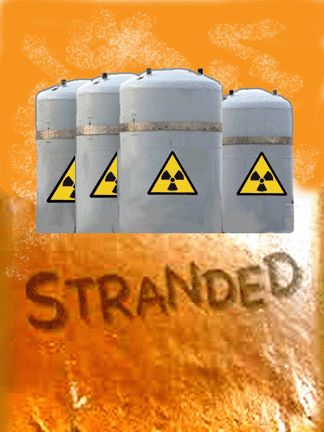

Putting aside the criticism from some advocacy groups about restarting transfers at all, the move brings up a larger question: Where will the waste at the San Onofre Nuclear Generating Station, known as SONGS, eventually go?
Some of the options are fairly well known, such as reviving a controversial site in Nevada, while others are more obscure, such as a proposal to send the waste down deep boreholes.
But regardless of the pros and cons of each proposal, getting consensus and putting a plan into action can be elusive in a nuclear sector where the confluence of science, industry and politics all too often leads to stalemate.
“Finding solutions is hard,” said David Victor, the chairman of the SONGS Community Engagement Panel. “If it were an easy problem, we would have solved it by now.”
SONGS is located right above the beach at San Onofre and although the plant has not generated electricity since 2012, it is home to 3.55 million pounds of radioactive waste that dates from the time when the plant was active.
Many in the San Diego area worry about the waste (or, as nuclear proponents prefer to call it, spent fuel) resting so close to the ocean and busy Interstate 5 — and located in a populous region with a history of seismic activity…….
To avoid the resistance seen at Yucca, it’s been proposed to build the facilities only if they receive consent form local and state authorities. Two interim storage sites have been mentioned — one in southeastern New Mexico and another in west Texas.
But is interim storage really interim? Absent a permanent location like Yucca Mountain, the communities that give the OK to build an interim storage facility may end up having the waste stuck in their backyards for decades to come.
“Until there is an idea of a long-term repository,” said Maria Korsnick, CEO of the Nuclear Energy Institute, at a recent Senate hearing, “anybody that raises their hands for that consolidated interim storage [site] is, de facto, the long-term” site.
A new company based in Berkeley, Calif., called Deep Isolation has a different idea: sending nuclear waste down boreholes drilled deep into the ground, deploying much of the same technology and equipment oil and gas companies use.
“Instead of having to mine a vast repository with people and trucks going underground, we now have remote drilling technologies that are so advanced,” said Elizabeth Muller, CEO of Deep Isolation. “So if we want to go down into rock a mile underground, and if we can test that rock and make sure it has been isolated from the biosphere for millions of years, we think that is a great place to isolate the spent fuel.”
Under Deep Isolation’s plan, individual boreholes would be drilled vertically about one to two miles deep and, using horizontal drilling techniques, the borehole would gradually curve sideways and run along a rock formation.
Nuclear fuel assemblies encased in narrow canisters about 15 inches in diameter and 15 feet long can be attached to a wire assembly, lowered into the hole and eventually placed along the horizontal bed.
To show that the concept can work, Deep Isolation conducted a test in January, taking an empty canister down a hole about a half-mile deep in Cameron, Texas and then successfully pulling it back up.
“The technology is so much more mature now than it was 30 years ago when people first started talking about borehole disposal,” Muller said.
But does it have practical applications for SONGS?
While Muller said that “technically, we can handle the waste at San Onofre,” she said Deep Isolation has been concentrating on potential clients at federal sites handling defense waste and international commercial sites.
“We like to think of Deep Isolation as another option in the mix,” Muller said. “We’re not a solution that’s going to be right for everybody. We’re not going to be right for every site. But for those communities and for those locations where people are not happy with the current options available to them, we’re happy to take a look.”
The used fuel’s dry storage facilities at SONGS are located on the plant’s premises, about 100 feet from the Pacific behind a seawall 28 feet high. The proximity to the ocean and concerns about rising sea levels have some calling for moving the waste to a higher location — such as a mesa on the east side of Interstate 5.
“It’s not optimal but does get away from many of the problems at the current site,” said Ray Lutz, national coordinator for the advocacy group Citizens Oversight. “It moves [the spent fuel] away from the water, out of tsunami danger.”
Lutz wants to see the used fuel placed about five miles from the plant.
But SONGS sits on an 85-acre chunk of Marine Corps Base Camp Pendleton, owned by the Department of the Navy, and the Navy has expressed no interest in moving the used fuel to the mesa. Military officials say they defer to the NRC’s stance that the fuel is safe where it is. https://www.latimes.com/california/story/2019-07-27/san-onofre-nuclear-waste-disposal

 Antinuclear
Leave a comment