Ground-level nuclear disasters leave much more radioactive fallout than Tokyo is willing to admit
 The danger of sourcing food and material from
 the Fukushima region Ground-level nuclear disasters leave much more radioactive fallout than Tokyo is willing to admit Hankyoreh By Seok Kwang-hoon, energy policy consultant of Green Korea Aug.25,2019 International concerns are growing over the Japanese government’s plans to provide meals from the Fukushima area to squads participating in the 2020 Tokyo Olympics. The starting point for the Olympic torch relay, and even the baseball stadium, were placed near the site of the Fukushima Nuclear Power Plant. It seems to be following the model of the Tokyo Olympics in 1964, where Japan’s rise from the ashes of the atomic bombs was underscored by having a young man born the day of the Hiroshima bombing act serve as the relay’s last runner. Here we can see the Shinzo Abe administration’s fixation on staging a strained Olympic reenactment of the stirring Hiroshima comeback – only this time from Fukushima.
But in terms of radiation damages, there is a world of difference between Hiroshima and Fukushima. Beyond the initial mass casualties and the aftereffects suffered by the survivors, the atomic bombing of Hiroshima resulted in little additional radiation exposure. Nuclear technology being as crude as it was back then, only around one kilogram of the Hiroshima bomb’s 64kg of highly enriched uranium actually underwent any reaction, resulting in a relatively small generation of nuclear fission material. Whereas ground-based nuclear testing results in large quantities of radioactive fallout through combining with surface-level soil, the Hiroshima bomb exploded at an altitude of 580m, and the superheated nuclear fission material rose up toward the stratosphere to spread out around the planet, so that the amount of fallout over Japan was minimal. Even there, most of the nuclides had a short half-life (the amount of time it takes for half the total atoms in radioactive material to decay); manganese-56, which has a half-life of three hours, was the main cause of the additional radiation damages, which were concentrated during the day or so just after the bomb was dropped. The experience of Nagasaki was similar. As a result, both Hiroshima and Nagasaki were able to fully resume as functioning cities by the mid-1950s without additional decontamination efforts.
Ground-level nuclear disasters leave much more radioactive fallout than Tokyo is willing to admit
nternational concerns are growing over the Japanese government’s plans to provide meals from the Fukushima area to squads participating in the 2020 Tokyo Olympics. The starting point for the Olympic torch relay, and even the baseball stadium, were placed near the site of the Fukushima Nuclear Power Plant. It seems to be following the model of the Tokyo Olympics in 1964, where Japan’s rise from the ashes of the atomic bombs was underscored by having a young man born the day of the Hiroshima bombing act serve as the relay’s last runner. Here we can see the Shinzo Abe administration’s fixation on staging a strained Olympic reenactment of the stirring Hiroshima comeback – only this time from Fukushima.But in terms of radiation damages, there is a world of difference between Hiroshima and Fukushima. Beyond the initial mass casualties and the aftereffects suffered by the survivors, the atomic bombing of Hiroshima resulted in little additional radiation exposure. Nuclear technology being as crude as it was back then, only around one kilogram of the Hiroshima bomb’s 64kg of highly enriched uranium actually underwent any reaction, resulting in a relatively small generation of nuclear fission material. Whereas ground-based nuclear testing results in large quantities of radioactive fallout through combining with surface-level soil, the Hiroshima bomb exploded at an altitude of 580m, and the superheated nuclear fission material rose up toward the stratosphere to spread out around the planet, so that the amount of fallout over Japan was minimal. Even there, most of the nuclides had a short half-life (the amount of time it takes for half the total atoms in radioactive material to decay); manganese-56, which has a half-life of three hours, was the main cause of the additional radiation damages, which were concentrated during the day or so just after the bomb was dropped. The experience of Nagasaki was similar. As a result, both Hiroshima and Nagasaki were able to fully resume as functioning cities by the mid-1950s without additional decontamination efforts……
http://www.hani.co.kr/arti/english_edition/e_editorial/907055.html
August 26, 2019 -
Posted by Christina Macpherson |
General News
No comments yet.
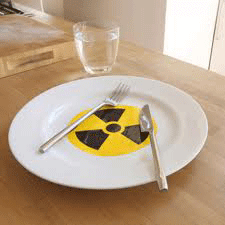 The danger of sourcing food and material from
 the Fukushima region Ground-level nuclear disasters leave much more radioactive fallout than Tokyo is willing to admit Hankyoreh By Seok Kwang-hoon, energy policy consultant of Green Korea Aug.25,2019 International concerns are growing over the Japanese government’s plans to provide meals from the Fukushima area to squads participating in the 2020 Tokyo Olympics. The starting point for the Olympic torch relay, and even the baseball stadium, were placed near the site of the Fukushima Nuclear Power Plant. It seems to be following the model of the Tokyo Olympics in 1964, where Japan’s rise from the ashes of the atomic bombs was underscored by having a young man born the day of the Hiroshima bombing act serve as the relay’s last runner. Here we can see the Shinzo Abe administration’s fixation on staging a strained Olympic reenactment of the stirring Hiroshima comeback – only this time from Fukushima.
 Antinuclear
Leave a comment