The role of climate change in Australia’s early bushfire season
 Climate change partly to blame for early bushfire
 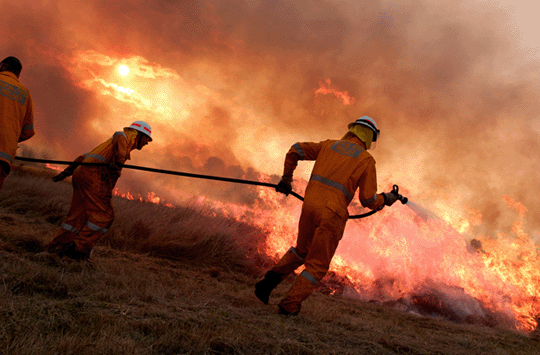 season, New analysis confirms the relationship between climate drivers such as El Niño, climate change and the Australian bushfire season, Guardian, Chris Lucas and Sarah Harris for The Conversation, 11 Oct 19
Summer might be more than six weeks away but out-of-control bushfires have already torn across parts of eastern Australia in recent days, killing two people, destroying homes and threatening more lives.
By Wednesday afternoon up to 30 homes were feared lost or badly damaged by bushfires burning in northern New South Wales. About 40 fires burned across the state.
This did not surprise meteorologists and fire agencies. Record-breaking heat and windy conditions were forecast for parts of NSW and Queensland this week, prompting severe fire danger ratings.
We’re often told the Australian bushfire season is starting earlier. This year it began in September on the eastern seaboard. Last year and in 2013 significant spring fires hit NSW and in 2015 they affected much of the nation’s southeast.
But what lies behind this phenomenon? We examined seasonal fire weather history for 44 years at 39 weather stations to find the answer.
This analysis is the most comprehensive ever conducted in Australia. It confirms the strength of the relationship between climate drivers such as El Niño, climate change and the Australian bushfire season. It also demonstrates that a few milder bushfire seasons do not mean climate change isn’t happening.
Hot, dry, windy conditions spell fire trouble
The prerequisites for a severe bushfire season are high temperatures, low humidity, and strong winds that coincide with long periods of low rainfall.
These weather ingredients are used to calculate an area’s fire danger rating, using the forest fire danger index. The index produces a score reflecting the severity of fire weather on a given day, where zero represents minimal anger, 50 represents conditions where a fire ban may be issued, and 100 is potentially catastrophic………
Climate change is a culprit too
The changed conditions have led to an average increase in severe seasonal bushfire weather across Australia, especially in southern parts of the continent. The increased severity affects all seasons but in particular spring, which means that, on average, the bushfire season is starting earlier.
Pulling it all together
Our research has made clear that climate modes bring large and rapid swings to the fire weather, while human-induced climate change gradually increases background fire weather conditions. The trend generally means an earlier start to the bushfire seasons than in the past.
Similarly, a few milder bushfire seasons among a string of record high seasons do not mean that climate change should be dismissed.
- Chris Lucas is a senior research scientist at the Australian Bureau of Meteorology and Sarah Harris is manager research and development at the Country Fire Authority.https://www.theguardian.com/australia-news/2019/oct/11/climate-change-partly-to-blame-for-early-bushfire-season
No comments yet.
1 This month
7 April – WEBINAR – Australia and the Doomsday Clock – Preventing nuclear war through NoFirstUse and other policies
Online | Tuesday April 7, 4:00-5:30pm, Australian Eastern Time / 8:00-9:30am Central Europe Time
– Access the registration link
15 April – Zoom –Nuclear Power is Not the Solution
Apr 15, 2026 01:00 AM in Canberra, Melbourne, Sydney

Join the International Physicians for the Prevention of Nuclear War (IPPNW) on Tuesday, April 14th for a timely webinar exploring the risks associated with nuclear power and challenging the myth that it offers a simple, safe, carbon-free solution to the climate crisis

21 April Webinar: No Nuclear Weapons in Australia
Start: 2026-04-21 18:00:00 UTC Canberra, Melbourne, Sydney (GMT+10:00)
End: 2026-04-21 19:30:00 UTC Canberra, Melbourne, Sydney (GMT+10:00)
Event Type: Virtual
A virtual link will be communicated before the event.
Host Contact Info: australia@icanw.org

of the week – Australians for War Powers Reform (AWPR)
To see nuclear-related stories in greater depth and intensity
 Antinuclear
Leave a comment