Keep Australia’s ban on nuclear power – Noel Wauchope at Federal Inquiry Hearing
 I’m here today to state that I totally oppose changing Australia’s present laws banning nuclear activities. At the present time, Australia’s in a bit of a mess energy-wise. There’s a big transition happening with energy, and—not much helped or understood by government, it seems—renewable energy is taking off pretty fast in Australia. But Australia is a kind of test canary for climate change. I think you all would know of the extremes of climate which we’re getting more of now, already, and which will come on in the future with climate change. It’s very important for Australia to decide what to do about it, and at present we have no energy policy for going forward, and the world is watching us—watching our energy policy and watching our Prime Minister cuddling a lump of coal, which doesn’t go down very well with the world. We are not showing ourselves to be a good global citizen. Worse, we’re not helping our own selves.
So what we need is a way forward. We need to head towards a zero-carbon economy. We have all the ability to go in that direction. We’ve got an intelligent, educated population. We can largely work very hard on energy efficiency. That is something which is kind of the forgotten, the ugly stepsister of energy, but the biggest thing we could do is plan and organise energy efficiency in our buildings, in our transport and in many other ways. As well as that, we need to pursue renewable energy and properly phase out coal.
When it comes to nuclear power, a debate on nuclear power for Australia is simply a waste of energy, time and money. We all know that it’ll take many decades to have nuclear power established in this country. The idea of small modular reactors, which has been put forward at times, is absolutely ridiculous. It would not happen for at least two decades. Imagine little reactors dotted about the country. It’s absurd. I believe that, while that discussion is on, we’re not heading in the direction that is practical and could be done. If we change the policy and cease to ban nuclear activities, that opens the door for the big nuclear companies, and the little ones—I suppose you could call NuScale little, although it’s probably very well funded for its propaganda if not for its actual setting up. With that distraction of removing the ban, we open the door for propaganda to be spread by these companies and their friends in Australia. Of course, some people in the defence industry are very interested because they’d be looking to small modular reactors for nuclear submarines. So I see this as a great distraction from what we should be talking about and what we should be doing.
Our laws were not just set up as a random whim; they were set up because of a realisation, well before the Fukushima thing happened, of the environmental and health hazards of nuclear power and of the issue of nuclear waste. Nobody has solved the problem, as Rosamund has said, of where to finally dispose of it. That hasn’t been worked out, and it seems quite ridiculous to keep on producing something for which we have no proper garbage can.
As well as that, there’s the question of weapons proliferation. Continue reading
The week in nuclear news Australia
Again – climate and nuclear news collide. In Japan, Typhoon Hagibis re-spreads nuclear contamination far and wide – nuclear workers at heightened risk. Low lying Marshall Islands, victim of nuclear testing, now declares a Climate Emergency.
AUSTRALIA
NUCLEAR
- Clean Energy Council slams Federal Nuclear Inquiry as “distraction” from real energy challenges. Dr Jim Green addresses Australia’s Federal Nuclear Inquiry.
- Navy chief looks to nuclear submarines for Australia.
- Kalgoorlie Mayoral Candidate John Katahana wants a Small Nuclear Reactor for the town.
- Government study found Kimba and Flinders Range areas to be unsuitable for nuclear waste dump. More bribery to Kimba and Hawker communities as nuclear waste dump ballot nears. Federal nuclear waste dump plan- it’s really High Level wastes! Wildly exaggerated economic claims by Australia’s National Radioactive Waste Management Taskforce.
CLIMATE. David Glynne Jones on the unwisdom of nuclear power for Australia in a heating climate. The role of climate change in A ustralia’s early bushfire season. Bushfires continue burning across Australia, destroying homes. Northern Territory Aboriginals call out for climate action as mangroves dieback with heat. Weather experts predict more heat and fire risk coming, though fewer cyclones. Climate change – heat -drought – more mass fish deaths to come.
Greens seek to outlaw coal use by 2030, push climate emergency as Labor wavers. Don’t nuke the climate Australia.
Dick Smith, Julian Assange, and USA’s “outrageous” claim to “universal jurisdiction over every person on earth”.
Civil Liberties – Media Freedom Barnaby Joyce and former foreign minister Bob Carr urge stoppingt extradition of Julian Assange to USA. Pamela Anderson to confront Scott Morrison and plead for Australia to help Julian Assange.
RENEWABLE ENERGY. Is Energy Minister Angus Taylor on a one-man mission to stop wind and solar? EnergyAustralia calls for “unity” to enable “inevitable” transition to renewables. Solar reaches 80 per cent share of demand in South Australia on Saturday. Clean-energy hub Adelaide a drawcard for local and global innovators. Queensland approves new 180MW wind farm, with possible battery. Massive 5,000MW solar and wind projects set to fuel WA’s hydrogen expansiono wind turbines. AEMO’s Zibelman calls for system plan, says ‘just in time’ investment won’t work.
INTERNATIONAL
Revealed by Wikileaks – facts about nuclear weapons and the nuclear industry.
Climate Scientists urge protestors to keep on going with Extinction Rebellion. Google publicly decries climate change, privately donates to climate denialism. Massive Carbon Tax is needed– International Monetary Fund. U.N. officials on how Nuclear Power is irrelevant to climate action. The woman who was first to scientifically show, in 1856, how atmospheric C02 caused global warming.
The impossibility of nuclear power solving climate change. Mainstream media fails to cover news on military carbon emissions.
Physics Nobel Laureate predicts NO Migration to Other Planets.
Dick Smith, Julian Assange, and USA’s “outrageous” claim to “universal jurisdiction over every person on earth”.
|
Dick Smith lobbied US to drop Julian Assange extradition The campaign for the Morrison government to intervene gathered momentum on Monday after former deputy prime minister Barnaby Joyce lent his support to the WikiLeaks founder’s cause. Independent MP Andrew Wilkie also revealed that a multi-party parliamentary group to “agitate” for Mr Assange to be brought home to Australia would be launched in the coming weeks and would include some members of the Coalition government. In April, Mr Smith voiced concerns to Washington’s man in Canberra that Mr Assange could be charged under an “outrageous” US claim to “universal jurisdiction over every person on earth”. “Australians, like Americans, may have mixed opinions on Julian Assange, however, I believe the tide will turn if it appears an Aussie is being made a scapegoat for a security failure of the US intelligence services,” Mr Smith wrote in the letter seen by The Age and The Sydney Morning Herald. “I can assure you that many Australians will not readily accept that Mr Assange is being held responsible for such a serious security failure, as embarrassing as it may be.” He said it was “imperative to maintain the good relations” between Australia and the US, but Washington would “jeopardise” the relationship by asking its courts to “criminalise journalistic endeavours”. “I believe this will damage the reputation of the United States as an upholder of freedom of speech and a defender of human rights, and result in untold damage to the good relations between Australia and the American people.” Treasurer Josh Frydenberg said the government would not intervene in attempts by the US to have the 48-year-old Australian stand trial, where he faces a sentence of 175 years if found guilty of computer fraud and obtaining and disclosing national defence information……. Confidential government briefing notes, inadvertently released on email by the Prime Minister’s Office on Monday, gave “talking points” to MPs if they were asked about Mr Assange and his fight against extradition from Britain to the US. …. https://www.theage.com.au/politics/federal/dick-smith-lobbied-us-to-drop-julian-assange-extradition-request-20191014-p530lf.html |
|

Typhoon Hagibis floods carry away thousands of Fukushima’s radioactive nuclear waste bags
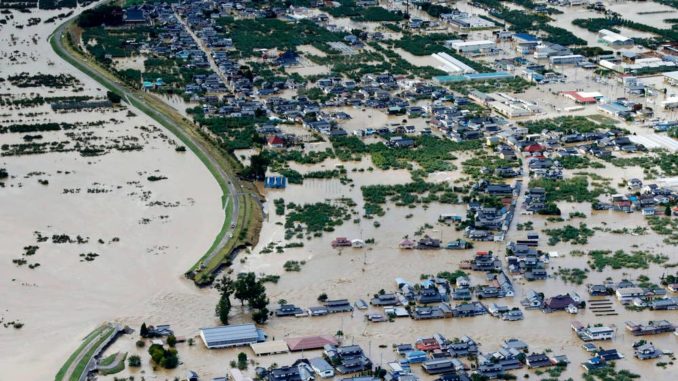
2,667 Radioactive Bags From Fukushima Swept Away By Typhoon Hagibis https://newspunch.com/1667-radioactive-bags-fukushima-swept-away-typhoon-hagibis/, October 14, 2019 Baxter Dmitry As Typhoon Hagibis hammered Japan on Saturday, thousands of bags containing radioactive waste at Fukushima were reportedly carried into a local stream by floodwaters.Experts warn the radioactive bags could have a devastating environmental impact across the entire Pacific region, reports Taiwan News.
According to Asahi Shimbun, a temporary storage facility containing 2,667 bags storing radioactive contaminants from the 2011 Fukushima nuclear disaster were “unexpectedly inundated by floodwaters brought by Typhoon Hagibis.“
Torrential rain flooded the storage facility and released the bags into a waterway 100 meters from the site.
Officials from Tamara City in Fukushima Prefecture said that each bag is approximately one cubic meter in size.
Authorities were only able to recover six of the bags by 9 p.m. on Oct. 12 and it is uncertain how many remain unrecovered while the potential environmental fallout is being assessed.
The radioactive waste swept away by Typhoon Hagibis represents the latest setback for Fukushima officials who have struggled to adequately quarantine the radiation.
StatesmanJournal reports: Seaborne radiation from Japan’s Fukushima nuclear disaster has been detected on the West Coast of the United States.
Cesium-134, the so-called fingerprint of Fukushima, was measured in seawater samples taken from Tillamook Bay and Gold Beach in Oregon, researchers from the Woods Hole Oceanographic Institution are reporting.
Because of its short half-life, cesium-134 can only have come from Fukushima.
Also for the first time, cesium-134 has been detected in a Canadian salmon, the Fukushima InFORM project, led by University of Victoria chemical oceanographer Jay Cullen, is reporting.
In both cases, levels are extremely low, the researchers said, and don’t pose a danger to humans or the environment.
Massive amounts of contaminated water were released from the crippled nuclear plant following a 9.0 magnitude earthquake and tsunami in March 2011. More radiation was released to the air, then fell to the sea.
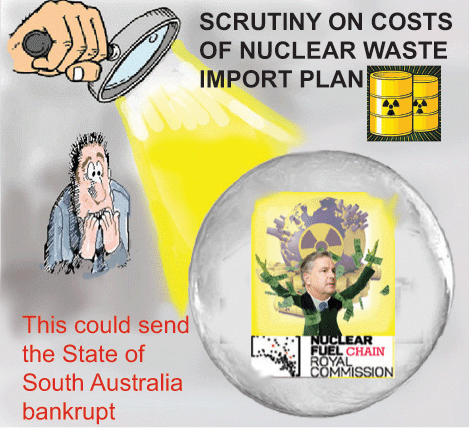
Wildly exaggerated economic claims by Australia’s National Radioactive Waste Management Taskforce
 Kazzi Jai .Fight To Stop Nuclear Waste In The Flinders Ranges, 15 Oct 19,
“Down in the Dumps” Report – August 2018
The Full Report is available in the Link below:
https://d3n8a8pro7vhmx.cloudfront.net/conservationsa/pages/9910/attachments/original/1534679998/Down_In_the_Dumps.pdf
Japan’s typhoon sweeps away radioactive waste bags in Fuushima Prefecture

TAMURA, Fukushima Prefecture–Bulk bags filled with greenery collected during decontamination efforts after the nuclear disaster at the Fukushima No. 1 nuclear power plant were swept into a river during Typhoon No. 19 on Oct. 12.
According to the Tamura city government, the bags were among 2,667 that have been stored temporarily at a site in the Miyakoji-machi district here.
The facility was flooded after heavy rains brought by the typhoon, and the water carried an unknown number of the bags to a river about 100 meters away.
A city government official received a phone call at around 9:20 p.m. on Oct. 12 from a nearby civil engineering firm, saying six of the bulk bags had been recovered from the river.
Each of the bulk bags was 1 cubic meter in size. No sheets had been placed over the bags as a precaution against the rain and wind from the typhoon.
A city official said consultations will be held with the Environment Ministry to determine possible effects on the environment.
The decontamination effort involved removing debris, such as soil, leaves and plants, containing radioactive substances released after the 2011 triple meltdown at the Fukushima No. 1 plant.
 |
ReplyForward
|
A radioactive dump is not an economic rainmaker.
Paul Waldon Fight To Stop Nuclear Waste Dump In Flinders Ranges SA, October 13, 19
One early report has Bill Gates, the owner of 108,502,519 Republic Services shares, valued at $6.9 billion deliver a recent return of $3 billion. Yes he is a wealthy man, but what about the people living adjacent to the nuclear waste belonging to the company, the company that Gates owns more than 30% of. The radioactive waste I refer to is adjacent to the working class suburb of Bridgeton, St Louis where sub-surface fires regularly produce noxious odors that waft across such neighbourhoods.
So is this the case of the truly needy and the truly greedy, could this be Hawker or Kimba, remember these sites failed to meet any and more of the Department of Industry, Innovation and Science criteria for the safe abandonment of deadly radioactive waste. https://www.facebook.com/groups/1021186047913052/
Northern Territory Aboriginals call out for climate action as mangroves dieback with heat
 NT traditional owners urge climate change policy makers to witness mangrove devastation ABC News, By Jane Bardon 14 Oct 19, Traditional owners are devastated by the lack of recovery at the site of Australia’s worst recorded mangrove dieback and are calling for action to limit climate change threats.
Key points:
- Scientists have said the severity of the mangrove dieback is on a par with Great Barrier Reef bleaching
- The Top End is experiencing sea level rise at two to three times global averages
- The CSIRO is warning the world is not on track to halt sea level rise
Traditional owner Patsy Evans had hoped there would be signs of recovery at the site of the mangrove dieback, in the Gulf of Carpentaria.
But during a recent visit to the area for the first time since 2015, when she and her husband alerted the Northern Territory Government to the extent of the damage, she was devastated by the scene.
She said she wanted policy makers to see how climate change was affecting the land near her home on the Limmen River, 750 kilometres south of Darwin.
“Go out and see what’s happening, be aware and look at it, and don’t make decisions where you are,” she said.
The mangroves were once nurseries for the mud crab, barramundi and prawn fisheries, but now consist mainly of dead trees and dusty earth.
The few live seedlings coming through are exposed, and vulnerable to damage from the fallen dead trees……
On par with Great Barrier Reef bleaching
“We can’t see any other driver of the dieback other than the extreme climatic envelope has shifted,” Charles Darwin University professor Lindsay Hutley said.
Dr Hutley said the extent and duration of the dieback was on a par with the severity of Great Barrier Reef bleaching………
Polar icecap melting underestimated
The CSIRO has mapped the average sea level rise of the Top End at between six and 13 millimetres a year — two to three times the rate off southern Australia and the global average……… https://www.abc.net.au/news/2019-10-14/climate-change-mangrove-traditional-owners-call-for-action/11598238
Devastating effect of Typhoon Hagibis on Japan, including on Fukushima
|
Why Typhoon Hagibis packed such a deadly, devastating punch in Japan, The Age, 15 Oct 19 Typhoon Hagibis proved to be extraordinarily devastating for northern Japan when it struck on the weekend, unleashing nearly one metre of rain in just 24 hours in some locations, causing widespread flash flooding as well as river flooding……
………….As the core of the storm pulled away from Tokyo Sunday, it dumped heavy rains across Toshigi as well as Fukushima Prefecture. Floodwaters there have raised concerns about radioactive contamination following the 2011 Fukushima nuclear disaster.
Typhoon Hagibis will go down in Japanese history as a multibillion-dollar disaster. The storm’s widespread impacts and high death toll are unusual for Japan, since the country is one of the best-prepared in the world for natural disasters
Climate studies suggest that the Japanese Archipelago could see more frequent and stronger typhoons in the future, due in large part to warming seas as a result of human-caused global warming. There is evidence showing that tropical cyclones in the Northwest Pacific Ocean Basin are reaching their maximum intensities further north than they used to, a trend some scientists attribute in part to climate change. This could send more intense storms into areas that typically see weaker storms, such as Honshu and other parts of northern and northeastern Japan.
One trend that is especially clear is that damage costs from typhoons in Japan are escalating, with three of the top 10 most expensive Japanese typhoons since 1950 occurring in the past 2 years alone. Typhoon Faxai, which affected Tokyo in early September. Typhoon Hagibis is extremely likely to increase this number to four. https://www.theage.com.au/world/asia/why-typhoon-hagibis-packed-such-a-deadly-devastating-punch-in-japan-20191015-p530o7.html
|
|
|
Weather experts predict more heat and fire risk coming, though fewer cyclones

|
Australia could see fewer cyclones, but more heat and fire risk in coming months The Conversation, Jonathan Pollock, Climatologist, Australian Bureau of Meteorology, Andrew B. Watkins, Head of Long-range Forecasts, Australian Bureau of Meteorology, Catherine Ganter Senior Climatologist, Australian Bureau of Meteorology. Paul Gregoryn, BOM, Australian Bureau of Meteorology, October 14, 2019
Northern Australia is likely to see fewer cyclones than usual this season, but hot, dry weather will increase the risk of fire and heatwaves across eastern and southern Australia.
The Bureau of Meteorology today released its forecast for the tropical cyclone season, which officially runs from November 1 to April 30.Also published today is the October to April Severe Weather Outlook, which examines the risk of other weather extremes like flooding, heatwaves and bushfires. Warmer oceans means more cyclones On average, 11 tropical cyclones form each season in the Australian region. Around four of those cross the coast. The total number each season is roughly related to how much cooler or warmer than average the tropical oceans near Australia are during the cyclone season……..
when ENSO is neutral, there is little push towards above or below average numbers of cyclones. Temperatures in the tropical Pacific Ocean have been ENSO-neutral since April and are likely to stay neutral until at least February 2020. However, some tropical patterns are El Niño-like, including higher-than-average air pressure at Darwin. This may be related to the current record-strong positive Indian Ocean Dipole – another of Australia’s major climate drivers – and the cooler waters surrounding northern Australia. The neutral ENSO phase alongside higher-than-average air pressure over northern Australia means we expect fewer-than-average tropical cyclones in the Australian region this season. The bureau’s Tropical Cyclone Season Outlook model predicts a 65% chance of fewer-than-average cyclones………. Other severe weatherWhile cyclones are one of the key concerns during the coming months, the summer months also bring the threat of several other forms of severe weather, including bushfires, heatwaves and flooding rain. With dry soils inland, and hence little moisture available to cool the air, and a forecast for clear skies and warmer days, there is an increased chance that heat will build up over central Australia during the spring and summer months. This increases the chance of heatwaves across eastern and southern Australia when that hot air is drawn towards the coast by passing weather systems.
Likewise, the dry landscape and the chance of extreme heat also raise the risk of more bushfires throughout similar parts of Australia, especially on windy days. And with fewer natural firebreaks such as full rivers and streams, even greater care is needed in some areas. Widespread floods are less likely this season……..https://theconversation.com/australia-could-see-fewer-cyclones-but-more-heat-and-fire-risk-in-coming-months-125139 |
|
Climate change – heat -drought – more mass fish deaths to come
The communities preparing for more devastating mass fish deaths in rural NSW, In the first in a series of reports from communities along the Darling River, SBS News meets those who have been impacted by water mismanagement and drought., BY ANEETA BHOLE 14 Oct 19, Rural New South Wales communities are bracing for another ecological disaster, despite efforts to save local fish populations.
More than a million fish died in December 2018 and January this year along the Darling River at Menindee, which was once home to 60 different fish species.
Local fisherman Graeme McCrabb still recalls the stench that saturated the town following what has been called Australia’s largest fish kill on record……….
Disconnected river system
A lack of fresh flows down the river, combined with the drought, are exacerbating the disaster.
“There’s six kilometres of dry riverbed and think when you’re looking at that everyday it’s really confronting,” he said.
“It’s a stark reminder of just how dire the situation is.”…………
Loss of culture
Barkindji man Michael ‘Smacka’ Whyman, lives upstream in Wilcannia.
He said the state of the water system is devastating to his community, the Barkindji people, or ‘Darling River folk’.
“I’d like to see the government stop draining or rivers our national waterways we’re living in the longest river in Australia and they’ve killed,” he said.
“The environmental damage alone is bloody massive.”
In September, an independent review by the state’s Natural Resources Commission found that the Barwon-Darling river system is an ‘ecosystem in crisis’.
The review found: “The weight of scientific evidence is clear: while reduced inflows due to drought, upstream extraction, and climate change are all impacting the flows in the Barwon- Darling, the Plan provisions that allow increased access to low flows have resulted in poor ecological and social outcomes downstream of Bourke.”……….
https://www.sbs.com.au/news/the-communities-preparing-for-more-devastating-mass-fish-deaths-in-rural-nsw
‘Curse of Flamanville’ strikes again as cost of EDF’s nuclear reactor soars
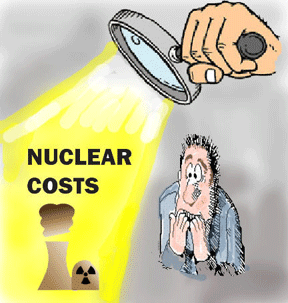 ‘Curse of Flamanville’ strikes again as cost of EDF’s reactor soars, 14 Oct 19, The French energy group that is building Britain’s new nuclear reactors has admitted that a similar project in Normandy will cost almost four times the original estimate.
EDF said that its European pressurised reactor in Flamanville was now expected to cost €12.4 billion. This is €1.5 billion more than the previous estimate.
Initially it was supposed to cost €3.3 billion and the reactor was supposed to come on stream in 2012. The company says that under the revised plan it hopes to load fuel at Flamanville at the end of 2022, a decade late.
EDF is an electrity business with interests worldwide, including operating 58 nuclear reactors in its home country. It is majority-owned by the French state, which holds an 83.7 per cent stake…(subscribers only) https://www.thetimes.co.uk/edition/business/edf-admits-flamanville-reactor-will-cost-four-times-original-estimate-k55qjn9b5?fbclid=IwAR0-APtlBA77Q8ixdA4VPMl3YCO24A_ivA0dL9Xf_Hyo0mwKn4w0898zmjY
Buried nuclear waste stays dangerous for a million years
Quite apart from the technological challenges and ethical issues these solutions present, both have one major drawback: to be successful they rely on external, uncontrollable factors. How could the knowledge required to interpret these things this be guaranteed to last?
Semiotician Thomas Sebeok recommended the creation of a so-called Atomic Priesthood. Members of the priesthood would preserve information about the waste repositories and hand it on to newly initiated members, ensuring a transfer of knowledge through the generations.
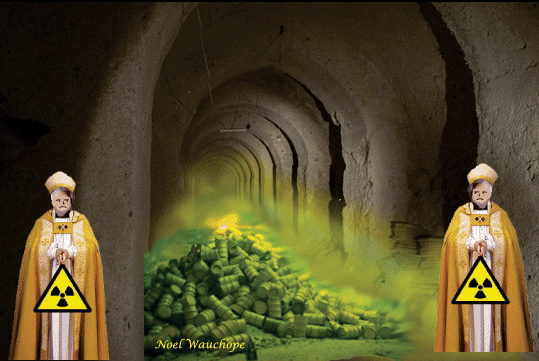
Buried nuclear waste stays dangerous for a million years — here’s how scientists plan to stop a future disaster
In thousands of years’ time, will they even understand the language written on our ‘keep out’ signs? https://inews.co.uk/news/long-reads/buried-nuclear-waste-danger-underground-future-disasters-814704
Here, deep beneath the sleepy fields and quiet woods along the border of the Meuse and Haute-Marne departments in north-east France, the French National Radioactive Waste Management Agency (Andra) has built its underground research laboratory.
The laboratory’s tunnels are brightly lit but mostly deserted, the air dry and dusty and filled with the hum of a ventilation unit.
Blue and grey metal boxes house a series of ongoing experiments – measuring, for example, the corrosion rates of steel, the durability of concrete in contact with the clay. Using this information, Andra wants to build an immense network of tunnels here.
It plans to call this place Cigéo, and to fill it with dangerous radioactive waste. It is designed to be able to hold 80,000 cubic metres of material.
Long-term risks of nuclear waste Continue reading
Wind energy could supply one third of global power by 2040, says Siemens — RenewEconomy

Wind energy could supply more than one third of global electric power demand by 2040 and save up to four million lives a year, according to new study from Siemens Gamesa. The post Wind energy could supply one third of global power by 2040, says Siemens appeared first on RenewEconomy.
via Wind energy could supply one third of global power by 2040, says Siemens — RenewEconomy
Climate expert Michael Mann slams climate deniers as ‘villainous’ and ‘immoral’ — RenewEconomy

Climate expert Michael E. Mann slams climate science deniers and expresses optimism that student strikes have shifted the conversation on climate change. The post Climate expert Michael Mann slams climate deniers as ‘villainous’ and ‘immoral’ appeared first on RenewEconomy.
via Climate expert Michael Mann slams climate deniers as ‘villainous’ and ‘immoral’ — RenewEconomy
1 This month
7 April – WEBINAR – Australia and the Doomsday Clock – Preventing nuclear war through NoFirstUse and other policies
Online | Tuesday April 7, 4:00-5:30pm, Australian Eastern Time / 8:00-9:30am Central Europe Time
– Access the registration link
15 April – Zoom –Nuclear Power is Not the Solution
Apr 15, 2026 01:00 AM in Canberra, Melbourne, Sydney

Join the International Physicians for the Prevention of Nuclear War (IPPNW) on Tuesday, April 14th for a timely webinar exploring the risks associated with nuclear power and challenging the myth that it offers a simple, safe, carbon-free solution to the climate crisis

21 April Webinar: No Nuclear Weapons in Australia
Start: 2026-04-21 18:00:00 UTC Canberra, Melbourne, Sydney (GMT+10:00)
End: 2026-04-21 19:30:00 UTC Canberra, Melbourne, Sydney (GMT+10:00)
Event Type: Virtual
A virtual link will be communicated before the event.
Host Contact Info: australia@icanw.org

of the week – Australians for War Powers Reform (AWPR)
To see nuclear-related stories in greater depth and intensity
 Antinuclear