Australia’s environment department is unlawfully withholding documents from the public
 The Transparency Project Freedom of information Environment department illegally withholds thousands of FOI pages
More than 10,000 pages of documents have not been made public, including records on Adani and the Angus Taylor grasslands saga , Guardian, Christopher Knaus @knausc Wed 16 Oct 2019
Australia’s environment department is unlawfully withholding more than 10,000 pages of freedom of information documents from the public, including internal records on Adani and the Angus Taylor grasslands affair.
The department has failed to place documents on its FOI disclosure log for the past 10 months, meaning material it has released to individual applicants is not visible to the wider public.
The failings, first reported by the Mandarin, are a breach of FOI law, which compels government agencies to publish documents online within 10 working days of giving them to the initial applicant.
It means more than 10,000 pages have not been published on the log, including internal records on its decision to approve the controversial groundwater plan for the Adani coalmine and on Taylor’s interactions with an investigation into land-clearing by a company he and his family part-owned.
Guardian Australia understands the department’s conduct has been the subject of an official complaint to the information watchdog, the office of the Australian information commissioner (OAIC). The OAIC typically does not comment on ongoing investigations………
Peter Timmins, a lawyer and highly-regarded FOI expert, said it showed a broader problem with the federal government’s attitude toward FOI.
“It shows a broader problem really about the state of FOI if we have agencies that can disregard quite clear obligations to make documents released publicly available on their disclosure log,” Timmins said. “The broader problem is that I think without appropriate leadership – and that really is at the highest level of government – about the importance of transparency and integrity, we see these breaches occur.”…….. https://www.theguardian.com/australia-news/2019/oct/16/environment-department-illegally-withholding-thousands-of-foi-pages
The “water footprint”of solar and wind power is far less than for coal and nuclear
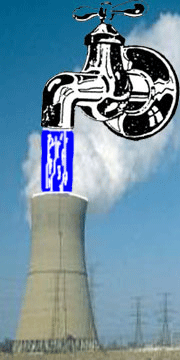 Solar, wind power can alleviate water stress https://www.businesstimes.com.sg/energy-
 commodities/solar-wind-power-can-alleviate-water-stress MON, OCT 21, 2019 –
That’s the conclusion of research published this week by the European Union’s Joint Research Centre, which is urging the bloc’s leaders to pay closer attention to the amount of water used by traditional coal, natural gas and nuclear power plants.
It takes more than 1,300 litres of water – enough to fill four bathtubs – to generate the electricity each European resident uses each day.
“For the EU, to decarbonise and increase the share of renewables of its energy supply, it needs to formulate policies that take the water use of energy sources into account,” wrote water and energy researchers led by Davy Vanham. Solar, wind, geothermal and run-of-river hydropower account for a “small fraction” of water used compared with what is consumed by biofuels and traditional thermal plants, they said.
The findings focus attention on the rising competition for water resources among households, industry and agriculture, exacerbated by a string of heatwaves and lower rainfall levels that have prompted shutdowns at power plants across the continent during periods of peak strain. Some of those incidents have been traced back to climate change.
The issue has been replicated in the US, India and China, underscoring how policies that touch on water, energy and food supplies tend to have impacts in all three spheres.
Coal, oil and nuclear plants account for about 30 per cent of the water needed to produce the electricity that Europeans consume. That compares with a 1.7 per cent share for all renewables combined, including solar, wind, geothermal and hydropower combined.
“The choice of which renewables to promote is essential to alleviate water stress and maintain ecosystems and their services,” the peer-reviewed paper said. “Policies on future energy investments therefore need to consider which renewables have low unit water footprints.”
Thermal power plants need water to cool reactions and use the steam to turn giant turbines for electricity. Solar panels and wind turbines can turn sunshine and air currents directly into electricity without producing the residual heat.
The researchers looked at energy consumption and generation data from the 28 EU nations, overlayed with information on climate change and water resources. They pinpointed areas in France, Poland and Spain where big power plants rely on large volumes of water.
“Recent summer droughts and heatwaves, such as in 2003, 2006, 2015 and 2018, which will only become more frequent due to climate change, have already led to water being a limiting resource for energy production throughout the EU,” they wrote. BLOOMBERG
Australian Prime Minister Morrison’s attitude to Pacific Islanders – “Take the Money and Shut Up about Climate Change”
 Take the money and shut up’: Ex-Tuvalu PM slams Morrison’s climate bargaining, The Pacific nation of Tuvalu is one of the world’s most vulnerable countries to the effects of climate change. SBS News has spoken to its former leader about Australia’s ‘lack of climate action’. Take the money and shut up’: Ex-Tuvalu PM slams Morrison’s climate bargaining, The Pacific nation of Tuvalu is one of the world’s most vulnerable countries to the effects of climate change. SBS News has spoken to its former leader about Australia’s ‘lack of climate action’.
SBS 23 OCT 19
BY NICK BAKER
Former Tuvalu Prime Minister Enele Sopoaga has accused the Morrison government of trying to buy the silence of Pacific Island leaders who are vocal about climate change. Mr Sopoaga, who has been a fierce advocate on climate change action, told SBS News on Wednesday that Prime Minister Scott Morrison’s climate policies were “un-Pacific” and that Australia was letting down the region. Earlier this year, Australia said it will steer $500 million of existing aid towards the Pacific to help the region cope with climate change. But Mr Sopoaga said some Pacific leaders felt like they were being told to “take the money and shut up”. “Putting this money on the table – $500 million – and then expecting Pacific Island countries like Tuvalu to say ‘OK, we’ll stop talking about climate change’, it’s not on … This is completely irresponsible.” He said greater action on climate change back in Australia was more important than Pacific aid. “Any amount of money that is coming with the Step-Up [Pacific aid program] cannot be seen as an excuse for no action at a domestic level to cut down on greenhouse emissions.”…….. HTTPS://WWW.SBS.COM.AU/NEWS/TAKE-THE-MONEY-AND-SHUT-UP-EX-TUVALU-PM-SLAMS-MORRISON-S-CLIMATE-BARGAINING
|
|
|
Nuclear costs – accidents, wastes – copped by the tax-payer
 This brings me to my biggest concern — the fact that those in our society whose business it is to determine risk will not insure nuclear power.
If you own a home, look at your homeowner’s insurance policy. You are not covered in the event of a nuclear accident. No one is. The nuclear industry exists only due to the liability limitations granted by Congress in the Price Anderson Act. Price Anderson requires the nuclear industry to fund an account of $12.6 billion. Any liability above that is supposed to be covered by taxpayers.
|
Nuclear energy is too costly and risky; better alternatives exist Common Ground / By Paul W. Hansen , 23 Oct 19, “……… Looking at the troubled history, poor economics, attendant risk and unsolved problem of nuclear waste disposal, I think there are much better alternatives for producing carbon free energy.
Today, there are 97 nuclear reactors in 29 states that produce electricity. Thirty-four reactors have been shut down. More orders for nuclear plants have been canceled than plants have been built. Only one plant has come online in the last 25 years. Early claims that nuclear power would be “too cheap to meter” proved false. Despite extensive public subsidies, nuclear plants across America have faced significant cost overruns……… Attempts to build new nuclear plants have been even more challenging. During the 1980s, the cost of Plant Vogtle’s first two nuclear units near Augusta, Georgia, jumped from an estimated $660 million to $8.87 billion. Regardless, 20 years later Georgia Power wanted to build the “next generation” of nuclear power plants. In August 2008, it was estimated that Plant Vogtle reactors 3 and 4 would cost $14.3 billion and begin operations in 2017. Today, updated estimates put the cost at $28 billion with an operation date of November 2022. The project is projected to be $14 billion over budget and more than 5 years behind schedule. The builder of the reactors, Westinghouse, has declared bankruptcy. In 2017, a similar two-unit plant in South Carolina, the V.C. Summer plant, was abandoned — costing about $5 billion. Concerns over the transportation and storage of highly radioactive spent nuclear fuel have prevented any nuclear waste repositories from being developed in the U.S. Spent fuel rods are stored onsite at nuclear plants. When uranium fuel is used up, usually after about 18 months, the spent rods are generally moved to deep pools of circulating water to cool down for about 10 years. The radioactive material is then transferred to metal casks. The waste remains dangerously radioactive for about 10,000 years. There is no plan for permanent disposal of this waste. This brings me to my biggest concern — the fact that those in our society whose business it is to determine risk will not insure nuclear power. If you own a home, look at your homeowner’s insurance policy. You are not covered in the event of a nuclear accident. No one is. The nuclear industry exists only due to the liability limitations granted by Congress in the Price Anderson Act. Price Anderson requires the nuclear industry to fund an account of $12.6 billion. Any liability above that is supposed to be covered by taxpayers. Then there are the issues of long-term decommissioning costs, nuclear accidents or terrorists. In Chernobyl and Fukushima, nuclear accidents have left large areas uninhabitable. What if the 9/11 terrorists had managed to crash those planes into the Indian Point Nuclear Power Plant north of New York City? While the reactor containment vessel might have survived the impact, the spent fuel rod pools may not have, leaving much of the New York metropolitan area uninhabitable. Nuclear energy has not worked out as planned. Far more carbon-free power can be generated at far less cost and risk by renewable energy and energy efficiency programs. https://www.jhnewsandguide.com/opinion/columnists/common_ground/nuclear-energy-is-too-costly-and-risky-better-alternatives-exist/article_71a11439-581d-572f-87c7-88dad34ddf74.html |
|
|
Why the nuclear lobby makes stuff up about cost of wind and solar — RenewEconomy

Nuclear lobby has been making such extraordinary and outrageous claims about wind, solar and batteries it makes you wonder if anything they say about energy can be taken seriously. The post Why the nuclear lobby makes stuff up about cost of wind and solar appeared first on RenewEconomy.
via Why the nuclear lobby makes stuff up about cost of wind and solar — RenewEconomy
47 experts urge NSW government to defend NSW law and climate — RenewEconomy

47 scientists and experts sign open letter urging NSW government not to overrule state laws requiring climate change impacts to be considered in the assessment of new coal mines. The post 47 experts urge NSW government to defend NSW law and climate appeared first on RenewEconomy.
via 47 experts urge NSW government to defend NSW law and climate — RenewEconomy
Australia solar market set for “big pivot,” not slow-down, says Nextracker — RenewEconomy

US smart solar tech outfit Nextracker “very bullish” on Australia’s big solar market, as it pivots from NEM-connected to commercial, industrial and off-grid projects. The post Australia solar market set for “big pivot,” not slow-down, says Nextracker appeared first on RenewEconomy.
via Australia solar market set for “big pivot,” not slow-down, says Nextracker — RenewEconomy
Solar, wind to drive Australia emissions lower, but so much more could be done — RenewEconomy

ANU energy experts say Australia’s emissions will fall over the next three years, thanks to wind and solar, but the analysis has been panned by the clean energy sector. The post Solar, wind to drive Australia emissions lower, but so much more could be done appeared first on RenewEconomy.
via Solar, wind to drive Australia emissions lower, but so much more could be done — RenewEconomy
1 This month

of the week – Australians for War Powers Reform (AWPR)
To see nuclear-related stories in greater depth and intensity
 Antinuclear