Dave Sweeney – on wining Nobel Prize, and on treaty on the Prohibition of Nuclear Weapons.
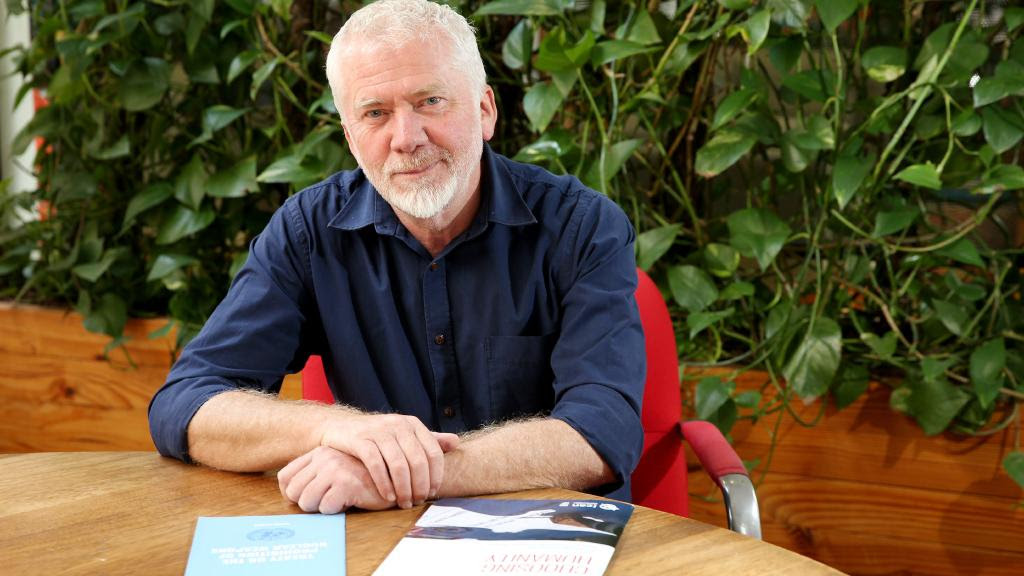
Dave Sweeney talks Nobel Prize and working against nuclear weapons https://www.weeklytimesnow.com.au/country-living/dave-sweeney-talks-nobel-prize-and-working-against-nuclear-weapons/news-story/02bae8fda0306529842b5e19bad835c2
A Nobel Prize winner who grew up on a farm has dedicated his life to one of humanity’s most important causes.
DAVE Sweeney’s story starts out like so many rural kids.
Growing up on a grazing property, east of Melbourne, he wanted to be a farmer, but his Dad wanted his son to achieve more skills.
So Dave dutifully got a degree, and a range of jobs, including as a teacher.
But then he went one better and got a Nobel Peace Prize.
 It was two years ago that Dave was one of the founding members of ICAN, the International Campaign to Abolish Nuclear Weapons, who travelled to Norway to receive the globally significant gong, which puts him in the same company as Mother Therese and Nelson Mandela.
“I didn’t actually go on the stage with the King of Norway,” the 57-year-old says.
“But I was in Norway for five days, for the formal reception, with the king and trumpets blowing, and a big party afterwards.”
It speaks volumes about Dave that he and his colleagues don’t run around promoting the fact they are Australia’s only Nobel Peace Prize winners.
Instead, he continues to knuckle down and get on with the job that won the prize in the first place.
“I don’t really talk about it much, only when people ask or I’m doing a presentation,” says Dave, who still speaks with a farmer’s easygoing attitude.
“I don’t have a T-shirt saying ‘Nobel winner’ or a screen saver.
“Winning hasn’t changed my daily life, but there’s been a sense of ‘the stuff this guy has been banging on about forever is actually important’ and ‘these people have done a significant thing’. It’s validation and it opens new doors to keep the momentum going.”
Working between his homes in Melbourne and South Gippsland’s Phillip Island, Dave is currently lobbying councils — including, most recently, Benalla — to get on board and pressure the Australian Government to ratify the Treaty on the Prohibition of Nuclear Weapons.
He says the ICAN Cities appeal is an initiative that is seeking to build a wider recognition of and support for the UN treaty. At its most basic, a council passes a version of a model resolution and writes to the prime minister and foreign minister urging them to support it.
“Other councils get more engaged — some have asked ICAN speakers to attend council and community events, profiled the issue and initiative on the websites and newsletters, flown an ICAN/Nobel flag from the town hall, hosted displays about ICAN and the issue in their libraries, commissioned murals and public artworks,” he said.
“There is much that can and could be done and it really depends on the people and place.
“An important part of the local government initiative, and of ICAN’s wider work, is that it is non-partisan. We don’t seek to score points – we want to make one: that there are no winners in a nuclear war.”
Since 1996 Dave has been the nuclear-free campaigner at the Australian Conservation Foundation, working to stop uranium mining and promote the responsible handling of radioactive waste.
His role also includes working to stop nuclear weapons. That’s how, in 2006, he was one of the voluntary founding members who met over a cup of tea and beer to nut out a strategy, which the following year led to the creation of ICAN.
Today, ICAN has spread to more than 500 groups in more than 100 countries, with its headquarters in Geneva.
According to the Nobel committee, ICAN was awarded the world’s most significant prize for “its work to draw attention to the catastrophic humanitarian consequences of any use of nuclear weapons and for its groundbreaking efforts to achieve a treaty-based prohibition of such weapons”.
“Often the deck feels stacked against us, that we can’t get a break and it’s not always fair. But this was awarded to a group of people who are not powerful or rich,” Dave says.
“It’s humbling and important recognition.”
He says just this year the Federal Government announced an inquiry into the nuclear energy industry, while in both NSW and Victoria there are pushes to examine the sector.
Dave says these are all under the guise of stopping climate change, even though science and industry are unanimous that renewables are the cheapest, fastest and easiest way to supply all our power needs.
“When you use a uranium fuel rod in a nuclear reactor you get a guaranteed three years of low- carbon electricity, and when you take the fuel rod out you get a guaranteed 100,000 years of toxic waste, which is poisonous to human life and the environment,” he says.
“There is a very poor risk-to- reward ratio.”
Yet despite setbacks, there are also breakthroughs.
He says just last week the Federal Environment Minister and the Northern Territory Government agreed with mining companies to transition out of uranium mining in Kakadu.
Dave says following Japan’s Fukushima disaster, the market for nuclear energy had dropped.
“In 2000, 22 per cent of global electricity came from nuclear energy, now it’s 11 per cent.
“Nuclear power is enormously expensive and slow. It would take 20 years to build a reactor in Australia and cost at least $20 billion.”
Dave says being raised in a rural farming family gave him a strong sense of the importance of social justice and caring.
“Mum and Dad were always decent, community-minded people. Mum would cut the sandwiches for the local emergency services and Dad would visit the sick,” he says.
“Even if I’d preferred to stay at home, it was always emphasised to me to put in.
“It’s a privilege to live in this country and so you give back, even if it’s something modest.”
He studied politics and literature, became a teacher, and later became an adviser at Oxfam, before former Prime Minister John Howard’s decision to mine uranium in Kakadu steered him into nuclear campaigning at ACF.
Given Dave has been campaigning on these globally-critical issues for more than two decades, what advice does he have for the younger generation, especially with the documented rise of eco-anxiety?
“I say to young people these problems aren’t of their making, so don’t feel guilt, otherwise you can’t get out of bed in the morning. But they do feel some responsibility and agency,” he says.
“Light a candle, say a prayer, put a sign saying ‘nuclear-free zone’ on your local school, do an act of kindness or a directed act of anger, write a letter to your council, the Prime Minister and the Foreign Minister saying we should ratify the Treaty.
“Yes, individual actions are small, but when you add the next action and the next and the next they really make a difference. Each action matters.”
Fire chief says Australia fires could be out of control for months
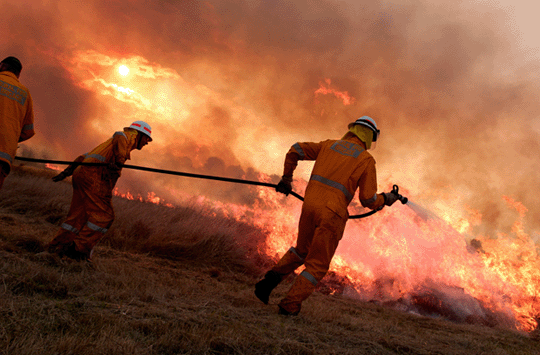 Australia fires could be out of control for months, says fire chief
Concern grows over wind changes and high temperatures forecast for later this week, Guardian, Ben Doherty in Sydney @bendohertycorro
Wed 13 Nov 2019 It could be months before eastern Australia has more than a million hectares of bushfires under control, the New South Wales fire chief has warned, as the country faces one of its worst bushfire outbreaks.After relief that no further lives were lost on Tuesday, concern was growing over unpredictable winds worsening fires in the neighbouring state of Queensland on Wednesday, with much hotter temperatures also predicted for the Sydney area in the coming days.
Gusty winds changing direction are predicted to fan flames in new directions and widen “catastrophic” fire fronts in Queensland and northern NSW, where more than 100 fires – one more than 150,000 hectares (370,000 acres) in size – are burning.
Forecasters warned that “dry lightning” strikes could ignite new blazes, with fires worsening when hotter temperatures arrive over the weekend. Temperatures in Queensland are currently up to 8C higher than average.
Shane Fitzsimmons, the commissioner of the NSW rural fire services, said: “The real challenge is we have an enormous amount of country that is still alight. They won’t have this out for days, weeks, months. Unfortunately the forecast is nothing but above-average temperatures and below-average rainfall over the next few months and we’ve still got summer around the corner.”
The current fires in NSW cover four times the land area that burned during the whole of 2018, according to Fitzsimmons. There are also fires in Western Australia, South Australia and the Northern Territory.
While the extent of the bushfires is less than those in New South Wales in 1974-75 , which destroyed 4.5m hectares (11m acres), forecasters and fire chiefs are concerned that so many fires are already under way before high summer………
Bushfires are a regular occurrence during Australian summers, but the intensity of this year’s fires, and how early in the season they have arrived, have unleashed an acute political debate over the impact of climate change in exacerbating Australia’s fire vulnerability.
The prime minister, Scott Morrison, whose conservative coalition government has been consistently criticised over its support for coal-mining and power plants, inaction on climate change, and Australia’s rising carbon emissions, has refused to answers questions on climate change worsening fires………
In one of the largest peacetime mobilisations of Australian forces, the defence minister, Linda Reynolds, is preparing to send army, navy and air force reserve forces – the equivalent of the UK’s Army Reserve – into the fire zone to assist with evacuations and logistics.
The military intervention might even include an unprecedented compulsory call-up of reserve forces, such is the scale of the fire damage. https://www.theguardian.com/australia-news/2019/nov/12/australia-fires-rage-out-of-control-catastrophic-day
23 fire and emergency services leaders from across Australia demand government action on climate change
 Ex-fire chiefs demand government find ‘urgent response’ to climate change, SBS, 14 Nov 19, A coalition of 23 fire and emergency services leaders from across Australia is demanding government action to cut emissions amid devastating bushfires. Ex-fire chiefs demand government find ‘urgent response’ to climate change, SBS, 14 Nov 19, A coalition of 23 fire and emergency services leaders from across Australia is demanding government action to cut emissions amid devastating bushfires.
Former fire chiefs from across Australia are calling on the federal government to act now against the “urgent threat” of climate change as bushfires devastate parts of the country. A coalition of 23 fire and emergency services leaders from every state and territory are insisting harder-to-control fires have broken out earlier-than-normal across New South Wales and Queensland because of global warming. The Emergency Leaders for Climate Action group is pressing for an urgent plan to phase out fossil fuels such as coal, oil, and gas, which they argue are “the root cause” of the problem…….. Former fire chiefs from across Australia are calling on the federal government to act now against the “urgent threat” of climate change as bushfires devastate parts of the country. A coalition of 23 fire and emergency services leaders from every state and territory are insisting harder-to-control fires have broken out earlier-than-normal across New South Wales and Queensland because of global warming. The Emergency Leaders for Climate Action group is pressing for an urgent plan to phase out fossil fuels such as coal, oil, and gas, which they argue are “the root cause” of the problem.https://www.sbs.com.au/news/ex-fire-chiefs-demand-government-find-urgent-response-to-climate-change |
|
Nuclear power wouldn’t be able to stand on its own feet without massive government support.

|
Nuclear power ‘dead and alive’, S&P proclaims, EURACTIV, 13 Nov 19, Growing competition from cheap renewable electricity, safety concerns, and rising costs of new plants are slowly driving nuclear power over the edge – except in Russia and China where the industry continues to enjoy extensive state support, S&P said in a note to investors.It’s probably one of the worst kept secrets in the energy world: nuclear power wouldn’t be able to stand on its own feet without massive government support.
Now, S&P Global Ratings has made it plain and clear to investors. “The global nuclear industry is facing challenges to do with safety concerns, tightening regulations post-Fukushima, phase-out policies in several countries, aging asset bases, increasingly volatile energy markets, and competition with renewables,” the rating agency wrote in the note, released on Monday (11 November). “We see little economic rationale for new nuclear builds in the US or Western Europe, owing to massive cost escalations and renewables cost-competitiveness, which should lead to a material decline in nuclear generation by 2040,” S&P said. But despite those challenges, it would be too soon to pronounce nuclear power dead, S&P adds. China and Russia, for instance, continue to build new nuclear capacities, supported by energy policies and significantly lower construction costs, the rating agency remarked.
In Europe, a battle has been raging below the radar on whether to include or reject nuclear power from an upcoming sustainable finance classification scheme aimed at driving private investments into the green economy. While France supports the inclusion of nuclear in the EU’s draft green finance taxonomy, Germany and Austria argue nuclear isn’t sustainable and shouldn’t be eligible for any kind of EU support. A final decision on the EU’s sustainable finance taxonomy is expected in December. https://www.euractiv.com/section/electricity/news/nuclear-power-dead-and-alive-sp-proclaims/ |
|
|

Nuclear industry infitrates U.S. universities (is this happening in Australia, too?)

|
UNIVERSITIES ACROSS AMERICA PROFIT FROM DEVELOPING NUCLEAR WEAPONS. IT’S UNCONSCIONABLE, https://www.newsweek.com/universities-funding-nuclear-weapons-research-1471572 BEATRICE FIHN ON 11/13/19 Americans like a good comeback story, but the recent revitalization of the nuclear arms race is not one to be cheered. President Trump plans to charge the American taxpayer nearly $100,000 a minute to expand the nation’s nuclear weapons capabilities.Other nuclear-armed countries are doing the same.
A new generation of nuclear weapons requires a new generation of workers to develop and maintain these weapons of mass destruction. The National Nuclear Security Administration reported to Congress that 40 percent of its workforce will be eligible to retire in the next five years.The U.S. government and its contractors have turned to the nation’s universities to provide this human capital. A new report documents formal ties between nearly 50 college campuses and the nuclear weapons complex. The extent to which universities have joined this endeavor is surprising. Supporting weapons of mass destruction does not show up in any university mission statements. In fact, it’s often the opposite: universities like to talk about bringing the benefits of knowledge to a global community. The dangers posed by nuclear weapons are clear. Yet universities still choose to support them anyway. Students and faculty now face a choice. They can become the next generation of weapons scientists. Or they can refuse to be complicit in this scheme, denying research partnerships or internships at nuclear weapons labs.Currently, universities across the country receive millions and in some cases billions of dollars to support nuclear weapons development. Universities directly manage nuclear weapons labs, form institutional agreements with these labs and related production sites, pursue research partnerships with nuclear weapons scientists, and provide targeted workforce development for these facilities. Many of the universities with more extensive connections to nuclear weapons are household names: the University of California, Texas A&M University, Johns Hopkins University, and the University of New Mexico. Others, such as local technical and vocational schools, are less well-known. Nuclear weapons are weapons of mass destruction, just like chemical and biological weapons. They carry devastating humanitarian and environmental consequences that do not stop at national borders. Thousands still suffer from the bombs dropped on Hiroshima and Nagasaki. Thousands more suffer from the effects of nuclear weapons testing in the 20th century, including in the U.S. One Centers for Disease Control and Prevention study estimated that radioactive fallout from nuclear tests would kill an additional 11,000 Americans due to an increase in fatal cancers. The United States has paid more than $2.3 billion in compensation to individuals affected by nuclear test fallout. Those most affected by tests around the world have been the already marginalized: indigenous and colonized peoples, women and children. Some see value in the nuclear weapons complex because it supplies thousands of jobs. These boosters fail to acknowledge the studies that demonstrate how defense spending produces fewer jobs per dollar than investment in other areas, like education, health care or infrastructure. The business of nuclear weapons does not provide jobs; it takes them away. Our choice today is between a future without nuclear weapons or no future at all. Seventy-nine nations (and counting) have signed the 2017 United Nations Treaty on the Prohibition of Nuclear Weapons; American states and cities are voting to urge the US to join them. Universities that support nuclear weapons make the wrong choice and their communities should refuse to be complicit. Students, faculty, alumni, and community members — who often fund these schools through their tax dollars — can also take concrete action to help their universities join the right side of history. They can push for transparency around any ties to the nuclear weapons complex, install ethical review processes for basic or dual-purpose research funded by the complex, and prohibit classified research. They can ask University administrations to stop direct management of nuclear weapons production sites and dissolve research contracts solely related to nuclear weapons production. University communities and administrations together can lobby the federal government to flip its funding priorities, so that nonproliferation and disarmament verification research receive more funding than weapons activities. A society can—and should—actively debate the extent to which universities are to serve explicitly national interests. But there should be no debate when it comes to supporting weapons of mass destruction. American academia must stop enabling mass murder. Beatrice Fihn is the Executive Director of the International Campaign to Abolish Nuclear Weapons (ICAN), the 2017 Nobel Peace Prize-winners. |
|
‘Insect apocalypse’ poses risk to all life on Earth
|
‘Insect apocalypse’ poses risk to all life on Earth, conservationists warn
Report claims 400,000 insect species face extinction amid heavy use of pesticides, Guardian, Damian Carrington Environment editor @dpcarrington, Wed 13 Nov 2019 The “unnoticed insect apocalypse” should set alarm bells ringing, according to conservationists, who said that without a halt there will be profound consequences for humans and all life on Earth.
A new report suggested half of all insects may have been lost since 1970 as a result of the destruction of nature and heavy use of pesticides. The report said 40% of the 1million known species of insect are facing extinction. The analysis, written by one of the UK’s leading ecologists, has a particular focus on the UK, whose insects are the most studied in the world. It said 23 bee and wasp species have become extinct in the last century, while the number of pesticide applications has approximately doubled in the last 25 years. UK butterflies that specialise in particular habitats have fallen 77% since the mid-1970s and generalists have declined 46%, the report said. There are also knock-on effects on other animals, such as the spotted flycatcher which only eats flying insects. Its populations have dropped by 93% since 1967. But conservationists said that insect populations can be rescued, by introducing firm targets to cut pesticide use and making urban parks and gardens more wildlife friendly. Scientists said insects are essential for all ecosystems, as pollinators, food for other creatures, and recyclers of nutrients. “We can’t be sure, but in terms of numbers, we may have lost 50% or more of our insects since 1970 – it could be much more,” said Prof Dave Goulson, at the University of Sussex, UK, who wrote the report for the Wildlife Trusts. “We just don’t know, which is scary. If we don’t stop the decline of our insects there will be profound consequences for all life on earth [and] for human wellbeing.”…… The planet is at the start of a sixth mass extinction in its history, with huge losses already reported in larger animals that are easier to study. But insects are by far the most varied and abundant animals, outweighing humanity by 17 times. Insect population collapses have been reported in Germany and Puerto Rico, and the first global scientific review, published in February, said widespread declines threaten a “catastrophic collapse of nature’s ecosystems”. Insects can be helped to recover by “rewilding” urban gardens and parks, Goulson said. “There is potential for a huge network of insect-friendly habitats right across the country. Already a lot of people are buying into the idea that they can make their gardens more wildlife friendly by letting go of control a bit. There are also quite a lot of councils going pesticide free.” But he said: “The bigger challenge is farming – 70% of Britain is farmland. No matter how many gardens we make wildlife friendly, if 70% of the countryside remains largely hostile to life, then we are not going to turn around insect decline.”……. https://www.theguardian.com/environment/2019/nov/13/insect-apocalypse-poses-risk-to-all-life-on-earth-conservationists-warn |
|
Scientists refute Barnaby Joyce’s claim that sun’s magnetic fields cause bushfires
The former deputy prime minister told Sky News he accepted that the climate crisis was making Australia hotter and drier.
Barnaby Joyce’s claim that changes to the sun’s magnetic fields were linked to the bushfires burning out of control across NSW have been rubbished by climate scientists.
The former deputy prime minister told Sky News he accepted that the climate crisis was making Australia hotter and drier….. “There’s just the the oscillation of the seasons. There’s a change in the magnetic field of the sun.”
Associate Professor Nerilie Abram, a climate researcher at the ARC Centre of Excellence for Climate Extremes, called his comments “ludicrous and grossly ill-informed”.
Dr Abram said she was unaware of any study suggesting changes to the sun’s magnetic field could increase Australia’s bushfire risk.
“I don’t know of any scientific study that says that,” she said.
Dr Abram said changes to the sun’s magnetic fields had a tiny effect on the Earth’s climate.
“They are not causing climate change……
Associate Professor Pete Strutton, from the Institute for Marine and Antarctic Studies at the University of Tasmania, said it was difficult to analyse Mr Joyce’s claim because it was so bizarre.
“I don’t even know what he means. We know what causes climate change,” he said. “What exactly would the magnetic fields influence? I can’t even … Are they influencing the amount of solar radiation reaching the Earth? It is hard to respond to because it is so wacky.” https://www.brisbanetimes.com.au/national/barnaby-joyce-says-sun-s-magnetic-fields-cause-bushfires-science-says-20191112-p539xb.html
Enthusiastic (misplaced) call for tax-payer funded Mars colonisation research
 When will these starry-eyed enthusiasts wake up to the intimate connection between space-Mars research, and Donald Trump’s nuclear-war-in-space project?
 Mars Society Australia has renewed its push for a Mars research station simulation to be built in the Arkaroola Wilderness Sanctuary, in outback South Australia.
The site would replicate a future Mars community, complete with a fake rocket ship, laboratories, rovers and scientists in spacesuits doing field experiments in rocky outcrops.
“It will allow us to do a wide range of activities that support the vision of human presence on Mars,” the society’s president, Jonathan Clarke, said.
“We can train people in field science and space operations in the area, and we can do education and outreach programmes…….
It’s leveraging off the creation of Australia’s new space agency, as well as US president Donald Trump’s hasty plan for America to return to the Moon by 2024, and hopefully go on to Mars. ……
In September, the Australian government announced it would invest $A150 million ($NZ162m) for Australian businesses and researchers to join the US’s Mars exploration project……https://www.nzgeo.com/audio/calls-for-a-mars-research-station-to-be-built-in-outback-south-australia/?utm_source=Facebook&utm_medium=FacebookPost&utm_campaign=Mars_research_station&fbclid=IwAR3lVBPG2YK12lphwTL83BDs1YHyc7M-o0Y1JwLNQTPRUfa3YCsWG457it8
Australian Energy Market Operator predicts ‘completely new’ two-sided energy market
|
Australia told to prepare for ‘completely new’ two-sided energy market https://www.theguardian.com/australia-news/2019/nov/14/australia-told-to-prepare-for-completely-new-two-sided-energy-market
Consumers should be rewarded for buying and selling energy in real time, Australian Energy Market Commission says Katharine Murphy Political editor @murpharoo, Thu 14 Nov 2019 Australia needs to prepare the ground for a two-sided national energy market, where consumers are rewarded for buying and selling energy in real time, according to the Australian Energy Market Commission.In a new discussion paper to be released on Thursday, the AEMC says technology has previously limited consumer participation in the energy grid but the advent of smart devices and virtual power plants has created the opportunity for a fully fledged two-sided market. Comparing the opportunity in energy with disruptive platforms such as eBay or Airbnb, the AEMC chairman, John Pierce, says “digitalisation has progressed to the point where it is time to consider a completely new approach”. He says the Australian Energy Market Operator knows how much generation to expect from scheduled generators, but now attention needs to turn to virtual power plants which households are creating through solar PV and local battery storage. As well as creating incentives for households to invest in smart appliances and distributed energy infrastructure, Pierce says there is opportunity to utilise more demand management in the system, because batteries, pool pumps, air conditioners and electric vehicles can be set to consume power off peak and export power back to the grid at times when that is most remunerative. The commission has already released a draft rule for a demand-response mechanism allowing large commercial and industrial users to sell forsaken demand directly into the wholesale market for the first time. The rule would put demand response on an equal footing to generation for the first time, with energy users paid as if they are generators. Pierce says the Australian energy market is already in the process of becoming more decentralised. The grid is transitioning away from centrally controlled, big generators dominating the market. “Looking to the future – both the demand and supply sides of the energy market would be actively engaged in electricity scheduling and dispatch processes – while delivering all the services people expect like hot water, air-con and dishwashing,” the AEMC chair says. “Less generation and network capacity would be needed in a market with higher levels of consumer participation and responsiveness. Decisions to consume or not to consume would be valued digitally through any device that’s connected to the internet and remotely controlled. “Then all you will need are price signals to automatically switch your household or business power plant from grid import to export and back again delivering the services you want at least cost. It would also be cheaper for streets and suburbs to share local generation resources and storage devices.” The AEMC paper will be released to contribute to market design work being undertaken by the Energy Security Board, with reform options expected to be pursued in 2020. |
Morrison govt – new loans for rare earths miners
New loans for rare earths miners Courier Mail , 13 Nov 19
The Morrison Government has announced a range of measures to help Australia become an “international powerhouse” in an untapped mining sector…. (subscribers only)
November 13 Energy News — geoharvey

Opinion: ¶ “Proposed New Rule Would Amp Up EPA War On Science” • A new rule proposed by the EPA would upend decades of scientific research – studies that have confirmed that air pollution leads to shortened life spans or that mercury impairs brain function in young children – by requiring all that confidential data […]
IEA tells Australia it’s on wrong track on climate, more wind and solar needed — RenewEconomy

IEA says some countries are reshaping their energy supply with climate targets in mind, but Australia is not one of them. The post IEA tells Australia it’s on wrong track on climate, more wind and solar needed appeared first on RenewEconomy.
via IEA tells Australia it’s on wrong track on climate, more wind and solar needed — RenewEconomy
Boris nukes — daryanenergyblog

A few weeks back Boris Johnson made reference to how the UK would shortly be building mini fusion reactors, courtesy of a generous grant of UK government funding (and thus brexit wasn’t going to be the disaster to UK science everyone is predicting). Of course, the actual nuclear scientists were quick to point out that […]
ACT introduces first electric bus on path to zero transport emissions — RenewEconomy

All-electric Yutong E12 bus to begin ferrying passengers around Canberra as the ACT government enacts plan to transition to 100% zero emissions bus fleet by 2040. The post ACT introduces first electric bus on path to zero transport emissions appeared first on RenewEconomy.
via ACT introduces first electric bus on path to zero transport emissions — RenewEconomy
Market re-design needs to factor in carbon, or there’s no point — RenewEconomy

The debate over energy-only and capacity signals will be redundant if the new market design does not factor in carbon emissions and climate change. The post Market re-design needs to factor in carbon, or there’s no point appeared first on RenewEconomy.
via Market re-design needs to factor in carbon, or there’s no point — RenewEconomy
1 This month
Chernobyl: The Lost Tapes – A good documentary on Chernobyl on SBS available On Demand for the next 3 weeks– https://www.sbs.com.au/ondemand/tv-program/chernobyl-the-lost-tapes/2352741955560
15 April – Zoom –Nuclear Power is Not the Solution
Apr 15, 2026 01:00 AM in Canberra, Melbourne, Sydney

Join the International Physicians for the Prevention of Nuclear War (IPPNW) on Tuesday, April 14th for a timely webinar exploring the risks associated with nuclear power and challenging the myth that it offers a simple, safe, carbon-free solution to the climate crisis

21 April Webinar: No Nuclear Weapons in Australia
Start: 2026-04-21 18:00:00 UTC Canberra, Melbourne, Sydney (GMT+10:00)
End: 2026-04-21 19:30:00 UTC Canberra, Melbourne, Sydney (GMT+10:00)
Event Type: Virtual
A virtual link will be communicated before the event.
Host Contact Info: australia@icanw.org

of the week – Australians for War Powers Reform (AWPR)
To see nuclear-related stories in greater depth and intensity
 Antinuclear