“Interim” radioactive waste dump could become permanent, with transport dangers, too
Some fear the “interim” storage facility could become a de facto permanent 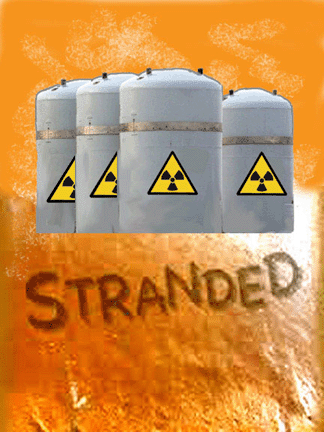 storage facility
transport of high-level radioactive waste across the state could also lead to potentially dangerous nuclear releases, leaving impacted communities responsible for emergency responses.
the proposal fits into a wider pattern of negligence and environmental racism on behalf of the federal government towards one of the United States’ poorest majority-minority states.
|
The proposal, which has been in the works since 2011, would see high-level waste generated at nuclear power plants across the country transported to New Mexico for storage at the proposed facility along the Lea-Eddy county line between Hobbs and Carlsbad. Holtec representatives say the facility would be a temporary solution to the nation’s growing nuclear waste problem, but currently there is no federal plan to build a permanent repository for the waste. Legislators, activists and residents alike share concerns about the proposals. Some fear the “interim” storage facility could become a de facto permanent storage facility if no other repository is built; others question the site selection for a nuclear facility so close to oil and gas activity in the Permian Basin. Increased transport of high-level radioactive waste across the state could also lead to potentially dangerous nuclear releases, leaving impacted communities responsible for emergency responses. Governor Michelle Lujan Grisham told U.S. Secretary of Energy Rick Perry in a letter that she opposes the project, while state Land Commissioner Stephanie Garcia Richard voiced safety concerns with the proposal. Several state industry associations, state legislators, and residents also oppose the project. Morgan briefed members of the Legislature’s interim Radioactive and Hazardous Materials Committee on how the proposal fits into a wider pattern of negligence and environmental racism on behalf of the federal government towards one of the United States’ poorest majority-minority states. “New Mexico doesn’t make the waste, why should we take the waste?” Morgan said. “What we’re advocating for is not a temporary, band-aid solution, but something more scientifically sound. The waste does have to go somewhere. However, storing it in New Mexico temporarily is not the right idea. It’s not safe; it’s not supported by the local communities; and New Mexico does not want it.” “We see this as environmental racism and perpetuating nuclear colonialism that is going to result in a continuation of a slow genocide,” she said……. Holtec’s proposal would see the majority of high-level nuclear waste in the U.S. transported to a consolidated interim storage facility located in southeastern New Mexico. If licensed, the facility would house up to 100,000 metric tons of high-level waste at capacity — more nuclear waste than currently exists in the country — for up to 40 years, while the federal government either re-opens Yucca Mountain or establishes a new deep repository to permanently store the waste. …… Nuclear colonialism and legacy wasteNuclear colonialism, a term first coined by environmentalist Winona LaDuke and activist Ward Churchill, describes a systematic dispossession of indigenous lands, the exploitation of cultural resources, and a history of subjugation and oppression of indigenous peoples by a government to further nuclear production of energy and proliferation of weapons. “All of the impacts from nuclear colonialism can be simplified by explaining it as environmental racism,” Morgan told state legislators last week. She pointed to the health and environmental consequences of uranium mining on the Navajo Nation during the last century. “My family lives in areas where there was past uranium mining. We’re still dealing with the legacy of all of the mining that fuelled World War II and the Cold War,” Morgan said. “This legacy is still unaddressed — not just in New Mexico, but in the entire country. For that reason, my concern is the health of our people, our environment.” Morgan explained to the committee that Diné people’s relationship to the landscape of the Navajo Nation goes beyond what’s recognized by most state and federal laws. “We do not believe we are separate from the environment,” Morgan said. “We are not here to protect the environment as land and as mountains, but as living, breathing entities.” Similar beliefs, sometimes referred to in policy discussions as “environmental personhood,” have gained recognition among regulators in countries across the world in recent years. “If there were to be any shipments that could possibly have an accident in these areas, they would severely impact not just the human populations, but also the cultural resources of these areas, which include medicines and our spiritual deities that live on these mountains,” she said. State Rep. Angelica Rubio, who chairs the committee, also acknowledged the troubling nuclear history of the state. There’s some historical trauma that exists in our state,” the Las Cruces Democrat said at the conclusion of the Holtec presentation. “It’s important to recognize that many communities and many of our land and water and our species have all been directly impacted by nuclear at one point in our history.” Indigenous sovereigntyNearly all of the state’s indigenous nations have formally opposed the project. Most recently, the All Pueblo Council of Governors adopted a resolution opposing the project, citing lack of tribal consultation as a key concern. “It’s quite significant, because it’s all of the pueblos of the state,” Morgan said. “It’s very important, because of the amount of history and cultural resources that they are also trying to protect. I’m very thankful to them for passing such a resolution.” Morgan argued that the proposed facility, should it be approved by the NRC, may also infringe on the sovereignty of the Navajo Nation. The Holtec proposal would see nuclear waste transported via railway to the facility in the southeast corner of the state. The Navajo Nation is located in the northwest corner of the state, but one major railway traverses the boundaries of the nation. Depending on where the nuclear waste is coming from, some of those shipments may travel across Navajo land. Such transportation would be illegal under Navajo Nation law, Morgan said. . “The Navajo Nation has passed what is called the Radioactive Materials Transportation Act of 2012, which prohibits the transport of all radioactive materials throughout the Navajo Nation,” she said. ……. https://nmpoliticalreport.com/2019/11/14/nuclear-colonialism-indigenous-opposition-grows-against-proposal-for-nations-largest-nuclear-storage-facility-in-nm/ |
|

No comments yet.
1 This month
Chernobyl: The Lost Tapes – A good documentary on Chernobyl on SBS available On Demand for the next 3 weeks– https://www.sbs.com.au/ondemand/tv-program/chernobyl-the-lost-tapes/2352741955560
15 April – Zoom –Nuclear Power is Not the Solution
Apr 15, 2026 01:00 AM in Canberra, Melbourne, Sydney

Join the International Physicians for the Prevention of Nuclear War (IPPNW) on Tuesday, April 14th for a timely webinar exploring the risks associated with nuclear power and challenging the myth that it offers a simple, safe, carbon-free solution to the climate crisis

21 April Webinar: No Nuclear Weapons in Australia
Start: 2026-04-21 18:00:00 UTC Canberra, Melbourne, Sydney (GMT+10:00)
End: 2026-04-21 19:30:00 UTC Canberra, Melbourne, Sydney (GMT+10:00)
Event Type: Virtual
A virtual link will be communicated before the event.
Host Contact Info: australia@icanw.org

of the week – Australians for War Powers Reform (AWPR)
To see nuclear-related stories in greater depth and intensity
 Antinuclear
Leave a comment