Record heat, catastrophic fire danger for South Australia – what a great place to plan transport and dumping of nuclear waste -NOT
|
Total fire bans declared across SA ahead of catastrophic conditions on Wednesday, ABC , 19 Nov 19 By Eugene Boisvert A total fire ban has been declared for South Australia on Tuesday ahead of catastrophic conditions expected on Wednesday.
Key points:
It is one of the first times the Country Fire Service (CFS) has declared a pre-emptive fire ban 24 hours before a hot and windy day, the agency’s head said. “It’s pretty unusual that we take a precautionary fire ban and I hope that people will realise we’ve done so in response to the severity of the conditions which are forecasted for Wednesday,” CFS chief officer Mark Jones said. Catastrophic fire conditions are expected on Wednesday for the lower Eyre Peninsula, the Yorke Peninsula, the Mid North and the Mount Lofty Ranges, when a total fire ban will also be in place All other regions have severe or extreme ratings, including the Adelaide metropolitan area. The Bureau of Meteorology has forecast a top of 42 degrees Celsius for Adelaide on Wednesday, after a high of 29C on Tuesday….. Fire season already started in SA The fire danger season has officially started in all of South Australia’s fire ban districts, apart from the lower South-East, where the season starts on Friday…… https://www.abc.net.au/news/2019-11-18/total-fire-bans-across-sa-on-tuesday-ahead-of-catastrophic-day/11713696 |
|
Journalism’s future in crisis – the case of Julian Assange
JOHN PILGER: Assange’s case will define the future of free journalism, https://independentaustralia.net/life/life-display/john-pilger-assanges-case-will-define-the-future-of-free-journalism,13324 By John Pilger | 18 November 2019 John Pilger describes the disturbing scene inside a London courtroom last week when the WikiLeaks publisher, Julian Assange, appeared at the start of a landmark extradition case that will define the future of free journalism.
Her face was a progression of sneers and imperious indifference; she addressed Julian Assange with an arrogance that reminded me of a magistrate presiding over apartheid South Africa’s Race Classification Board. When Julian struggled to speak, he couldn’t get words out, even stumbling over his name and date of birth.
When he spoke truth and when his barrister spoke, Baraister contrived boredom; when the prosecuting barrister spoke, she was attentive. She had nothing to do; it was demonstrably preordained. In the table in front of us were a handful of American officials, whose directions to the prosecutor were carried by his — back and forth this young woman went, delivering instructions.
Her knee in the groin was to announce that the next court hearing would be at remote Woolwich, which adjoins Belmarsh Prison and has few seats for the public. This will ensure isolation and be as close to a secret trial as it’s possible to get. Did this happen in the home of the Magna Carta? Yes, but who knew?
Who will then dare to expose anything of importance, let alone the high crimes of the West? Who will dare publish ‘Collateral Murder’? Who will dare tell the public that democracy, such as it is, has been subverted by a corporate authoritarianism from which fascism draws its strength?
Once there were spaces, gaps, boltholes, in mainstream journalism in which mavericks, who are the best journalists, could work. These are long closed now. The hope is the samizdat on the internet, where fine disobedient journalism is still practised.
The greater hope is that a judge or even judges in Britain’s court of appeal, the High Court, will rediscover justice and set him free. In the meantime, it’s our responsibility to fight in ways we know but which now require more than a modicum of Julian Assange’s courage.
Pursuing nuclear power slows down real action on climate change by faster, cheaper, energy sources
In sum, the nuclear industry seeks its own sales arrangements protected from competition, its own prices determined by political processes rather than markets, and diminished opportunities for its carbon-free competitors to express their value, reach their customers, and discover their own prices. This could be good for compliant legislators’ campaign contributions, but hardly in the national interest or helpful for climate protection.
If you haven’t heard this view before, it’s not because it wasn’t published in reputable venues over several decades, but rather because the nuclear industry, which holds the microphone, is eager that you not hear it. Many otherwise sensible analysts and journalists have not properly reported this issue. Few political leaders understand it either. But by the end of this article, I hope you will.
to protect the climate, we must save the most carbon at the least cost and in the least time, counting all three variables—carbon and cost and time. Costly options save less carbon per dollar than cheaper options. Slow options save less carbon per year than faster options. Thus even a low- or no-carbon option that is too costly or too slow will reduce and retard achievable climate protection.
anti-market monkeybusiness cannot indefinitely forestall the victory of cheaper competitors, but it can delay and diminish climate protection while transferring tens of billions of unearned dollars from taxpayers and customers to nuclear owners.
Does Nuclear Power Slow Or Speed Climate Change? Forbes Amory B. Lovins-18 Nov 19, Most U.S. nuclear power plants cost more to run than they earn. Globally, the World Nuclear Industry Status Report 2019 documents the nuclear enterprise’s slow-motion commercial collapse—dying of an incurable attack of market forces. Yet in America, strong views are held across the political spectrum on whether nuclear power is essential or merely helpful in protecting the Earth’s climate—and both those views are wrong.
How does the climate denialist Institute of Public Affairs (IPA) get away with being a “charity”?
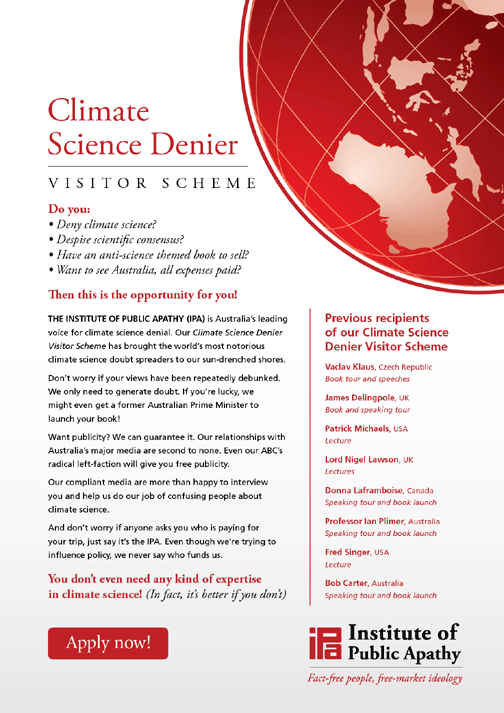
The climate denialist IPA and its ‘public interest’ charity status, Independent Australia, By David Paull | 19 November 2019, Since the IPA and CIS organisations argue against the scientific consensus on the climate change emergency isn’t that against the public interest? Why, then, are they classified as ‘charities’? David Paull reports.
The Prime Minister’s recent comments on the rights of individuals to undertake actions, such as boycotts, that may adversely affect “secondary” company interests raises questions of free speech and public interest.
But the increasingly shrill advocacy for climate denial in the public sphere in this country has reached a stage where it seems that substantive scientific arguments regarding future Earth scenarios are being drowned out.
The debate has descended – thanks in no small part to Murdoch media and political pundits – so that now it’s a “conspiracy” by the Bureau of Meteorology and NASA, or it’s “sun-spots”, which will initiate a new “ice-age”. Even the line, “We must take a balanced view” provides anti-science advocates with a platform.
Which raises the clear question: Is climate change denial of benefit to our community? Or, to put it another way, if some are still arguing against the scientific consensus on the climate change emergency we are confronting, isn’t that against the public interest?
What does it take to be a charity?
As it turns out, not if you are a “charity” registered with the Australian Charities and Not-for-profit Commission (ACNC). When talking about climate denialist organisations, key among those in Australia is the Institute of Public Affairs (IPA) and the Centre for Independent Studies (CIS). Both have generated substantial public communication, which is “climate sceptical” in nature and at deviance from the consensus scientific view. Yet both organisations – particularly the IPA – and through their front groups such as the Australian Environment Foundation, have been at the forefront of promoting the idea that global warming is a conspiracy. Examples are the recent book published by the IPA and edited by Dr Jennifer Marohasy who is working on releasing a new edition next year.
The CIS, while not being a loud advocate of climate scepticism, has certainly hosted talkfests which have articulated these views. Both organisations are also within the international Atlas Network, which channels money into groups around the world that seek to further the climate denialist and libertarian agendas. And both have registered charities with the Australian Charities and Not-For-Profits Commission (ACNC).
The IPA’s registered charity is called Trustee For Institute Of Public Affairs Research Trust, while the CIS has registered a charity under the name of, The Centre For Independent Studies Ltd……
Follow the money
The IPA receives only about ten to 20 per cent of its annual income through its charity, most of which is spent each year, amounting to some $800,000 in 2017-18. These are nearly all classed as “donations” under the ACNC disclosure requirements — though of course “donors” are not required to be identified…….
Both charities claim they are benefiting the “general community of Australia”. However, given the difficulty in matching a climate denialist agenda with a supposed community benefit, this simply does not stack up anymore.
The reviews by the ACNC in January 2014 of the charitable status of these two registered charities, in this light, needs to be reviewed again. This is particularly so of the IPA with its increasing focus on spreading misinformation (none of which stands up to proper scientific scrutiny) since 2014.
But there are also other issues which need clarification in order that better transparency occurs, such as better definitions of income and expenditure, the question of influence by foreign entities and perhaps what is key: whether charity funds being used by these organisations is for a purpose that may be deemed as being of detriment to the community. Charitable status should be relinquished under these circumstances.
I have written to the Australian Charities and Not-for-profit Commission (ACNC) to undertake a fresh review of these charities and await a response in anticipation. You can make a complaint to the ACNC HERE. David Paull is an Australian ecologist . You can follow David on Twitter @davesgas. https://independentaustralia.net/politics/politics-display/the-climate-denialist-ipa-and-its-public-interest-charity-status,13325
50 bushfires continue to rage across New South Wales
 Sydney smoke: city covered in thick haze as more than 50 bushfires burn across NSW People with asthma or respiratory illness should stay inside, health authorities warn, Guardian Australian Associated Press, Tue 19 Nov 2019 Sydney woke up to a thick blanket of smoke over the city on Tuesday as New South Wales headed into the first of two “tough days” this week, with temperatures likely to rise to the 40s and little-to-no rainfall forecast.Most of the state’s east coast was under severe or very high fire danger ratings, with more than 50 bushfires burning, of which 28 remained uncontained. Sydney smoke: city covered in thick haze as more than 50 bushfires burn across NSW People with asthma or respiratory illness should stay inside, health authorities warn, Guardian Australian Associated Press, Tue 19 Nov 2019 Sydney woke up to a thick blanket of smoke over the city on Tuesday as New South Wales headed into the first of two “tough days” this week, with temperatures likely to rise to the 40s and little-to-no rainfall forecast.Most of the state’s east coast was under severe or very high fire danger ratings, with more than 50 bushfires burning, of which 28 remained uncontained.
All were at “advice” level on Tuesday morning, with more than 1,300 firefighters on the ground. Six lives and 530 homes have been lost since NSW bushfire season hit, with more than 420 homes destroyed in the past fortnight alone. “More than 1,300 firefighters continue work on these fires tonight, ahead of forecast hot, dry and windy conditions tomorrow,” the Rural Fire Service said. Winds dragged smoke from a huge fire at Gospers Mountain north-west of the Sydney over the city on Tuesday morning, and the haze was not likely to dissipate until a southerly change in the afternoon…… Parts of the state under severe fire danger on Tuesday included Greater Sydney, Greater Hunter, Illawarra/Shoalhaven, Southern Ranges and Central Ranges fire regions. These regions, along with the Northern Slopes and North Western regions, were also under a total fire ban. Much of the rest of eastern NSW and the Australian Capital Territory were under very high fire danger. Some 1.6m hectares of land have been burnt so far – more than the entire 1993-94 bushfire season……https://www.theguardian.com/australia-news/2019/nov/19/sydney-smoke-city-covered-in-thick-haze-as-more-than-50-bushfires-burn-across-nsw |
|
A bit of good news – patients’exposure to medical radiation is going down
 Radiology efforts over past decade led to 20% drop in patient’s radiation dose, report shows https://www.healthimaging.com/topics/molecular-imaging/radiology-20-drop-patients-radiation-dose Matt O’Connor | November 18, 2019 Radiology has undertaken many efforts to reduce patient exposure to radiation during imaging exams, and findings from a new report suggest those campaigns have made a significant impact. Radiology efforts over past decade led to 20% drop in patient’s radiation dose, report shows https://www.healthimaging.com/topics/molecular-imaging/radiology-20-drop-patients-radiation-dose Matt O’Connor | November 18, 2019 Radiology has undertaken many efforts to reduce patient exposure to radiation during imaging exams, and findings from a new report suggest those campaigns have made a significant impact.
The report, published Monday, Nov. 18, by the National Council on Radiation Protection and Measurements, showed doses dropped by 15% to 20% among U.S. patients between 2006 and 2016. Per person, the estimated average dose fell from 2.92 millisievert (mSv) in 2006 to 2.16 mSv in 2016. “We are pleased, but not surprised, that despite a steadily increasing and aging population, the medical radiation dose Americans receive is going down,” Continue reading |
Business demand is helping drive the energy transition to wind and solar — RenewEconomy

Corporate energy users have supported 5.2GW of new renewable energy capacity and procured nearly 2.3GW of mostly solar and wind powered electricity, new report shows. The post Business demand is helping drive the energy transition to wind and solar appeared first on RenewEconomy.
via Business demand is helping drive the energy transition to wind and solar — RenewEconomy
Coal seen as biggest threat to Victoria power supply — RenewEconomy

The biggest threat to Victoria’s future power supply comes not from more renewables, but unreliable brown coal power plants, and government efforts to prop up black coal units. The post Coal seen as biggest threat to Victoria power supply appeared first on RenewEconomy.
via Coal seen as biggest threat to Victoria power supply — RenewEconomy
November 18 Energy News — geoharvey

Opinion: ¶ “Metamorphosis In Fukushima – Installing 11 Solar Power Plants And 10 Wind Power Plants” • How does one renew an area devastated by nuclear waste? Kurosawa’s film Dreams deals with the issue. But in Fukushima Prefecture, it is real-life matter, with planning for 11 solar power plants and 10 wind power plants on […]
Strong demand for renewables jobs drives industry-leading wages growth — RenewEconomy

Continued investment in renewable energy projects sees renewables sector deliver some of the strongest wages growth in Australia. The post Strong demand for renewables jobs drives industry-leading wages growth appeared first on RenewEconomy.
via Strong demand for renewables jobs drives industry-leading wages growth — RenewEconomy
Cheaper, cleaner, smarter – how wind, solar and batteries are changing Australia’s grid — RenewEconomy

New reports from market operator and market regulator show that – despite the politics – Australia’s grid is getting cleaner, cheaper and smarter. The post Cheaper, cleaner, smarter – how wind, solar and batteries are changing Australia’s grid appeared first on RenewEconomy.
Canavan revives carbon capture in new effort to underpin coal generators — RenewEconomy

Resources minister Matt Canavan has revived proposals for carbon capture and storage projects to help justifiy government backing of new coal projects. The post Canavan revives carbon capture in new effort to underpin coal generators appeared first on RenewEconomy.
via Canavan revives carbon capture in new effort to underpin coal generators — RenewEconomy
Now is the time, Mr Morrison. — Urban Wronski Writes

“In this bucket is my house”, Aaron Crowe tells other unquiet Australians rallying in Macquarie St, Sydney, Tuesday. He lifts an organic compost bin, a repurposed twenty gallon steel red drum with hand-made wooden lid, a homely relic of former peaceful, rural domesticity, now, destroyed forever, aloft. The 38 year-old-father tips a few charred, remnants […]
UNSW first engineering school to sign declaration to reduce harmful carbon emissions — RenewEconomy

As the engineering sector turns its attention to the climate crisis, UNSW Engineering has taken the lead in being the first university to commit to a movement steering the profession towards a low carbon future. The post UNSW first engineering school to sign declaration to reduce harmful carbon emissions appeared first on RenewEconomy.
via UNSW first engineering school to sign declaration to reduce harmful carbon emissions — RenewEconomy
The week in climate/nuclear news Australia
 This is a bit more boring than usual, as, apart from the Australian bushfires, not many climate and nuclear events have been in the news this week.
A new book brings the nuclear and climate threats together in a scary warning. In The Plutocene: Blueprints for a post-Anthropocene Greenhouse Earth, Andrew Glikson considers a future scenario where nuclear war, radioactive pollution, and global heating combine to produce a new era. He urges a range of tactics to avert this gloomy future.
S and P Global Ratings has made it plain: nuclear power can survive only with massive tax-payer support.
A bit of good news – Ocean Cleanup Makes History by Successfully Collecting First Plastic From Great Pacific Garbage Patch.
AUSTRALIA
CLIMATE.
- A cauldron of extreme heat developing in Western Australia is heading straight for the east coast bushfire zone. Meterologist shocked at prospect of Australia’s coming summer of heat and drought. The 2009 CSIRO Warning regarding the Increasing risk of Bushfire in Australia. Fire chief says Australia fires could be out of control for months. 23 fire and emergency services leaders from across Australia demand government action on climate change.
- Scientists refute Barnaby Joyce’s claim that sun’s magnetic fields cause bushfires. A twisted and so-called religious view of bushfires and climate change.
- Coal lobby wields power over Australian govt, like the National Rifle Association does in USA. Australia’s energy market was quietly tipped back in favour of coal generators. Scott Morrison shuns Torres Strait Islanders worried about climate change. Australia may seek forgiveness, rather than permission, for Kyoto carryover.
- Sweden dumps Australian bonds over “large climate footprint”. IEA tells Australia it’s on wrong track on climate, more wind and solar needed.
NUCLEAR.
Federal Govt to decide on new radioactive waste storage facility next year. Flood risk at proposed nuclear dump site at Wallerberdina. Open letter from Japan, to nuclear waste site candidates. With 40% opposed to Kimba nuclear waste dump, is this “consensus”. A duplicitous letter from Sam Chard, General Manager, Radioactive Waste Taskforce.
Australian Government report states that Lucas Heights spent nuclear fuel rods (for Kimba dump?) are High Level Wastes.
Rio Tinto drives ERA rehabilitation of Ranger uranium mine.
From Ziggy Switkowski – a new load of nuclear codswallop.
RENEWABLE ENERGY. ACT introduces first electric bus on path to zero transport emissions . Rooftop solar hits 45% of demand and sets new grid low in W.A. Rooftop solar delivers yet another record low in grid demand for South Australia. Renewables sector slams new network pricing proposals, says it will kill investment.
INTERNATIONAL
Climate change is a health emergency – physicians.
World Nuclear Waste Report. Dangerous radioactive hot particles span the globe. Still no country for old nuclear waste. Tritium and other radionuclides are hazardous,even in transport and storage.
Will Air Independent Propulsion (AIP) submarines make nuclear submarines relatively obsolete?
400,000 insect species face extinction.
In framing Julian Assange, The FBI tried to make Iceland complicit.
MARSHALL ISLANDS. U.S. won’t clean up Marshall Islands nuclear waste dome but wants it free of anti-U.S. graffiti. Nuclear tomb: The Runit Dome is chipping and cracking. The climate crisis https://www.esquire.com/news-politics/politics/a29760935/marshall-islands-nuclear-waste-climate-change/is tied up in the dangers of nuclear weapons in ways that nobody predicted
1 This month
7 April – WEBINAR – Australia and the Doomsday Clock – Preventing nuclear war through NoFirstUse and other policies
Online | Tuesday April 7, 4:00-5:30pm, Australian Eastern Time / 8:00-9:30am Central Europe Time
– Access the registration link
15 April – Zoom –Nuclear Power is Not the Solution
Apr 15, 2026 01:00 AM in Canberra, Melbourne, Sydney

Join the International Physicians for the Prevention of Nuclear War (IPPNW) on Tuesday, April 14th for a timely webinar exploring the risks associated with nuclear power and challenging the myth that it offers a simple, safe, carbon-free solution to the climate crisis

21 April Webinar: No Nuclear Weapons in Australia
Start: 2026-04-21 18:00:00 UTC Canberra, Melbourne, Sydney (GMT+10:00)
End: 2026-04-21 19:30:00 UTC Canberra, Melbourne, Sydney (GMT+10:00)
Event Type: Virtual
A virtual link will be communicated before the event.
Host Contact Info: australia@icanw.org

of the week – Australians for War Powers Reform (AWPR)
To see nuclear-related stories in greater depth and intensity
 Antinuclear