Sydney afflicted with smoke, as many fires out of control in New South Wales
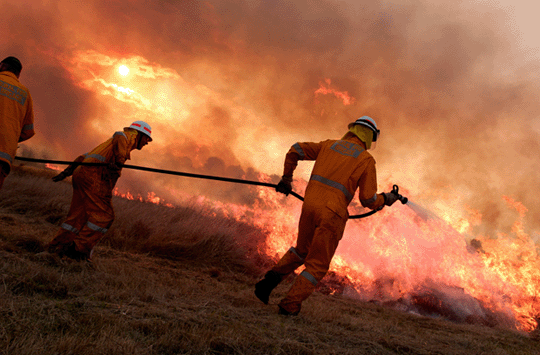 Sydney set for more ‘poor’ air quality as NSW South Coast bushfires continue to burn, SBS, 3 Dec 19, The Bureau of Meteorology says smoke is forecast to linger in parts of Sydney on Tuesday, creating “poor” air quality in the city…….. The state government says air quality on Tuesday will be “poor due to particles” from the extensive smoke coming from bushfires burning across the state…… Sydney set for more ‘poor’ air quality as NSW South Coast bushfires continue to burn, SBS, 3 Dec 19, The Bureau of Meteorology says smoke is forecast to linger in parts of Sydney on Tuesday, creating “poor” air quality in the city…….. The state government says air quality on Tuesday will be “poor due to particles” from the extensive smoke coming from bushfires burning across the state……
There were 119 bush and grass fires burning across NSW on Monday evening with 48 of these uncontained. The out-of-control fire at Currowan is burning across almost 25,000 hectares and is being pushed east towards coastal communities but tempered overnight as gusty northeasterly winds moderated…… Two million hectares of NSW land have been burnt since July in more than 7000 fires, with authorities dubbing it the “most challenging bushfire season ever”. Six people have died while 673 homes have been destroyed to date. https://www.sbs.com.au/news/sydney-set-for-more-poor-air-quality-as-nsw-south-coast-bushfires-continue-to-burn |
|
Australia warned on climate refugees
Australia warned on climate refugees THE AUSTRALIAN
The former prime minister of Tuvalu, Enele Sopoaga, has warned Australia could be on the frontline of a new wave of “climate refugees” displaced by extreme weather events and rising sea levels, during the ABC’s Q&A program broadcast from Suva, Fiji. ….(subscribers only)
Fukushima’s contaminated water is an issue affecting all of humanity — Fukushima 311 Watchdogs

An ocean dump could lead to a global ecological disaster An image of the Fukushima nuclear power plant, including storage tanks for contaminated water, taken by Greenpeace campaigner and Swedish photographer Christian Aslund on Oct. 16, 2018. December 1, 2019 As the possibility of Japan dumping contaminated water from the Fukushima Nuclear Power Plant into […]
via Fukushima’s contaminated water is an issue affecting all of humanity — Fukushima 311 Watchdogs
COP25, and Australia’s position at the Madrid climate talks
 Earth has a couple more chances to avoid catastrophic climate change. This week is one of them https://theconversation.com/earth-has-a-couple-more-chances-to-avoid-catastrophic-climate-change-this-week-is-one-of-them-128120 Robert Hales
Director Centre for Sustainable Enterprise, Griffith University, December 3, 2019 Almost 200 world leaders gather in Madrid this week for climate talks which will largely determine the success of the Paris agreement, and by extension, the extent to which the planet will suffer under climate change.
Negotiations at the so-called COP25 will focus on finalising details of the Paris Agreement. Nations will haggle over how bold emissions reductions will be, and how to measure and achieve them.
Much is riding on a successful outcome in Madrid. The challenge is to get nations further along the road to the strong climate goals, without any major diplomatic rifts or a collapse in talks.
What COP25 is about
COP25 is a shorthand name for the 25th meeting of the Conference of Parties to the UN Framework Convention on Climate Change (or the nations signed up to the Paris agreement).
After Paris was signed in 2015, nations were given five years in which to set out bolder climate action. Current targets expire in 2020. At next year’s November COP in Glasgow, nations will be asked to formally commit to higher targets. If Madrid does not successfully lay the groundwork for this, the Glasgow talks are likely to fail.
The United Nations says the world must reduce overall emissions by 7.6% every year over the next decade to have a high chance of staying under 1.5℃ warming this century.
The 1.5℃ limit is at the upper end of the Paris goal; warming beyond this is likely to lead to catastrophic impacts, including near-total destruction of the Great Barrier Reef.
Presently, emissions reduction targets of nations signed up to Paris put Earth on track for a 3.2℃ increase.
A global carbon market
Parties will debate the mechanism in the Paris agreement allowing emissions trading between nations, and via the private sector.
Such mechanisms could lower the global cost of climate mitigation, because emissions reduction in some nations is cheaper than in others. But there are concerns the trading regime may lack transparency and accountability.
Among the risks are that emissions cuts are “double counted” – meaning both the buying and selling nation count the cuts towards their targets, undermining the aims of the agreement.
Help for vulnerable nations
Small island states say COP25 is the last chance to take decisive action on global emissions reduction.
Fossil fuel burning in the developing world is largely responsible for the carbon dioxide that drives global warming. Developing nations are particularly vulnerable to the loss and damage caused by climate change.
Parties will discuss whether an international mechanism designed to assess and compensate for such damage is effective.
Developing nations are expected to contribute to the Green Climate Fund to help poorer nations cope with and mitigate climate change. Some 27 nations contributed US$9.78 billion in the last funding round.
Some nations have indicated they will not contribute further, including Australia, which says it already helps Pacific nations through its overseas aid program.
Arguments about cost
Nations opposed to adopting stronger emissions reduction targets often argue the costs of decarbonising energy sectors, and economies as a whole, are too high.
However, recent cost benefit analysis has found not taking action on climate change will be expensive in the long run.
Realisation is also growing that the cost of emissions reduction activities has been overestimated in the past. In Australia, prominent economist Ross Garnaut recently said huge falls in the cost of equipment for solar and wind energy has created massive economic opportunity, such as future manufacturing of zero-emission iron and aluminium.
The shift in the cost-balance means nations with low ambition will find it difficult to argue against climate mitigation on cost grounds.
Australia’s position at Madrid
At the Paris talks, Australia pledged emissions reduction of 26-28% by 2030, based on 2005 levels. The Morrison government has indicated it will not ramp up the goal.
About 68 nations said before COP25 they will set bolder emissions reduction targets, including Fiji, South Africa and New Zealand. This group is expected to exert pressure on laggard nations.
This pressure has already begun: France has reportedly insisted that a planned free trade deal between Australia and the European Union must include “highly ambitious” action on climate change.
The Climate Action Tracker says Australia is not contributing its fair share towards the global 1.5℃ commitment. Australia is also ranked among the worst performing G20 nations on climate action.
The Madrid conference takes place amid high public concern over climate change. Thousands of Australians took part in September’s climate strikes and the environment has reportedly surpassed healthcare, cost of living and the economy as the top public concern.
Climate change has already arrived in the form of more extreme weather and bushfires, water stress, sea level rise and more. These effects are a small taste of what is to come if negotiations in Madrid fail to deliver.
Johanna Nalau, Samid Suliman and Tim Cadman contributed to this article.
To National Party members. “Climate Change” is real, not “dirty words”
Nobody called the thoroughly urban mayor of Venice, Luigi Brugnaro a “raving inner city lunatic” when he said flooding due to climate change had brought his city “to its knees”.
Equally not prone to lunacy, Japan’s Prime Minister, Shinzo Abe, cautioned in the wake of Typhoon Hagibis that “making the world more resilient to natural disasters will be more important in the years to come”, in light of studies showing an “increase in cyclone intensity because of climate change”.
In contrast, amid recent Californian wildfires, US President Donald Trump tweeted the state’s Governor, Gavin Newsom, had done “a terrible job of forest management”, failing to “clean” his forest floors. Newsom retorted: “You don’t believe in climate change. You are excused from this conversation.”
In their absolute refusal to “go there” on climate change, our parliamentarians have more in common with Trump than the rest of the world when it comes to their inability to walk and chew gum on disaster response and climate change.
Fair enough, Deputy Prime Minister Michael McCormack was right to point out that what people in the grip of disaster most urgently need “is a little bit of sympathy, understanding and real assistance”. But that shouldn’t mean treating them like simpletons, and ruling out any discussion on the cause of their trauma and strategies to prevent it.
And it’s not just, as McCormack claimed, “woke capital city greenies” demanding answers. The Nationals’ own constituency wants to have the conversation.
Rural newspaper The Land surveyed its readers on the eve of the March NSW election. A “whopping 63 per cent” of respondents, the news outlet declared, “believed in climate change”. And 15 per cent said the issue would determine their vote.
The state poll delivered an average swing of 25 per cent against the Nationals in four seats. These are electorates devastated by mass fish kills and long-term drought. There’s no hesitation among some in National Party ranks about what needs to change.
WA Nationals leader Mia Davies told The West Australian that the party’s constituents expect them “to be a part of the conversation” on climate change. “When you live in regional Western Australia you see the impact of climate change … we are dealing with [it] on a day-to-day basis.”
The party’s own polling ahead of the May federal election revealed “climate change is a key issue” for voters in National-held seats. The party’s member for Gippsland, Darren Chester, remarked many of his most ardent supporters are “practical environmentalists” who “expect a balanced and rational … response to climate change”.
There. He said it. Climate change. Not so hard after all.
Fukushima Journey, Pt. 2: Olympics Propaganda, Thyroid Cancers, Japanese Govt. Lies – 4 days in Fukushima Prefecture w/Beverly Findlay-Kaneko — Fukushima 311 Watchdogs

November 28, 2019 This Week’s Featured Interview: Fukushima Journey: The “Disappearing” Nuclear Disaster – 4 days on-the-ground in Fukushima Prefecture with Beverly Findlay-Kaneko continues. She lived in Yokohama, Japan for 20 years until March 2011 after the Great Eastern Japan Earthquake. She worked at Yokohama National University and The Japan Times. Beverly has a […]
COP25: youth ‘leadership’ contrasts with government inaction, says UN chief
COP25: youth ‘leadership’ contrasts with government inaction, says UN chief, Ahead of Madrid climate change conference António Guterres says political will missing, Guardian, Fiona Harvey Environment correspondent, 2 Dec 19, António Guterres, the United Nations secretary general, contrasted the “leadership” and “mobilisation” shown by the world’s youth on the climate emergency with the lack of action by governments, which were failing to keep up with the urgency of the problem despite increasing signs that the climate was reaching breakdown.
Before the start of a critical conference on the climate crisis on Monday, he said the world had the technical and economic means to halt climate chaos, but what was missing was political will.
“The technologies that are necessary to make this possible are already available. Signals of hope are multiplying. Public opinion is waking up everywhere. Young people are showing remarkable leadership and mobilisation. [But we need] political will to put a price on carbon, political will to stop subsidies on fossil fuels [and start] taxing pollution instead of people.”
Guterres called for further investment from rich countries and support for poor nations to make the changes needed to reduce greenhouse gas emissions and cope with the impacts of global heating. Amid rising temperatures, wildfires, heatwaves, droughts and floods, the danger signals were clear and must be acted on without further delay, he said…..
The countries most at risk of deluge from climate chaos have issued an impassioned plea to the industrialised world ahead of crucial negotiations on the Paris agreement that start on Monday in Madrid.
“We see [these talks] as the last opportunity to take decisive action,” Janine Felson, deputy chair of the Alliance of Small Island States (AOSIS) told the Guardian.
“Anything short of vastly greater commitment to emission reduction, a new climate finance goal and tangible support for disaster risk reduction will signal a willingness to accept catastrophe.” https://www.theguardian.com/science/2019/dec/01/island-states-want-decisive-action-to-prevent-inundation
On climate policy – “To err on the side of danger is a stupid thing to do.”
One website tracking climate emergency declarations says 1,195 jurisdictions in 25 countries, representing 454 million people, have already voted on the [climate] emergency.
This week the European parliament joined them, as did Ballina shire council in northern New South Wales, the 76th local government authority in Australia to make the declaration.
In the Nature article, the scientists highlight nine “tipping points” that, if crossed, become almost impossible to stop. At least five are already “active”.
“To err on the side of danger is a stupid thing to do.”
Formula for climate emergency shows if ‘reaction time is longer than intervention time left’ then ‘we have lost control’ Graham Readfearn
If you’re the captain of the Titanic, approaching a giant iceberg with the potential to sink your ship becomes an emergency only when you realise you might not have enough time to steer a safe course.
And so it is, says Prof Hans Joachim Schellnhuber, when it comes to the climate emergency.
Rather than being something abstract and open to interpretation, Schellnhuber says the climate emergency is something with clear and calculable risks that you could put into a formula. And so he wrote one. Continue reading
More than 20 million people across the globe displaced by “climate-fuelled” disasters
 ‘Nobody is immune’: Climate-fuelled disasters ‘Nobody is immune’: Climate-fuelled disasters  forcing millions from their homes, As the 25th UN climate summit gets underway in Spain, a new report by Oxfam has found disasters fuelled by climate change are the top driver of human displacement. forcing millions from their homes, As the 25th UN climate summit gets underway in Spain, a new report by Oxfam has found disasters fuelled by climate change are the top driver of human displacement.
SBS NEWS BY CASSANDRA BAIN 2 DEC 19 More than 20 million people across the globe have been displaced by “climate-fuelled” disasters in the past decade, new research by Oxfam has revealed.The Oxfam report found people are three times more likely to be internally displaced by cyclones, floods and bushfires, than they are by conflict, and seven times more likely than earthquakes and volcanic eruptions.
It linked a number of recent catastrophic events to climate change, including Cyclone Winston which devastated Fiji in 2016, the prolonged drought in Guatemala, and recent bushfires across NSW and Victoria. “The current bushfires in Australia have shown that nobody is immune to the impacts of the climate crisis,” Oxfam Australia climate change advisor Simon Bradshaw told SBS News. “Our research reaffirms that communities in the Pacific face particularly severe impacts from global heating, including being forced from their homes by extreme weather disasters.” The report found small island nations, including Fiji and some of Australia’s other Pacific neighbours, make up seven of the 10 countries facing the highest risk of internal displacement from extreme weather events. On average, nearly five per cent of the populations of Tuvalu, Cuba and Dominica were displaced by extreme weather each year in the decade between 2008 and 2018. Emissions per capita from developing small island nations are about a third of those of high-income countries. We can see clearly that extreme weather disasters, many of which of course are being heavily exacerbated by the climate crisis, have been by far the biggest driver of displacement within countries over the last decade,” Mr Bradshaw said. Mr Bradshaw said the report shone a light on the unequal impacts of the climate crisis across the globe. It found people living in low-income countries such as India, Nigeria, and Bolivia are more than four times likely to be displaced by extreme weather disasters than people in richer countries, such as the United States or Australia……. Oxfam is now calling on world leaders at COP25 to reduce their country’s carbon emissions and provide more support to help low-income communities recover from climate disasters. During the summit, delegates from 125 countries will discuss climate-related challenges and progress towards the 2015 Paris Agreement, which aims to limit the global temperature increase to 1.5 degrees Celsius……. HTTPS://WWW.SBS.COM.AU/NEWS/NOBODY-IS-IMMUNE-CLIMATE-FUELLED-DISASTERS-FORCING-MILLIONS-FROM-THEIR-HOMES
|
Australian research indicates even greater risk of Antarctic ice melt
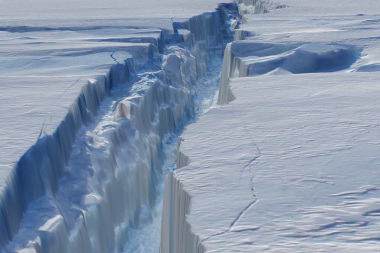 Antarctic ice sheets could be at greater risk of melting than previously thought, Science Daily, December 2, 2019, University of South Australia Antarctic ice sheets could be at greater risk of melting than previously thought, Science Daily, December 2, 2019, University of South Australia
|
|
Coal power becoming ‘uninsurable’ as firms refuse cover
 Coal power becoming ‘uninsurable’ as firms refuse cover, US insurers join retreat from European insurers meaning coal projects cannot be built or operated, Guardian, Julia Kollewe, Mon 2 Dec 2019 The number of insurers withdrawing cover for coal projects more than doubled this year and for the first time US companies have taken action, leaving Lloyd’s of London and Asian insurers as the “last resort” for fossil fuels, according to a new report.The report, which rates the world’s 35 biggest insurers on their actions on fossil fuels, declares that coal – the biggest single contributor to climate change – “is on the way to becoming uninsurable” as most coal projects cannot be financed, built or operated without insurance. Coal power becoming ‘uninsurable’ as firms refuse cover, US insurers join retreat from European insurers meaning coal projects cannot be built or operated, Guardian, Julia Kollewe, Mon 2 Dec 2019 The number of insurers withdrawing cover for coal projects more than doubled this year and for the first time US companies have taken action, leaving Lloyd’s of London and Asian insurers as the “last resort” for fossil fuels, according to a new report.The report, which rates the world’s 35 biggest insurers on their actions on fossil fuels, declares that coal – the biggest single contributor to climate change – “is on the way to becoming uninsurable” as most coal projects cannot be financed, built or operated without insurance.
Ten firms moved to restrict the insurance cover they offer to companies that build or operate coal power plants in 2019, taking the global total to 17, said the Unfriend Coal campaign, which includes 13 environmental groups such as Greenpeace, Client Earth and Urgewald, a German NGO. The report will be launched at an insurance and climate risk conference in London on Monday, as the UN climate summit gets underway in Madrid. The first insurers to exit coal policies were all European, but since March, two US insurers – Chubb and Axis Capital – and the Australian firms QBE and Suncorp have pledged to stop or restrict insurance for coal projects. At least 35 insurers with combined assets of $8.9tn, equivalent to 37% of the insurance industry’s global assets, have begun pulling out of coal investments. A year ago, 19 insurers holding more than $6tn in assets were divesting from fossil fuels…… https://www.theguardian.com/environment/2019/dec/02/coal-power-becoming-uninsurable-as-firms-refuse-cover |
|
Transparency, the olympics, and that damned water, Part 2 — Fukushima 311 Watchdogs

Official messaging about Fukushima focuses on happiness. Tuesday November 26th, 2019 Part 2: What about the Olympics? The concerns we hear about the 2020 Olympics are more generalized and less focussed than those about the water in the tanks at Fukushima Daiichi. Some people ask us if it’s safe to come to Japan at all. […]
via Transparency, the olympics, and that damned water, Part 2 — Fukushima 311 Watchdogs
Transparency, the olympics, and that damned water, Part 1 — Fukushima 311 Watchdogs

Joe’s drone image of the water tanks at Fukushima Daiichi, December ,2018 Tuesday November 26th, 2019 Questions, questions… It’s hard to say what we get more questions about lately, the 2020 Olympics or the plan to release water from Fukushima Daiichi to the Pacific Ocean. Both issues involve public safety. How safe from radiation […]
via Transparency, the olympics, and that damned water, Part 1 — Fukushima 311 Watchdogs
COP25 Mandate: The Geopolitics of Mutual Empowerment — Engage4Climate.org

COP25 Strategy Brief from Citizens’ Climate Education, the Engage4Climate Network and Resilience Intel The time between the COP25 (opening today in Madrid) and the COP26 (next November in Glasgow) constitutes an unprecedented moment for creative collaboration in the improvement of human experience and outcomes. During that time, 195 nations must upgrade their Nationally Determined Contributions […]
via COP25 Mandate: The Geopolitics of Mutual Empowerment — Engage4Climate.org
Hot particles in Japan: what does this mean for the Olympics and beyond? — Fukushima 311 Watchdogs

November 21, 2019 Hundreds of thousands of people – athletes and spectators – will flood into Japan for the 2020 Olympics. But exposure dangers from the Fukushima nuclear catastrophe have not ended since the meltdowns and explosions spread radioactive contamination over large areas reaching down to Tokyo and beyond. Soon after the start of the […]
via Hot particles in Japan: what does this mean for the Olympics and beyond? — Fukushima 311 Watchdogs
1 This month
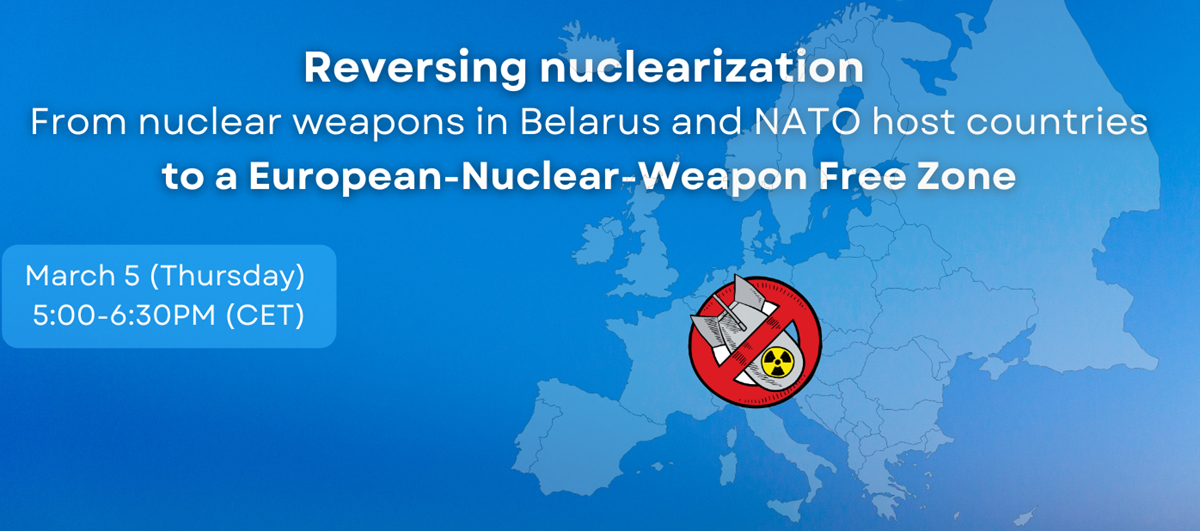
6 March -Online – Reversing nuclearization:
From nuclear weapons in Belarus and NATO host countries to a European-Nuclear-Weapon Free Zone
Mar 6, 2026 03:00 AM in Canberra, Melbourne, Sydney

of the week – Australians for War Powers Reform (AWPR)
To see nuclear-related stories in greater depth and intensity
 Antinuclear