Prudent nuclear ban should remain: ACF
 Prudent nuclear ban should remain: ACF, https://www.miragenews.com/prudent-nuclear-ban-should-remain-acf/ 13 Dec 19, Australia’s bipartisan, long standing and prudent prohibition on nuclear energy should remain in force as it stands.
In response to the release of the House of Representatives standing Committee on Environment and Energy’s report into the prerequisites for nuclear energy in Australia, the Australian Conservation Foundation’s (ACF) Nuclear Free Campaigner, Dave Sweeney, said:
“ACF strongly holds that the bipartisan, long standing and prudent prohibition on nuclear energy in Australia should remain in force as it stands.
“From the heartland to the harbour, the terrible drought and bushfires we are experiencing leave no doubt that Australia must quickly transition away from climate-wrecking fuels like coal, oil and gas.
“The Australian Energy Market Operator’s roadmap for the efficient development of the National Electricity Market makes it clear that Australia’s energy transition is heading towards small and large-scale renewables.
“Australia’s long standing, sensible moratorium on nuclear energy, enacted by John Howard, does not preclude discussion or debate on nuclear. There has been plenty of both.
“But while no commercial operator will touch nuclear, the moratorium remains important as it prevents a reckless government pouring public money into this economically and environmentally risky industry.
“Australians know nuclear reactors overseas cost a fortune, take decades to build and come with the possibility of disastrous accidents and the certainty of eternal radioactive waste.
“Cheap, clean, safe reactors don’t exist outside the minds of nuclear true believers. Flirting with nuclear is no basis for a credible national energy policy.
“The climate crisis we are living through is too serious and too urgent to fiddle at the margins with nuclear.
“We need to avoid the distraction of a nuclear cul de sac and take the renewable path.
“Australia’s future is renewable, not radioactive.”
In September a broad coalition of faith, union, environmental, Aboriginal and public health groups, representing millions of Australians, issued a strong statement opposing nuclear power.
Residents vote against nuclear waste dump near Hawker in South Australia
|
Residents vote against nuclear waste dump near Hawker in South Australia
Green groups say 52% vote against federal government facility should rule out region as potential site, Guardian, Australian Associated Press, Thu 12 Dec 2019 Residents in South Australia’s Flinders Ranges have voted narrowly against having a nuclear waste dump in their region.About 52% of the people who took part in the ballot voted against the federal government’s facility being established on land near Hawker. The result came after a similar poll of residents on SA’s Eyre Peninsula voted almost 62% in favour of the dump being built on one of two sites near Kimba. The federal government is yet to respond to the poll, but environmental groups said it should rule out the Flinders Ranges as a potential dump site. Australian Conservation Foundation campaigner Dave Sweeney said the result came amid clear opposition from regional pastoralists and the area’s native title holders. “There is no broad community support for a national radioactive waste facility in the Flinders Ranges,” Sweeney said. The Friends of the Earth said it was time for the federal government to abandon the dump plan altogether. “The government has previously stated that 65% would be a figure that would indicate the broad community support they need to select a site,” spokeswoman Mara Bonacci said. “These ballot results show that the minister does not have that support.”…… The community ballots are not binding on the government, which has promised to provide financial incentives to the community around the selected site. https://www.theguardian.com/australia-news/2019/dec/12/residents-vote-against-nuclear-waste-dump-near-hawker-in-south-australia |
|
|
UN climate talks bogged down – no sign of real action
 UN talks struggle to stave off climate chaos, https://www.sbs.com.au/news/un-talks-struggle-to-stave-off-climate-chaos 13 Dec 19, Observers and delegates at the UN’s COP25 climate summit said negotiators had largely failed to live up to the conference’s motto: Time for Action.
United Nations climate negotiations in Madrid were set to wrap up with even the best-case outcome likely to fall well short of what science says is needed to avert a future ravaged by global warming.
The COP25 summit comes on the heels of climate-related disasters across the planet, including unprecedented cyclones, deadly droughts and record-setting heatwaves.
As pressure inside and outside the talks mounts, old splits dividing rich polluters and developing nations – over who should slash greenhouse gas emissions by how much, and how to pay the trillions needed to live in a climate-addled world — have reemerged.
Newer fissures, meanwhile, between poor, climate vulnerable nations and emerging giants such as China and India – the world’s No.1 and No.4 emitters – may further stymie progress.
To not lose time, the 12-day meet was moved at the last minute from original host Chile due to social unrest.
Not even appearances from wunderkind campaigner Greta Thunberg – named Time Person of the Year Wednesday, much to the chagrin of Donald Trump — could spur countries to boost carbon-cutting pledges that are, taken together, woefully inadequate.
“We are appalled at the state of negotiations,” said Carlos Fuller, lead negotiator for the Association of Small Island States (AOSIS), many of whose members face an existential threat due to rising sea levels.
Shifting alliances
The narrow aim of the Madrid negotiations is to finalise the rulebook for the 2015 climate accord, which enjoins nations to limit global temperature rises to “well below” two degrees Celsius.
Earth has already warmed 1C, and is on track to heat up another two or three degrees by 2100.
But “raising ambition” on emissions remains the overarching goal in Madrid.
There are two very clear visions,” Spain’s minister for energy and climate change Teresa Ribera told reporters.
“There are those that want to move quicker and those that want to hide behind things which aren’t working, so as not to advance.”
The deadline under the Paris treaty for revisiting carbon cutting commitments – known as NDCs, or nationally determined contributions – is 2020, ahead of the next climate summit in Glasgow.
But Madrid was seen as a crucial launch pad where countries could show their good intentions. Nearly 80 countries have said they intend to do more, but they only represent 10 percent of global emissions.
Conspicuously absent are China, India and Brazil, all of whom have indicated they will not follow suit, insisting that first-world emitters step up.
Fantasy land’
But some countries historically aligned with the emerging giants over the course of the 25-year talks broke rank Thursday.
“The failure of major emitters — including Australia, the United States, Canada, Russia, India, China, Brazil – ‘to commit to submitting revised NDCs suitable for achieving a 1.5C world shows a lack of ambition that also undermines ours,” AOSIS said in a statement.
The talks received a meagre shot in the arm Friday after the EU pledged to make the bloc carbon-neutral by 2050.
The much-heralded decision was immediately undermined however by the refusal of Poland – a major emitter – to sign on.
The UN said this month that in order for the world to limit warming to 1.5C, emissions would need to drop over seven percent annually to 2030, requiring nothing less than a restructuring of the global economy.
In fact, they are currently rising year-on-year, and have grown four percent since the Paris deal was signed.
“It’s basically like what’s happening in the real world and in the streets, the protesters, doesn’t exist,” Alden Meyer from the Union of Concerned Scientists, told AFP.
“We are in a fantasy land here.”
Without strong commitments from big emitters to up their own contributions to the climate fight, Meyer said the talks would have failed to fulfil their purpose.
“Countries need to be on a track to be 1.5C compatible, that’s the bottom line.”
250m tonnes of CO2 emitted from Australia’s bushfires
Australia’s bushfires have emitted 250m tonnes of CO2, almost half of country’s annual emissions. Forest regrowth can reabsorb emissions from fires but scientists fear natural carbon ‘sinks’ have been compromised, Guardian,Graham Readfearn @readfearn, Fri 13 Dec 2019
Bushfires in New South Wales and Queensland have emitted a massive pulse of CO2 into the atmosphere since August that is equivalent to almost half of Australia’s annual greenhouse gas emissions, Guardian Australia can reveal.
Analysis by Nasa shows the NSW fires have emitted about 195m tonnes of CO2 since 1 August, with Queensland’s fires adding a further 55m tonnes over the same period.
In 2018, Australia’s entire greenhouse gas footprint was 532m tonnes of carbon dioxide equivalent.
Experts say the pulse of CO2 from this season’s bushfires is significant, because even under normal conditions it could take decades for forest regrowth to reabsorb the emissions.
But scientists have expressed doubt that forests already under drought stress would be able to reabsorb all the emissions back into soils and branches, and said the natural carbon “sinks” of forests could be compromised.
The figures were provided to Guardian Australia by Dr Niels Andela, a scientist at the Nasa Goddard Space Flight Center and a collaborator in the Global Fire Emissions Database……….
Prof David Bowman, a fire ecologist at the University of Tasmania, said that under normal conditions the regrowth would reabsorb the CO2. But he said the ongoing drought, combined with climate change, meant conditions were not normal.
“Drought-stressed trees recover less well – carbohydrates reserves are exhausted – and under climate change tree growth may be slow and fires more frequent, meaning less tree biomass and even loss of forest cover.
“This is a nasty negative feedback cycle of a biosphere carbon sink becoming a source [of carbon].” https://www.theguardian.com/environment/2019/dec/13/australias-bushfires-have-emitted-250m-tonnes-of-co2-almost-half-of-countrys-annual-emissions
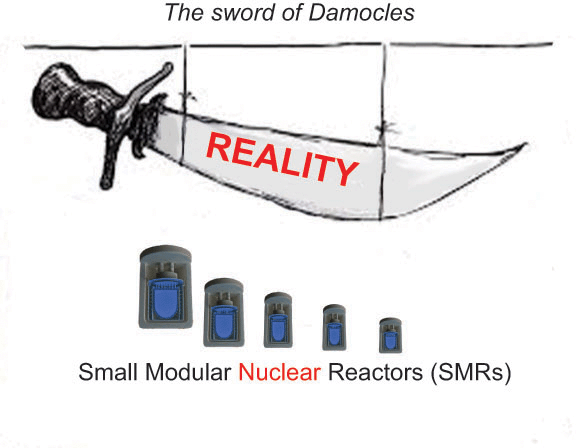
Small Modular Nuclear Reactors – too slow, too risky, too costly – not an answer to climate change
 Renewables – Not Small Modular Nuclear Reactors – Are the Solution to Climate Change, https://cela.ca/renewables-not-small-modular-nuclear-reactors-are-the-solution-to-climate-change/ December 4, 2019 By Theresa McClenaghan, Kerrie Blaise (CELA) and Guest Author Chris Rouse (New Clear Free Solutions) The idea of Small Modular Reactors (“SMRs”) was in the news this week with the federal government being urged to provide even more research money to develop this “new” nuclear power technology. The premise is that SMR’s are a needed, cost effective, safe and realistic solution to climate change. Renewables – Not Small Modular Nuclear Reactors – Are the Solution to Climate Change, https://cela.ca/renewables-not-small-modular-nuclear-reactors-are-the-solution-to-climate-change/ December 4, 2019 By Theresa McClenaghan, Kerrie Blaise (CELA) and Guest Author Chris Rouse (New Clear Free Solutions) The idea of Small Modular Reactors (“SMRs”) was in the news this week with the federal government being urged to provide even more research money to develop this “new” nuclear power technology. The premise is that SMR’s are a needed, cost effective, safe and realistic solution to climate change. However, SMRs are not the answer or even part of the answer to climate change given the problematic environmental, social and economic attributes of the proposed technology. Instead, in our view, investment is urgently needed in Canada’s vast and enviable renewable energy resources which are already scalable and provide safer, less costly, and more socially acceptable means of energy generation.
SMRs are not yet commercially available. Indeed, Canada’s SMR Roadmap, produced by the Canadian Nuclear Association, only sets out a path for having a commercial demonstration unit in the 2030s. To contend that SMR technology can aid in combatting climate change is potentially damaging to climate action, as it misses the 10-year window we have to reverse emissions and decarbonize. It also distracts from the urgent work needed to respond to the climate emergency. We already have many tools in our renewable energy toolbox. Canada’s electricity grid is 65% renewable, mainly from our vast hydro resources. These resources, used in combination with 30% to 35% wind and solar, makes a renewable grid achievable. Several jurisdictions have already achieved or surpassed this threshold, such as Prince Edward Island, where 43% of its power comes from wind alone. We also have access to other renewable energy resources such as biomass, geothermal, and tidal to assist in our transition to a low-carbon economy. Studies also continue to demonstrate viable pathways to a renewable grid, which are both technically and economically feasible. One report from Nova Scotia provides a pathway to reach a 90% renewable grid by 2030 and a study from New Brunswick plots a cost effective solution to achieve a 95% renewable grid. While work is needed to achieve the remaining 5% over time, the immediate need – and the focus of governmental efforts – should be on prioritizing the first 90% to 95% shift to renewables. Despite what appears as widespread interest in SMRs, very few countries have been willing to invest in their construction. Apart from technology’s risks, the problem is one of poor economics: nuclear energy is already known to be expensive and the cost-competitiveness of SMRs is contingent upon their mass fabrication. Hundreds if not thousands of SMRs would need to be deployed in order to be economically viable. Past experience also dictates this new reactor technology may never become commercially available. For instance, after two decades and hundreds of millions of taxpayer dollars, the two prototype MAPLE reactors were abandoned in 2008 because they could not be safely operated. The Gentilly 1 prototype reactor in Quebec which received similar investment, also failed and after 180 days of operation was mothballed. Despite public assurances of SMRs’ ‘passive’ and ‘inherent’ safety, SMR operators and suppliers would be protected from liability in the event of an accident under the current rules; the current nuclear liability rules are a concession by governments to the nuclear industry because of the inherent hazard that private nuclear investors do not want to underwrite. Furthermore, after 50 years of nuclear energy production, we still do not have an approved plan for Canada’s high, intermediate and low-level radioactive waste stockpiles. Because of the diverse range of fuels which can be used by SMRs, new radioactive waste streams will be created, thus increasing the complexity of the used nuclear fuel waste problem, with new types of nuclear waste hazards being introduced. The touted benefit of SMRs for use in remote and rural regions would also mean increased transport of radioactive substances on roads and railways across the country. This poses unique proliferation risks since the waste from enriched fuels can produce quantities of plutonium that could be attractive for diversion to malicious purposes. The greater the number of sites and communities with SMRs, the greater the proliferation risks because of challenges in monitoring, keeping track and measuring plutonium in spent fuel, which must be kept secure. Furthermore, Canada’s nuclear safety regulator advocated with the federal government to remove SMRs from public, more rigorous forms of decision-making under Canada’s new Impact Assessment Act (IAA). Despite requirements for wind and solar farms to undergo environmental assessments, either provincially or federally, SMRs would not trigger an environmental assessment under the current federal IAA Project List regulation. The coming into force of the Impact Assessment Act in June 2019 wholly exempts SMRs from environmental, or impact assessment review. Investment in nuclear power at the 11th hour is a distraction from real climate action when scalable, cost-effective renewable solutions could and need to be employed. Already climate-burdened future generations should not have new risks imposed on them, due to SMR’s radioactive waste and accompanying proliferation risk. We need to invest in known renewable energy solutions, and not the promise of a hypothetical and risky technology. |
|
Kimba now the likely site for nuclear waste dump

Resources Minister Matt Canavan says after a ballot of local residents voted narrowly against hosting the facility, the site near Hawker is no longer an option.
More than 860 people cast a ballot in the poll with 454, or just under 53 per cent, voting against establishing the dump on Wallerberdina Station.
“This ballot does not demonstrate a sufficient level of support and I will no longer consider this site an option for the facility,” Canavan said in a statement on Friday.
A similar poll conducted on Eyre Peninsula recently returned a 62 per cent vote in favour of the idea, with two sites near Kimba in the running.
Australian Conservation Foundation campaigner Dave Sweeney said the Hawker result also came amid clear opposition from regional pastoralists and the area’s native title holders………https://indaily.com.au/news/2019/12/13/kimba-firms-as-nuclear-dump-site-after-hawker-vote/
Even within a pro nuclear propaganda article, admission that renewables are a better bet
|
“…… Roger Dargaville, a Senior Lecturer in Resources Engineering with the Department of Civil Engineering at Monash University, is more confident of the standalone capability of renewables. In 2018, the proportion of Australia’s total electricity generated from renewables passed 20 per cent for the first time, with clean energy contributing 21.3 per cent of total electricity generation. This was an increase compared to 2017, when renewables were responsible for 17 per cent of total electricity generation. And there’s more in the pipeline. “As we approach the 2020 renewable energy target of at least 33,000 GWh per year, we have seen a rush of new projects. After that, most of the states have renewable targets of 50 per cent or more that, combined with the continuing falling prices of PV, should lead to a continuation of the trend.” Dargaville said many published studies already show that 100 per cent renewable systems are technically achievable, cost-effective and reliable, without having to resort to nuclear power….” Australia’s review of its energy mix resurrects the nuclear power debate, by Create Digital, 10 Dec 19 |
|
Rio Tinto appeals Takeovers Panel decision on uranium miner ERA
Rio Tinto appeals Takeovers Panel decision on uranium miner ERA, THE AUSTRALIAN, NICK EVANS, RESOURCE WRITER, 13 Dec 19,
 Rio Tinto has appealed a Takeovers Panel decision preventing it from taking complete control of uranium miner ERA, as the fallout from the company’s hard-ball tactics to fund the clean-up of the Ranger uranium mine continues.
The Takeovers Panel handed dissident ERA investor Richard Magides a moral victory on Wednesday, declaring ERA’s decision to accept a Rio offer to underwrite a $476m equity issue was made in “unacceptable circumstances”…...(subscribers only)
Coalition MPs squabble over climate science as Australia burns
 , New Daily, Daniel McCulloch 13 Dec 19, Nationals deputy leader Bridget McKenzie has blasted an “irrational” state colleague for daring to link the NSW bushfires to climate change.
Their ugly public stoush has dragged on for several days.
He inflamed the internal spat after suggesting he would rather listen to climate scientists than the federal frontbencher on the effects of global warming.
But Senator McKenzie said “I actually have a science degree – I am one of the few in parliament that does”.
December 13 Energy News — geoharvey

COP25: ¶ “Crunch Time At Climate Talks Amid Discord On Carbon Markets” • Officials from almost 200 countries are poring over revised drafts, preparing for a last push at an annual UN summit to finalize rules for the Paris climate accord amid signs that resolving the issue of international carbon markets may be postponed for […]
A tale of two markets: Rooftop PV smashes records as large-scale wind, solar slow down — RenewEconomy

Regulator’s report shows early signs of a dramatic fall in new large-scale renewables investment, to lowest level since mid-2016. The post A tale of two markets: Rooftop PV smashes records as large-scale wind, solar slow down appeared first on RenewEconomy.
Snowy 2.0 will reduce greenhouse gas emissions in Australia: truth or lie? — RenewEconomy

Snowy Hydro has claimed that its massive “Snowy 2.0” pumped hydro scheme will reduce emissions by storing renewable electricity. Is this correct? The post Snowy 2.0 will reduce greenhouse gas emissions in Australia: truth or lie? appeared first on RenewEconomy.
via Snowy 2.0 will reduce greenhouse gas emissions in Australia: truth or lie? — RenewEconomy
Combining home solar, batteries and EVs will be better deal than solar alone by 2024 — RenewEconomy

IEEFA report finds with “modest” suite of EV incentives, payback for rooftop PV, a home battery and electric vehicle falls to just five years today, and zero by 2030. The post Combining home solar, batteries and EVs will be better deal than solar alone by 2024 appeared first on RenewEconomy.
via Combining home solar, batteries and EVs will be better deal than solar alone by 2024 — RenewEconomy
Australia’s biggest steel city targets net zero emissions by 2050 — RenewEconomy

Wollongong, the NSW home to Australia’s biggest steelworks, has committed to becoming carbon neutral by 2050, with a view to reducing that timeline to 2030. The post Australia’s biggest steel city targets net zero emissions by 2050 appeared first on RenewEconomy.
via Australia’s biggest steel city targets net zero emissions by 2050 — RenewEconomy
Energy Insiders Podcast: Why networks really like wind and solar — RenewEconomy

Network owners were once seen as villains for over-charging on local networks, but they’re pretty happy about building new links to capture wind and solar resources. The post Energy Insiders Podcast: Why networks really like wind and solar appeared first on RenewEconomy.
via Energy Insiders Podcast: Why networks really like wind and solar — RenewEconomy
1 This month
7 April – WEBINAR – Australia and the Doomsday Clock – Preventing nuclear war through NoFirstUse and other policies
Online | Tuesday April 7, 4:00-5:30pm, Australian Eastern Time / 8:00-9:30am Central Europe Time
– Access the registration link
15 April – Zoom –Nuclear Power is Not the Solution
Apr 15, 2026 01:00 AM in Canberra, Melbourne, Sydney

Join the International Physicians for the Prevention of Nuclear War (IPPNW) on Tuesday, April 14th for a timely webinar exploring the risks associated with nuclear power and challenging the myth that it offers a simple, safe, carbon-free solution to the climate crisis

21 April Webinar: No Nuclear Weapons in Australia
Start: 2026-04-21 18:00:00 UTC Canberra, Melbourne, Sydney (GMT+10:00)
End: 2026-04-21 19:30:00 UTC Canberra, Melbourne, Sydney (GMT+10:00)
Event Type: Virtual
A virtual link will be communicated before the event.
Host Contact Info: australia@icanw.org

of the week – Australians for War Powers Reform (AWPR)
To see nuclear-related stories in greater depth and intensity
 Antinuclear