Dodgy #ScottyFromMarketing govt process for Kimba nuclear waste dump needs investigation

Inhumane treatment of Australian Julian Assange by UK government
 Julian Assange and the Inhumanity of the British State: ‘Unofficial’ Solitary Confinement as Torture 21st Century Wire, JANUARY 26, 2020 BY NINA CROSS
 Up until this week, Assange has been held in solitary confinement in Belmarsh prison. Incredibly, it was the other prisoners along with Assange’s legal team, who have pressured the government officials to respect the law and allow Assange to be removed from solitary confinement, resulting in his transfer to a general wing. This piece looks at how Assange was unofficially segregated in the prison’s healthcare unit, with no recourse to systems designed for prisoners in official solitary confinement regimes as applied under Prison Rule 45, leaving him out of reach of rules and law.
The sustained violation of the human rights of Wikileaks founder, Julian Assange, has been carried out in full view of the world throughout his arbitrary detention in HMP Belmarsh. Until now, condemnation of his treatment and pleas to end his suffering have been met with denial and silence by the British authorities.
But the announcement this week that Assange has been moved out of Belmarsh healthcare unit where he has been detained in solitary confinement since May, is a sign that the campaign to stop his persecution is gaining traction. Continue reading
Stainless steel canisters for nuclear wastes may be dangerous
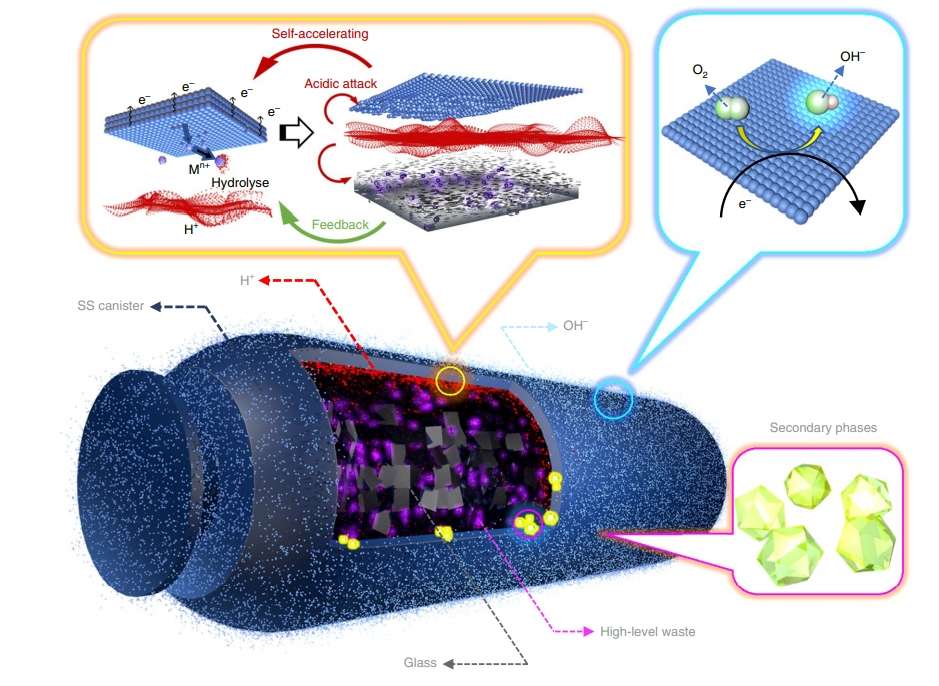
Schematic of a stainless steel nuclear waste canister, with radioactive particles (purple) trapped inside in glass and the acidic spiral that starts when water, steel, and glass are brought together. Guo et al/Nature Materials
|
By David Szondy January 28, 2020 A new study by researchers at Ohio State University suggests that stainless steel may not be the best choice for containing high-level nuclear waste. By simulating long-term storage conditions, the team found that the storage materials interact with each other more than previously thought, causing them to degrade faster.
The storage of nuclear waste is more than a perennial political football, it is an existential problem. Whatever one’s opinions about nuclear power or weapons, there are thousands of tons of nuclear waste temporarily stored around the world, meaning that a way must be found to store it all
safely in the long term.
The most important type of nuclear waste is the high-level waste left over from reprocessing nuclear fuel or from nuclear weapon production. Such waste is made up of a complex mixture of radioactive isotopes with half-lives ranging from years to millennia. Though reactors have been operating all over the world for over 75 years, only Finland has started to build a permanent storage facility for such very dangerous waste.
That may show a remarkable lack of political will or even courage, but perhaps this reluctance will turn out to be serendipitous. That’s because the favored way of storing high-level waste is to vitrify it. That is, to mix the isotopes with molten glass or ceramics to form a chemically inert mass that can be sealed in stainless steel canisters before being sealed in an underground storage facility.
That plan may now have to change if the Ohio study is correct. Led by Xiaolei Guo, the team took glasses and ceramics and put them in close contact with stainless steel in various wet solutions for 30 days in conditions similar to those that would be found in the proposed US Yucca Mountain nuclear waste repository.
In the real-life scenario, the glass or ceramic waste forms would be in close contact with stainless steel canisters,” says Xiaolei. “Under specific conditions, the corrosion of stainless steel will go crazy. It creates a super-aggressive environment that can corrode surrounding materials.”
They found that the steel interacted with the glass or ceramic to produce severe and localized corrosion that both damaged the steel and corroded and cracked the glass and ceramics. According to the team, this is because the iron in stainless steel has a chemical affinity with the silicon in glass, accelerating corrosion. This indicates that the current models may not be sufficient to keep this waste safely stored,” says Xiaolei. “And it shows that we need to develop a new model for storing nuclear waste.” The research was published in Nature Materials. Source: Ohio State University |
|


Morrison is dangerously wrong on gas, and needs to wake up to new technologies — RenewEconomy

Morrison’s claim that gas is a key transition fuel for Australia’s switch to renewables is wrong and hopelessly out of date. He needs to catch up to Tesla. The post Morrison is dangerously wrong on gas, and needs to wake up to new technologies appeared first on RenewEconomy.
via Morrison is dangerously wrong on gas, and needs to wake up to new technologies — RenewEconomy
Adaptation to bushfires might not be achievable without stronger action to curb emissions
 (Cartoon above, courtesy of Independent Australia and Mark David)
Australia is ‘ground zero’ in climate crisis and must show leadership, top researchers say https://www.theguardian.com/australia-news/2020/jan/29/australia-is-ground-zero-in-climate-crisis-and-must-show-leadership-top-researchers-say Lisa Cox, Wed 29 Jan 2020, Adaptation to bushfires might not be achievable without stronger action to curb emissions, letter warns, Lisa Cox Australia’s current position as “ground zero” for both the impacts of climate change and policy uncertainty presents an opportunity for the country to emerge as a leader in responding to the climate crisis, according to Australian Research Council laureates.
In a letter signed by 80 ARC laureate fellows, some of Australia’s top researchers said claims strong action to cut emissions would be economically destructive have no basis and are not “consistent with Australia’s traditional optimism and ingenuity, nor with historical experience”.
“Reducing emissions is a global challenge that requires collective action,” the letter said.
“But Australia’s current visibility as ground zero for both climate impacts and climate policy uncertainty presents a unique opportunity for us to emerge as a leader on this challenge.”
The ARC laureate fellows are a small group of researchers selected by the ARC as the top researchers across all fields in Australia.
The letter, whose signatories include decorated academics in mathematics, science, economics, and language and culture, said the government’s focus on adapting to changed fire patterns “is not enough”.
It was written as the country’s unprecedented bushfire season continues, with emergency warnings in place on Tuesday for a fire burning in the Namadgi national park near Canberra.
“We welcome government actions to help current victims and improve adaptation to future fires, as well as its acceptance of a role for climate change in the catastrophe,” the letter said.
“But this is not enough, because the greenhouse gas amounts driving warming are still rising: the world is only at the beginning of the climate change phenomenon.”
The bushfire emergency has brought the Coalition government’s climate policies into sharp focus.
The prime minister, Scott Morrison, was criticised for his handling of the crisis through Christmas and early January, and for his failure to meet with former emergency chiefs who warned of the coming catastrophe last year.
Morrison said this month that the government’s response to the increasingly visible effects of the climate crisis would be to address “adaptation and resilience” rather than strengthening policies to reduce emissions.
But the letter warns that without stronger action to curb emissions, the impacts of further temperature rises could be such that adaptation is not achievable.
“This dire outlook demands stronger mitigation of carbon emissions,” it said.
“Many argue that actions to achieve this would be economically destructive. This claim has no basis, nor is it consistent with Australia’s traditional optimism and ingenuity, nor with historical experience.”
They wrote that achieving net zero emissions was a large but achievable task, and “far less risky and irresponsible” than allowing continued global heating.
Australia faced international criticism as one of a handful of countries at the United Nations climate conference in Madrid in December that were responsible for thwarting a deal on the rulebook for the Paris climate agreement.
Australia is the only country that plans to use carryover credits from the Kyoto period to meet its targets under the Paris agreement.
Inflexible baseload power no longer needed. Surplus nuclear power has become an embarrassment
Out of earshot of the politicians, the question of what to do with all the surplus power when demand is low is being tackled by increasing storage capacity but also by making green hydrogen. Some nuclear buffs are even suggesting hydrogen production might be the only viable hope for using up their spare power.
The tide is coming: why our beaches are vanishing
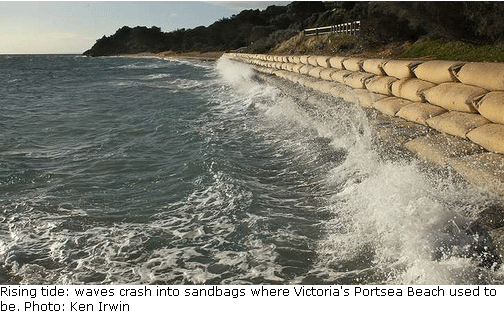
Communities around the country are coming face-to-face with the growing threat of coastal erosion. And as the climate crisis hastens, the problem is only going to get worse…
CHARLIE LEWIS AND KISHOR NAPIER-RAMAN JAN 28, 2020, Australia is crumbling into the sea. Experts estimate there are hundreds of beaches and coastal communities around the country at risk from coastal erosion. Within decades, as sea levels rise, that number could be in the thousands….. (subscribers only) https://www.crikey.com.au/2020/01/28/australias-collapsing-coast-beach-erosion/
South Australia encourages rooftop solar and battery storage in new homes — RenewEconomy

Home builder Stoddart to add solar and batteries to new homes, and partner with Powershop and Reposit in creation of new virtual power plant in South Australia. The post South Australia encourages rooftop solar and battery storage in new homes appeared first on RenewEconomy.
via South Australia encourages rooftop solar and battery storage in new homes — RenewEconomy
Solar installed in Bidyadanga with lower electricity costs — RenewEconomy

The remote community of Bidyadanga in the West Kimberley will now receive lower power bills with the successful installation of 160 kilowatts of solar on community buildings. The post Solar installed in Bidyadanga with lower electricity costs appeared first on RenewEconomy.
via Solar installed in Bidyadanga with lower electricity costs — RenewEconomy
January 29 Energy News — geoharvey

Opinion: ¶ “Kathryn Murdoch: ‘We’re Really Excited To Back Whoever The Nominee Is’” • For Kathryn Murdoch, daughter-in-law of Rupert Murdoch, there comes a time when you have to speak out. She sees us in a “make or break” moment for both climate change and American democracy, two causes in which she’s investing $100 million […]
Morrison questions importance of global climate treaties, to treat symptoms of climate change — RenewEconomy

Scott Morrison repeats the standard script from the coal lobby in major speech that questioned the value of the Paris Agreement. The post Morrison questions importance of global climate treaties, to treat symptoms of climate change appeared first on RenewEconomy.
Big US utility says “near-firm renewables” soon to be cheaper than fossil fuels — RenewEconomy

Head of NextEra says cost of wind and solar paired with battery storage will soon beat the cost of coal, gas and nuclear. The post Big US utility says “near-firm renewables” soon to be cheaper than fossil fuels appeared first on RenewEconomy.
via Big US utility says “near-firm renewables” soon to be cheaper than fossil fuels — RenewEconomy
Know your NEM: Soft demand keeps prices low, Coalition’s bad gas play — RenewEconomy

Soft demand is keeping gas prices low, the Coalition’s bad choice on gas generation, and why community storage makes more sense than household storage. The post Know your NEM: Soft demand keeps prices low, Coalition’s bad gas play appeared first on RenewEconomy.
via Know your NEM: Soft demand keeps prices low, Coalition’s bad gas play — RenewEconomy
New Zealand builds first zero-emissions commuter ferry in southern hemisphere — RenewEconomy

New Zealand team races to make Wellington first city in Southern Hemisphere to boast a zero-emissions electric ferry. The post New Zealand builds first zero-emissions commuter ferry in southern hemisphere appeared first on RenewEconomy.
via New Zealand builds first zero-emissions commuter ferry in southern hemisphere — RenewEconomy
Australia being left behind as global corporate renewable PPA market surges ahead — RenewEconomy

Corporate market for wind and solar rose sharply in 2019, but in Australia it slowed dramatically, partly due to growing grid connection frustrations. The post Australia being left behind as global corporate renewable PPA market surges ahead appeared first on RenewEconomy.
via Australia being left behind as global corporate renewable PPA market surges ahead — RenewEconomy
1 This month
Chernobyl: The Lost Tapes – A good documentary on Chernobyl on SBS available On Demand for the next 3 weeks– https://www.sbs.com.au/ondemand/tv-program/chernobyl-the-lost-tapes/2352741955560
15 April – Zoom –Nuclear Power is Not the Solution
Apr 15, 2026 01:00 AM in Canberra, Melbourne, Sydney

Join the International Physicians for the Prevention of Nuclear War (IPPNW) on Tuesday, April 14th for a timely webinar exploring the risks associated with nuclear power and challenging the myth that it offers a simple, safe, carbon-free solution to the climate crisis

21 April Webinar: No Nuclear Weapons in Australia
Start: 2026-04-21 18:00:00 UTC Canberra, Melbourne, Sydney (GMT+10:00)
End: 2026-04-21 19:30:00 UTC Canberra, Melbourne, Sydney (GMT+10:00)
Event Type: Virtual
A virtual link will be communicated before the event.
Host Contact Info: australia@icanw.org

of the week – Australians for War Powers Reform (AWPR)
To see nuclear-related stories in greater depth and intensity
 Antinuclear