“Mercenary science”- crooked science funded by corporations
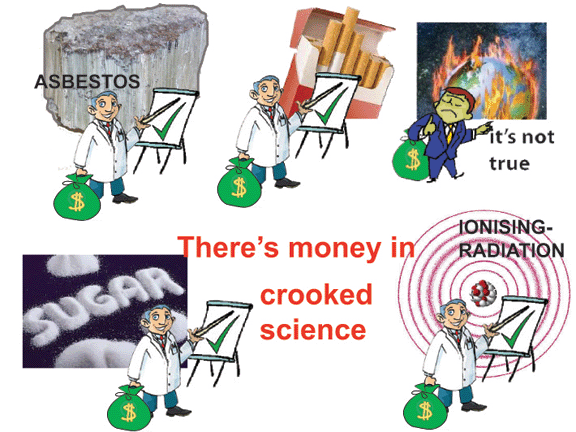 Why is the nuclear industry not mentioned in relation to “mercenary science”?
  Independent Russian scientists gave comprehensive accounts of the effects of the Chernobyl disaster – they were vilified by both Russia and the West . That’s another side of this issue -destroy the credibility of honest scientists.
While the vast majority of scientists, both employed publicly and privately, are honest and do their work as part of a larger quest for truth, there are a few notable exceptions. Specifically, a few mercenary science consulting firms have been very effective at helping corporations continue selling harmful chemicals and drugs long after they should have stopped.
Michaels, who has a new book on the topic titled “The Triumph of Doubt: Dark Money and the Science of Deception,” has been studying this problem for years, in part by virtue of his 8-year tenure at OSHA. Now a public health professor at George Washington University, Michaels’ book pulls back the curtain on the way that dark money and for-profit science is quite literally killing Americans.
David Michaels: Mercenary science means [when scientists] produce studies that aren’t designed to better understand the world, or they help make the world a better place — which is why most scientists are in the business of science – but to defend products and to defend corporations. And often to influence regulation or to slow the compensation of victims.
This is the Enron-ization of science. It’s created a fiction in order to promote an actual game, fiction around science. And it is quite mercenary. In fact, this phrase is not one that I invented, but actually is used by these consulting companies whose business model is to provide some using reports and testimonies to corporations, so they can continue to market dangerous products or activities without being hindered by regulation or by compensating the people they’ve hurt.
What would you say is the most shocking, real-life example of something like this — of mercenary science becoming embedded in mainstream discourse?
I think the most famous [example] is in the tobacco industry… who didn’t invent it, but who certainly gained the most from it — and in climate change. There’s actually some overlap between some of the same mercenary scientists in both examples.
But as I write [in my book], this is now become standard operating procedure for virtually every industry, and in many cases, it’s the same so-called scientists who are involved in doing it. Nowadays, the instinct of corporate leaders — CEOs and executives —when there’s an allegation that their product could be causing harm is to say, “How can we show that it isn’t causing harm?” Not, “how can we determine whether or not we cause harm,” and then figure out what to do about it.
Other examples [include] opioids, and essentially how a few pharmaceutical companies misrepresented the studies to make it look like these opioids were not addictive. We have a death toll of tens of thousands a year as a result of that…………
David Michael’s new book, “The Triumph of Doubt: Dark Money and the Science of Deception,” is out from Oxford University Press on February 3, 2020. https://www.salon.com/2020/02/02/the-art-of-scientific-deception-how-corporations-use-mercenary-science-to-evade-regulation/
No comments yet.
1 This month
Chernobyl: The Lost Tapes – A good documentary on Chernobyl on SBS available On Demand for the next 3 weeks– https://www.sbs.com.au/ondemand/tv-program/chernobyl-the-lost-tapes/2352741955560
15 April – Zoom –Nuclear Power is Not the Solution
Apr 15, 2026 01:00 AM in Canberra, Melbourne, Sydney

Join the International Physicians for the Prevention of Nuclear War (IPPNW) on Tuesday, April 14th for a timely webinar exploring the risks associated with nuclear power and challenging the myth that it offers a simple, safe, carbon-free solution to the climate crisis

21 April Webinar: No Nuclear Weapons in Australia
Start: 2026-04-21 18:00:00 UTC Canberra, Melbourne, Sydney (GMT+10:00)
End: 2026-04-21 19:30:00 UTC Canberra, Melbourne, Sydney (GMT+10:00)
Event Type: Virtual
A virtual link will be communicated before the event.
Host Contact Info: australia@icanw.org

of the week – Australians for War Powers Reform (AWPR)
To see nuclear-related stories in greater depth and intensity
 Antinuclear
Leave a comment