Liberal-National Coalition in nuclear disarray
|
Mr Barilaro’s position is also causing division in his National Party, with some of the party’s coastal MPs concerned that his position would put their seats at risk. The Nationals’ leader last week declared his party would support Mr Latham’s bill when it comes back before the upper house for a vote this month. The bill would allow the bans on uranium mining and nuclear power to be lifted but it has not yet been considered by the Liberal or National party rooms or cabinet. It follows a parliamentary inquiry report, which said the government should support the bill. But the issue has caused such anger within Liberal ranks that one senior minister told the Herald they would quit cabinet before supporting Mr Latham’s bill. A senior Liberal minister said: “I did not get into Parliament to support a One Nation bill”, while another minister said: “Crossbenchers don’t set the government’s agenda”. “It’s amazing that John Barilaro listens to the views of One Nation over his colleagues,” a fourth senior minister said. Last week, Local Government Minister and Liberal MP Shelley Hancock told Parliament she would not support a nuclear reactor in her electorate. But Mr Barilaro shot back and said the Liberals repeatedly say they “support technology agnostic energy policy” but then refuse to have a discussion about the role of nuclear. “Forget about this being a crossbench bill, I would take this to my party room and then put up my own bill if I need to,” Mr Barilaro said. |
|
|

Nuclear reactors, large or small, are NOT “zero carbon”
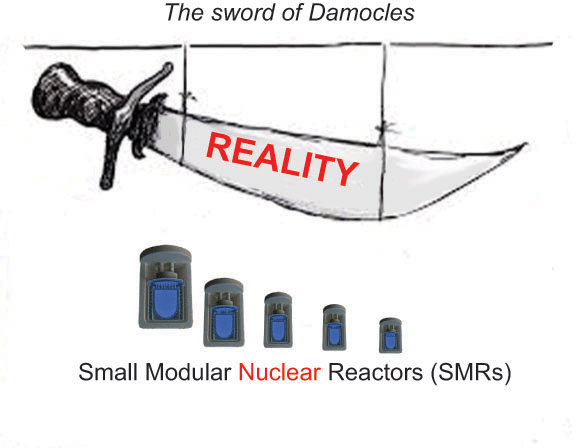
On the international media, so many articles swallow the line that nuclear power, whether large or small is “zero carbon”. In reality, nuclear reactors themselves DO emit a tiny amount of Carbon 14, – so they’re not “zero”. But when you look at the entire chain of construction through to demolition, and the fuel chain through from mining to waste disposal, – nuclear power is a huge carbon emitter. The whole nuclear propaganda seems now to based on this “zero carbon”story – although nuclear enthusiasts previously were often climate change deniers. The length of time needed to set up millions of these little reactors means that they’d be irrelevant to climate change action. However, that same delay would help the coal industry to just keep on going for much longer than it should. Nuclear and coal – partners in this cover-up of the truth.
Are Small Nuclear Reactors REALLY better?
The Smaller Is Better Movement in Nuclear Power, Are miniature reactors really safer?  Mother Jones LOIS PARSHLEY, 8 Mar 20,
Huge computer screens line a dark, windowless control room in Corvallis, Oregon, where engineers at the company NuScale Power hope to define the next wave of nuclear energy. Glowing icons fill the screens, representing the power output of 12 miniature nuclear reactors. Together, these small modular reactors would generate about the same amount of power as one of the conventional nuclear plants that currently dot the United States—producing enough electricity to power 540,000 homes. On the glowing screens, a palm tree indicates which of the dozen units is on “island mode,” allowing a single reactor to run disconnected from the grid in case of an emergency.
Christiana Figueres- “Australia, you’re not ‘meeting and beating’ your emissions targets”

Be honest Australia, you’re not ‘meeting and beating’ your emissions targets https://www.smh.com.au/environment/climate-change/be-honest-australia-you-re-not-meeting-and-beating-your-emissions-targets-20200307-p547u1.html 8 Mar 20, Optimistic. Prosperous. A country of rare beauty, blessed with abundant natural resources. Australia has all the “golden eggs” needed to position itself as a global leader, to help its Asia-Pacific region leapfrog to a new energy future, and to guarantee Australian prosperity in the process.
Watching this summer’s unprecedented firestorms, I was heartbroken by the sheer scale of the human and ecological tragedy. “This must be the tipping point on climate politics in Australia,” I said to myself. “Surely now the politicians will join hands and forge a bipartisan plan for a better future.”
Instead, the climate wars have returned, driven by a handful of deniers afraid to let go of longstanding vested interests, and given air by powerful media sympathisers and a Prime Minister unwilling to fully embrace the science and stare them down.
For Australia, the choice between danger and opportunity is clear, and that choice must be made now. Since the 2008 Stern Review, the world has known that the cost of not acting is much greater than the cost of our current path. And since the 2008 Garnaut Review, Australians have known that without stronger action, droughts and bushfires would become more frequent and intense, and “observable by 2020”. It is time to move on from denial, delusion and delay towards preparedness, productivity and prosperity.
The following three steps will put Australia on track to the future we must create.
First, be honest about where Australia is at. Your country is much more than 1.3 per cent of the global climate problem. Carbon emissions from Australia’s use and export of fossil fuels account for about 5 per cent of the global fossil fuel footprint. With exports included, Australians have the biggest per capita carbon footprint in the world.
Australia is not “meeting and beating” its emissions targets. Emissions have increased in every calendar year since 2014. The government’s own projections say Australia will reduce emissions by only 16 per cent by 2030, not the 26 to 28 per cent it promised in Paris, nor the 50 per cent required by science to limit warming to 1.5 degrees. Kyoto “carryover” can’t be used to make up the gap. The Paris Agreement doesn’t allow it. To suggest otherwise is at best an attempt to paper over Australia’s lagging efforts; and at worst, a legally baseless ploy that encourages cheating and holds back development of the next phase of carbon markets.
A highly vulnerable Australia cannot address climate change on its own, but its heel dragging leaves it without the international credibility to drive a stronger global response. The Australian government must look seriously at how to really meet and beat its 2030 target, and ask other major emitters to join it in an alliance for higher ambition at the COP26 climate summit in Glasgow this November.
Second, Australia needs a bipartisan, long-term vision for decarbonisation. Rattled by the bushfires and growing evidence of climate-related risks and stresses, Australia’s biggest corporations – including Rio Tinto, Qantas, Telstra and BHP – have announced support for a national net zero target for 2050. For them, legislating this target is important to finally end the climate wars, and provide the necessary certainty to underpin investment in the transition.
All states and territories have 2050 net zero targets, as do 73 other nations, including Britain and Canada. British Prime Minister Boris Johnson would welcome Australia joining these ranks ahead of the COP26, and giving consideration to the British model of using an independent expert body to advise government on five-yearly carbon budgets en route to net zero by 2050. Independent MP Zali Steggall’s private members’ bill does exactly that.
Third, Australia must embrace net zero by 2050 as a central pillar of its economic plan for the future. The plan must prioritise the policies, industries and technologies that are scientifically aligned with the 1.5 degree temperature limit, and retire those that are not, albeit with gratitude for the service provided in the past.
Despite a booming renewables industry, coal still accounts for around 60 per cent of Australia’s energy mix. But the technology is tired and unreliable in the summer, highly polluting, and no longer price competitive with solar and wind, firmed up by big batteries or pumped hydro. There is no place for governments signed up to the Paris Agreement to provide subsidies for dying coal. We must instead invest in the future.
These ground-breaking projects are just three examples of how Australia can lead and prosper. With political honesty and vision, ambitious targets, and a stubborn commitment to innovation, Australia stands ready to assume its rightful place as a clean energy superpower of the world. With the right choices, the future is bright.
Christiana Figueres is the former UN climate chief who oversaw the negotiation of the 2015 Paris Agreement, and is convenor of the Mission 2020 climate campaign. She is co-author of The Future We Choose and is visiting Australia this week.
Government advisers warn Britain against costly new nuclear reactors

 Times 7th March 2020, Net Zero Report. Plans for nuclear plants in Britain face fresh uncertainty after government advisers warned against backing costly new reactors. The nuclear industry wants the government to commit to a funding system to back the construction of reactors, including EDF’s proposed Sizewell plant in Suffolk.
However, the National Infrastructure Commission, set up in 2015 to provide impartial advice to the government, reiterated concerns in a report about backing more nuclear plants. It noted that there had been cost reductions in renewable power technologies such as wind and solar over the past ten years, but “costs of building and running nuclear power stations have not
fallen consistently, even in countries that have built fleets of similar reactors”. Given the potential for other non-intermittent technologies to complement renewables, it said that this “weakened the case for committing to a new fleet of nuclear power stations”.
https://www.thetimes.co.uk/article/advisers-raise-doubts-over-new-nuclear-plants-8hd85cr6d
Global heating is causing a decline in River flows in Murray Darling Basin
 ‘We need a serious conversation’: River flows could decline 40% in Australia’s foodbowl, SMH, by Mike Foley, March 8, 2020 River flows in Australia’s food bowl, the Murray Darling Basin, will decline by as much as 40 per cent over the next 50 years under the current trajectory of global warming, one of Australia’s top hydrologists has warned.Internationally recognised hydrologist Francis Chiew, a CSIRO research leader and co-author on the Intergovernmental Panel on Climate Change, said Australia was the driest and among the most water-dependent countries in the world. ‘We need a serious conversation’: River flows could decline 40% in Australia’s foodbowl, SMH, by Mike Foley, March 8, 2020 River flows in Australia’s food bowl, the Murray Darling Basin, will decline by as much as 40 per cent over the next 50 years under the current trajectory of global warming, one of Australia’s top hydrologists has warned.Internationally recognised hydrologist Francis Chiew, a CSIRO research leader and co-author on the Intergovernmental Panel on Climate Change, said Australia was the driest and among the most water-dependent countries in the world.
“We have the driest inhabited continent, we’ve got the least water by far per square kilometres of land surface,” Dr Chiew said. “Australia actually has among the world’s highest per capita water use – comparable to Asia and the Americas.” Dr Chiew said the upper range forecast is for a 40 per cent decline in the volume of water flowing down rivers and a “conservative” forecast sees Australian river flows declining 20 per cent. His forecast is based on global average temperatures increasing by 2 degrees, which is the target of the international emissions reduction targets under the Paris Agreement. The IPCC puts the current trajectory of warming, without increasing emissions reduction, at more than 3 degrees. The modelling includes a range of scenarios. “There is high confidence and strong evidence of declining water availability. But there’s less confidence in how much and by when,” he said……… Dr Chiew urged decision makers to grapple with the hard topics now. “We have got to have a serious conversation about what we want to do under climate change,” he said. https://www.smh.com.au/environment/climate-change/we-need-a-serious-conversation-river-flows-could-decline-40-percent-in-australia-s-foodbowl-20200304-p546t4.html |
|
|
1 This month
7 April – WEBINAR – Australia and the Doomsday Clock – Preventing nuclear war through NoFirstUse and other policies
Online | Tuesday April 7, 4:00-5:30pm, Australian Eastern Time / 8:00-9:30am Central Europe Time
– Access the registration link
15 April – Zoom –Nuclear Power is Not the Solution
Apr 15, 2026 01:00 AM in Canberra, Melbourne, Sydney

Join the International Physicians for the Prevention of Nuclear War (IPPNW) on Tuesday, April 14th for a timely webinar exploring the risks associated with nuclear power and challenging the myth that it offers a simple, safe, carbon-free solution to the climate crisis

21 April Webinar: No Nuclear Weapons in Australia
Start: 2026-04-21 18:00:00 UTC Canberra, Melbourne, Sydney (GMT+10:00)
End: 2026-04-21 19:30:00 UTC Canberra, Melbourne, Sydney (GMT+10:00)
Event Type: Virtual
A virtual link will be communicated before the event.
Host Contact Info: australia@icanw.org

of the week – Australians for War Powers Reform (AWPR)
To see nuclear-related stories in greater depth and intensity
 Antinuclear