Christiana Figueres’ message of climate hope
“So, for me, optimism is not simply the result of having attained something. It is rather a strategy, the input, the approach with which we must face climate change because it is the only way to enhance the probability of success.”
It’s an arresting thought – the only way to succeed, or merely survive, is to hope. Not a passive hope, but a hungry and angry hope, one that will force us to act.
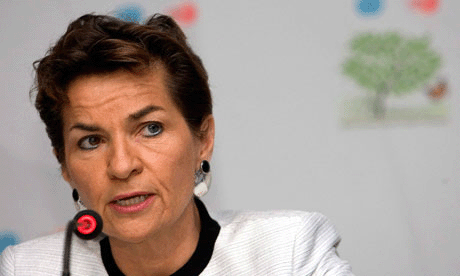
No wonder people are overwhelmed about the future of the planet, feel helpless, overcome with grief and worried nothing is being done, that nothing can be done, that it’s all too late. Our children are having nightmares, wracked with a sense of loss before they full possessed anything. The term “eco-anxiety” was defined by the American Psychological Society as “”a chronic fear of environmental doom” in a 2017 report which cited evidence of people “deeply affected by feelings of loss, helplessness, and frustration due to their inability to feel like they are making a difference in stopping climate change”.
What climate activists have failed to do, she says is to capture people’s imaginations with a vision of what a new world could be like: “What I think we have been lacking is to be able to paint the picture to really build out in people’s imagination what is an economy like Australia going to be like 10, 15 years from now when it has moved over to renewables? What does it mean for the quality of cities? What does it mean for the quality of agriculture? What does it mean for the Great Barrier Reef? What does it mean for camping in the bush safely without having to worry about … fires? It is a much, much healthier, longer term, stable economy that we can definitely build, and must be built. But we haven’t painted that picture very well. Hence, if you do not have a visual destination of the positive world that you want to construct, it’s very difficult for people to gravitate there.”
So we must dream.
“Obviously, the doom and gloom makes us concerned, helpless, hopeless, despair, grief, all that family of sentiments that are important because we have to understand what is out there,” she said. “But we have not been able to point to the fact that actually now in this decade we are in the most consequential decade of the history of humankinds. Because over the next 10 years we will decide whether we are at one half the global emissions in order to be able to move on to much, much better healthier, safer more stable world. That is going to be determined over the next 10 years. And Australia has to be part of that transformation.”
Figueres was troubled, though, that when she met Greta Thunberg she understandably struggled to infuse her with optimism. To those Australians who share Thunberg’s despair, she said that she too shares the pain and anguish of those troubled about the earth, particularly the hellish, devouring bushfires, but argued that we need to use that emotion as a fuel for determination and resolve: “I believe very firmly,” she said, “that we cannot stay in the pain and the grief and the despair as our ultimate destination of the journey. We have to be able to face that reality without denying it, whatsoever, understand it, and in a martial arts way turn the energy that comes out of that pain and that grief into a firm commitment, a resolute, gritty determination, to actually do what it takes to protect nature and to protect human life, because if we do not approach this with a firm resolve, we will lose it.
“So, for me, optimism is not simply the result of having attained something. It is rather a strategy, the input, the approach with which we must face climate change because it is the only way to enhance the probability of success.”
It’s an arresting thought – the only way to succeed, or merely survive, is to hope. Not a passive hope, but a hungry and angry hope, one that will force us to act. We can’t afford to sink into despair. We can afford, in the way of the martial arts, to wrestle our anxiety into force and strength. In sickness and in health. “It is what we do now,” says Figueres, “that counts.”
No comments yet.
1 This month
7 April – WEBINAR – Australia and the Doomsday Clock – Preventing nuclear war through NoFirstUse and other policies
Online | Tuesday April 7, 4:00-5:30pm, Australian Eastern Time / 8:00-9:30am Central Europe Time
– Access the registration link
15 April – Zoom –Nuclear Power is Not the Solution
Apr 15, 2026 01:00 AM in Canberra, Melbourne, Sydney

Join the International Physicians for the Prevention of Nuclear War (IPPNW) on Tuesday, April 14th for a timely webinar exploring the risks associated with nuclear power and challenging the myth that it offers a simple, safe, carbon-free solution to the climate crisis

21 April Webinar: No Nuclear Weapons in Australia
Start: 2026-04-21 18:00:00 UTC Canberra, Melbourne, Sydney (GMT+10:00)
End: 2026-04-21 19:30:00 UTC Canberra, Melbourne, Sydney (GMT+10:00)
Event Type: Virtual
A virtual link will be communicated before the event.
Host Contact Info: australia@icanw.org

of the week – Australians for War Powers Reform (AWPR)
To see nuclear-related stories in greater depth and intensity
 Antinuclear
Leave a comment