Scientists Warn Worse Pandemics Are on the Way if We Don’t Protect Nature
 Scientists Warn Worse Pandemics Are on the Way if We Don’t Protect Nature https://www.ecowatch.com/pandemics-environmental-destruction-2645854694.html?rebelltitem=4#rebelltitem4 Jordan Davidson
Apr. 27, 2020 A group of biodiversity experts warned that future pandemics are on the horizon if mankind does not stop its rapid destruction of nature.
Writing an article published Monday by The Intergovernmental Science-Policy Platform on Biodiversity and Ecosystem Services (IPBES), the authors put the responsibility for COVID-19 squarely on our shoulders.
“There is a single species that is responsible for the COVID-19 pandemic – us. As with the climate and biodiversity crises, recent pandemics are a direct consequence of human activity – particularly our global financial and economic systems, based on a limited paradigm that prizes economic growth at any cost. We have a small window of opportunity, in overcoming the challenges of the current crisis, to avoid sowing the seeds of future ones,” the authors wrote on IPBES.
The authors of the report include the three co-chairs of the comprehensive 2019 IPBES Global Assessment Report on Biodiversity and Ecosystem Services, which found that one million species of plants and animals are at risk of extinction within decades. The fourth author, Peter Daszak, is the president of EcoHealth Alliance and is tasked with spearheading the IPBES’ next global assessment, as The Guardian reported.
The authors argue that government stimulus plans need to include sustainable and nature-positive initiatives. “It may be politically expedient at this time to relax environmental standards and to prop up industries such as intensive agriculture, long-distance transportation such as the airlines, and fossil-fuel-dependent energy sectors, but doing so without requiring urgent and fundamental change, essentially subsidizes the emergence of future pandemics,” the authors wrote.
They also fault wanton greed for allowing microbes that lead to novel diseases to jump from animals to humans.
“Rampant deforestation, uncontrolled expansion of agriculture, intensive farming, mining and infrastructure development, as well as the exploitation of wild species have created a ‘perfect storm’ for the spillover of diseases from wildlife to people,” they wrote in their article.
They warn that 1.7 million unidentified viruses known to infect people are estimated to exist in mammals and water birds. Any one of these may be more disruptive and lethal than COVID-19.
With that in mind, the authors suggest three facets that should be considered for COVID-19-related stimulus plans. Countries should strengthen environmental regulations; adopt a ‘One Health’ approach to decision-making that recognizes complex interconnections among the health of people, animals, plants, and our shared environment; and prop up healthcare systems in the most vulnerable countries where resources are strained and underfunded. “This is not simple altruism – it is vital investment in the interests of all to prevent future global outbreaks,” the scientists argue in their IPBES article.
“The programs we’re talking about will cost tens of billions of dollars a year,” Daszak told The Guardian. “But if you get one pandemic, even just one a century, that costs trillions, so you still come out with an incredibly good return on investment.
“Business as usual will not work. Business as usual right now for pandemics is waiting for them to emerge and hoping for a vaccine. That’s not a good strategy. We need to deal with the underlying drivers.”
Their assessment has been supported recently by others in the scientific community. A study published earlier this month blamed human impact on wildlife for the current outbreak, as The Guardian reported.
The authors of the new article end their piece on an optimistic note about nature’s resiliency. “We can build back better and emerge from the current crisis stronger and more resilient than ever – but to do so means choosing policies and actions that protect nature – so that nature can help to protect us,” they wrote.
Rampant, unmonitored use of water by Australia’s coal industry in time of drought!
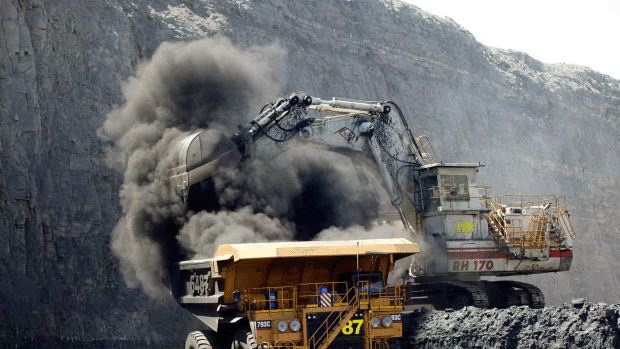 Aren’t we in a drought? The Australian black coal industry uses enough water for over 5 million people, The Conversation, Ian Overton, Adjunct Associate Professor, Centre for Global Food and Resources, University of Adelaide, 4 May 20, Aren’t we in a drought? The Australian black coal industry uses enough water for over 5 million people, The Conversation, Ian Overton, Adjunct Associate Professor, Centre for Global Food and Resources, University of Adelaide, 4 May 20, Water is a highly contested resource in this long, oppressive drought, and the coal industry is one of Australia’s biggest water users. Research released today, funded by the Australian Conservation Foundation, has identified how much water coal mining and coal-fired power stations actually use in New South Wales and Queensland. The answer? About 383 billion litres of fresh water every year. That’s the same amount 5.2 million people, or more than the entire population of Greater Sydney, uses in the same period. And it’s about 120 times the water used by wind and solar to generate the same amount of electricity. Monitoring how much water is used by industry is vital for sustainable water management. But a lack of transparency about how much water Australia’s coal industry uses makes this very difficult. Adani’s controversial Carmichael mine in central Queensland was granted a water licence that allows the company to take as much groundwater as it wants, despite fears it will damage aquifers and groundwater-dependent rivers. Now more than ever, we must make sure water use by coal mines and power stations are better monitored and managed………. No transparencyData on total water use by coal mines is not publicly available. Despite the development of Australian and international water accounting frameworks, there is no reporting to these standards in coal mine reports. This lack of consistent and available data means water use by the coal industry, and its negative effects, is not widely reported or understood. The problem is compounded by complex regulatory frameworks that allow gaps in water-use reporting. A patchwork of government agencies in each state regulate water licences, quality and discharge, coal mine planning, annual reviews of mine operations and water and environmental impacts. This means that problems can fall through the gaps…….. https://theconversation.com/arent-we-in-a-drought-the-australian-black-coal-industry-uses-enough-water-for-over-5-million-people-137591 |
|
|
|||||||
The human species destroys nature at its peril – pandemic a warning sign
|
As Tasmania prepares to enter the recovery phase of the COVID-19 pandemic, calls are growing for the crisis to be seen as a warning for the future. The pandemic has had widespread health and economic ramifications across Tasmania. Thirteen people have died, thousands have been quarantined and more than 20,000 people have lost their jobs. While we don’t know exactly what animal species the virus originated from, scientists widely consider bats the likely source. Dr Scott Carver is a senior lecturer at the University of Tasmania who specialises in the ecology and epidemiology of infectious diseases. He said human impacts on the environment can create new contacts with animals and increase risk of pathogens transferring between animals and humans.
“Pathogen spillover between species … happens quite often,” Mr Carver said. “It is just that most pathogens don’t cause really significant health outcomes. Some of them, however, do. “The chance of any one spillover event resulting in an epidemic is low, but if you increase the opportunity for that to happen, through increasing new contacts, then the probability increases.” He said implementing policies to limit the risk of potential future pandemics would benefit both public health and biodiversity. “With a growing human population size and growing human impacts on the environment it is not surprising that you get more of these events happening,” Dr Carver said. “It is incumbent upon us to really take a serious look at the way we treat the environment and think about policies that can limit these sorts of things.” UTAS’s Dr Olivia Hasler believes legislating a law of ecocide could be one way to approach establishing these policies. “Ecocide is an attempt to criminalise human activities that destroy and diminish the well-being and health of ecosystems and species within an ecosystem,” she said. She said the COVID-19 pandemic had highlighted how connected we were as a society, and she hoped that would not be forgotten in the recovery effort. “A law against ecocide would provide accountability to those that are in positions of power to make decisions about the use of our resources and shared land,” Dr Hasler said…… https://www.examiner.com.au/story/6743091/human-impacts-on-the-environment-could-be-increasing-the-risk-of-pandemics/?cs=95 |
|
Solar heating
 Renew Extra 2nd May 2020, Dave Elliott: Solar power prospects are looking good, but for solar heat as
well as solar electricity. It is clear than solar photovoltaic power generation is booming around the world, with over 580 GW of PV solar installed by the end of 2019, and much more expected, but it’s worth noting that there is also a large amount of direct solar heating system capacity in use (470 GW thermal), and that too is also growing.
large inter-seasonal heat stores, allowing summer heat to be used for winter warming via local district heating networks.
augments heat supplied by other means, including from biomass combustion, but new approaches are being adopted which enhance the solar and bioenergy input using large heat pumps. Although (fossil) gas fired heating still often has the edge, solar heating with heat stores can be competitive with other heating sources if district heating networks already exists, as they do in Denmark. And of course the carbon emissions associated with using
fossil gas are then avoided.
https://renewextraweekly.blogspot.com/2020/05/solar-heats-up.html
Australia’s govt betting on a fossil-fuel led recovery – despite expert advice on renewable energy
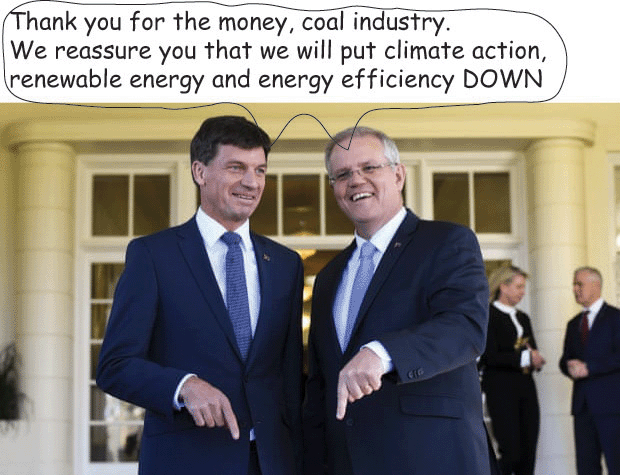 Trouble with gas: the Coalition is betting on the fossil fuel for recovery – but the sums don’t add up
The Australian government says gas is ‘essential’, but the global view is it’s the second-least desirable source of electricity Guardian, Adam Morton Environment editor @adamlmorton, Sun 3 May 2020 The agency that runs Australia’s electricity last week gave its verdict on how to deliver what would have seemed fanciful not that long ago – a power grid that within five years should at times be able to run on 75% wind and solar energy.
The Australian Energy Market Operator delivered a report on integrating renewable energy into the system with an optimistic message.
As described by its chief, New Yorker Audrey Zibelman, the technical capacity was already there, but markets and regulations would have to be adjusted. There were no “insurmountable reasons” why the grid could not take even higher levels of renewables, as it will need to for Australia to meet the Paris agreement goal of zero greenhouse gas emissions.
The minister in charge of both energy and cutting emissions, Angus Taylor, chose a different emphasis.
In a statement issued as the study was released, Taylor said it had highlighted the challenges of increased amounts of solar and wind given the system needed continuous inertia – support from constantly running “synchronous generation” – to ensure grid stability. He suggested that inertia could come from gas-fired power.
The market operator’s report does not mention gas generation, but the fossil fuel – often described as having half the emissions of coal, though recent studies have suggested it could be much more – is clearly on Taylor’s mind. A few days earlier he had given interviews to Nine newspapers to support the idea of a “gas-fired recovery” from the Covid-19 pandemic, suggesting it may be a focus of future economic stimulus measures……..
Andrew Grant, head of oil, gas and mining with London-based financial thinktank Carbon Tracker, says the global view of gas has flipped from it being seen as a cleaner fuel than coal, to it being the second-least desirable source of electricity. He points to analysis by the International Energy Agency that found global gas-fired power generation must begin to decline later this decade under a sustainable development scenario. “Better than coal is not exactly a ringing endorsement,” Grant says. …….
t there is little evidence that the Australian electricity grid will need more gas power. Last year, it provided about 9% of generation. The market operator assessment suggested this could fall to near zero in the second half of this decade before returning in a much smaller amount – less than a third of what it is now – in the 2030s if the grid was to run at lowest cost……
Simon Holmes à Court, senior advisor to the Climate and Energy College at the University of Melbourne, says the services needed for a secure power grid are increasingly available from sources other than gas, including government-backed large batteries and potentially through adjustments at wind or additions at solar farms……… https://www.theguardian.com/australia-news/2020/may/03/trouble-with-gas-the-coalition-is-betting-on-the-fossil-fuel-for-recovery-but-the-sums-dont-add-up
The nuclear pandemic — Beyond Nuclear International
Celebrating a sustainable Earth means eliminating nuclear power and weapons
Here’s who I’m cheering for — Beyond Nuclear International
Indigenous protectors of the Amazon deserve our applause too
via Here’s who I’m cheering for — Beyond Nuclear International
May 3 Energy News — geoharvey

Opinion: ¶ “In Midst Of Natural Gas Glut, Plastic Industry Bent, Not Broken (Yet)” • With energy demand dropping, there was the oil glut, and then a natural gas glut. Gas stakeholders have expanded petrochemical operations, anticipating an increase in the demand for plastic. But it seems that the plastic hedge is also starting to […]
South Australia winemaker completes shift to 100% renewables with solar car park — RenewEconomy

3MW solar system completed at Pernod Ricard Barossa Valley wineries rounds off the French company’s journey to 100% renewables for its Australian operations. The post South Australia winemaker completes shift to 100% renewables with solar car park appeared first on RenewEconomy.
via South Australia winemaker completes shift to 100% renewables with solar car park — RenewEconomy
Want an economic tonic, Mr Morrison? Use that stimulus money to turbocharge renewables — RenewEconomy

The best way to shore up Australia’s future energy supplies is to invest economic stimulus money in renewables. The post Want an economic tonic, Mr Morrison? Use that stimulus money to turbocharge renewables appeared first on RenewEconomy.
Another record month for rooftop solar, but Covid-19 likely to hit in May — RenewEconomy
Australia’s rooftop solar market charts second-highest month in April 2020 with 237MW new capacity. But analysts expect a Covid-19 drop-off to hit in May. The post Another record month for rooftop solar, but Covid-19 likely to hit in May appeared first on RenewEconomy.
via Another record month for rooftop solar, but Covid-19 likely to hit in May — RenewEconomy
1 This month

of the week – Australians for War Powers Reform (AWPR)
To see nuclear-related stories in greater depth and intensity
 Antinuclear