Colleen Grantham spells it out on Kimba nuclear waste dump- NO Broad Community Consent, NO Transparency
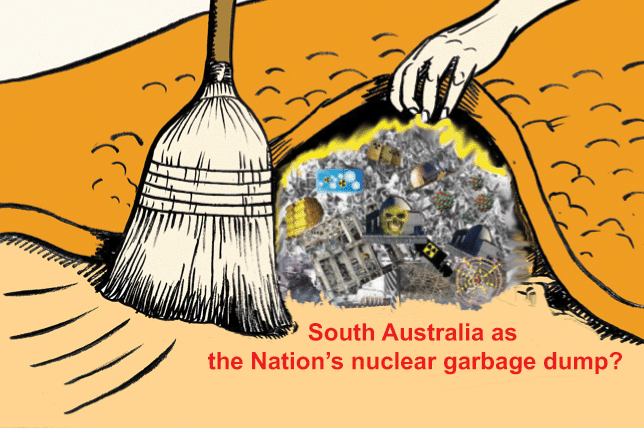
I am appalled to learn that the Native Title awarded to the Bungarla People of this District has been
dissolved on the property in question, thus providing an “out” for the Government to need to
consider their views on this issue.
we need to protect our country’s HEALTH and our
ECONOMY and I struggle to see how this facility in this location will do anything but destroy both.
Colleen Grantham Submission 89 to Committee Secretariat, Senate Standing Committees on Economics
Re – Proposed National Radioactive Waste Management Facility
Dear Committee
Thank you for taking the time to consider this submission of opposition to the establishment of a
National Radioactive Waste Management Facility on FARMING land known as ‘Napandee’ in the
District Council of Kimba.
I grew up the daughter of a farmer in the District Council of Wudinna which is a neighbouring council
precinct to Kimba. No one in this council district has had an opportunity to be heard or to influence
the outcome of the CLOSED voting on this facility, yet some of its farming residents live much closer
to the proposed site than those people residing in the township of Kimba. PLEASE PROVIDE AN
EXPLANATION HOW THIS OUTCOME CAN POSSIBLY BE CONSIDERED FAIR OR REASONABLE given the
potential direct NEGATIVE impacts such a facility could have on their future livelihoods and those of
the generations to come.
The Government and its Agencies have continued to widely publish via all mediums that the facility
in question has received “Broad Community Support” for its establishment at the Napandee site,
HOWEVER, not one of the FIVE Ministers who have held this portfolio during the FIVE years of
consideration of this project has EVER been able to publicly quantify or provide a decent description
of what BROAD COMMUNITY SUPPORT would entail. Instead it appears that those in power are just
making up a number as it suits their purpose, thus FORCING this project ahead DESPITE a huge
number of people both inside and outside the District Council of Kimba being OPPOSED to its
establishment.
The process to date has already, metaphorically speaking, exploded a nuclear bomb in the town and
wider district. A once tight knit, cohesive community is now so far divided that people are not
shopping locally or supporting other community activities because they feel unsafe in their own
town.
Given the far reaching implications that such a facility would have on the whole of Eyre Peninsula, I
would have thought it PRUDENT that any Government consider the thoughts and impacts on the
WHOLE OF EYRE PENINSULA and not just one single Council district consisting of approximately 800-
900 people. This is a NATIONAL issue, bringing with it serious potential risks which should absolutely
NOT be decided on the thoughts of one small community of this size.
FARMING land in South Australia represents 4.5% of the state’s total land mass. I CANNOT
understand how any responsible Government would willingly sacrifice and put at risk productive
agricultural land that makes a huge contribution to the economy of this state and therefore this
nation! Continue reading
Shirley Inglis – 5th generation Kimba resident – on hasty nuclear waste legislation – this plan has really hurt people
Shirl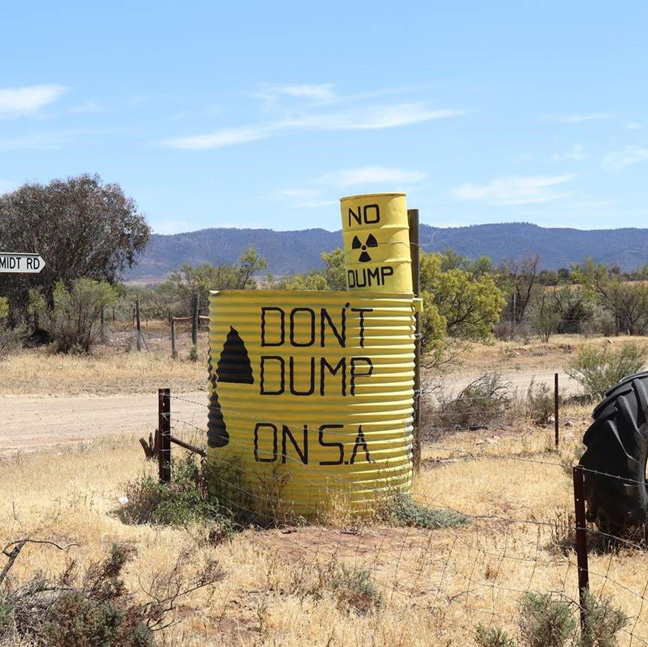 ey Inglis – Submission to Sentae Committee re National Radioactive Waste Management Amendment (Site Specification, Community Fund and Other Measures) Bill 2020 [Provisions] Submission 88
I have found it difficult to understand why a radioactive waste facility needs to be placed amongst farmlands in Kimba. The community I grew up in has seen many changes, growth and struggles over time, but has survived. Much smaller communities than ours continue to soldier on despite hardships and adapted to these circumstances.
Only Kimba has been chosen to host a facility after Rowan Ramsey thought it was a good idea back in 2015 to nominate his land. What has happened since is continued stance that this must be accepted at all cost. I have a lack of trust in what the government proposes and how this has continually changed just like this amended Bill.
As I see out my twilight years that has seen five generations of family live in this community, it is saddening to think of how this has really hurt people.
People must be comfortable with such a proposal, and the best possible solution for Australia’s radioactive waste must be the government’s priority to take the time to get it right..
I hope that your Committee can recommend a better process to be found that respects all Australians to find the right outcome, and not this one.
Assange unwell, stuck in solitary confinement while court hearing delayed till September
In his fight against extradition to the US, where he faces 175 years in prison and being subjected to harsh conditions under “Special Administrative Measures”, Assange is rendered defenseless. He is in effective solitary confinement, being psychologically tortured inside London’s maximum-security prison. With the British government’s refusal to release him temporarily into home detention, despite his deteriorating health and weak lung condition developed as consequences of long detention, Assange is now put at risk of contracting coronavirus. This threatens his life.
Now, as the world stands still and becomes silent in our collective self-quarantine, Assange’s words spoken years ago in defense of a free internet call for our attention from behind the walls of Belmarsh prison:
“Nuclear war, climate change or global pandemics are existential threats that we can work through with discussion and thought. Discourse is humanity’s immune system for existential threats. Diseases that infect the immune system are usually fatal. In this case, at a planetary scale.”
 Assange’s US extradition, Threat to Future of Internet and Democracy, CounterPunch by NOZOMI HAYASE 8 May 20 On Monday May 4, the British Court decided that the extradition hearing for WikiLeaks publisher Julian Assange, scheduled for May 18, would be moved to September. This four month delay was made after Assange’s defense lawyer argued the difficulty of his receiving a fair hearing due to restrictions posed by the Covid-19 lockdown. Monday’s hearing at Westminster Magistrates’ Court proceeded without enabling the phone link for press and observers waiting on the line, and without Assange who was not well enough to appear via videolink.
Sunday May 3rd marked World Press Freedom Day. As people around the globe celebrated with online debates and workshops, Assange was being held on remand in London’s Belmarsh prison for publishing classified documents which exposed US war crimes in Iraq and Afghanistan. On this day, annually observed by the United Nations to remind the governments of the importance of free press, Amnesty International renewed its call for the US to drop the charges against this imprisoned journalist.
The US case to extradite Assange is one of the most important press freedom cases of this century. The indictment against him under the Espionage Act is an unprecedented attack on journalism. This is a war on free speech that has escalated in recent years turning the Internet into a battleground.
Privatized censorship Continue reading
Small agricultural communities target in USA, and now in Australia, for toxic radioactive nuclear wastes
Paul Waldon Fight To Stop A Nuclear Waste Dump In South Australia, 7 May 20
Here in South Australia we have the small agriculture community of Kimba destined to run the same parallels, fueled by the same environmentally blind visions of a few community and socially impudent locals.
So with the WHO’s loss of economic gratuity, no permission to report, a nuclear coterie that is not forthcoming when there are accidents, a media that is nobbled by government interests and the U.S.NRC events notification reporting no less than 1,100 accidents per year, how can anyone lay claim this is a safe industry? https://www.facebook.com/groups/941313402573199/
Global heating: intolerable bouts of extreme humidity and heat already coming to pass across the world
 Potentially fatal bouts of heat and humidity on the rise, study finds Potentially fatal bouts of heat and humidity on the rise, study finds
Scientists identify thousands of extreme events, suggesting stark warnings about global heating are already coming to pass, Guardian, Nina Lakhani 9 May 2020 Intolerable bouts of extreme humidity and heat which could threaten human survival are on the rise across the world, suggesting that worst-case scenario warnings about the consequences of global heating are already occurring, a new study has revealed.Scientists have identified thousands of previously undetected outbreaks of the deadly weather combination in parts of Asia, Africa, Australia, South America and North America, including several hotspots along the US Gulf coast. Humidity is more dangerous than dry heat alone because it impairs sweating – the body’s life-saving natural cooling system. The number of potentially fatal humidity and heat events doubled between 1979 and 2017, and are increasing in both frequency and intensity, according to the study published in Science Advances.…… The ominous findings come as something of a surprise to scientists, as previous studies had projected such extreme weather events would occur later in the century, mostly in parts of the tropics and subtropics where humidity is already a problem. ….. https://www.theguardian.com/environment/2020/may/08/climate-change-global-heating-extreme-heat-humidity |
|
The Liberal coalition government killing the ABC by 1000 cuts – but a possible way exists to save it
 With luck the ABC can be saved , Crispin Hull, 8 May 20, This week’s report on ABC funding should alarm Australians.
The death by a thousand cuts of the ABC and the slow strangulation of Medicare have become woven into in Liberal Party’s DNA since John Howard turned Robert Menzies’ broad church of a liberal-conservative Liberal Party into a purely conservative one by shutting out almost everyone left of the nave.
A different liberal-conservative Liberal Party, on the other hand, would have recognised them as essential Australian institutions to be nurtured and supported. After all, the ABC has been around since 1932 and Medicare (in one form or another) since 1973.
The Liberal Party’s desired outright abolition of both has been impossible because of the two institutions’ ingrained popularity. So the onslaught has to be cunningly dressed up as measures to “improve” Medicare and to voice support for the independence of the ABC and promise “no cuts” while ever trying to bully the ABC; sway its board to the right; and to apply cuts to stifle its voice.
This week’s report by the independent think tank Per Capita says that the ABC has lost $783 million in funding since the Coalition came to power in 2013, starting with $245 million in the 2014 Budget, despite Tony Abbott’s promise before the 2013 election that he would not cut the ABC.
More cuts in staff and programming will come before the end of this financial year. They follow seven years of program and staff slashing, critically a 50 per cent cut in the hours of scripted Australian drama.
The Per Capita report concludes that real funding per year since 1985-86 is down 30 per cent or $370 million. Per head of population, the ABC’s funding has been halved in that time. The cuts have come despite the ABC having to provide extra services to keep up with the digital age.
Very likely the Government will cut more as it seeks to claw back from the Covid-19 crisis, even though the ABC – especially the excellent Dr Norman Swan – did so much to inform Australians about the pandemic, as it always does in times of crisis.
What can be done? The ABC itself is down to the bone, though perhaps it could cut out all sport which the commercials to well enough. It is doubtful a Coalition Government would ever increase real funding for the ABC. Perhaps the best we can hope for is that Labor makes some suggestions that the Coalition feels obliged to match or that they become reality with a Labor Government (whenever that might be). ……..
funding solution used in Britain, New Zealand, and only Western Australia among the Australian states to fund culture which could help fund the ABC – a lottery. The Federal Government should set up its own national lottery to boost ABC funding……..
The BBC is well-funded and broadcasters throughout the world line up to pay for its product. The result is a lot of soft-power dividend for Britain. Australia, too, would get a lot of benefit from properly funding the ABC, not least a better-informed community.
Silly me. It’s that last bit the Coalition detests more than anything. http://www.crispinhull.com.au/2020/05/08/with-luck-the-abc-can-be-saved/?utm_source=mailpoet&utm_medium=email&utm_campaign=crispin-hull-column-16-nov-2019_99
Australian government stops listing major threats to species under environment laws
|
Australian government stops listing major threats to species under environment laws
Documents show department has stopped recommending assessment of ‘key threatening processes’ affecting native wildlife Lisa Cox ,Guardian 8 May 2020 The federal government has stopped listing major threats to species under national environment laws, and plans to address listed threats are often years out of date or have not been done at all. Environment department documents released under freedom of information laws show the government has stopped assessing what are known as “key threatening processes”, which are major threats to the survival of native wildlife. Conservationists say it highlights the dysfunctional nature of Australia’s environmental framework, which makes aspects of wildlife protection optional for government. The Environment Protection and Biodiversity Act is being reviewed, a once-a-decade requirement under the legislation, and there are calls for greater accountability rules to be built into Australia’s environmental laws. It follows longstanding criticism that the act is failing to curb extinction. ‘An unacceptable excuse’In a series of reports since 2018Australia has uncovered multiple failures including delays in listing threatened species and habitats, threatened species funding being used for projects that do not benefit species, critical habitat not being protected, and recovery actions for species not being adopted or implemented. The act lists threats such as feral cats, land clearing and climate change as key threatening processes that push native plants and animals towards extinction. Once a threat is listed, the environment minister decides whether a plan – known as a threat abatement plan – should be adopted to try to reduce the impact of the threat on native species. Advertisement
But a 2019 briefing document shows the department has stopped recommending the government’s threatened species scientific committee assess new key threatening processes for potential listing……… ‘It’s shocking really’Further government data shows that of the 21 listed major threats, only three of those were listed in the last decade of the act, the most recent was in 2014…… The process for listing threats can also take years and is subject to ministerial discretion. Major alterations to the flow of river systems – caused by industry and dams – was accepted by the department for assessment in 2016 but removed from the list by the then environment minister, Josh Frydenberg. The only major threat currently under assessment – “fire regimes that cause biodiversity decline” – has been on the assessment list since 2008 and remains incomplete 12 years later. Its deadline is listed as August 2013. Fire regimes that cause biodiversity decline refers to changes in the frequency and scale of fire due to human influence. Every state of the environment report identifies changed fire patterns as a major threat to the survival of native wildlife. “They haven’t even listed it as a threat, let alone done something about it. It’s shocking really,” Andrew Cox, the chief executive of the Invasive Species Council, said. ……. ‘The system’s broken’Environmental organisations and the threatened species scientific committee have highlighted the weaknesses of the KTP system in submissions to the EPBC review, chaired by Graeme Samuel. ‘The system’s broken’Environmental organisations and the threatened species scientific committee have highlighted the weaknesses of the KTP system in submissions to the EPBC review, chaired by Graeme Samuel……… “It’s all optional. That’s the problem,” James Trezise, a policy analyst at the Australian Conservation Foundation, said. “A threat abatement plan is this optional thing where it’s optional to establish them, it’s optional to implement them, there’s no system for tracking them and there’s not enough resources available.”…. https://www.theguardian.com/environment/2020/may/08/australian-government-stops-listing-major-threats-to-species-under-environment-laws |
|
Australian Renewable Energy Agency funds end in 2022 – a major blow for solar research
 ‘Major blow’ looms for top Sydney solar research unit as funds wither, SMH. By Peter Hannam, May 8, 2020 The future of a leading research centre whose designs power $50 billion in solar systems globally is at risk because of the uncertain future of the federal government agency that funds it.Richard Corkish, a senior lecturer at the University of NSW’s School of Photovoltaic and Renewable Energy Engineering, said as much as 80 per cent of his section’s money is provided by the Australian Renewable Energy Agency (ARENA) which is due to run out of funds in 2022. ‘Major blow’ looms for top Sydney solar research unit as funds wither, SMH. By Peter Hannam, May 8, 2020 The future of a leading research centre whose designs power $50 billion in solar systems globally is at risk because of the uncertain future of the federal government agency that funds it.Richard Corkish, a senior lecturer at the University of NSW’s School of Photovoltaic and Renewable Energy Engineering, said as much as 80 per cent of his section’s money is provided by the Australian Renewable Energy Agency (ARENA) which is due to run out of funds in 2022.
We’ll get significantly smaller unless something positive comes along,” said Dr Corkish, who is also chief operating officer of the UNSW-based Australian Centre for Advanced Photovoltaics. “It’s a major blow for us.” His school has already begun turning away prospective PhD students who would otherwise have contributed to multiple lines of scientific inquiry aimed at improving the efficiency and performance of solar cells, their integration into power networks and other renewable energy developments. …… Mark Butler, Labor’s climate spokesman, said “letting ARENA’s resourcing lapse is a devastating self-inflicted wound for Australia’s clean energy future that exposes the Liberals anti-renewable and anti-climate action ideology”. “Scott Morrison should be looking for a COVID-19 recovery plan which brings forward investment in new renewable projects which would create tens of thousands of new jobs, stimulate regional economies, and deliver cheaper power prices,” Mr Butler said. Mark Butler, Labor’s climate spokesman, said “letting ARENA’s resourcing lapse is a devastating self-inflicted wound for Australia’s clean energy future that exposes the Liberals anti-renewable and anti-climate action ideology”. “Scott Morrison should be looking for a COVID-19 recovery plan which brings forward investment in new renewable projects which would create tens of thousands of new jobs, stimulate regional economies, and deliver cheaper power prices,” Mr Butler said……. https://www.smh.com.au/environment/climate-change/major-blow-looms-for-top-sydney-solar-research-unit-as-funds-wither-20200507-p54r3j.html |
|
W.A. rare earths mine taps solar and battery storage — RenewEconomy
Northern Minerals signs PPA with Soluna Australia for 100kW solar, 200kWh battery system to help power its Brown’s Range rare earths mine in W.A. east Kimberley region. The post W.A. rare earths mine taps solar and battery storage appeared first on RenewEconomy.
via W.A. rare earths mine taps solar and battery storage — RenewEconomy
May 8 Energy News — geoharvey
Science and Technology: ¶ “Planting Trees Is No Panacea For Climate Change, Says Ecologist” • In a commentary that appears in Science, an ecologist at the University of California Santa Cruz and a forestry scientist at the University of São Paulo endorse the benefits of trees but caution against a simplistic view of tree-planting as […]
Queensland’s Yurika to install 15MW of solar on shopping centres — RenewEconomy

Queensland government-owned utility Yurika Energy inks deal with QIC Global Real Estate to install 15MW of rooftop solar across five major shopping centre sites. The post Queensland’s Yurika to install 15MW of solar on shopping centres appeared first on RenewEconomy.
via Queensland’s Yurika to install 15MW of solar on shopping centres — RenewEconomy
Helen Haines launches renewable energy plan for regional Australia — RenewEconomy
Independent Federal Member for Indi Helen Haines has launched a plan to ensure regional Australia benefits from a coming boom in renewable energy. The post Helen Haines launches renewable energy plan for regional Australia appeared first on RenewEconomy.
via Helen Haines launches renewable energy plan for regional Australia — RenewEconomy
Switching to renewables could cut industry energy costs by almost a quarter — RenewEconomy

Australian heavy industries could slash energy costs by turning to wind and solar, and the clean energy switch is key to a manufacturing revival. The post Switching to renewables could cut industry energy costs by almost a quarter appeared first on RenewEconomy.
via Switching to renewables could cut industry energy costs by almost a quarter — RenewEconomy
States so far ahead of Australia government, it’s as if they are in a different industrial era — RenewEconomy
A tri-partisan mix of Liberal, Labor and Greens energy ministers show that states and territories are so far ahead of federal Coalition government on climate and energy, it’s as though they are in a different industrial era. The post States so far ahead of Australia government, it’s as if they are in a different industrial…
Covid-19 co-operation lays out pathway for climate ambition, CMI says — RenewEconomy

Carbon Markets Institute chief says new found government cooperation provides chance to align Covid-19, bushfire responses with climate action. The post Covid-19 co-operation lays out pathway for climate ambition, CMI says appeared first on RenewEconomy.
via Covid-19 co-operation lays out pathway for climate ambition, CMI says — RenewEconomy
1 This month

of the week – Australians for War Powers Reform (AWPR)
To see nuclear-related stories in greater depth and intensity
 Antinuclear