A reality check on the cost of nuclear power for Australia
 Nuclear cost and water consumption – The elephants in the control room, Open Forum.com.au. Peter Farley | December 20, 2019 Nuclear cost and water consumption – The elephants in the control room, Open Forum.com.au. Peter Farley | December 20, 2019 Cost There are four nuclear plants being built around the world where public information on costs is reasonably reliable.
These are Plant Vogtle in the US (US$27.5bn, 2.2GW), Framanville France (€12.4bn+, 1.6 GW), Olkiluoto in Finland (around €10 bn+, 1.6 GW) and Hinckley Point in the UK (₤22 bn+, 3.2 GW). There are two further plants whose power costs have been published, Akkuyu in Turkey US$127/MWh and Barakah in the Emirates US$110/MWh. It should be emphasised that none of these costs are the full cost recovery. For example in the British case it is estimated that some $10 bn has been spent by others on upgrading the grid and backup power supplies. In Turkey the cost of the plant is just that, and doesn’t include civil works, grid connections, cooling water supply. In the US plant Vogtle has benefited from some US$8bn of federal government loan guarantees and an unusual form of financing where customers have paid about 8% premium on their bills for 10-12 years before the plant is to be commissioned. All of the plants get catastrophe insurance and some security from their government and most have inadequate bond structures for long term waste storage. They also rarely pay for cooling water. Many have preferential supply agreements which will require other cheaper sources of power to turn off to allow the nuclear plants to keep running. However, even on the published information, nuclear power plants in democracies are running at about A$13m/MW. In our case we do not have an experienced nuclear workforce, Australian construction costs are higher by 20-30% for large projects – and there are 5,000 tradesmen on site at Plant Vogtle out of a workforce of 9,000 as nuclear power plants are very large projects. We do not have the heavy fabrication facilities required, and these cost hundreds of millions to build For example the Osborne Naval Shipyard design for 1/10th of the throughput of a nuclear fab shop cost $380m. Even the inspectors would have to be imported. So it is reasonable to suggest that new nuclear in Australia would cost at least A$16m per MW including subsidised construction finance, resulting in a first day of operation cost of a 2.2 GW plant of A$41 bn. Amortised over 50 years station life at a very low weighted average cost of capital at 5.5% – lower than plant Vogtle – that still works out at about $2.4 bn/yr. Due to the variability of demand in Australia the plants would be unlikely to be able to achieve a capacity factor above about 80% – halfway between the US and France and higher than Korea. So over a typical year a two unit 2.2 GW plant would be expected to generate about 15,500,000 MWh meaning the fixed costs per MWh would be $2.4bn/15.5m or $156/MWh. The daily running costs of US nuclear plants average out at US$40/MWh. This is lower than France and almost certainly lower than any new nuclear plant in Australia could achieve due to the much larger American skill base, higher utilisation and lower operating temperatures. The best case for Australia would be A$60+ for maintenace and operation. Thus an Australian nuclear power station could be expected to deliver power at a cost of A$216/MWh. Now if you use the cheaper Barrakah design at about US$5,300/MW and allow for 15 years of inflation at 1.5% to allow time for the project to come online, and a modest 10% Australian premium, power here could be produced at about A$10.4 bn per GW. After a slightly lower capacity factor of 75%, about the same as Korea, and a realistic WACC of 6.5% the ammortisation amounts to $107/MWh with a similar A$60/MWh operating and maintenance cost and the total delivered cost of power is a mere A $167/MWh. This figure aligns closely with the figure quoted by the CEO of the Barrakah plant some years ago at US$110/MWh The costs of a renewable alternative It should be noted that many of the arguments about relative costs are based on the figures used in the Finkel report. These are well out of date. Nuclear power has become even more expensive and actual renewable contracts in Australia are down 40-50% on the Finkel figures. Thus if we dispersed 2 GW of wind $3.6 bn, 1.2 GW of tracking solar $1.8bn, 2 GW of rooftop solar $2.5 bn, 1 GW of waste/biomass/geothermal $2.5bn and 1 GW/15GWh of pumped hydro $1.8 bn and 1 GW/ 2 GWh of batteries $1.2bn across the NEM the total cost would be $13.5 bn. Annual generation would be 17,500 GWh – more than the nuclear plant – and minimum available output would be 2.5 GW+. Typical hot day peak demand at 5pm would be about 4GW. About 30% of generation would go through storage at 85% efficiency, so net output would be around 16,500 GWh. Some would be curtailed so we can assume a similar annual output to the nuclear plant. However the operating costs average around $18 and the capital, even if amortised over 30 years are only $59/MWh for a total of $77 including backup. In summary, for 1/3rd of the investment, in one third of the time, we can get renewable power and backup for 1/3rd of the cost of nuclear power……https://www.openforum.com.au/nuclear-cost-and-water-consumption-the-elephants-in-the-control-room/?fbclid=IwAR2M3NxMjfrDJNWTG9tatKSARHGUKWVcG_CE-bSW5wtnAbwhGnYxd1ElugU |
|
Graham Mantle: substantial bribe and biased propaganda, as the Australian Government foists a nuclear waste dump on a farming community
 Graham Mantle, To the Committee of Inquiry: National Radioactive Waste Management Amendment (Site Specification, Community Fund and Other Measures) Bill 2020 [Provisions] Submission 44
The possibility of a National Radioactive Waste Management Facility at Kimba concerns far more than 61.58% of the people of Kimba. (Approximately 600 in favour)
I submit that this facility, together with a substantial bribe for Kimba, is being foisted on South Australia and the Eyre Peninsula in particular because no other state wants it. The fact that it has taken the government five
years to gain a 61.58% majority of the Kimba population of 1057 speaks for itself.
I have seen the kind of persuasive information to which the people of Kimba have been subjected. The ‘information’ fed to them carefully avoided mention of the possibility or probability of adverse perceptions, not only towards Kimba and what is grown there, but towards the entire Eyre Peninsula and even South Australia as a whole. viz “ South Australia – oh yes, the nuclear dump state…”
Farming, though rewarding, is a tough game and, after overcoming all the other issues, you don’t need adverse
perceptions when it comes to selling your produce. Tourism, too, can be a fickle business and perceptions are
vital to attracting visitors to the peninsula.
The Barngarla traditional owners a voice for over 3000 First Nation people who reside on Eyre Peninsula have
been denied a hearing in this deliberation. That is inexcusable in the spirit of reconciliation. They, together with
all who live on the Eyre Peninsula, have a right to be heard.
Finally, I draw your attention to South Australian Legislation:
Nuclear Waste Storage Facility (Prohibition) Act 2000.
This Act binds the Crown in right of the State and, in so far as the legislative power of the State permits, in all
its other capacities.
The objects of this Act are to protect the health, safety and welfare of the people of South Australia and to
protect the environment in which they live by prohibiting the establishment of certain nuclear waste storage
facilities in this State.
I implore you to reject the proposal to put a radioactive waste facility at Kimba.
With respect
Graham Mantle
Injustice of UK court process regarding Julian Assange. Assange too sick to attend

2. In addition to other ongoing health concerns, Assange faces the serious risk of exposure to Covid in Belmarsh prison, and has been advised that even going to the video room to take part in hearings is unsafe. This is another reason he should be immediately released.
3. Assange’s lawyers have long complained they have had insufficient access to him in prison. Under lockdown conditions, they have had no access to him at all. They have repeatedly flagged that this lack of access seriously impacts their ability to prepare his defence.
4. One of the next steps agreed today is that psychiatric reports on Assange from the prosecution and defence will be due to the court on 31 July. Remember that UN Special Rapporteur @NilsMelzer has expressed alarm many times that Assange shows symptoms of psychological torture.
5. It is a welcome step that the continuation of the full extradition hearing was adjourned, as lockdown conditions present clear barriers to open justice – but 7 September may not be late enough to make a meaningful difference. Also the court is still struggling to find a venue.
6. It remains extremely frustrating that the court does not adequately accommodate NGO observers. I have never experienced so much difficulty accessing a trial in any country as at Woolwich Crown Court in February, and the teleconference option we now have is far from sufficient.
7. The press are also facing severe restrictions. Only 6 journalists have been allowed to attend in person the past 2 hearings, with others limited to the awful phone line. This case is of high public interest and a better solution must be found before the full hearing resumes.
8. Assange’s next callover hearing has been scheduled for 29 June at 10 am. We urge the court to find workable solutions to enable his safe attendance and ensure the press and observers are able to properly monitor proceedings. /END
Massive amounts of money flow from U.S. taxpayers into the nuclear industry
 The Crushing Cost Of Nuclear Waste Is Weighing On Taxpayers, Oil Price
By Haley Zaremba – Jun 19, 2019 The Maine Yankee nuclear power plant hasn’t produced a single watt of energy in more than two decades, but it cost U.S. taxpayers about $35 million this year.” So begins a powerful report this week about the crushing cost of nuclear waste storage by the Los Angeles Times……..
In the United States, where the nuclear industry is ailing, this is particularly bad news. More plants are shutting down than are going online, and many of the nuclear plants that are continuing to function are able to do so in large part thanks to government subsidies at the state level, which is to say, even more taxpayer dollars.
The Trump administration, for its part, has made efforts to combat the rising prices of nuclear waste storage–albeit extremely controversial ones. Just this month, “in a move that will roll back safety standards that have been observed for decades” says not-for-profit news organization Truthout, “the Trump administration reportedly has plans to reclassify nuclear waste previously listed as “high-level” radioactive to a lower level, in the interest of saving money and time when disposing of the material.”
While this may be a quick fix for the massive amounts of money flowing out of taxpayer pockets and into the nuclear energy industry, it’s certainly not a sustainable solution for what could easily become a national health crisis if mismanaged. ……https://oilprice.com/Alternative-Energy/Nuclear-Power/The-Crushing-Cost-Of-Nuclear-Waste-Is-Weighing-On-Taxpayers.html
Concerns raised over pension investments in nuclear weapons

“Once this is ratified by 50 states and comes into effect as a new piece of international law, the implications will be significant for nuclear armed states and financial institutions alike.
“The biggest banking corporations have a global reach and cannot disregard international law.”
03/6/20 A report by the UK Nuclear Weapons Financing Research Group has raised concerns about the number of pension providers investing in companies that are producing nuclear weapons.
The report, Banks, Pensions and Nuclear Weapons: Investing in Change, found that among pension providers, policy on restricting investment in nuclear weapons is generally limited to ethical funds. Continue reading
COVID-19 Commission stacked with fossil-fuel bigwigs. Surprise surprise -they find gas is the answer
 Transparency called for in fossil fuel-stacked COVID-19 Commission, Independent Australia, Martin Hirst | 2 June 2020 Who’s running the country and where are they taking us? Dr Martin Hirst thinks the Canberra bubble is filling with gas.
IN THE LAST WEEK of March, right at the start of Australia’s response to the coronavirus pandemic, Prime Minister Scott Morrison announced the formation of the National COVID-19 Coordination Commission (NC-19CC). He said it would “solve problems” so “we all get through to the other side”.
Now, at the start of June, we have some idea of what the “other side” looks like according to the leading figures on the Coordination Commission. From what we can glean from the cheap seats in the bleachers, the future is going to be a gas — literally gas……
For a start, the NC-19CC is an energy sector lovefest.
The Commission chair is Neville (Nev) Power and he’s well connected to the Australian energy and mining industries. He is Deputy Chairman of Strike Energy Ltd and for nearly a decade was managing director and CEO of Fortescue Metals Group.
Catherine Tanna is the managing director of Energy Australia, ‘one of Australia’s leading electricity and gas retailers’ according to the helpful but rather anodyne biographies provided on the commission’s website.
The commission’s “special advisor” is the American chemical industry leader, Andrew Liveris, a former CEO and chairman of the Dow Chemical Company and on the board of a major Saudi oil company.
There are two other important members of NC-19CC: the head of the Department of Prime Minister and Cabinet, Phil Gaetjens and the head of Home Affairs, Mike Pezzulo. These are also political appointments — Gaetjens is a loyal fixer for Morrison and Pezzulo is Home Affairs Minister Peter Dutton’s lieutenant.
Who does the Commission report to?
Australians first heard of the Coordinating Commission when Morrison announced it at a media event on 25 March, but he didn’t tell us how the members were selected, or why, or by whom.
Presumably, it was a “captain’s pick” by Morrison……
In mid-May, the Senate select committee that is holding an ongoing inquiry into the Government’s response to the pandemic requested Mr Power come and chat with it, but he didn’t show up. Instead, the PM’s protector, Phil Gaetjens and Peter Harris, the CEO of the Commission, came to block any real scrutiny of the Commission.
All that the senators were able to learn was that there are no rules in place for managing conflicts of interest and that the Commission’s members and advisors were being handsomely paid for their time and service. According to the transcript, almost every other question was stonewalled.
Apparently, the commissioners are also recruiting other people “through their own networks” according to Phil Gaetjens, but who remain largely unknown to the public — to help across various things to do with the economy re-opening.
Greens Senator Peter Whish-Wilson grilled Phil Gaetjens about the advice the commissioners might provide, but the PM’s advisor would only say that most advice would be confidential.
This has not satisfied a coalition of public interest watchdog groups who collectively issued a statement calling for greater transparency round the discussions and decisions of the NC-19CC………
I should mention that many environmental groups are concerned that the COVID-19 Commission is stacked with fossil fuel advocates, and with good reason. …… https://independentaustralia.net/politics/politics-display/transparency-called-for-in-fossil-fuel-stacked-covid-19-commission,13954
Australia’s first offshore wind project says it can cover early exit of Yallourn — RenewEconomy
The proposed 2,000MW Star of the South project – what would be Australia’s first offshore wind farm – says it can cover the loss of an early exit of Yallourn, one of Victoria’s three remaining brown coal generators. Yallourn was not scheduled to close until around 2032, although the Australian Energy Market Operator has now……
via Australia’s first offshore wind project says it can cover early exit of Yallourn — RenewEconomy
Electric and hybrid car sales jump in Australia, as fossil fuel market plunges again — RenewEconomy
Sales of fossil fuel cars plunged again in Australia last month, but plug-in and hybrid sales increased, pointing to fundamental change in the market. The post Electric and hybrid car sales jump in Australia, as fossil fuel market plunges again appeared first on RenewEconomy.
via Electric and hybrid car sales jump in Australia, as fossil fuel market plunges again — RenewEconomy
June 3 Energy News — geoharvey

Opinion: ¶ “Extinction Crisis ‘Poses Existential Threat To Civilisation’” • Human impacts on the places on Earth with the most richness of life have brought hundreds of wild animals to the brink of extinction, a study shows. We are in the sixth mass extinction, with only ourselves to blame. And what we do in the […]
Rooftop solar market powers on in Australia, despite Covid-19 blip — RenewEconomy
Covid-19 finally having some impact on Australian rooftop solar market, but May installations were still the third highest month on record. The post Rooftop solar market powers on in Australia, despite Covid-19 blip appeared first on RenewEconomy.
via Rooftop solar market powers on in Australia, despite Covid-19 blip — RenewEconomy
China takes steps to exclude “clean coal” eligibility for green bonds — RenewEconomy
Small but significant climate step forward for China with reports Beijing has moved to exclude “clean coal” technologies from a list of projects eligible for green bonds. The post China takes steps to exclude “clean coal” eligibility for green bonds appeared first on RenewEconomy.
via China takes steps to exclude “clean coal” eligibility for green bonds — RenewEconomy
Webinar: Opportunities in high efficiency, bifacial, and new solar designs — RenewEconomy
How quickly should Australian developers and installers embrace new solar technologies in their projects? Solar technology efficiencies always seem to be increasing. How did we get here and what does it mean for bankable, bifacial projects in Australia? What can we learn from the international solar supply chain and technology deployment trends? What considerations should……
via Webinar: Opportunities in high efficiency, bifacial, and new solar designs — RenewEconomy
Solar and wind’s stunning cost advantage sparks call for mass coal closure — RenewEconomy
Stunning cost reductions in solar and wind power continue, with countries urged to replace 500MW of existing coal to deliver billions in savings. The post Solar and wind’s stunning cost advantage sparks call for mass coal closure appeared first on RenewEconomy.
via Solar and wind’s stunning cost advantage sparks call for mass coal closure — RenewEconomy
1 This month
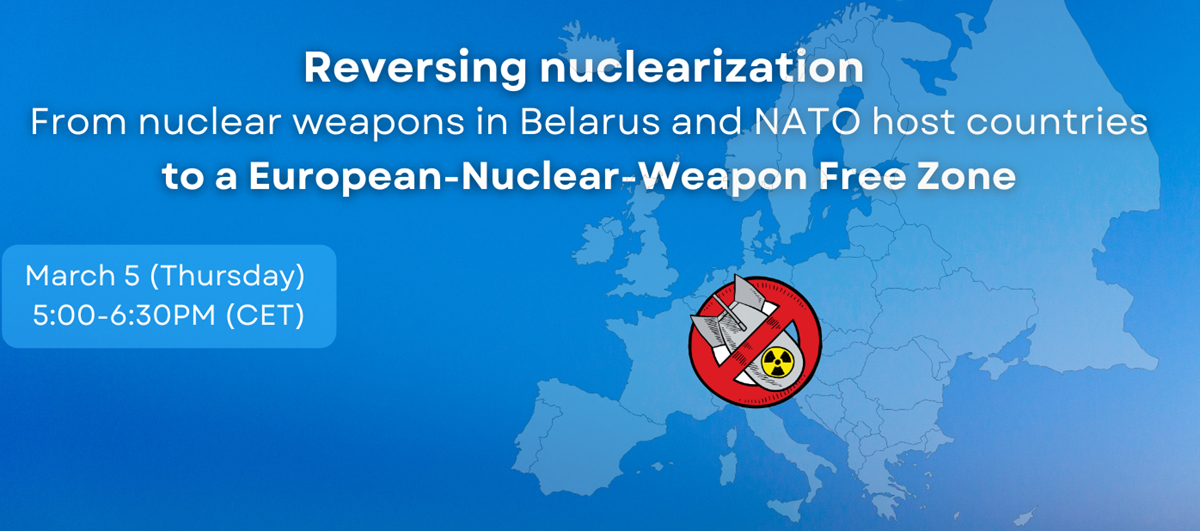
6 March -Online – Reversing nuclearization:
From nuclear weapons in Belarus and NATO host countries to a European-Nuclear-Weapon Free Zone
Mar 6, 2026 03:00 AM in Canberra, Melbourne, Sydney

of the week – Australians for War Powers Reform (AWPR)
To see nuclear-related stories in greater depth and intensity
 Antinuclear