Australia’s govt rushes nuclear waste Bill through Lower House, but this story is not over.
The federal government’s radioactive waste laws the House of Representatives today, however they failed to win broad support or approval.
Importantly, Labor joined with Greens, Centre Alliance and independents to vote against the contested push to move Australia’s radioactive waste from ANSTO’s secure Lucas Heights facility in southern Sydney to a site near Kimba in regional South Australia.
While accepting the need for improved radioactive waste management, Labor MPs highlighted deep concerns with the government’s approach and called for further detail and review.
Concerns included:
- The double handling of problematic and long-lived Intermediate Level Waste (ILW) through the unnecessary transport from an above-ground extended interim storage facility at ANSTO to an above-ground extended interim storage at a less resourced regional facility.
- The continuing opposition of the region’s Barngarla Traditional Owners.
- The lack of a rationale for a new set of waste laws.
- The government’s decision not to de-couple consideration of the different waste streams (ILW and Low Level Waste). Labor urged the government to allow wider project consideration, including through a current Senate review.
The Greens spoke strongly against the plan – as did Zali Steggall. Andrew Wilkie and Centre Alliance’s Rebekah Sharkie also voted against the legislation – further details in the Hansard transcript and voting record attached fyi
From here – among other things – we need to work to highlight and detail the unresolved concerns via the Senate review (still tracking to report at the end of July) and the subsequent Senate consideration and vote on these laws.
Today the government has had a short-term political win at the expense of building consensus or credibility – we saw a political numbers exercise but we did not see agreement, evidence or responsibility. The government’s plan is deeply deficient and more people are seeing and acknowledging this – this story will grow and change the approach to radioactive waste management.
Australia’s House of Representatives passed the National Radioactive Waste Management Amendment Bill
 11 June 2020, Federal govt just passed the National Radioactive Waste Management Amendment Bill through the lower house of federal parliament, which sounds like bad news but could be good news, an own goal by the government and minister Keith Pitt
Labor voted against the Bill and spoke strongly against it (including the shadow minister Brendan O’Connor, SA MP Tony Zappia and others) … raising issues of Traditional Owner opposition, double-handling of intermediate-level waste, etc etc. I’m guessing Labor also pointed out that voting on the Bill before the Senate Inquiry is complete is poor form.
Zalia Steggall spoke strongly, linking the dump to BLM and raising numerous other issues.
Andrew Wilkie voted against.
Some recent lobbying by Maritime Union of Australia might have been useful in getting the ALP to show some decency, as well as lobbying by Dave Sweeney and David Noonan
The Senate Committee is meeting tomorrow to discuss the inquiry into the Bill.
The Maritime Union of Australia (SA branch) rejects Nuclear Waste Bill, discusses transport dangers
the proposal to move long-lived intermediate-level waste (ILW) from interim above-ground storage at Lucas Heights to interim above-ground storage at the Kimba site….exposes communities to unnecessary risks, and it exposes workers (including MUA members) to unnecessary risks. .. and raises “implications for security”… the considerable distances involved create a whole additional level of risk.
MUA policy is that our members will not be involved in moving nuclear waste. The toxicity
of the waste is severe.
The Maritime Union of Australia (SA branch) to Senate Committee on National Radioactive Waste Management Amendment (Site Specification, Community Fund and Other Measures) Bill 2020 [Provisions] Submission 19 The Maritime Union of Australia (SA branch) recommends that the Senate Committee rejects the National Radioactive Waste Management Amendment (Site Specification, Community Fund and Other Measures) Bill 2020 (hereafter the NRWM Amendment Bill).
The Bill is designed to advance a fundamentally flawed radioactive waste management process which should be put on hold until such time as a comprehensive independent inquiry is held to investigate all options for managing radioactive waste
powers to override Commonwealth and state laws.
in SA. The proposed nuclear waste facility is illegal under South Australia’s Nuclear Waste Facility (Prohibition) Act. Instead of respecting that state legislation, the Federal Government intends to override it and the NRWM Amendment Bill outlines a regulatory mechanism to override SA law and thus to undermine democratic rights.
Desmond Menz – Constitutional problems in Nuclear Waste Bill – could lead to High Court case?

why ultimately was South Australia the only state to contain the final three sites?
A tiny community poll seems to have informed the final decision, and contradicts the Minister’s stated position of “broad community support”. Just 0.037% of the voting public in SA have had a say.
why did South Australia become the only state to be chosen for the nuclear waste site, knowing that a Citizens Jury in 2016 had rejected a major nuclear waste storage industry in South Australia following the outcomes of the Nuclear Fuel Cycle Royal Commission? The Citizens Jury was substantially more representative of the views of the people of SA, in comparison with the very small poll of the eligible residents of the District Council of Kimba..
former Minister Canavan’s snap decision? The decision on site selection was announced on Saturday morning 1 February 2020, and by the afternoon Senator Canavan had resigned
Desmond Menz SUBMISSION TO ECONOMICS LEGISLATION COMMITTEE OF THE
AUSTRALIAN PARLIAMENT ON THE National Radioactive Waste Management Amendment (Site Specification, Community Fund and Other Measures) Bill 2020 Submission 13
In September 2019 ….I raised critical concerns about the validity of the National Radioactive Waste Management Act 2012 (NRWM Act) in relation to the Australian Constitution, and also the lawfulness of the process about site selection. I also raised concerns about breaches of South Australian law. It seems that my concerns were either ignored or dismissed. I again raise these critical matters for the attention of the Economics Legislation Committee. If they are not responded to, then it would not be too much a stretch of the imagination to have them resolved in a higher court of law, quite possibly the High Court of Australia. In my view, the Economics Legislation Committee should not make any decision on the Amendment Bill until all issues I have countenanced have been resolved.
Main Concerns
1.It is contended that inconsistency between the federal National Radioactive Waste Management Act 2012 (NRWM Act) and the South Australian Nuclear Waste Storage (Prohibition) Act 2000 (NWSP Act) (and other similar state/territory laws), has been manufactured by the Australian Parliament. This is a serious issue, and one that not even the Senate Standing Committee for the Scrutiny of Bills has acknowledged. It is incomprehensible why this matter was not addressed way back in 2010 during the establishment of the NRWM Act.
It is also contended that there are Constitutional matters that need to be resolved to affirm the safety of the federal law, including the Amendment Bill, because at the moment there are sufficient concerns relating to inconsistency between federal and state laws to inhibit the lawful and constitutional passage of the Amendment Bill. [here he gives an example from a previous High Court case]……… Continue reading
Ivan Quail says -No logic in double handling of nuclear waste, and makes 14 strong recommendations

There is no logic behind the proposal to move intermediate-level waste from interim above-ground storage at Lucas Heights to interim above-ground storage at the Kimba site. The proposed double-handling is illogical, it exposes communities to unnecessary risk, and ARPANSA’s Nuclear Safety Committee says it
breaches international best practice
It should further be borne in mind that we in Australia currently enjoy an international
reputation for clean green agricultural products and food. Are we prepared to put that at risk?
Ivan Quail to Senate Committee on National Radioactive Waste Management Amendment (Site Specification, Community Fund and Other Measures) Bill 2020 [Provisions] Submission 12
Intermediate level radioactive waste should not be stored above ground. Low- and intermediate-level radioactive wastes are buried in geological repositories. These repositories must isolate the nuclear waste from the biosphere for as long as 100,000 years. Only solid wastes are stored; liquid wastes are solidified by cementation or bitumen. The strategy adopted by many countries for the disposal of low and intermediate level radioactive wastes requires an engineered repository placed at considerable depth underground.
https://www.sciencedirect.com/topics/chemistry/intermediate-level-radioactive-waste
Long-lived intermediate-level (category S) wastes will be stored above ground in an engineered facility designed to hold them secure for an extended period and to shield their radiation until a geological repository is eventually justified and established, or alternative arrangements made.
Don’t send uranium to India- Dr Vaishali Patil speaks to Australia
 Dr Patil spoke on the first of the Yellowcake Country webinars on 10th June. She spoke of the beautiful country of the Konkon area, formerly a place of thriving agriculture, fruit growing and fishing. It is now known for having the largest nuclear power plant in the world. Despite the opposition of farmers and fishermen, this gigantic and enormously expensive nuclear project has gone ahead.
The local people have continued their protest for 15 years. The government has the right to commandeer land for nuclear activities, giving very little compensation. Many protestors have been gaoled. Livelihoods are threatened, not only by the loss of land, but also, the remaining agricultural and fishing industries lose their markets, due to both the real contamination of the environment, and the perceived contamination, as the area becomes known as a nuclear hub.
Environmental damage has affected the lives of the community, as well as their livelihoods. Radiation has resulted in a rise in cancer incidence. Men who never took part in the past, in protest movements are now joiningthe anti-nucler movement. But women have always been prominent in opposition to nuclear power, in the Jaitapur Anti-Nuclear Movement. It’s a peaceful protest, following Ghandian philosophy. But activists face gaol, and condemnation – are depicted as being against development, against the national interest.
Nuclear power contributes very little to India’s energy, less than 2% of energy supply. However the government invests hugely in it. Despite the devastation from the recent cyclone, despite the onslaught of the coronavirus, the government pours huge amounts of money into nuclear industry, nuclear weapons. This investment continues, while the cyclone destruction has ravaged the Konkon area, with 7000 school buildings collapsed, 500,000 trees uprooted, and thousands of migrant workers still walking through.
The National Alliance of Anti Nuclear Movement of India (NAAM) continues its work and calls for Australia’s anti-nuclear movement to join forces with it, and work to prevent the export of uranium to India.
Senator Rex Patrick – nuclear waste dump should not go on agricultural land

Australia’s very bad record on environment: it’s no time to weaken our laws
 Now is not the time to weaken our environmental protections, Canberra Times, Katherine Barraclough, Fiona Armstrong , 10 June 20 Now is not the time to weaken our environmental protections, Canberra Times, Katherine Barraclough, Fiona Armstrong , 10 June 20
As Australia’s primary environmental legislation undergoes a once-in-a-decade review, businesses and the government have spoken of the need to cut environmental bureaucracy (so-called “green tape”) and speed up approvals. However, health experts insist that environmental protections must be strengthened. Why? Because the stark reality is that our health is fundamentally dependent on the health of the natural world – for clean air, water and soils, food security, protection against infectious diseases and a stable climate. Nature is also the source of over half of all medicines we rely on. Last month, more than 180 health professionals and 19 health groups published an open letter to federal Environment Minister Sussan Ley, warning a failure to significantly reform Australia’s environmental law, the Environmental Protection and Biodiversity Conservation Act (EPBC Act), will risk fuelling further public health crises. Signatories included Nobel laureate Professor Peter Doherty, former Australian of the Year Professor Fiona Stanley and nutritionist and dietician Dr Rosemary Stanton. Despite being a wealthy, developed nation, Australia’s environmental track record is among the worst of all countries. We lead the world in mammal extinctions, have the highest rate of biodiversity loss bar Indonesia, and have been recognised as a land-clearing and deforestation “hotspot”. It is estimated that in Queensland and NSW alone, land clearing kills some 50 million mammals, birds and reptiles annually. Our scarce water resources are in decline, and some of our most precious marine environments, including the Great Barrier Reef, face collapse. Climate change constitutes one of the most serious threats to our natural environment and our nation’s public health, and yet Australia is one of the highest per-capita emitters of greenhouse gases. This degradation of our natural environment is, in essence, a dismantling of our life support systems. That it has occurred despite the existence of the EPBC Act is a clear indication that major environmental law reform is required. Unfortunately, examples of failed environmental protections in Australia are plentiful…….. https://www.canberratimes.com.au/story/6777567/now-is-not-the-time-to-weaken-our-environmental-protections/?cs=14230#gsc.tab=0 |
|
Our existential threat – our extinction
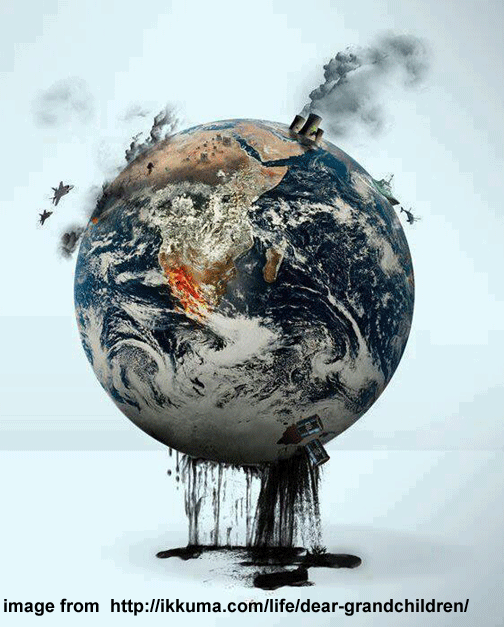 Externalities Are Our Existential Threat, Medium, 10 June 20, It’s the “ex’s” we need to worry about the most. Externalities that create an existential threat. The ultimate threat: Our extinction.
An externality is defined by the Oxford English Dictionary as “a side effect or consequence of an industrial or commercial activity that affects other parties without this being reflected in the cost of the goods or services involved”. Externalities in a global context are the consequence that everyone bears for everyone else’s actions. Externalities result in us all bearing the consequences of living out of synchronization with Nature, but unfortunately in most cases the poor and the vulnerable pay a higher price, disproportionate to their contribution to the cause.
The negative externality consequences of most human economic activity are unaccounted; seemingly off loaded free of charge to the ecosphere. But Nature has a balance sheet — these unaccounted, costs of doing business, that are charged to Nature, are turned into debts. These debts will be settled at a later date and not in a manner of our choosing. The challenge for us is that in many cases the debts are slow to become obvious to everyone, remaining invisible or disguised for a prolonged period. Linking cause and effect is very complex and spans long periods of time, often not directly attributable. It is like a very slow moving train crash — you barely notice it happening but you’ll know when it hits, and then it’s too late. We are all aboard that slow train right now.
In developed countries, we are fortunate to not have to face the poverty, war, famine, diseases that affected humans in the pre-industrial and early industrial times. Capitalism has been an amazing wealth creating and poverty reducing system. Most of us cannot even comprehend how fortunate we are. However, there is a downside to the considerable progress we have made since the industrial revolution; the unintended consequences. Never before were humans able to have an impact on future generations aside from culture or knowledge that was passed on. Today that is different — our actions are determining the fate of billions of people, those currently alive and those not yet born. Unfortunately, we have been brewing trouble……
capitalism can only operate in the best interests of society if it is governed well. It is the good governance part that we have been lacking — unfortunately we have a corrupted, crony capitalism that stems from problems with our democratic system. Quite simply, we seem to be unable to elect leaders who actually care about the long term interests of the people. Our entire political system is deeply corrupted by money — elected officials represent those who contribute to their campaigns, not their constituents, and that’s dominated by the very wealthy, corporations and special interest organizations, not the typical citizen. This is something that needs mainstream understanding as it is the root of all society’s problems and why they are never sensibly addressed.
The common theme is that we have proved ourselves to be incapable of acting in our collective best interests. Together we are all on that metaphorical slow train, steaming towards a cliff edge with no one in the driver’s seat attempting to steer us away from inevitable catastrophe…… Continue reading
Reviews of two TV shows on Australia’s nuclear history at Maralinga
|
Two TV programs revisit Australia’s nuclear history at Maralinga, In Daily, 9 June 20, Two new ABC television programs – both about the mid-century British nuclear testing at Maralinga in South Australia – approach tricky territory in very different ways, writes Mick Broderick.Over successive Sunday nights, the ABC has premiered two important television programs recounting the history of nuclear testing in Australia – the documentary Maralinga Tjuratja and a six-drama series Operation Buffalo. Both explore the ramifications of the Anglo-Australian nuclear venture conducted at Maralinga during the cold war – but in very different ways. Interest in exploring Australia’s atomic history has lingered long after the 1980s Royal Commission into the British nuclear tests in regional South Australia between 1953 and 1963. The new programs seek to add to our understanding of the traumatic and bizarre nature of this time. Familiar groundRecent books by Frank Walker, Elizabeth Tynan and Christobel Mattingley reappraise the official record or draw further from eyewitness accounts. The Nuclear Futures community arts project facilitated a number of Australian and international collaborative art undertakings during 2014-16. A major travelling exhibition, Black Mist Burnt Country (2016-19), toured galleries and museums across Australia showcasing Indigenous and non-Indigenous artworks featuring our nuclear history. There is an important back catalogue of documentary making on the subject, including Backs to the Blast (1981), The Secret Country (1985), Fortress Australia (2001), Silent Storm (2003) and Australian Atomic Confessions (2005). By contrast, Australian film and television drama has made rare ventures into the domain, most notably with Michael Pattinson’s Ground Zero (1987). Clearly, there is still more to say about the events at Maralinga and the other test sites. Maralinga Tjarutja: listening to Indigenous voicesI’ve met with displaced indigenous populations, military veterans and downwind communities affected by cold war nuclear testing and heard their testimony over the years. It was refreshing to encounter a local documentary on the subject produced and narrated by Indigenous Australians. Written and directed by Larissa Behrendt, Maralinga Tjarutja stresses that the Indigenous people of this area should not be solely defined by their displacement and exposure to the nuclear tests, but by millennia of being in-country, where culture, knowledge and country are indivisible. The Indigenous elders interviewed for the documentary reveal a perspective of deep time and an understanding of place that generates respect for the sacredness of both. Importantly, the documentary foregrounds a genuine hunger for knowledge and “truth” alongside the desire to reconcile two at times conflicting narratives, black and white. It reveals the uncertainty that some Maralinga lands remain problematic for habitation, especially for traditional cooking. Elders, children and grandchildren describe the sadness and loss still affecting them, tinged with a hope for the future through the regeneration of the bush overseen by local Oak Valley rangers. The profound and often tragic legacy of British nuclear testing in Australia will continue to have a long cultural and environmental half-life impacting flora, fauna and families for many generations to come. With people gagged by the UK Official Secrets Act and missing, inconclusive or disputed findings about the impacts from exposure to radiation, intergenerational trauma will linger due to uncertainty and anxiety. Operation Buffalo: new fiction, bad historyThe introductory credits for the new six-part ABC series Operation Buffalo declares it “a work of historical fiction”, a point immediately qualified with the proviso “but a lot of the really bad history actually happened”. Viewers expecting a serious docu-drama forensically recounting the major controversies surrounding the British atomic tests in Australia will be disappointed…….. The narrative economy dictated by a historical drama format often results in the conflation of characters and events, as evident in the 2019 HBO series Chernobyl. So, what obligation if any do the series creators have to accurately present these events? In the weeks to come, Operation Buffalo will likely touch on matters still raw in the national psyche. They include Britain’s unilateral abandonment of major military and scientific joint-ventures in Australia, secret human radiation experiments, the mistreatment of Indigenous populations and service personnel, and the compounded denials and deceit over the contamination of the Maralinga lands. The scattergun approach may yet find its target. Operation Buffalo is screening over six weeks on ABC and is available to stream on iView. Maralinga Tjarutja can still be watched via iView. https://indaily.com.au/arts-and-culture/2020/06/09/two-tv-programs-revisit-australias-nuclear-history-at-maralinga/ |
|
Legal fight continues against nuclear waste dump in U.S. District of Columbia
|
Beyond Nuclear filed its appeal on June 4 in the U.S. Court of Appeal for the District of Columbia, questioning the federal Nuclear Regulatory Commission’s April 23 decision to reject challenges to Holtec International’s application for a license to build and operate a consolidated interim storage facility (CISF) that would hold nuclear waste at the surface until a permanent, deep geological repository was available to hold the waste permanently. The facility would store up to 173,000 metric tons of the waste. Such a permanent repository does not exist, and Beyond Nuclear — a non-profit organization that addresses nuclear issues nationwide — worried one wouldn’t be available until 2048. The group also pointed to another NRC order in October 2018 where the NRC deemed contentions inadmissible but argued against both decisions that it said upheld a regulatory process that violated federal law. The licensing process itself was illegal, read NRC’s court filing, because it considered the possibility that the U.S. Department of Energy would take ownership of the waste — a move illegal under federal law unless a permanent repository is available to hold the waste. “This NRC decision flagrantly violates the federal Administrative Procedure Act (APA), which prohibits an agency from acting contrary to the law as issued by Congress and signed by the President,” said Mindy Goldstein, an attorney for Beyond Nuclear. “The Commission lacks a legal or logical basis for its rationale that it may issue a license with an illegal provision, in the hopes that Holtec or the Department of Energy won’t complete the illegal activity it authorized. The buck must stop with the NRC.”…….. https://www.currentargus.com/story/news/local/2020/06/10/federal-appeal-filed-against-nuclear-waste-site-proposed-near-carlsbad/5317995002/ |
|
|

Why W.A. is emerging as the new hot spot for wind energy in Australia — RenewEconomy
W.A. wind farms dominate list of best performing wind projects in Australia in 2019, but it is the improvements in co-located wind projects that point to technology lift. The post Why W.A. is emerging as the new hot spot for wind energy in Australia appeared first on RenewEconomy.
via Why W.A. is emerging as the new hot spot for wind energy in Australia — RenewEconomy
June 10 Energy News — geoharvey

World: ¶ “Peugeot’s New 330-Kilometer e-Traveler Electric Van” • The electric van space has been dominated by a few models. In the past few years, we’ve seen some new entrants try to break in, but one particular announcement looks especially promising. It is that Peugeot is now offering the Peugeot e-Traveler, with a range of […]
Contracts awarded for Brisbane’s $1b all-electric Metro bus project — RenewEconomy
Arup and Acciona lead winning tender for $1 billion all-electric Brisbane Metro bus fleet. The post Contracts awarded for Brisbane’s $1b all-electric Metro bus project appeared first on RenewEconomy.
via Contracts awarded for Brisbane’s $1b all-electric Metro bus project — RenewEconomy
Researchers unveil solar windows that self-adjust to allow right amount of sunlight — RenewEconomy
Researchers develop self-adjusting solar window, that can automatically balance energy output with need for natural light into buildings. The post Researchers unveil solar windows that self-adjust to allow right amount of sunlight appeared first on RenewEconomy.
via Researchers unveil solar windows that self-adjust to allow right amount of sunlight — RenewEconomy
1 This month
7 April – WEBINAR – Australia and the Doomsday Clock – Preventing nuclear war through NoFirstUse and other policies
Online | Tuesday April 7, 4:00-5:30pm, Australian Eastern Time / 8:00-9:30am Central Europe Time
– Access the registration link
15 April – Zoom –Nuclear Power is Not the Solution
Apr 15, 2026 01:00 AM in Canberra, Melbourne, Sydney

Join the International Physicians for the Prevention of Nuclear War (IPPNW) on Tuesday, April 14th for a timely webinar exploring the risks associated with nuclear power and challenging the myth that it offers a simple, safe, carbon-free solution to the climate crisis

21 April Webinar: No Nuclear Weapons in Australia
Start: 2026-04-21 18:00:00 UTC Canberra, Melbourne, Sydney (GMT+10:00)
End: 2026-04-21 19:30:00 UTC Canberra, Melbourne, Sydney (GMT+10:00)
Event Type: Virtual
A virtual link will be communicated before the event.
Host Contact Info: australia@icanw.org

of the week – Australians for War Powers Reform (AWPR)
To see nuclear-related stories in greater depth and intensity
 Antinuclear